











The Notes app gives users a dedicated space inside Profit.co to write, organize, and collaborate on notes. Admins control its availability and visibility behavior through dedicated toggles, and note owners control who can view or edit each note when they share it.
Table of Contents
What is the Notes App in Profit.co?
The Notes app is a workspace where you organize content into folders and individual notes. Each note supports rich formatting through the "/" command, including Normal Text, Topics, Bulleted Lists, Checklists, and Headings, along with dividers, task creation linked to a workspace or board, "@" mentions, and text color or highlighting.
Profit.co separates Notes access into two toggles. An App-level toggle controls whether the standalone Notes app appears in the left navigation panel. A separate Notes settings page, grouped alongside other collaboration controls such as Documents, Tags, Hashtagged Conversations, and Feed Permissions, controls the notes tab that appears inside other modules such as OKRs and Tasks, and governs two additional visibility behaviors: syncing notes across aligned key results, and allowing users to create notes visible only to themselves.
When you share a note, you choose whether each person gets Viewer or Editor access. Editors can edit the note and become co-owners of tasks created in it.
| Setting | What It Controls |
|---|---|
| Notes app (App-level toggle) | Shows the standalone Notes app in the left navigation panel |
| Enable Notes (Notes settings page) | Shows the notes tab inside other modules, such as OKRs and Tasks |
| Sync notes in assigned key results | Whether notes on a key result sync across every aligned OKR |
| Enable Private Notes | Whether users can create notes visible only to themselves |
| Share access (Viewer or Editor) | Whether a person can only read a note or can edit it and co-own its tasks |
Why the Notes App Matters
Before this settings page existed, there was no way to control whether notes synced across key results or stayed private, only whether the standalone Notes app was visible at all. Now, admins can also govern the notes tab inside other modules such as OKRs and Tasks, and decide whether note content follows key results across their alignment tree or stays private to each user.
Turning on key result sync means anyone reviewing an aligned OKR sees the same note content without opening the original key result. Turning on private notes gives individuals a place for drafts, reminders, or working notes without exposing them to the rest of the team.
Sharing controls let you decide who can only read a note and who can edit it. Tasks created in a shared note are automatically assigned to the note's Editors, so action items from a discussion reach the right owners without being reassigned manually.
How It Works
Only Admins can access the Notes settings page used in Method 1. Method 2 applies to any user working inside a folder or note.
Method 1
Step 1
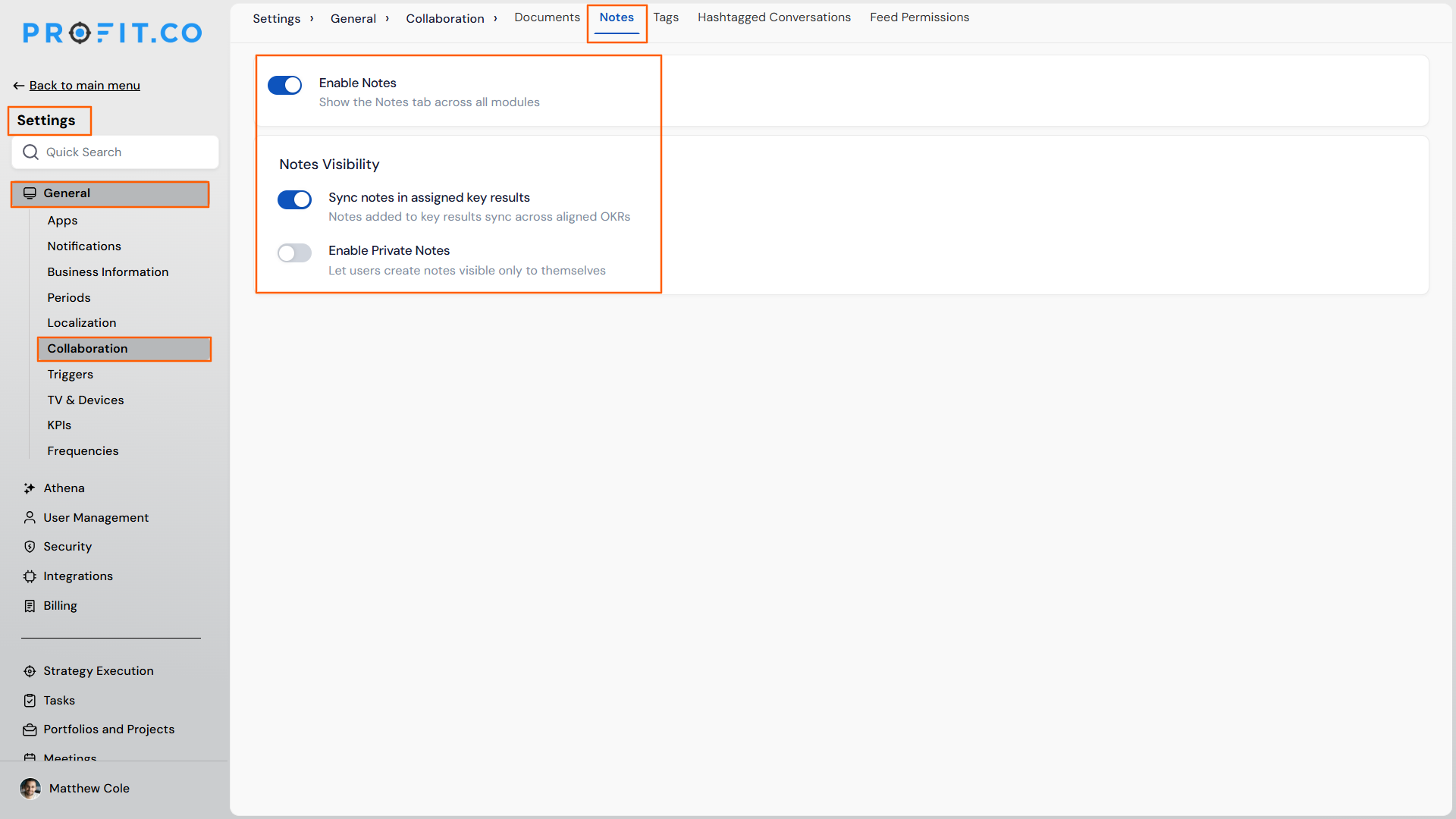
- Navigate to Settings → General → Collaboration → Notes.
- Toggle Enable Notes to show the notes tab inside modules such as OKRs and Tasks.
- Toggle Sync notes in assigned key results to sync note content across aligned OKRs.
- Toggle Enable Private Notes to let users create notes visible only to themselves.
Note
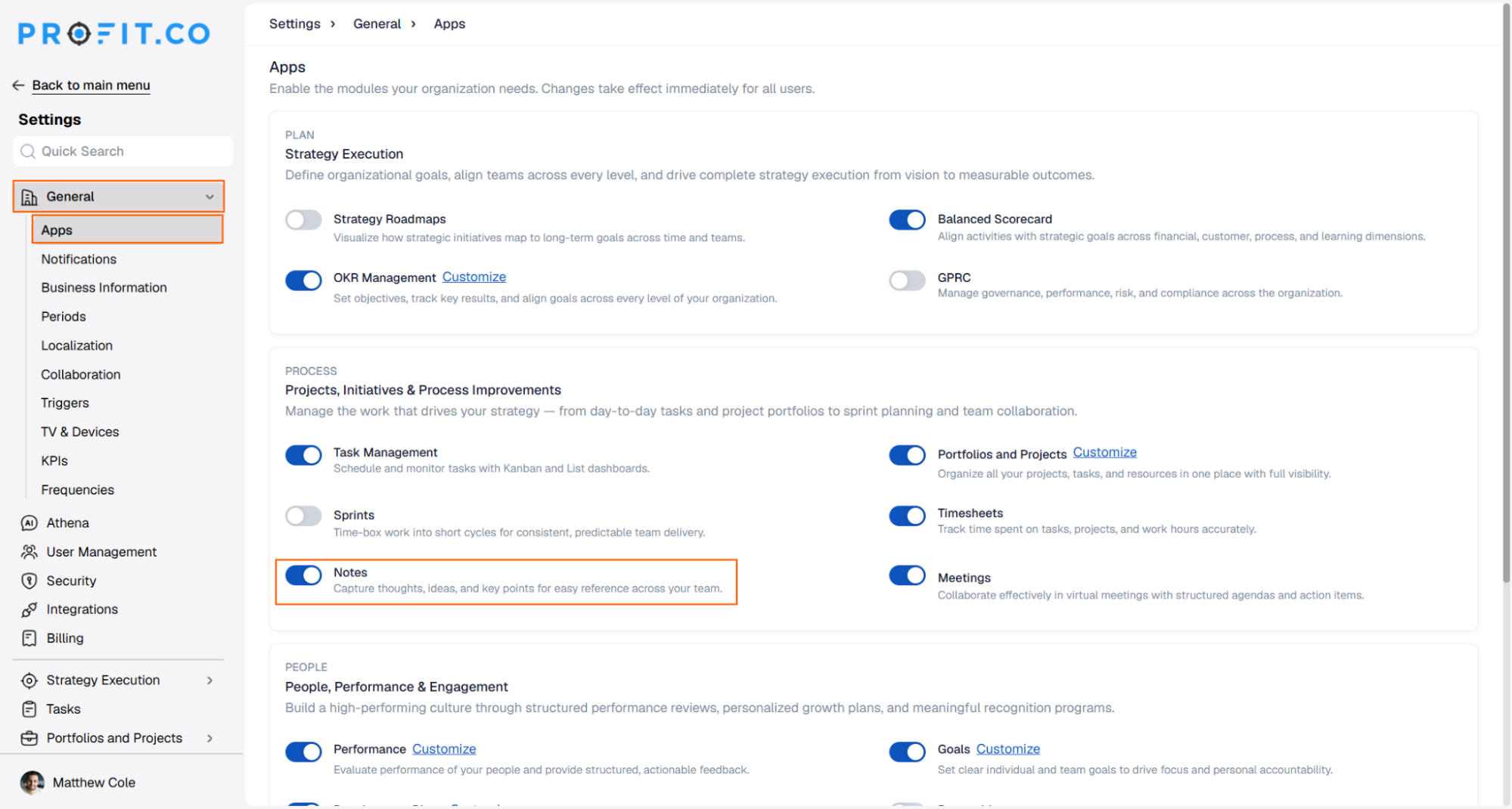
This setting controls the notes tab inside other modules. To show the standalone Notes app in the left navigation panel, enable it separately under Settings → General → Apps.
Method 2: Create, Share, and Collaborate on Notes (End User)
Step 1
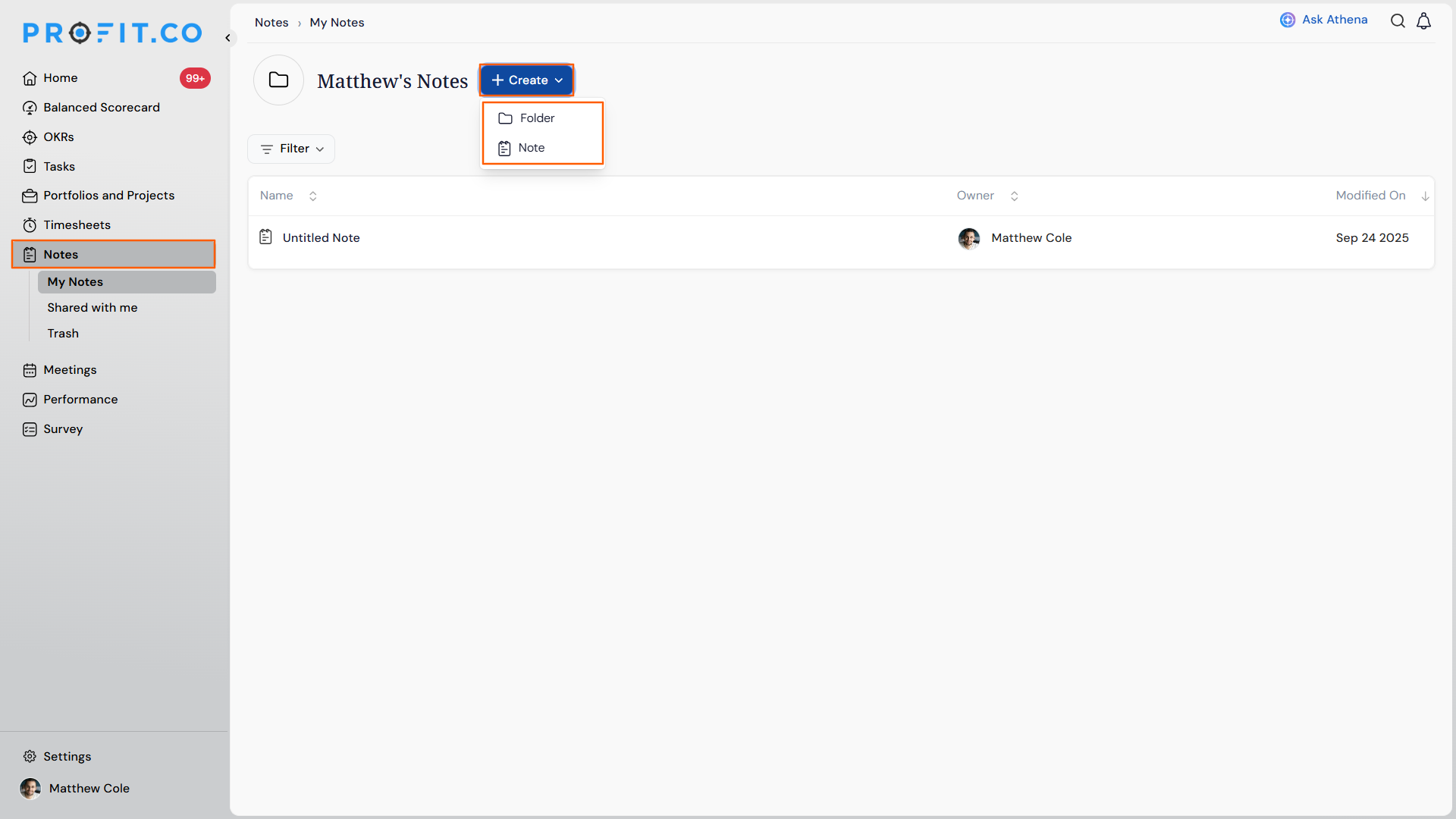
- Navigate to Notes from the left navigation panel.
- Click + Create and select Folder.
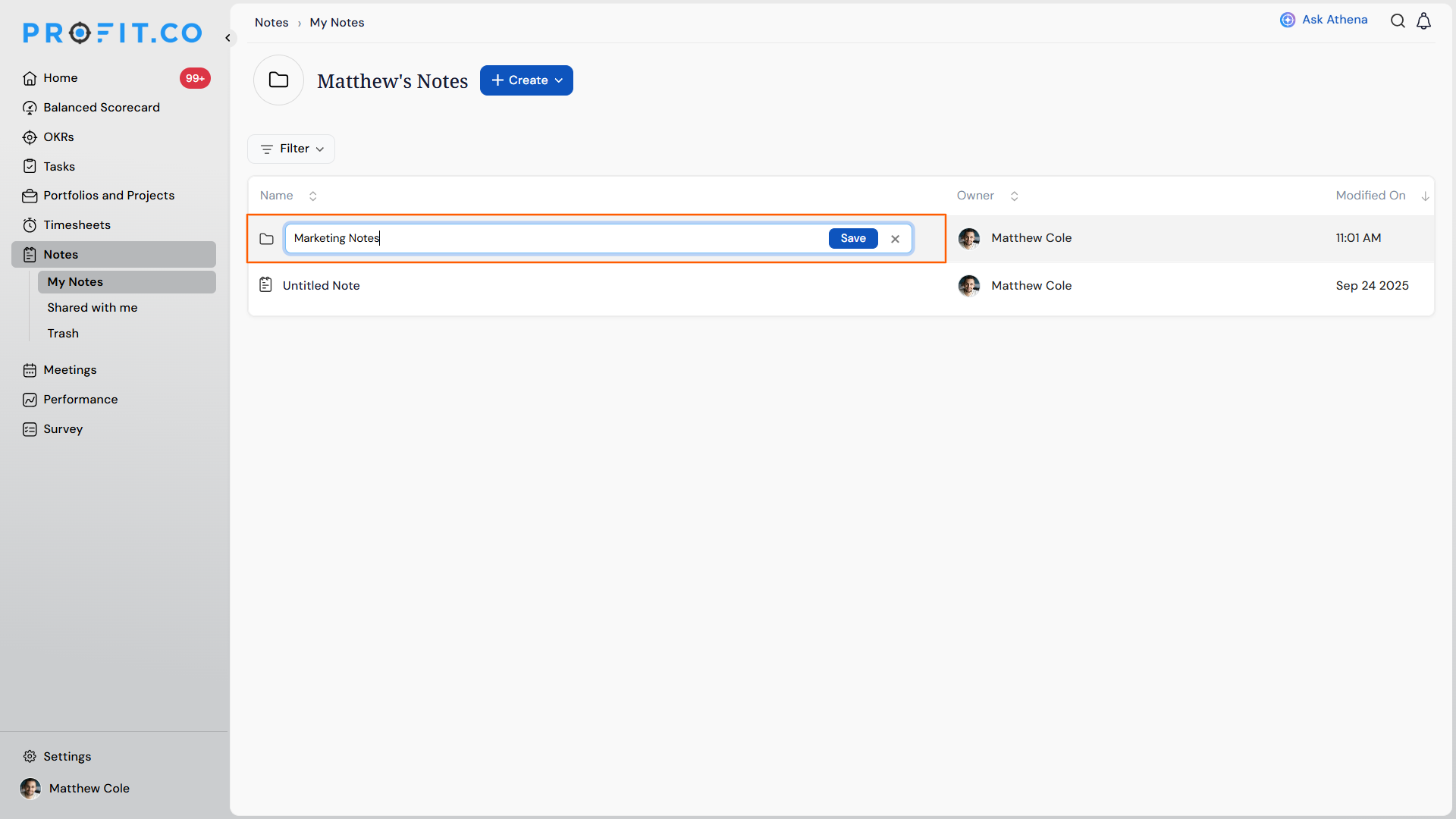
- Enter the folder name and click Save.
Step 2
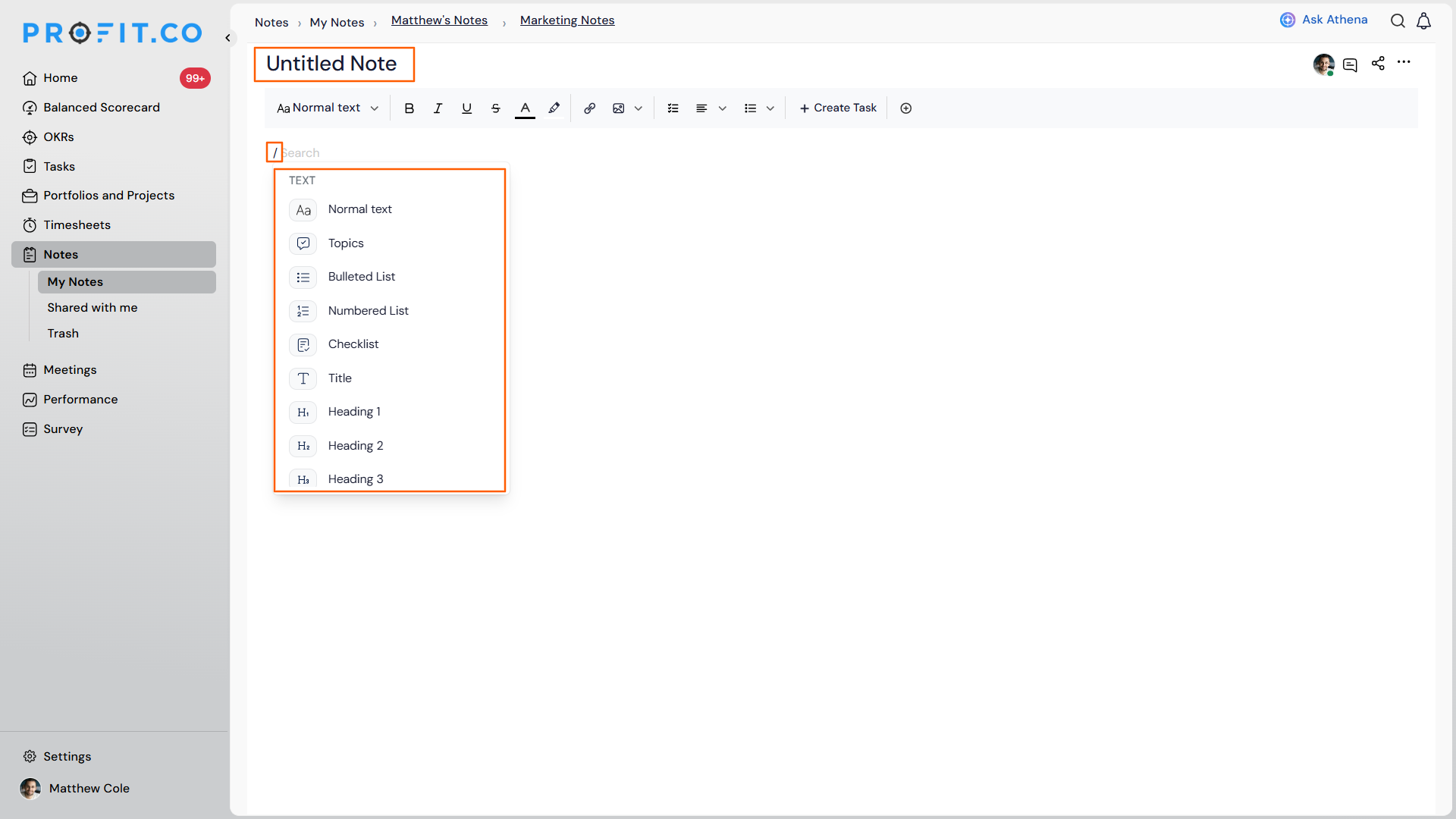
- Click the folder, then click + Create and choose Note.
- Use the "/" command to add Normal Text, Topics, Bulleted Lists, Checklists, or Headings.
- Add dividers, create linked tasks, mention users with "@", and apply text color or highlights.
Step 3
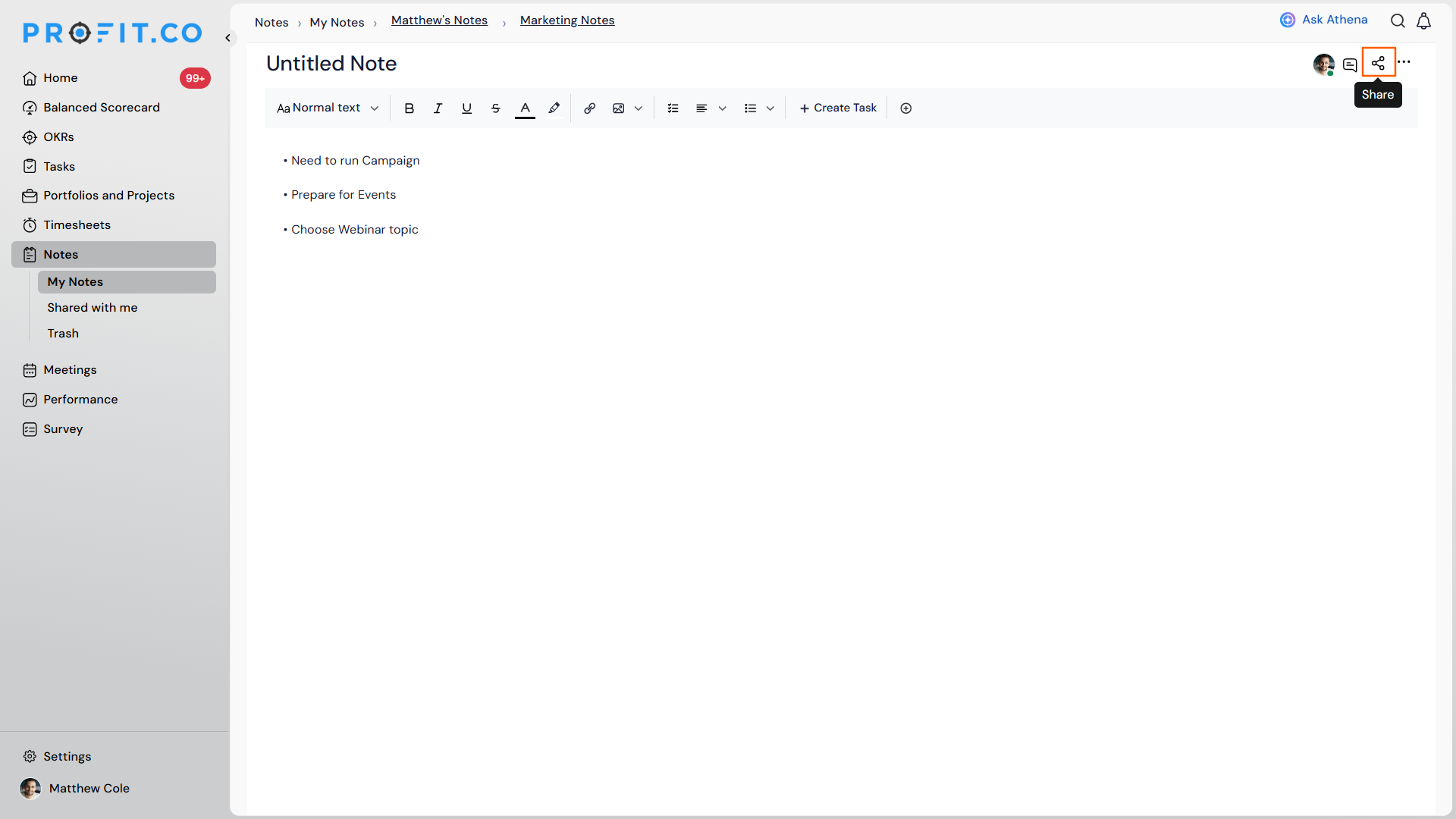
- Open the note and click Share.
- Add the users you want to share the note with.
- Select Viewer or Editor from the access dropdown.
- Add an optional message and click Share.
- Each person's access level is shown under People with access.
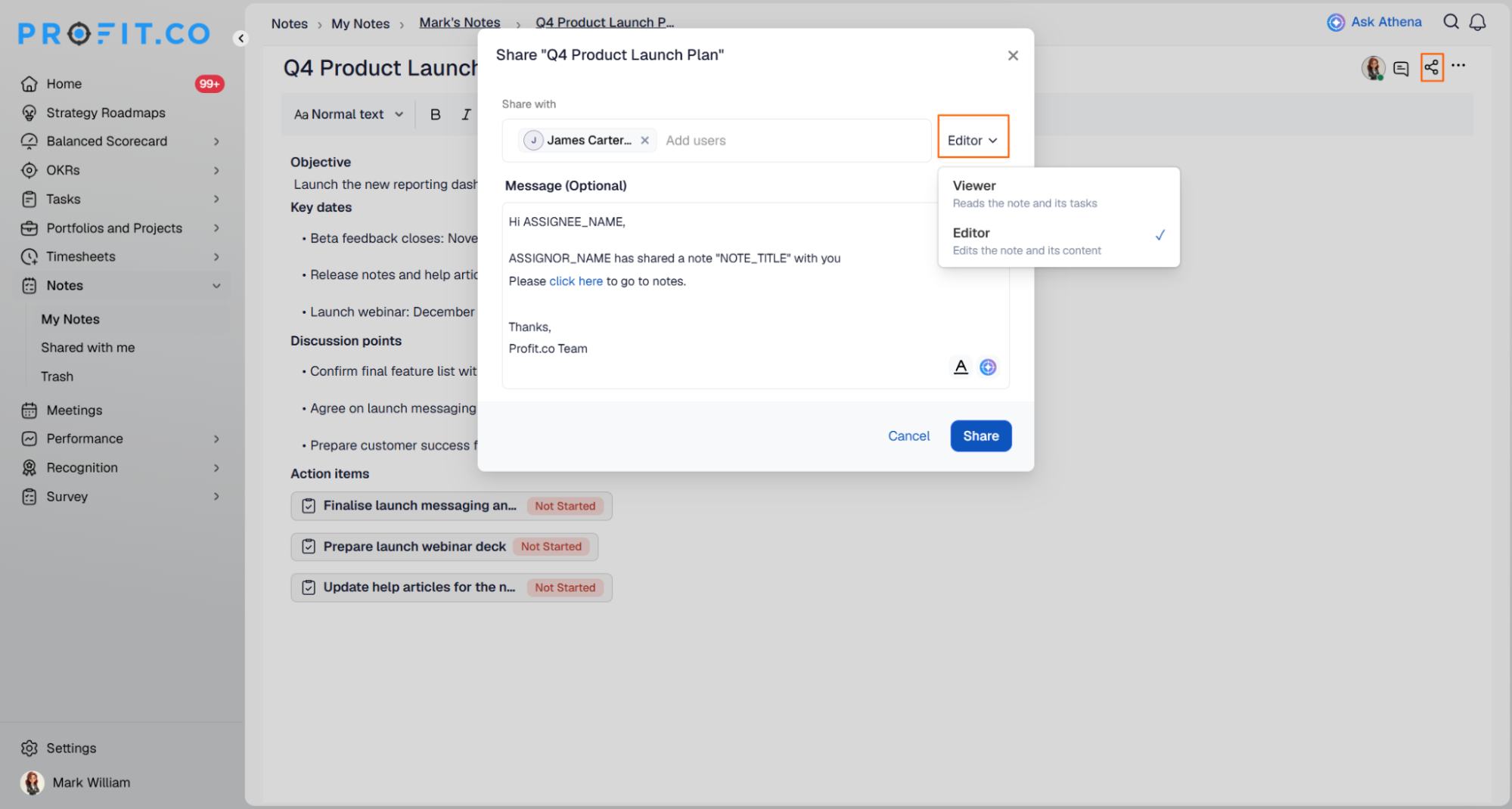
| Access Level | What They Can Do |
|---|---|
| Viewer | Reads the note and its tasks |
| Editor | Edits the note and its content, and becomes a co-owner of tasks created in it |
Note
People who already had access to a note are set to Editor, so they keep the same access as before.
Note
To add Editors as task co-owners, enable Multiple Assignees under Settings → Tasks → General → Task Assignment.
Step 4
- Each task in a note shows its status.
- Hover over a task to preview details such as assignee and due date.
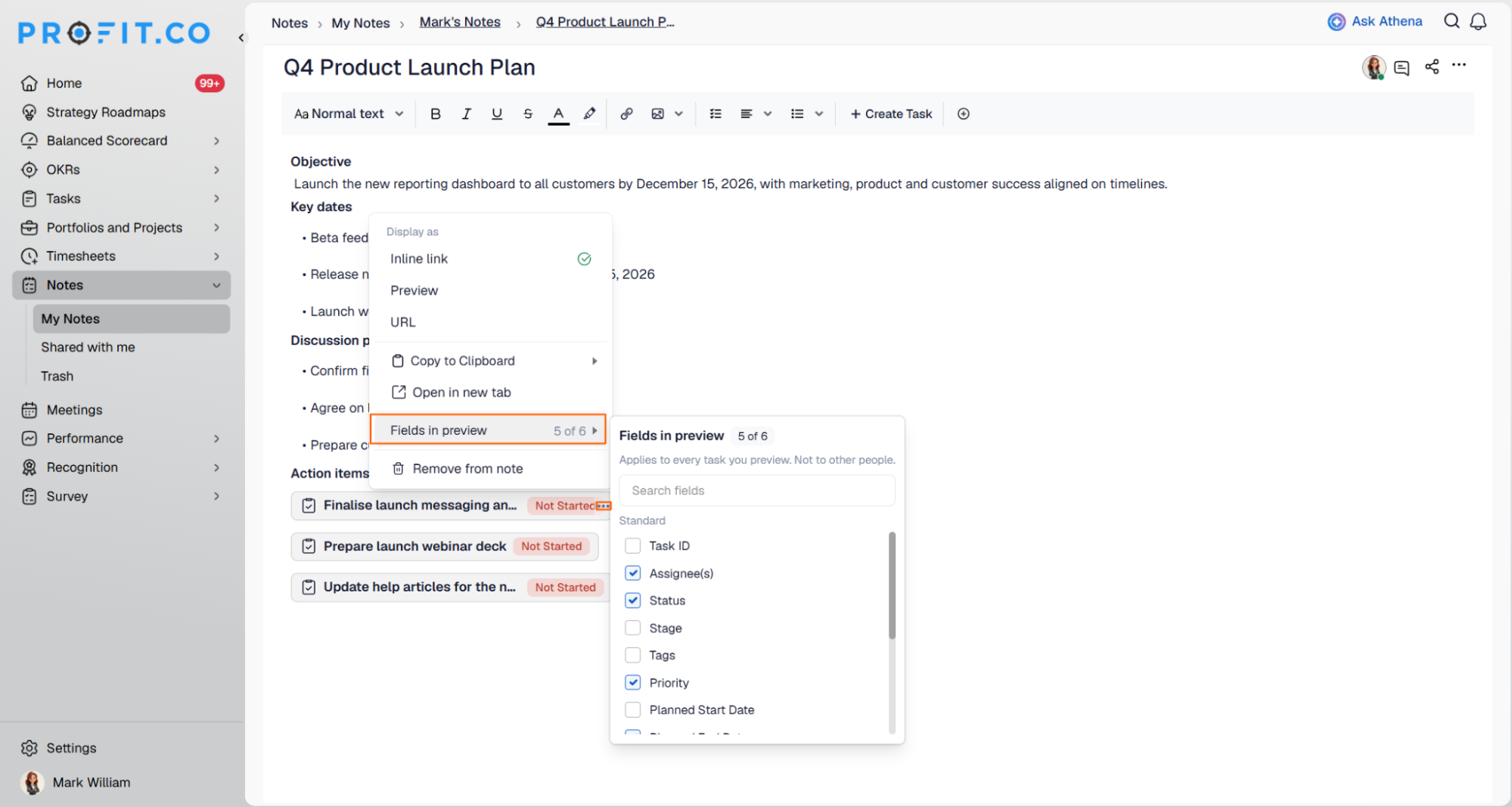
- Click the ellipsis (⋯) icon on a task to display it as an Inline link, Preview, or URL, copy its details, open it in a new tab, or remove it from the note.
- Use Fields in preview to choose which fields appear when you preview tasks. This applies only to you, not to other people.
Step 5
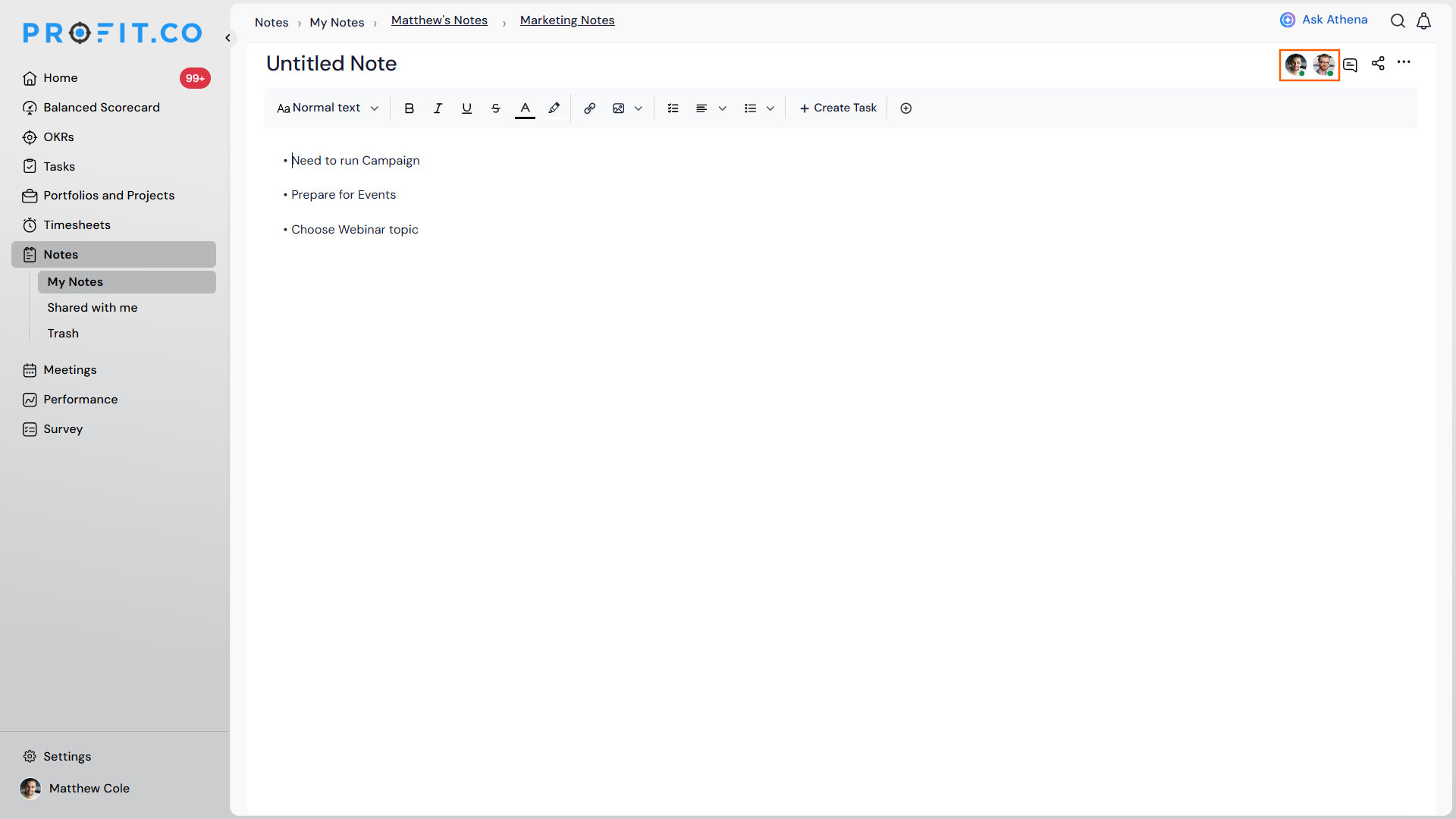
- Collaborate on the note and view who is editing it in real time.
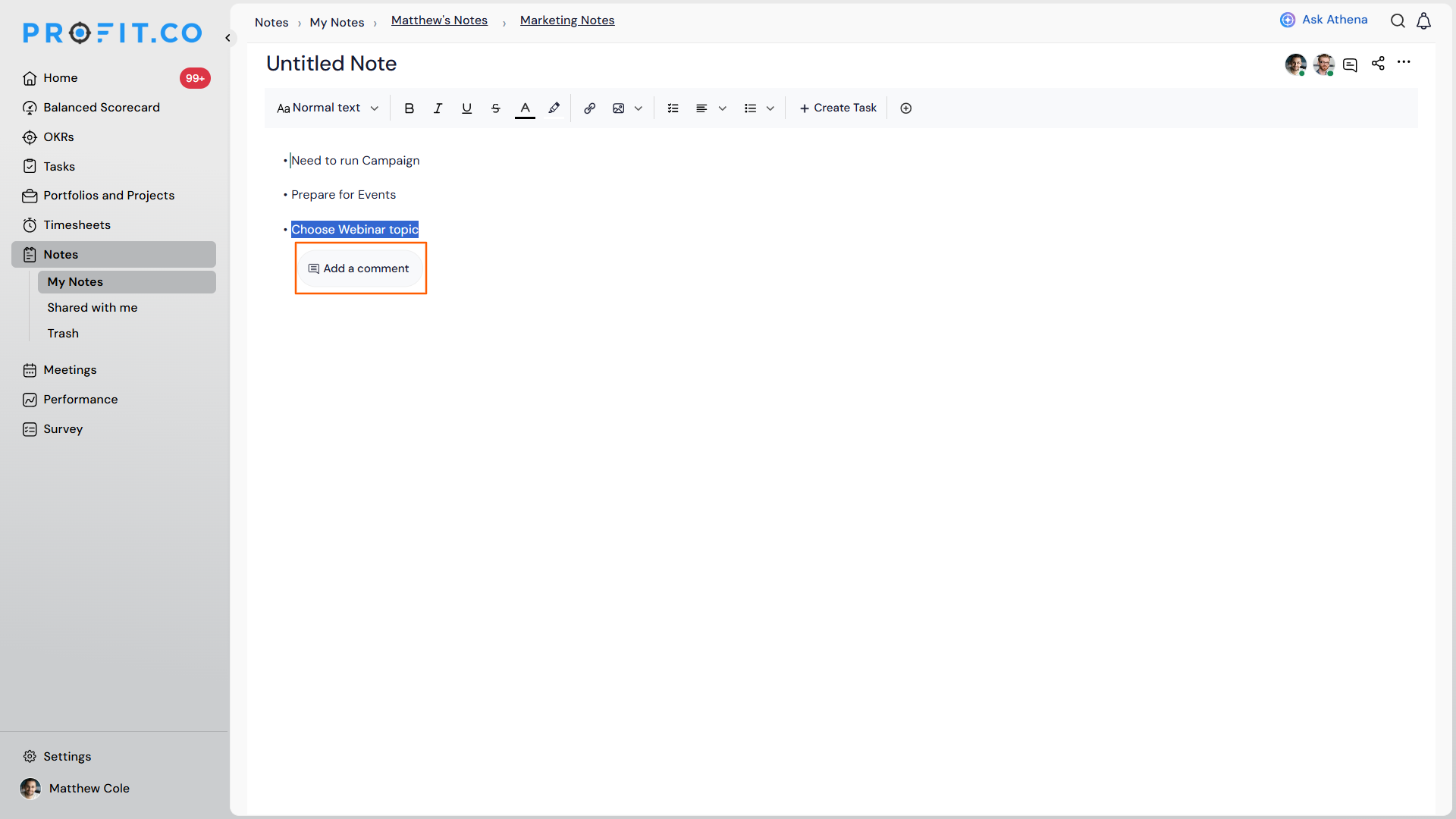
- Add comments by selecting text, and reply to existing comments.
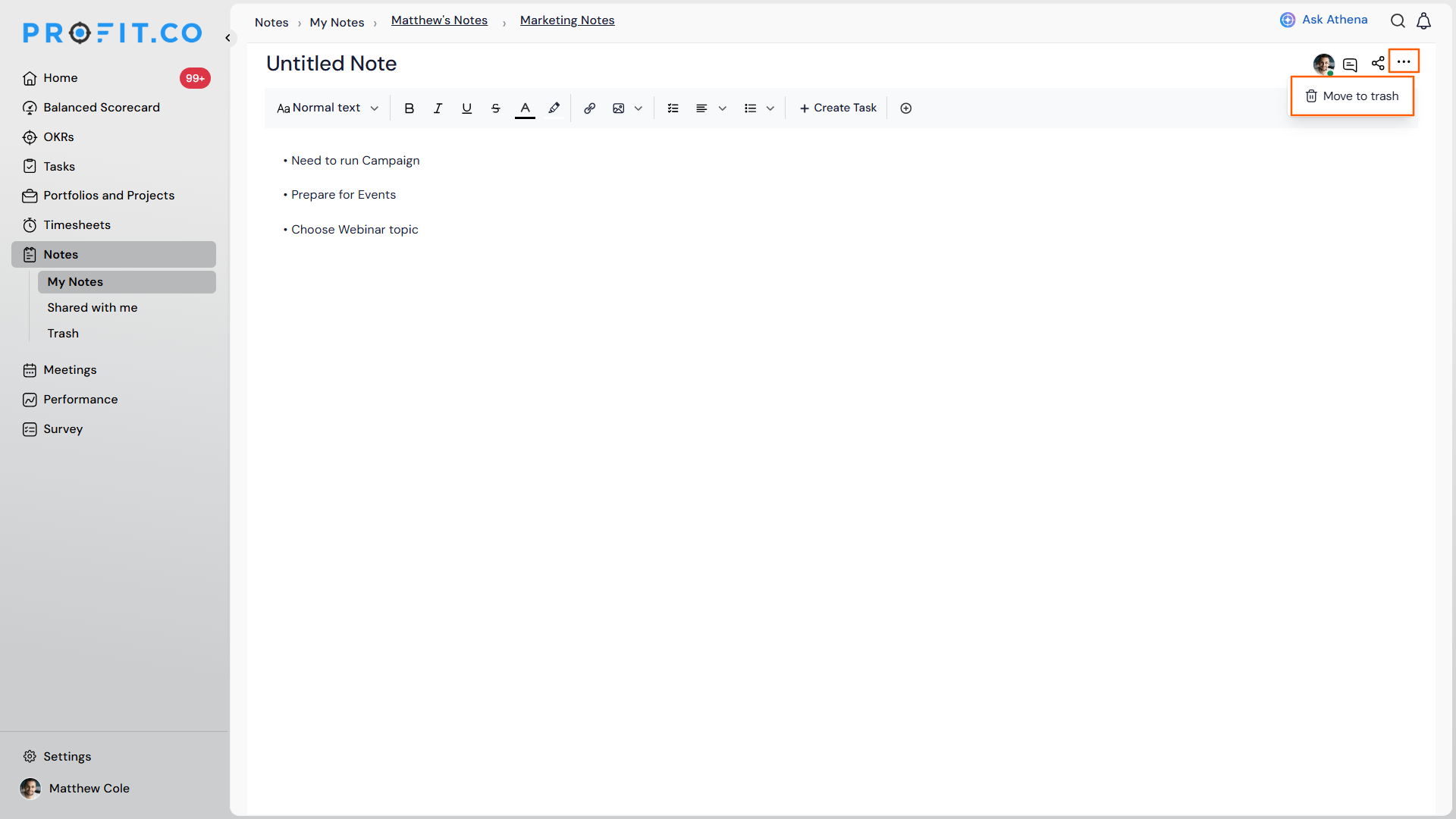
- To remove the note, click the ellipsis icon and select Move to Trash.
Notes App Scenarios and Their Outcomes
These outcomes cover what happens to your Notes content and settings, not the steps used to configure them.
| Scenario | What Happens |
|---|---|
| You turn off Enable Notes on the Notes settings page after notes already exist inside other modules. | Existing notes stay intact, and they reappear exactly as left once you turn Enable Notes back on. |
| You turn off Enable Private Notes after users have created private notes. | Those private notes remain hidden and inaccessible to their owners, and they stay that way until you re-enable Enable Private Notes. |
| You turn on Sync notes in assigned key results while aligned OKRs already exist. | Profit.co syncs notes across every already-aligned OKR immediately, and it does not notify any user of the change. |
| You share a note with a user as a Viewer. | The user can read the note and its tasks but cannot edit the note or become a co-owner of its tasks. |
| You create a task in a note shared with multiple Editors. | Every user who holds Editor access at that time is added as a co-owner of the task, even if they are not a member of the task's board. |
| You share a note that already contains tasks with a new Editor. | The share panel lists the existing tasks and asks you to confirm before the new Editor is added as a co-owner. |
| You give a department access to a note. | Department members can access the note, but they are not added to its tasks as co-owners. |
| Multiple Assignees is turned off when a task is created in a shared note. | Editors are not added as co-owners of the task. |
Best Practices for the Notes App
- Turn on Sync notes in assigned key results before rolling out cross-team OKR reviews, since the sync applies retroactively and reaches every already-aligned OKR the moment you enable it.
- Communicate to users when you enable Enable Private Notes for the first time, since the setting has no built-in notification and adoption depends on people knowing the option exists.
- Confirm with your team before disabling Enable Notes on the Notes settings page. Existing notes inside OKRs and Tasks are preserved, but no one can access them until you turn it back on.
- Review who currently has private notes before turning Enable Private Notes off, since those notes become inaccessible to their owners until you re-enable the setting.
- Keep folder names specific to the review cadence or workspace they belong to, so shared and synced notes stay easy to trace back to their source key result.
- Give Editor access only to people who should own the tasks created in a note, and use Viewer for stakeholders who only need to stay informed.
- Add people individually as Editors when they need to be task co-owners, since department members are not added as co-owners.
- Enable Multiple Assignees before creating tasks in shared notes, so every Editor is added as a co-owner.
- Review the task list shown in the share panel before adding a new Editor to a note that already contains tasks.
Related Articles
Frequently Asked Questions
Yes. Both toggles sit under Notes Visibility and can be turned on or off separately. Enabling one does not require or affect the other.
Yes. Enable Private Notes controls who can see a specific note, so a note marked private stays visible only to its owner even when key result notes are set to sync across aligned OKRs.
No. The standalone Notes app requires the App-level toggle, and the notes tab inside other modules such as OKRs and Tasks requires the Enable Notes toggle on the Notes settings page. Until an Admin turns on the relevant toggle, that entry point does not appear.
A Viewer can read the note and its tasks. An Editor can edit the note and becomes a co-owner of tasks created in it.
Make sure Multiple Assignees is enabled under Settings → Tasks → General → Task Assignment.
No. Departments can access the note, but their members are not added as co-owners. Add people individually as Editors to make them co-owners.
[Answer not provided in source document]
Execute your strategy with confidence
Connect OKRs, tasks, and teams in one place with Profit.co
