

Profit.co lets you see every department and sub-department in your organization laid out as a connected tree, with the number of OKRs tied to each one shown right alongside it. This gives you the full department structure on a single page.
Table of Contents
- What is Department Hierarchy View?
- Why Does Department Hierarchy View Matter?
- How Does Department Hierarchy View Work?
- What Happens When You Use Department Hierarchy View?
- What Are the Best Practices for Department Hierarchy View?
- Related Articles
- What Are Some Frequently Asked Questions About Department Hierarchy View?
What is Department Hierarchy View?
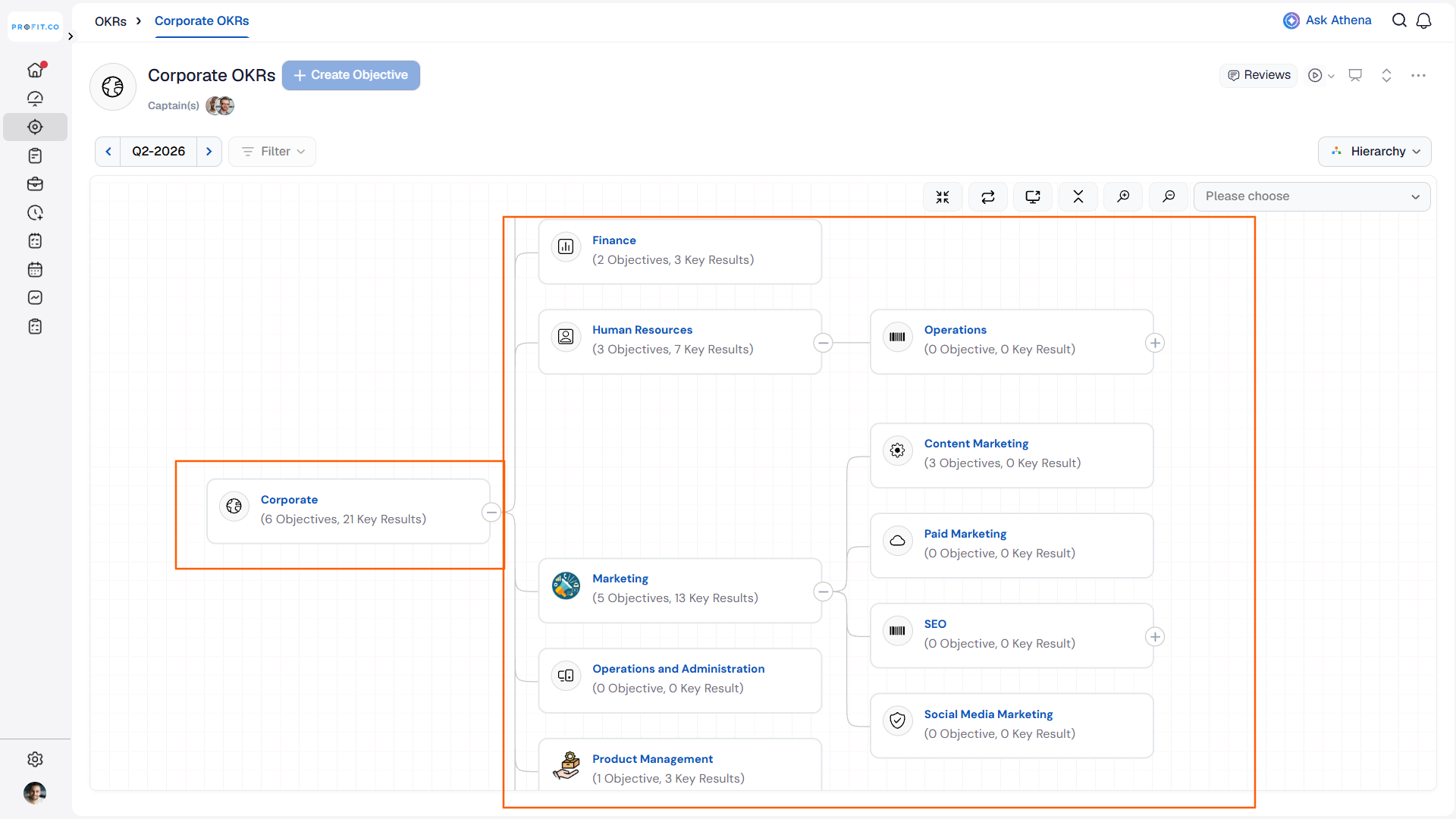
Department Hierarchy View is a tree-structured page, found under OKRs → All OKRs → Views → Hierarchy, that lists every department and sub-department in your organization along with the links between them. Corporate OKRs sits at the top, with departments branching down from it.
Each department name displays its own "No. of OKRs" count directly in the tree, and the page covers the entire organization, not only the departments you personally belong to.
Why Does Department Hierarchy View Matter?
Without this view, understanding how departments relate to each other, or which ones carry the most OKRs, means opening each department individually and comparing manually. The Hierarchy page puts the full department structure and OKR counts on one page.
It also surfaces sub-department relationships that aren't obvious from a flat department list, so you can see reporting lines between departments without checking a separate org chart.
How Does Department Hierarchy View Work?
Step 1: Open the Hierarchy View
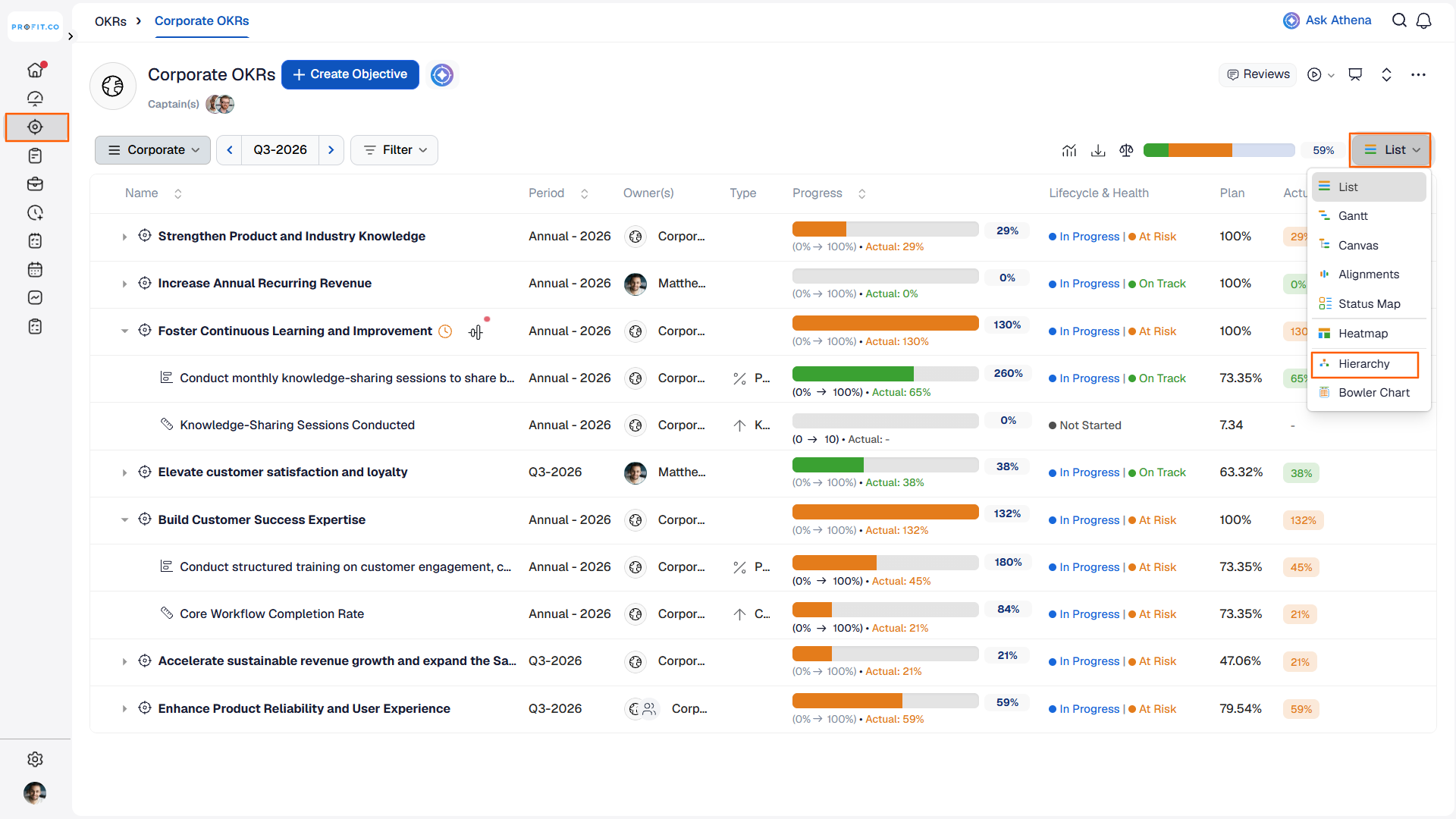
- Navigate to OKRs → All OKRs from the left navigation panel.
- On the Views tab, choose Hierarchy.
Step 2: Review the Department Tree
- Locate the Corporate OKRs name at the top of the tree.
- Check the No. of OKRs count shown next to each department name.
Step 3: Expand Sub-Departments (Optional)
- Click the Expand icon next to a department to reveal its sub-departments.
What Happens When You Use Department Hierarchy View?
| Scenario | What Happens |
|---|---|
| You open the Department Hierarchy page. | Profit.co displays every department's OKR count and position in the tree for the entire organization, not filtered to just the departments you belong to. |
| You click the Expand icon on a department that has sub-departments. | Profit.co reveals the sub-departments underneath it in the tree, without changing the OKR counts shown for any department. |
| You view a department that has no sub-departments. | Profit.co shows no Expand icon next to that department, since there is nothing nested beneath it to reveal. |
| You open the Department Hierarchy page to check counts or structure. | Profit.co presents this information for review only, and it does not change the OKR counts, hierarchy, or Objectives belonging to any department. |
What Are the Best Practices for Department Hierarchy View?
- Use the No. of OKRs count next to each department to spot which departments carry the most OKR volume, since the Hierarchy page already totals that number per department without opening each one individually.
- Expand sub-departments before assuming a top-level department has no nested teams, since departments without sub-departments won't show the Expand icon at all.
- Use the Hierarchy page instead of comparing departments one at a time when you need an organization-wide view, since every department appears together in a single tree.
- Remember the Department Hierarchy page always reflects the full organization, not just your own department, so treat it as a structural overview rather than a personal OKR list.
Related Articles
- How to view all the department OKRs in Profit.co?
- How do I set the department visibility and the access list?
What Are Some Frequently Asked Questions About Department Hierarchy View?
Sub-departments are collapsed by default. Click the Expand icon on a department to reveal the sub-departments beneath it.
No. The count only shows how many OKRs are associated with that department. It doesn't indicate progress, status, or scoring for those OKRs.
No. It's limited to departments and sub-departments. Individual employees and their personal OKRs don't appear on this page.
Execute your strategy with confidence
Connect OKRs, tasks, and teams in one place with Profit.co
