













Profit.co separates OKR status into Lifecycle Stage and Health Status, each configured under Settings → Strategy Execution → Planning → Outcome. Health Status is then derived using one of two interchangeable rollup approaches.
Table of Contents
- What is OKR Status and Color Code Linking?
- Why Does OKR Status and Color Code Linking Matter?
- How Does OKR Status and Color Code Linking Work?
- What Happens When You Use OKR Status and Color Code Linking?
- What's the Difference Between Confidence Rollup and Progress Velocity?
- What Are the Best Practices for OKR Status and Color Code Linking?
- Related Articles
- What Are Some Frequently Asked Questions About OKR Status and Color Code Linking?
What is OKR Status and Color Code Linking?
Profit.co separates OKR status into two concepts under Settings → OKRs → Planning → Outcome. Lifecycle Stage tracks where an OKR is in its journey (Not Started → In Progress → Completed → Archived), while Health Status (On Track, At Risk, In Trouble, and other configurable statuses) applies only while an OKR is in the In Progress stage.
Health Status is configured from the Health & Velocity panel, opened via the Health edit icon on the In Progress stage. From there, a Status Rollup Approach, either Confidence Rollup or Progress Velocity, determines how an Objective's or Parent KR's own status is derived; only one approach can be active at a time.
Note
Lifecycle stages and health statuses are tracked separately, even though both appear together in the Statuses settings area.
Why Does OKR Status and Color Code Linking Matter?
Separating Lifecycle Stage from Health Status means a team can tell whether an OKR is simply not started yet, or whether it's actively in progress and falling behind, instead of one status value trying to answer both questions at once.
Having two interchangeable rollup approaches also means an Objective's status can reflect either how its own Key Results are doing (Confidence Rollup) or how the Objective itself is pacing against its own plan (Progress Velocity), depending on which answers the question your team actually needs.
How Does OKR Status and Color Code Linking Work? (Step-by-Step Guide)
Method 1: Configure Lifecycle Stages
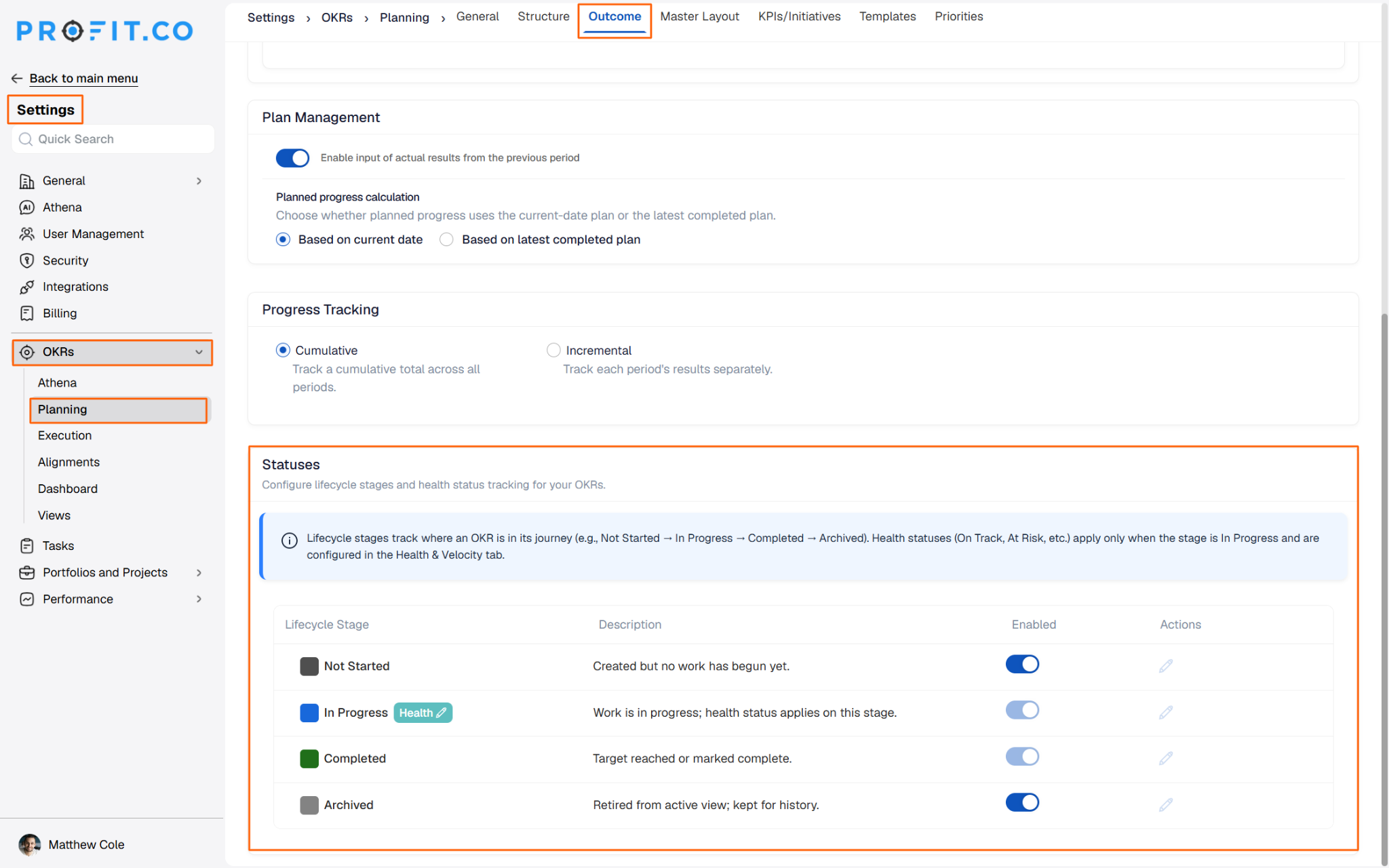
Step 1: Open the Outcome Settings
- Navigate to Settings → OKRs → Planning
- Open the Outcome tab
Step 2: Review and Enable Lifecycle Stages
- In the Statuses section, review each Lifecycle Stage: Not Started, In Progress, Completed, Archived
- Toggle a stage enabled on or off, or click the edit icon to adjust it
Method 2: Configure Health Status and Rollup Approach
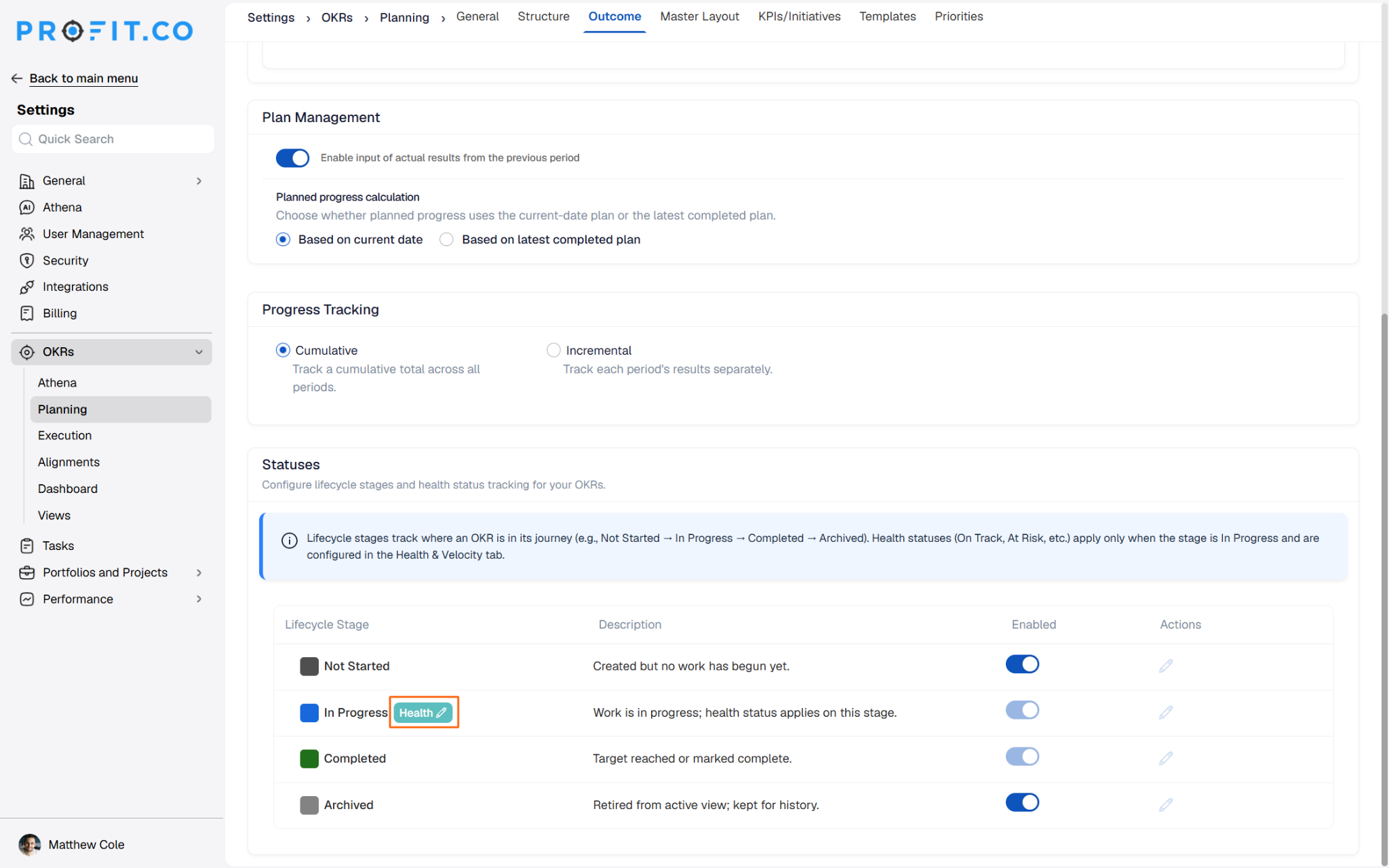
Step 3: Open Health & Velocity
- Click the Health edit icon next to the In Progress stage
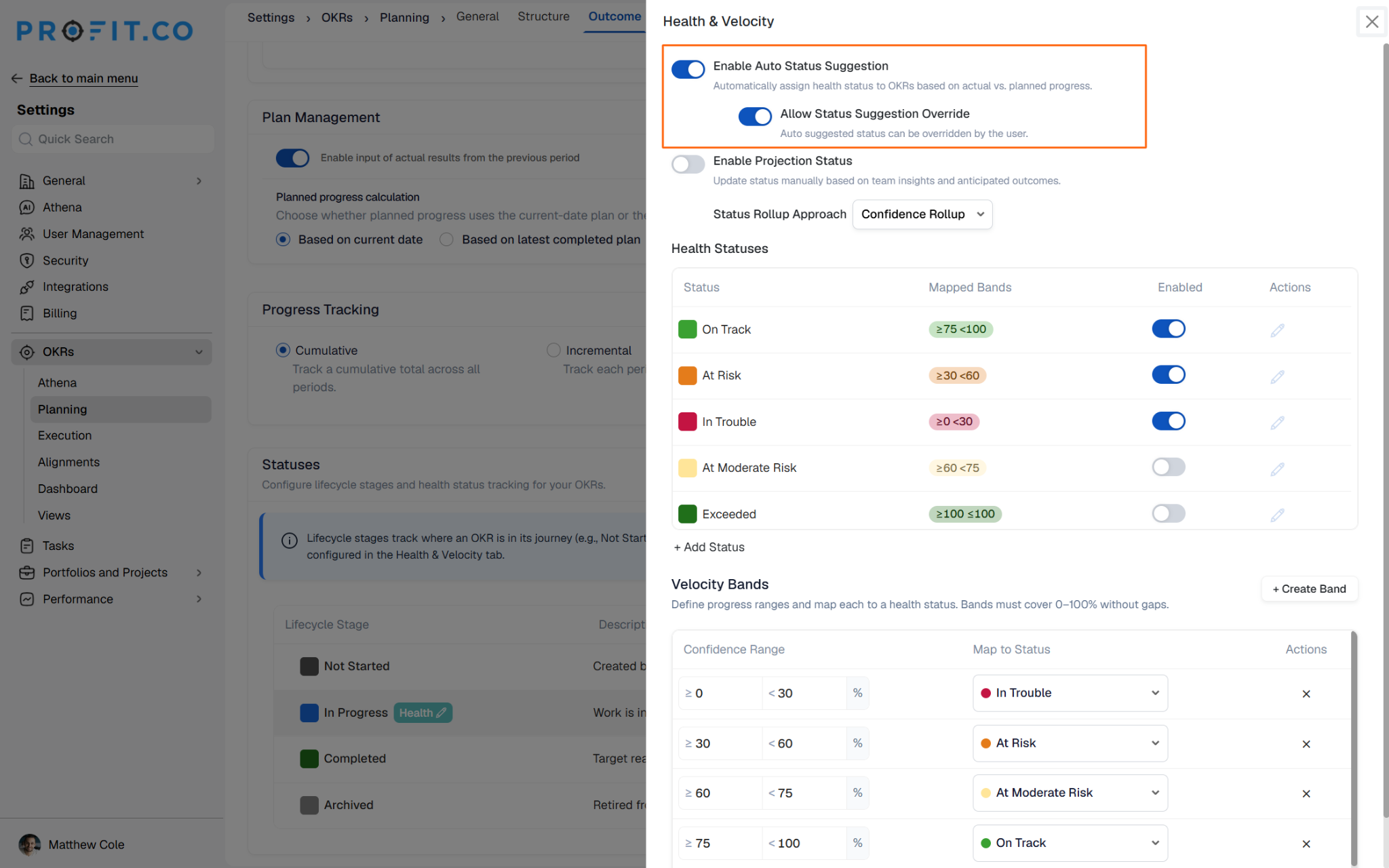
Step 4: Set Status Suggestion Options
- Turn on Enable Auto Status Suggestion to calculate health automatically
- Turn on Allow Status Suggestion Override to let users change the suggested status
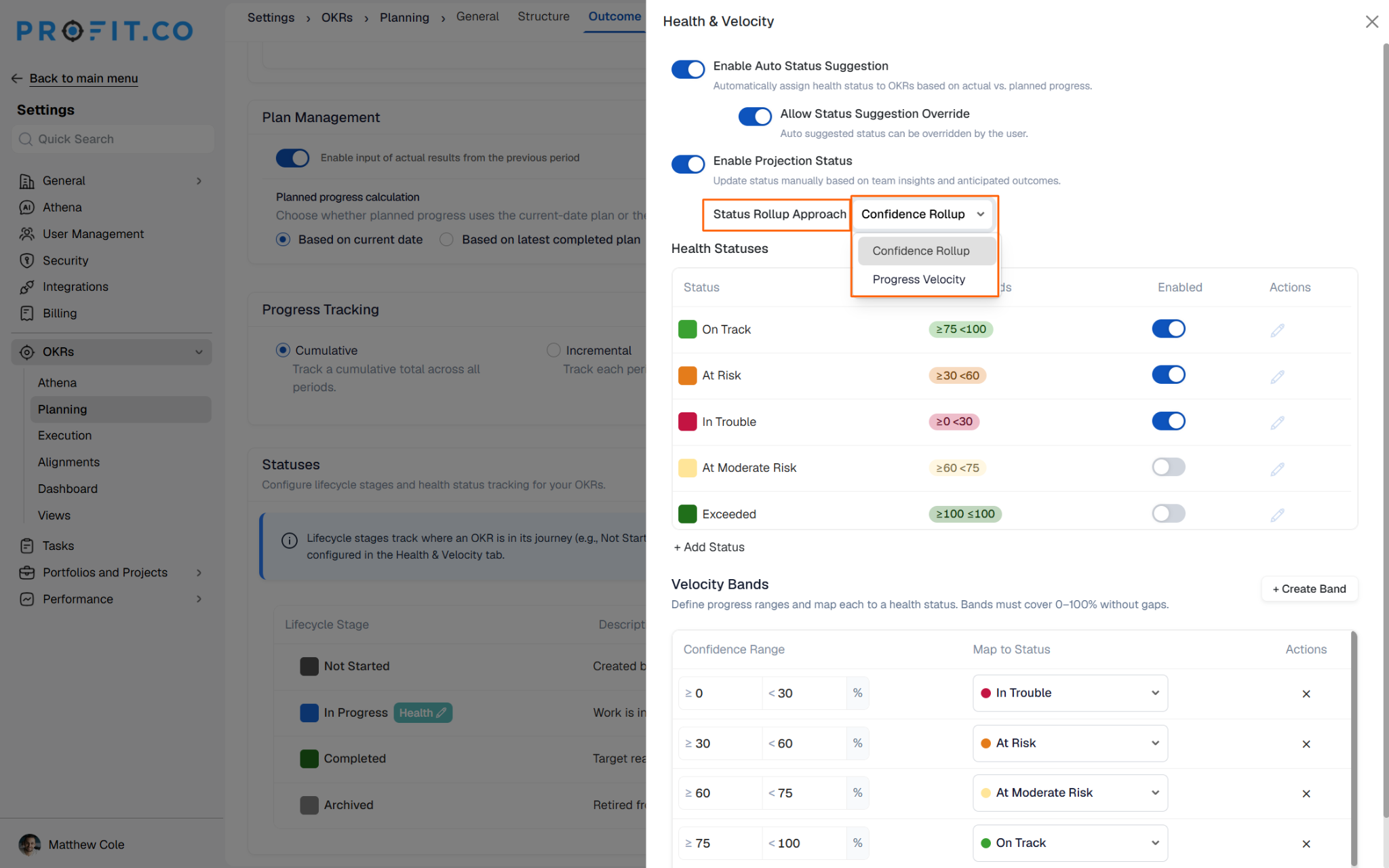
Step 5: Choose a Status Rollup Approach
- Select Confidence Rollup to derive status from the average of Key Result statuses, and set ranges in the Health Statuses table
- Select Progress Velocity to derive status from the Objective's own Actual ÷ Plan percentage, and set ranges in the Velocity Bands table
What Happens When You Use OKR Status and Color Code Linking?
| Scenario | What Happens |
|---|---|
| You move an OKR out of the In Progress stage, into Not Started, Completed, or Archived. | Profit.co stops showing a Health Status for it, since health status only applies while an OKR is In Progress. |
| You select Confidence Rollup as the Status Rollup Approach. | Profit.co derives the Objective's or Parent KR's status from the average of its Key Results' status values, based on the ranges set in the Health Statuses table. |
| You select Progress Velocity as the Status Rollup Approach. | Profit.co derives the Objective's or Parent KR's status from its own Actual ÷ Plan percentage, based on the ranges set in the Velocity Bands table. |
| You switch between Confidence Rollup and Progress Velocity. | Profit.co applies only one approach at a time, so switching changes how every Objective and Parent KR status is derived going forward. |
| You turn on Allow Status Suggestion Override. | Profit.co lets users change the status it auto-suggests during a check-in, rather than locking it to the calculated value. |
What's the Difference Between Confidence Rollup and Progress Velocity?
| Confidence Rollup | Progress Velocity | |
|---|---|---|
| Status is derived from | The statuses of the Key Results or Sub-KRs below | The Objective's or Parent KR's own Plan and Actual |
| Calculation | Average of the status values | Actual ÷ Plan × 100 |
| Ranges set in | Health Statuses table | Velocity Bands table |
| Answers | How are the Key Results doing together? | Is the Objective on pace today? |
What Are the Best Practices for OKR Status and Color Code Linking?
- Keep one Status Rollup Approach for the whole cycle, since switching mid-cycle changes how every Objective's status is derived and breaks week-to-week comparisons.
- Keep Key Result statuses current before relying on Confidence Rollup, since the Objective's status is only as accurate as the Key Result statuses behind it.
- Set realistic Plans before relying on Progress Velocity, since the Objective's status is only as accurate as the Plan behind it.
- Use Allow Status Suggestion Override sparingly, since frequent manual overrides make statuses less consistent across your account.
- Check a Lifecycle Stage's Enabled toggle before assuming an OKR should show a Health Status, since health only displays while the stage is In Progress.
Related Articles
- What is the difference between Confidence Rollup and Progress Velocity Status Rollup Approaches?
- What is OKR Health Status in Profit.co?
- Tim Newbold: Drive OKR Outcomes with Confidence Scoring
- Strategy Health Metrics: Seven Vital Signs and What an Abnormal Reading Actually Means
What Are Some Frequently Asked Questions About OKR Status and Color Code Linking?
No. Only one Status Rollup Approach can be active at a time.
It applies to both. A Parent KR's status is derived from its Sub-KRs the same way an Objective's status is derived from its Key Results.
Yes. Use + Add Status below the Health Statuses table to create a custom status with its own range, such as At Moderate Risk.
Yes. On Track, At Risk, and In Trouble are configurable, so you can rename them or add additional statuses from the Statuses settings area.
Execute your strategy with confidence
Connect OKRs, tasks, and teams in one place with Profit.co
