In any organization, customer loyalty is essential for sustainability and growth. Loyal customers and employees become your brand ambassadors by spreading the word about your business on social media, sharing invaluable feedback about your services or products, and sharing referrals.
The main goal of the Customer Retention Rate (CRR) is to measure how long customers remain loyal to the brand and continue using their products or services over time. Let’s explore what CRR is, what it means for your organization, and how to calculate it.
What is Customer Retention Rate?
Customer Retention Rate (CRR) measures the percentage of loyal customers. As an HR manager, you can leverage the retention rate to evaluate how long employees stay with your company.
The retention rate is a percentage that represents the total of customers or employees your company retains over a particular period. For instance, if you had 50 employees at the beginning of the year and you lost 10 of them by the end of the year, your retention rate is 80%.
It’s a critical metric that gives insight into your success at keeping existing customers or employees. A higher CRR indicates that you can successfully build customer loyalty and secure repeat purchases from your current consumers.
The Customer Retention Rate also provides insight into consumer or employee satisfaction levels with your products or services and any loyalty or benefit programs you offer.In the long run, this also provides insights into Customer Lifetime value (CLV). All these aspects ultimately affect your profitability and revenue growth.
To learn more about how to improve your Organization’s Customer Retention Rate.
Why is Customer Retention Rate Important?
Higher Retention Rates provide tangible advantages for gaining increased revenues and profits. For instance, it results in lower acquisition costs and better brand recognition. Customer retention is a cost-effective strategy for organizations. It costs more to acquire new customers than to retain existing ones.Do what you do so well that they will want to see it again and bring their friends

Calculating Retention Rate
To calculate your retention rate, follow the steps below.- Identify the time frame you want to evaluate.
- Determine the total number of existing employees or customers at the start and end of this period.
- Determine how many new employees you have gained during the period.
- Use the Customer Retention Rate formula to calculate.
Customer Retention Rate formula
The Customer Retention Rate formula is: [(E-N)/S] x 100
- E= Employees or customers at period end
- N= New employees or customers who joined within this period
- S= Number of employees or customers at the start of the period
How do you calculate the Customer Retention Rate?
Calculating Customer Retention Rate (CRR) is simple: Start with the total of customers or employees you have at the last period you’re examining. For instance, for the annual CRR, you’ll use the number you have on December 31st. You’ll then deduct the total of new customers or employees you gained between January 1st and December 31st. The next step is dividing the figure you get by the initial sum of customers or employees and then multiplying by 100 to get a percentage.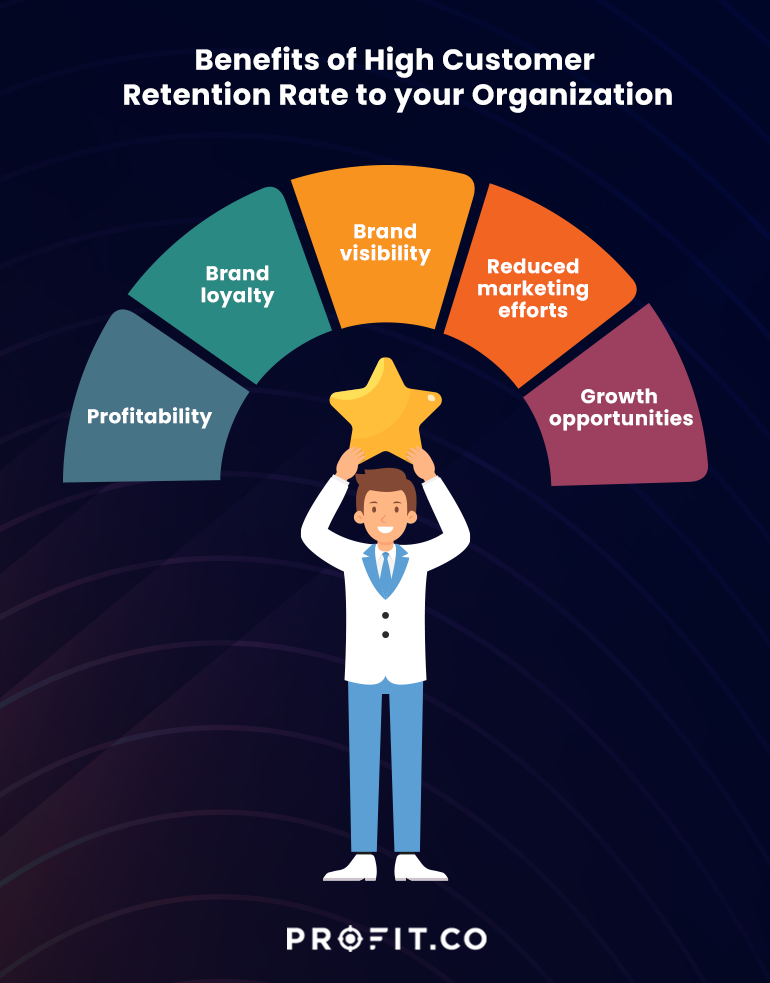
Benefits of High Customer Retention Rate
A high Customer Retention Rate (CRR) is a key indicator of business success and can significantly benefit businesses. By keeping the same customer base and team, you can expect increased profitability and revenue due to several factors. Firstly, when existing customers and team members remain loyal, they generate more lifetime value for your business as they become more familiar with your products or services, leading to greater sales figures. You don’t have to invest resources to acquire new users or team members. Customer retention reduces costs associated with marketing campaigns, hiring, and training, which you can use to improve product and service quality or offer benefits instead, both of which contribute positively towards increasing your sales figures. If you have low retention rates, it’s essential to re-evaluate your strategies. Higher retention rates improve brand recognition among existing and potential customers once word-of-mouth recommendations spread about your products or services. It also reduces the Churn rate and leads to increased visibility for your business without any additional promotional efforts, resulting in more growth opportunities.Conclusion
A high Retention Rate is critical just like Customer Acquisition Rate (CAC) for businesses to succeed in the long term. Focusing on keeping customers and employees satisfied and loyal provides multiple benefits for your organization. With customer retention as a priority, you will reap the benefits of higher revenue, profitability, and improved brand recognition, thanks to lower costs associated with acquiring new customers and team members. The best move is to track this metric regularly to make informed decisions about the strategies you’ll use to increase employee satisfaction levels and optimize operations.Ready to start your OKR journey to help you with Customer Retention Rate today?
Frequently asked questions
Customer Retention Rate (CRR) is a metric used to measure the percentage of your remaining and loyal customers over a certain period.
The CRR formula is
Customer Retention Rate= Customers End of Period – Number of Acquired Customers / Number of Customers Beginning of Period X 100