

Profit.co enhances your OKR organization through a flexible tagging system that allows you to categorize, filter, and manage objectives with customizable labels that reflect your organizational structure and priorities.
Table of Contents
- What are tags in Profit.co Objectives?
- Why add tags to Objectives?
- Common tag examples for Objectives
- How do I add tags when creating an Objective?
- How do I apply multiple tags to an Objective?
- Best practices for using tags in Objectives
- How tags improve OKR management workflow
- Related Questions
- Frequently Asked Questions
What are tags in Profit.co Objectives?
Tags are customizable labels that you can attach to Objectives to categorize, organize, and filter them based on various criteria. They act as metadata that helps you quickly identify, group, and search for Objectives across your organization, making OKR management more intuitive and efficient.
Why add tags to Objectives?
Adding tags to Objectives provides powerful organizational capabilities:
| Benefit | Description |
|---|---|
| Enhanced organization | Group Objectives by themes, priorities, or categories |
| Quick filtering | Instantly find relevant Objectives using tag-based search |
| Strategic clarity | Distinguish between "Aspirational" vs "Committed" goals |
| Department alignment | Categorize cross-functional Objectives by department (Sales, Finance, etc.) |
| Custom classification | Create your own taxonomy that matches your business needs |
| Visual identification | Color-coded tags provide instant visual recognition |
| Reporting efficiency | Generate reports based on tagged Objective groups |
| Multi-dimensional view | Apply multiple tags to see Objectives from different perspectives |
Common tag examples for Objectives
| Category | Tag Examples |
|---|---|
| Priority-based tags | Aspirational, Committed, Stretch Goal, Mission Critical |
| Department-based tags | Sales, Finance, Engineering, Marketing, Customer Success |
| Strategic theme tags | Revenue Growth, Customer Experience, Digital Transformation, Operational Excellence |
| Timeline tags | Q1 Priority, Quick Win, Long-term Initiative |
Note
You can choose more than one tag for your Objective to create multi-dimensional categorization.
How do I add tags when creating an Objective?
Method 1: Select an existing tag
When you create an Objective using the form:
Step 1
- Enter the Objective name in the creation form.
- Locate the Tag field in the form.
Step 2
- Click on the Tag dropdown.
- Select one or multiple tags from the available list.
- The selected tags will appear on your Objective.
Step 3
- Complete the remaining required fields (owner, period, description, etc.).
- Click Create to finalize your Objective.
Your Objective is now created with the selected tag(s) applied.
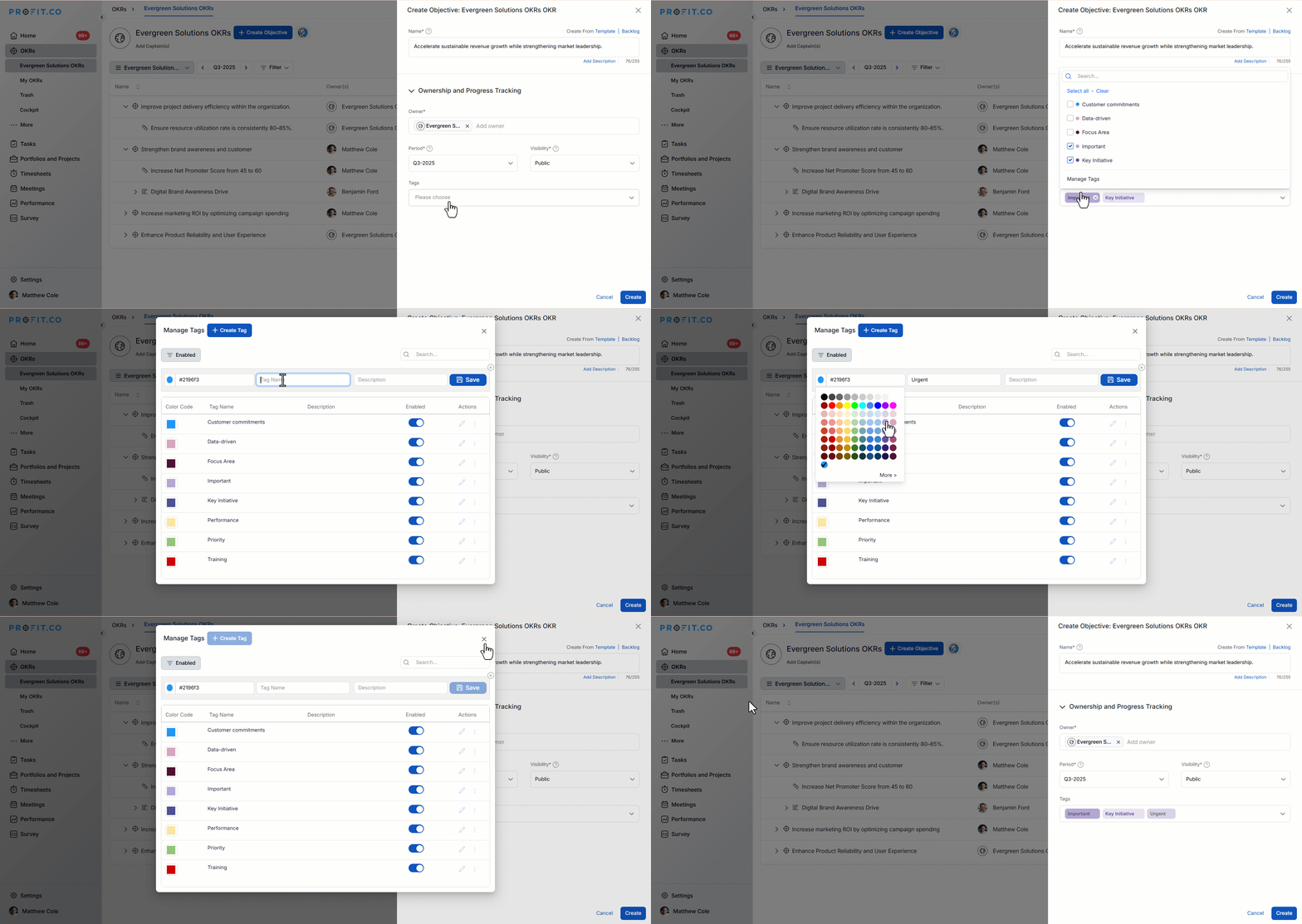
Method 2: Create a new tag
If the tag you need doesn't exist yet:
Step 1
- While creating your Objective, click on the Tag field.
- Click the + Add Tag button in the dropdown.
Step 2
- A popup window will appear with tag creation options.
- Choose the color for your new tag (for visual identification).
- Enter the tag's name that describes your categorization.
Step 3
- Click the Add button to create the new tag.
- The new tag will be automatically applied to your current Objective.
- It will now be available in the tag list for future Objectives.
Step 4
- Complete the remaining required fields.
- Click Create to finalize your Objective.
Your Objective will be created with your newly created custom tag.
How do I apply multiple tags to an Objective?
To apply multiple tags:
- Click on the Tag field during Objective creation.
- Select additional tags as needed.
- All selected tags will display on your Objective.
Example: An Objective could have tags for both priority ("Committed") and department ("Sales") to provide multi-dimensional context.
Best practices for using tags in Objectives
- Establish a tagging taxonomy: Create a consistent tagging system across your organization.
- Use descriptive names: Make tag names clear and self-explanatory.
- Limit tag proliferation: Don't create too many similar tags that cause confusion.
- Color code strategically: Use colors consistently (e.g., red for urgent, blue for departmental).
- Combine tags meaningfully: Use multiple tags to provide comprehensive context.
- Regular tag audits: Periodically review and consolidate unused or redundant tags.
- Train your team: Ensure everyone understands your tagging conventions.
- Use for reporting: Leverage tags in dashboards and reports for strategic insights.
- Balance specificity: Tags should be specific enough to be useful but broad enough to be reusable.
How tags improve OKR management workflow
Filtering and search
- Quickly filter Objectives by one or multiple tags.
- Search across departments or strategic themes.
- Create custom views based on tag combinations.
Reporting and analytics
- Generate reports showing progress by tag category.
- Compare performance across different strategic themes.
- Analyze resource allocation by department or priority.
Team collaboration
- Help team members find relevant Objectives quickly.
- Provide context about Objective importance and category.
- Enable cross-functional visibility and alignment.
Related Questions
Frequently Asked Questions
While Profit.co allows multiple tags per Objective, it's recommended to use 2-4 tags maximum for clarity. Too many tags can make categorization confusing rather than helpful.
Yes, Super Users and Admins can typically delete tags from the system. However, deleting a tag will remove it from all Objectives where it's been applied, so use this feature carefully.
Tag visibility typically follows the same permissions as Objective visibility. If a user can view an Objective, they can see its tags. The ability to create or modify tags may be restricted based on user roles.
Yes, tags are specifically designed to enhance filtering capabilities in reports, dashboards, and list views. You can create custom views based on single tags or combinations of tags to get precisely the insights you need.
Execute your strategy with confidence
Connect OKRs, tasks, and teams in one place with Profit.co
