

Profit.co's Control KPI key result type lets you set upper and lower boundary limits on a KPI, ensuring performance stays within a defined range rather than simply trending in one direction. Use it to enforce thresholds, maintain consistency, and measure whether a metric is operating within expected bounds.
Table of Contents
What is Control KPI?
Control KPI is one of seven key result types in Profit.co, designed for metrics that must stay within a defined boundary rather than increase or decrease. Instead of chasing a growth target, you define an acceptable operational range and track whether the KPI stays inside it.
It applies to recurring activities, operational consistency checks, and any scenario where going above or below a threshold signals a problem — not just falling short of a goal.
Why Control KPI Matters
Many business metrics are not about growth — they are about stability. Response times, error rates, budget ratios, and compliance hours all have ideal operating ranges where both extremes signal risk.
Control KPI gives teams a structured way to set those guardrails inside their OKRs, make progress visible through a bounded threshold model, and trigger action when the metric drifts out of range — without requiring a separate monitoring tool.
Control KPI Value Types
When creating a Control KPI key result, you must select one of three Value Types that define how the boundary is applied:
| Value Type | How It Works | Example Use Case |
|---|---|---|
| At Most | Sets an upper limit; progress is measured by keeping the KPI at or below the cap. | Maintain API response time at most 400ms |
| At Least | Sets a lower limit; progress is measured by keeping the KPI at or above the floor. | Maintain website visits of at least 10,000 per week |
| In Between | Sets both upper and lower bounds; progress is measured by keeping the KPI inside the range. | Maintain employee training hours between 20 - 40 hours/month |
| Constraint | Sets a not-to-exceed cap; the actual value must not exceed the defined cap. | Keep project expenses within a not-to-exceed cap of $50,000 |
How It Works
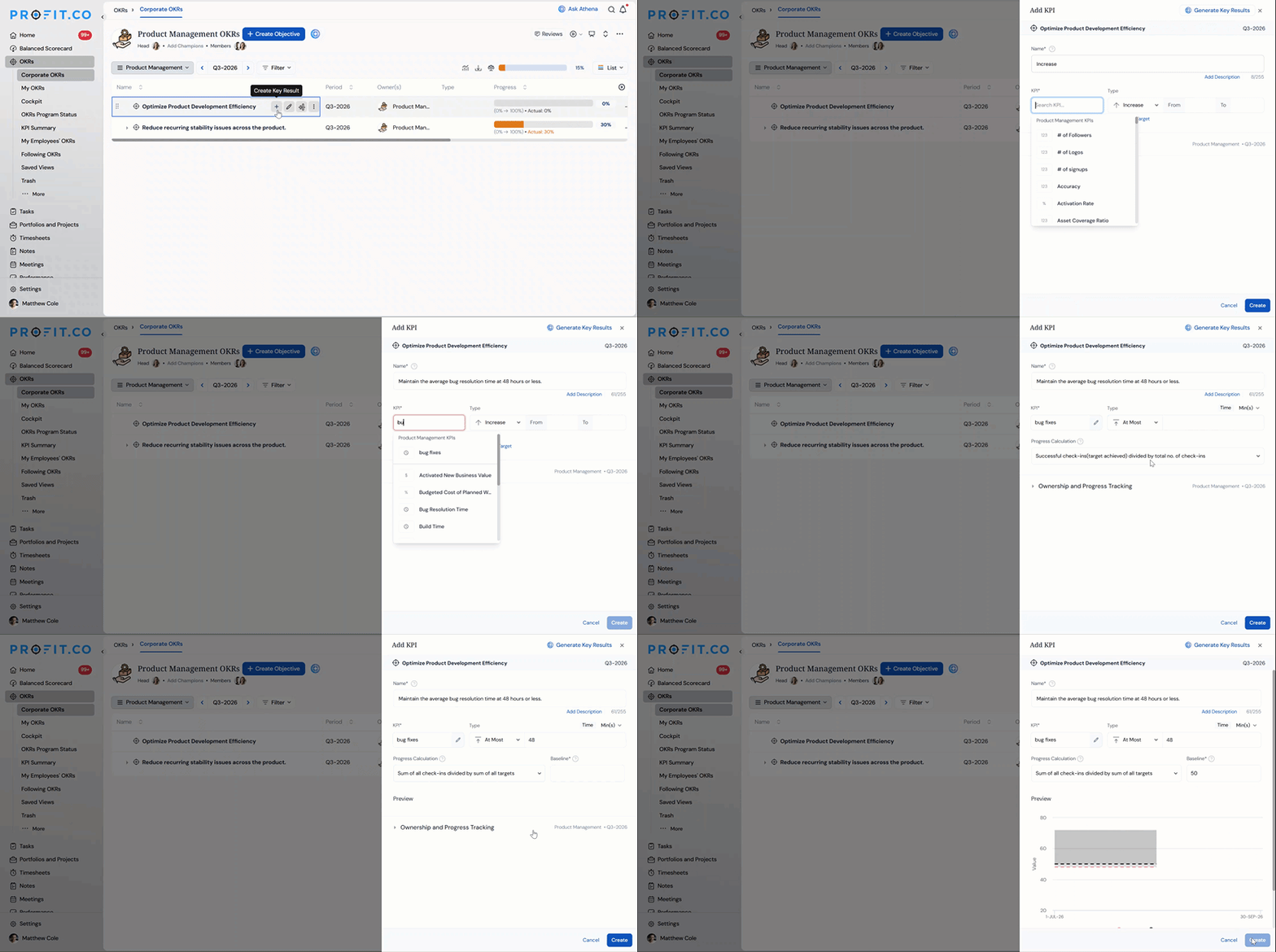
Follow these steps to create a key result using Control KPI in Profit.co:
- Go to OKRs in the left navigation panel.
- Hover over the Objective under which you want to create the key result.
- Click the + icon and choose the + Add KPI option.
- Enter the Key Result Name, choose the required KPI, select the appropriate Value Type (At Most, At Least, In Between, or Constraint), and enter the values.
- Once done, click Create.
- The newly created key result will appear on the OKR page under the associated Objective.
Best Practices for Control KPI
- Reserve Control KPI for stability metrics only: If your goal is growth or reduction, use Increase KPI or Decrease KPI instead. Control KPI is specifically for metrics that must operate within a bounded range.
- Set limits based on historical data: Use past performance to define realistic upper and lower thresholds — overly tight ranges will flag healthy fluctuations as failures.
- Enforce system-level limits via Settings when applicable: Navigate to Settings → OKRs → KPIs to pre-configure upper and lower limits on a KPI category so they apply consistently across all key results using that KPI.
- Match KPI and Value Type across Sub Key Results: When using a KPI-Based roll-up approach, the Key Result Type, KPI, and Value Type of all Sub Key Results must match the Parent Key Result for progress to roll up correctly.
- Use In Between for compliance and operational ranges: When a metric must stay between two values (e.g., budget utilization between 80–100%), In Between gives you a two-sided guardrail that At Most and At Least cannot provide alone.
Related Questions
- Click here to learn more about What's a Control KPI?
- Click here to learn more about how to enforce upper and lower limits for Control KPI
- Click here to learn more about how the Control KPI Key Result roll-up approach works in Profit.co
Frequently Asked Questions
You can edit the key result from the OKR page using the edit action. However, if the key result already has check-in data recorded, changing the Value Type may affect historical progress calculations. Review existing check-ins before making this change.
Yes. For Control KPI, KPI-Based is the only applicable roll-up calculation type. Equally Weighted and % Weighted are not supported. Additionally, the Key Result Type, KPI, and Value Type of all Sub Key Results must match the Parent Key Result exactly for progress to aggregate correctly.
Progress is determined by whether the reported check-in value falls within the defined threshold. For At Least, the KPI must meet or exceed the floor. For At Most, it must stay at or below the cap. For In Between, the value must remain within both the lower and upper bounds. Values outside these limits are reflected as below-target progress.
Execute your strategy with confidence
Connect OKRs, tasks, and teams in one place with Profit.co
