

Top-down alignment lets the owner of a higher-level Objective or Key Result pull other OKRs in as contributors, using the Add Contributing OKRs option inside the Align/Unalign action.
Table of Contents
What is Top-Down Alignment?
Top-down alignment is Profit.co's cascading approach: strategic goals set at a higher level flow down so that department, team, and individual OKRs visibly support the same outcome. The Add Contributing OKRs option inside the Align/Unalign action is how you execute that cascade on an Objective or Key Result that already exists, by pulling other objectives or key results in as contributors so their progress feeds into yours.
Why Top-Down Alignment Matters
Without a cascade mechanism, a corporate objective's progress reflects only the work entered directly against it, even when departments and teams are actively driving toward the same outcome elsewhere. Add Contributing OKRs closes that gap: once you pull another OKR in as a contributor, Profit.co factors its progress into your objective's calculation, so the number on the corporate objective reflects real departmental execution instead of a manually recomputed estimate.
How It Works
The steps below walk through the perspective of a higher-level Objective owner pulling in a departmental or individual OKR as a contributor, the most common way top-down alignment is executed.
Step 1
- Navigate to OKRs and open the corporate or department Objective you want other OKRs to contribute to.
- Click the More-options (•••) icon on the objective's row.
- Select Align from the menu.
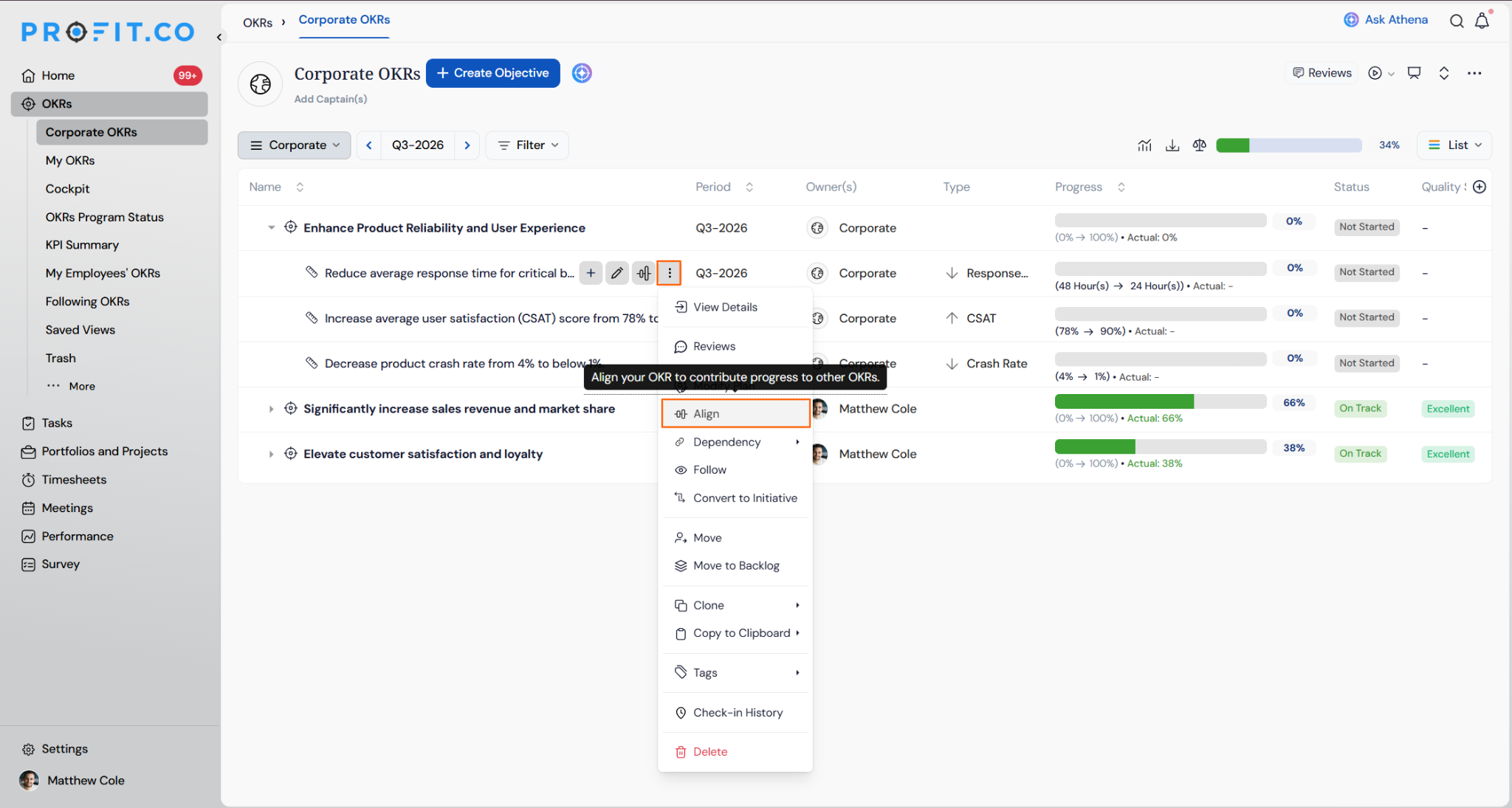
- Select the Add Contributing OKRs card. Click Next.
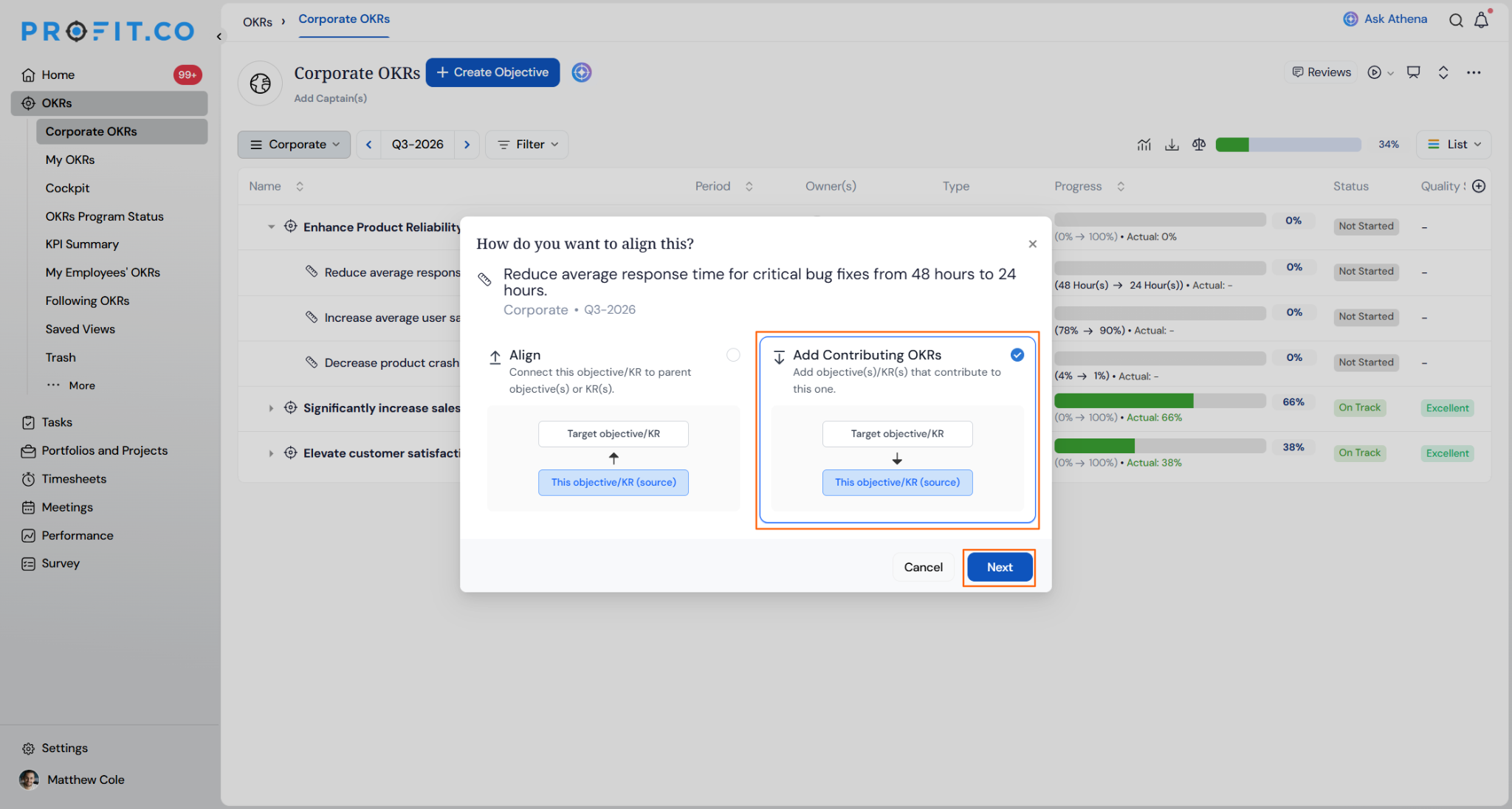
Note
The alignment flow can also be accessed directly from the Alignment icon in the side panel. Select Align/Unalign, and in the pop-up, choose the Add Contributing OKRs card and click Next.
Step 2
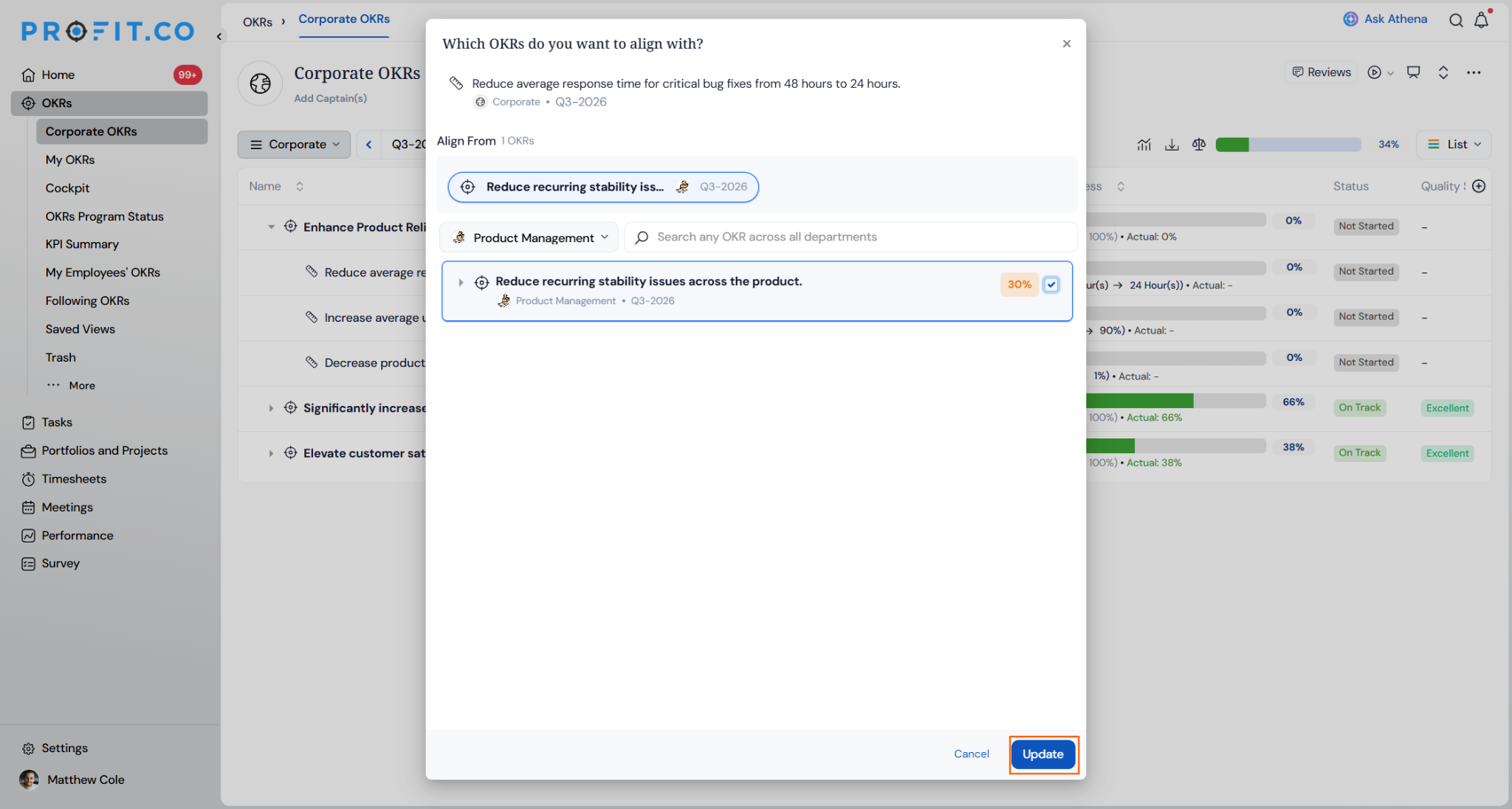
- On the Which OKRs do you want to align with? screen, use the search bar or the department filter to find each target OKR.
- Check the box next to each OKR you want to add as a contributor.
- Click Update to confirm the selections.
- Click Cancel instead if you want to close the screen without saving.
Note
If the assignee deletes the assigned Objective or Key Result, it won't be deleted on the Owner's side.
Top-Down Alignment Scenarios and Their Outcomes
| Scenario | What Happens |
|---|---|
| You add another OKR as a Contributing OKR to your Objective or Key Result. | Profit.co records the connection under Aligned To, and your objective's progress calculation includes the newly added contributing OKR from that point forward. |
| You delete a Key Result that has active alignment links with other OKRs. | Profit.co removes the alignment links to those OKRs and recalculates their progress accordingly. |
| You delete a weighted Key Result while other Key Results in the same Objective also carry assigned weights. | Profit.co opens a Modify Key Results Weightage table showing current and proposed weights for the remaining Key Results, and requires the total to equal 100% before the deletion proceeds. |
| You choose to proceed with the current weight instead of the proposed weight during that deletion. | Profit.co deletes the Key Result but leaves the remaining Key Results at their original percentages, which no longer total 100%. |
| You cancel the Align/Unalign flow before clicking Update. | Profit.co discards the selection and creates no alignment link. |
Adding Multiple Contributing OKRs at Once
The selection screen is not limited to one contributing OKR per session. You can check the box next to several OKRs before clicking Update, and Profit.co lists the running total under Aligned To on the objective's alignment view.
Tip
Apply the department filter first when you plan to add contributors from more than one department, then check each box before a single Update click.
Best Practices for Top-Down Alignment
- Select Add Contributing OKRs, not Align, when the dialog opens. Both cards sit in the same screen, and picking Align instead connects your OKR upward to a parent rather than pulling other OKRs in as contributors.
- Before deleting a weighted Key Result, review the Modify Key Results Weightage table and choose Proceed with proposed weight if you want the remaining Key Results to still total 100%.
- Use the department filter on the Which OKRs do you want to align with? screen before searching by name, especially when multiple departments have similarly named OKRs.
- Check the Aligned To count on an Objective before deleting a Key Result underneath it, since the deletion recalculates progress for every OKR that was aligned to it.
- When adding several contributing OKRs in one session, verify every checkbox selection before clicking Update, since the dialog does not ask for confirmation on each item individually.
Related Articles
- How to align key results?
- What's the difference between alignment and assignment?
- How do I view the assigned and aligned OKRs and Key results in a single place?
Frequently Asked Questions
Yes. The How do you want to align this? dialog applies to any of the three, and the objective/KR labels in the dialog cover both record types.
Yes. The Which OKRs do you want to align with? screen includes a department filter and a search bar that covers OKRs company-wide.
No. Add Contributing OKRs is a standalone action available from the OKR list view at any time, while the older Assign options ran only when a new Key Result was first created under an objective.
Execute your strategy with confidence
Connect OKRs, tasks, and teams in one place with Profit.co
