In this guide
- What is Employee Engagement?
- Why is Employee Engagement important?
- Top 10 Employee Engagement Ideas
- Employee Engagement Activities: 25 Ideas Across Every Format
- Innovative Employee Engagement Ideas for 2026
- Employee Engagement Committee Ideas, Events, and Contests
- Monthly Employee Engagement Ideas: A Year-Round Activity Calendar
- In Conclusion
- Frequently Asked Questions
What is Employee Engagement?
Employee engagement refers to the emotional commitment, enthusiasm, and sense of connection that employees feel toward their organisation, their work, and their colleagues. Engaged employees are more productive, less likely to leave, and more likely to advocate for their employer. Employee engagement ideas and activities are the structured initiatives organisations use to build and sustain that commitment.
Definition: Employee engagement is essentially the nature of the relationship between an organization and its employees.
Employee engagement is an important workplace principle that, when encouraged correctly, motivates employees to put their best efforts towards their jobs. When companies find creative ways to engage employees, they are passionate and committed to the organization that they work for.
Employee engagement happens when both the employee and the organization have a mutual respect and commitment. If companies can make employees feel acknowledged, appreciated and seen, they can increase performance and productivity, and as a result, benefit the organization.
Employee engagement matters a lot, for work is a huge part of our lives, and everyone seeks happiness at work.
Why is Employee Engagement important?
Which organization wouldn’t want their employees to be happy at work? They want them to look forward to coming to work everyday, and to love their jobs. But this ‘want’ doesn’t come easy. It takes work.
With so many job opportunities out there, employees are no longer tied down to one job for the rest of their career. If they do not feel appreciated and acknowledged, they will definitely go seeking a place that will recognize their efforts. Therefore, it’s very important to cultivate a workplace culture that can retain the best performers.
That’s where Employee Engagement comes into the picture. Employee Engagement has a direct impact on the organization’s success.
Top 10 employee engagement ideas that work and can help an organization succeed:
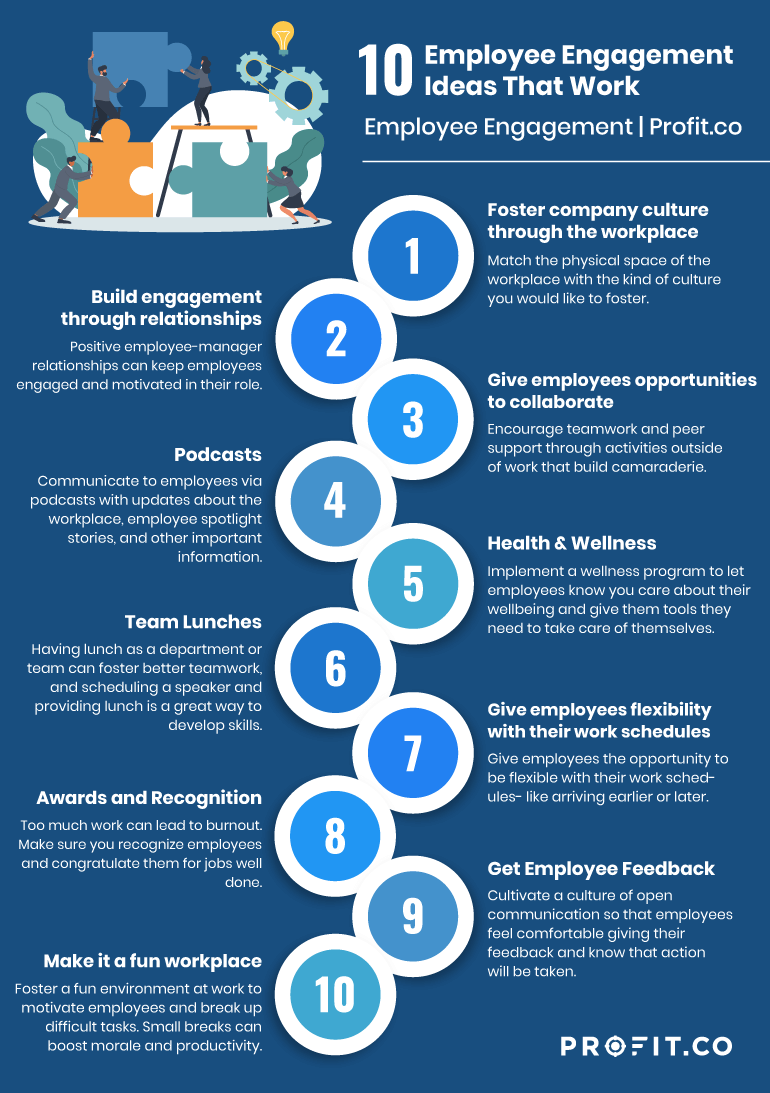
1. Foster company culture through the workplace
The environment where people are, the physical space that they occupy, can have a huge impact on their state of mind. This space can be used to foster the culture, the values and the beliefs of the organization. A positive culture can be cultivated in the form of decor, the colors and lighting, the kind of furniture and machines used, the floorplan. Everything that’s used to create an office plan has the potential to communicate the company culture to its employees.
2. Building engagement through relationships
Employees leave bad bosses, not bad jobs. This goes on to explain how much of an impact relationships can have on engagement. A bad boss or bad leadership results in a high turnover rate, and employees find it hard to find motivation to be at the workplace for the long run.
It is, however, possible to create an environment where employees can form relationships. Find creative ways to foster engagement, for example:
- A Hobbies and Interests Club
In an organization, there would be employees across departments who share similar interests. Creating Interests and Hobbies Clubs gives them the opportunity to explore those interests together, that helps build friendships and strong bonds that will help the employees and the organization alike, in the long run. It could be in the form of a Chess Club, Sports Club, Book Club : it can be anything that aligns with the interests of the employees and values of the organization. - Scavenger Hunt
A Scavenger Hunt is an employee engagement idea that can help newly hired employees get familiar with the office and act as an ice breaker to initiate a conversation with the other employees and get to know and forge relationships and connections.
3. Give employees opportunities to collaborate
Speaking of fun clubs and Scavenger Hunts, team events are a great way to liven up the workplace. Leaders should create plenty of opportunities for the employees to get to know each other and work together. Team events can provide opportunities for different departments to interact and collaborate with each other to achieve a common goal, which can help encourage productivity.
Some fun employee engagement ideas include:
- Escape rooms
- Murder mysteries
- Quizzes
- White river rafting
- Bowling
- Karaoke
These activities build a sense of camaraderie and make it possible for employees from different departments, or different cities, to interact with each other. Employees who bond well with their co-workers are more engaged with their workplace. It helps them come out of their silos and see how their work can impact other departments and can be beneficial to the organization. It also helps break the monotony of a regular workday.
Workshops are yet another way of employees collaborating with each other. An interactive workshop helps forge relationships between the members. Here are a few things that employees can gain from a workshop:
- Share industry insights with each other and learn more
- Learn from each other’s experiences : what works at the workplace and what doesn’t.
- Brainstorm ideas and strategies that can be executed on various projects
When team events are introduced in every department, the company’s employee experiences are sure to bring about a positive change. Workshops are a great avenue, especially to the newly appointed employees, to show how they can contribute and ‘showcase’ their skills.
4. Podcasts
Podcasts being so accessible are a great medium for internal communications. They can help with the following:
- Reaching remote workers
- Communicating company culture
- Narrating employee stories
Do bear in mind that creating podcasts requires some work beforehand: pre-production, production, post-production and execution of material. Make sure that it’s not a repetition of the information that has already been conveyed through other channels (like newsletters or through emails). It just will end up being a waste of time and money for everyone involved. Have a clear calendar in place for all the processes involved and the release of content.
5. Health and Wellness
When an employee is cared for, there is so much gratitude and commitment that the organization gets in return. A program centered around health and wellness can prove great for boosting productivity and morale. A free internal gym for the employees to use, a discounted gym membership elsewhere, or yoga are some good ideas. If there’s a cafeteria, take into consideration dietary restrictions when deciding on the cafeteria menu and make sure quality ingredients are used.
6. Team Lunches
Food has always been a good way to bond. Team lunches can be a great platform for people of the same department, or different departments to interact. There’s also the concept of lunch and learn, where the organization invites a speaker to talk about a certain topic, or get employees to talk about a topic, while sharing a meal and discussing the learnings afterwards. It’s a great way to build relationships, and a good way to improve employee engagement.
7. Give employees flexibility with their work schedules
Give employees the flexibility to work that works for them best. Whether it is coming in to work a little earlier to leave earlier, letting them come in later if they worked late the previous day, or giving them the option of working from home. Make remote working an option. There have been enough technological advancements that can make working remotely a breeze.
The option to work remotely makes it less stressful for employees and they can also save on time they spend commuting. The past year during the pandemic is evidence that working remotely is possible.
Employees don’t need to always be at the workplace : that doesn’t necessarily guarantee high productivity. Giving employees the freedom of flexibility at the workplace makes them happier, more productive and engaged. They get to decide their work schedules or location that suit their needs better.
When employees are given the freedom to choose what works best for them, as long as deadlines are met and quality of work doesn’t suffer, it goes a long way in keeping them engaged and winning their trust. The management and employees can together decide what works well and what needs to change.
8. Awards and Recognition
Be sure to appreciate employees for all the hard work they do. No matter how small or big, every contribution matters. Irrespective of how diligent or committed they are, too much work can lead to burn out. Refill their energy levels with recognition and appreciation and celebrate their hard work. Make sure to do this publicly.
A great way to do this is in the form of awards. Organize a night out for an awards ceremony for all employees to get together and recognize the winners. It can be a fun award ceremony with awards for ‘The Most Punctual Employee of the month’, or ‘The Most Creative Employee of the month’ or ‘The Best Department’. Make it a fun night with dinner, music and entertainment. These can also feature on the company newsletter or the noticeboards.
Digital platforms and softwares can help with the distribution of awards. Software such as Profit.co’s employee engagement module allows users to award one another with specific points or accolades, and keeps a line of communication and appreciation open within any organization.
To find out more, book a free demo
9. Get Employee Feedback
An organization needs constructive feedback on what is working well and what isn’t, so make sure you get feedback from employees. The management might think something is working well, but the employees might not agree with it. Therefore, it’s very important to regularly seek feedback. And for that to happen, the organization needs to cultivate a culture of open communication so that employees always feel comfortable giving their honest feedback and know that action will be taken.
An organization that fosters an environment where employees are welcome to share their ideas and opinions is an organization that’s on the path to success; because employees who are encouraged to express their ideas are employees who are more productive. They feel heard and acknowledged and therefore are motivated to work.
Getting employee feedback through an employee engagement activity like surveys is also a way of showing that the organization takes them seriously and values their opinions. Pulse surveys are a great way to determine the best way to drive employee engagement. Therefore, they work harder for the organization to succeed and meet its objectives, thus making them more engaged with the organization. Overall, a win-win situation for all.
10. Make it a fun workplace
With so much time spent at work, it’s very important that the place of work is a place that employees want to go. Foster a fun environment at work so that employees feel motivated to go to work everyday. Fun activities help increase engagement and productivity levels and also helps break the monotony of work.
There are a lot of ways to add some fun to the workplace. Some examples are:
- A short informational documentary movie session
- A movie night once a month every Friday evening
- Game night every now and then
- A potluck or catered lunch once a month
- A Halloween party on Halloween
Employee Engagement Activities: 25 Ideas Across Every Format
Employee engagement activities are structured events, programmes, or initiatives that give employees opportunities to connect, learn, be recognised, and contribute beyond their day-to-day tasks. They can be in-person, remote, low-cost, or high-investment: what matters is that they are consistent, inclusive, and genuinely valued by the people they are designed to engage.
The 10 ideas above cover the foundations of employee engagement strategy. This section goes further, mapping 25 specific employee engagement activities across five categories, so you can select the formats that best suit your team’s size, budget, and culture.
According to Gallup’s 2024 State of the Global Workplace report, organisations with consistently engaged teams see 21% higher profitability and 59% lower turnover compared to those with disengaged employees. Activities are the mechanism that makes engagement tangible.
Team Bonding
| Activity | Format | Best For | Cost |
|---|---|---|---|
| Escape room challenge | In-person group (8-20 people) | Cross-departmental mixing | Low-Medium |
| Lunch roulette (random team pairings) | In-person or virtual | Breaking silos in large teams | Free |
| Company-wide trivia tournament | Hybrid or virtual | All team sizes | Free-Low |
| Team cooking or baking class | In-person | Close-knit teams and offsites | Medium |
| Volunteer day (company-organised) | In-person community activity | Purpose-driven culture building | Low |
Recognition
| Activity | Format | Best For | Cost |
|---|---|---|---|
| Peer-nominated monthly awards | In-person ceremony or digital | Reinforcing team values | Free-Low |
| Public shout-out board (digital or physical) | Slack channel or wall display | Ongoing, daily recognition | Free |
| Work anniversary spotlights | Newsletter or team meeting | Retention and loyalty | Free |
| ‘Manager of the Quarter’ reverse recognition | Team vote, shared publicly | Improving manager relationships | Free |
| Recognition platform with points/badges | Digital (e.g. Profit.co) | Scalable, trackable recognition | Low-Medium |
Learning & Development
| Activity | Format | Best For | Cost |
|---|---|---|---|
| Lunch-and-learn sessions | In-person or virtual | Skill sharing across teams | Free-Low |
| Internal skills exchange marketplace | Digital or in-person | Cross-functional learning | Free |
| Book club with discussion sessions | Monthly, hybrid | Intellectual engagement | Free |
| External speaker series | In-person or virtual | Inspiration and industry insight | Medium |
| Learning stipend programme | Individual, self-directed | Autonomy and development | Medium |
Wellness
| Activity | Format | Best For | Cost |
|---|---|---|---|
| Step challenge or movement tracker | Digital, individual or team | Physical health and friendly competition | Free-Low |
| Mindfulness or meditation sessions | Weekly, virtual or in-person | Stress reduction and focus | Free-Low |
| Flexible ‘focus time’ blocks | Structural (no meetings) | Deep work and autonomy | Free |
| Wellbeing check-in in 1:1 meetings | Manager-employee 1:1s | Individual awareness and support | Free |
| Financial wellness workshop | Annual or quarterly | Holistic employee wellbeing | Low |
Social
| Activity | Format | Best For | Cost |
|---|---|---|---|
| Theme-based monthly lunch | In-person team lunch | Culture and casual connection | Low |
| Seasonal celebration events | Quarterly in-person event | Team morale and shared memory | Medium |
| Office games corner or common space | Permanent office feature | Daily informal engagement | Low-Medium |
| Cultural celebration calendar | Monthly awareness events | Inclusion and belonging | Free |
| End-of-year team retrospective dinner | Annual in-person | Closure, recognition, connection | Medium |
Fun Employee Engagement Activities in the Office
In-office environments have the advantage of spontaneity and physical presence. These activities work especially well for teams that share a workspace regularly:
- Desk decoration competition (seasonal: Halloween, holiday, team theme)
- Office bingo card (find a colleague who has [X trait or experience]: icebreaker for large teams)
- Midweek coffee challenge: different coffee pairing every Wednesday with a conversation prompt card
- Photo challenge: weekly team photo prompt posted in the office and shared on a company channel
- ’15-minute fix’ collaboration board: employees post a problem they need help with, anyone can spend 15 minutes helping
- Office plant adoption: teams care for an office plant, name it, and report its progress
Fun Employee Engagement Activities for Remote and Hybrid Teams
Remote and hybrid teams require more intentional engagement because the organic social interactions of an office are absent. These formats work across distances:
- Virtual coffee roulette: weekly random pair-up for a 15-minute informal video call, no agenda
- Async celebration channel: a dedicated Slack or Teams channel for sharing wins, milestones, and good news
- Remote trivia or quiz nights: monthly optional virtual games night with a low-key competitive format
- ‘Show your workspace’ Friday: team members share their home workspace setup, creating personal connection
- Collaborative playlist: team members contribute songs to a shared Spotify playlist, playing during virtual work sessions
- Virtual escape room: structured online escape room for teams of 4-10, multiple platforms available
Innovative Employee Engagement Ideas for 2026
Innovative employee engagement ideas for 2026 focus on three shifts: personalisation (recognition and development that feels individual, not generic), asynchronous connection (keeping remote and hybrid employees engaged without more meetings), and purpose alignment (connecting individual work to organisational and social impact). The 10 ideas below reflect these shifts and go beyond the standard activities found in most engagement programmes.
The employee engagement landscape has changed significantly in the past three years. Traditional approaches, including team lunches, awards ceremonies, and office social events, remain valuable, but they are no longer sufficient on their own. The following 10 ideas represent what leading organisations are doing differently in 2026.
10 Innovative Employee Engagement Ideas That Work in 2026
| Innovative Idea | What It Involves | Why It Works in 2026 |
|---|---|---|
| AI-assisted personalised recognition | Use performance data and manager input to generate specific, contextualised recognition messages at scale, so no one gets a generic ‘great job’ that feels copy-pasted | Personalisation is the single biggest predictor of whether recognition feels meaningful. AI makes individual-level recognition scalable across large teams. |
| Skills exchange marketplace | An internal platform where employees post skills they can teach and skills they want to learn, with facilitated peer-to-peer sessions over lunch or online | Combines learning with connection. Surfaces hidden expertise, builds cross-functional relationships, and costs nothing beyond coordination time. |
| Reverse mentoring programme | Younger or newer employees mentor senior leaders on digital fluency, Gen Z culture, or emerging tools; a formal programme with structured sessions | Engagement for both cohorts: junior staff feel valued and visible; senior staff gain practical skills and signal genuine openness to learning. |
| Transparency dashboards | Share company performance data, OKR progress, and team metrics openly with all employees, accessible in real time | Employees who understand how their work connects to company results are consistently more engaged. Transparency is the structural enabler. |
| Employee-led ERGs (Employee Resource Groups) | Formal groups led by employees around shared identities, interests, or purposes, supported by budget and senior sponsorship | Employees who lead ERGs report significantly higher engagement. They build community, develop leadership skills, and strengthen belonging. |
| Wellbeing stipends (unrestricted) | Monthly stipend ($50-$150) that employees can spend on anything that improves their wellbeing: gym, books, meditation apps, massages | Unrestricted stipends communicate genuine trust and respect for individual preferences. Highly valued with minimal administrative overhead. |
| Purpose-linked OKRs | Explicitly connect individual OKRs to the organisation’s social or environmental purpose, showing the ‘why’ behind every goal | Employees who see their work contributing to a meaningful purpose are more resilient, more creative, and more willing to go beyond expectations. |
| No-meeting deep work time | Designated blocks (e.g. 9am-12pm on Tuesdays and Thursdays) protected from all meetings company-wide | Meeting overload is one of the top drivers of disengagement in 2026. Protected focus time is a structural signal that the organisation respects people’s work. |
| Internal hackathons | Quarterly 24-48 hour innovation sprints where cross-functional teams work on a defined challenge; problem can be internal or external | High engagement, high energy, visible outcomes. Surfaces ideas that matter and develops relationships outside normal reporting lines. |
| Engagement ambassador programme | Volunteer employees in each team who own engagement planning for their group, supported by HR but employee-led | Engagement ambassadors drive localised, authentic activities that HR-led programmes often cannot. Ambassadors themselves become highly engaged. |
Low-Cost and Free Employee Engagement Ideas
Effective employee engagement does not require a large budget. The most consistently impactful engagement activities are free: they require time and intention, not spend.
| Low-Cost / Free Idea | How to Run It | Time Investment |
|---|---|---|
| Public shout-out board (physical or digital) | Set up a shared space: a pinboard in the office or a dedicated Slack channel where anyone can post recognition for a colleague at any time | 5 minutes to set up; ongoing with no management needed |
| Peer recognition notes | Weekly prompt for all team members to write one handwritten or digital note recognising a specific colleague contribution | 5 minutes per person per week |
| Lunch roulette | Randomly pair employees across departments for a 30-minute lunch or virtual coffee: use a spreadsheet or free tool to randomise pairings | 30 minutes per participant monthly |
| Skill-sharing sessions | Monthly 30-minute session where one team member teaches something: a work skill, hobby, or language, to the team | 30 minutes monthly; no preparation cost |
| Team retrospective (start/stop/continue) | Monthly 20-minute team session to celebrate what worked, drop what didn’t, and plan what to try next | 20 minutes monthly; no cost |
| Manager ‘listening hours’ | Weekly 30-minute open-door slot where any employee can talk to a manager informally: no agenda, no notes | 30 minutes per manager per week |
Employee Engagement Ideas for Small Companies
Small companies have a structural advantage in engagement: every leader knows every employee by name, decisions happen fast, and culture is shaped by a small number of people who interact daily. These ideas leverage that advantage:
- Whole-team goal setting: involve everyone in quarterly goal setting, not just the leadership team. When employees help set the direction, they own the outcome.
- Founder or CEO AMA (Ask Me Anything): a monthly 30-minute open session where employees ask any question, creating transparency and trust that large companies struggle to replicate.
- Individual development conversations: with smaller teams, every manager can have a genuine 1:1 development conversation once a month, asking about career goals, not just task progress.
- Flexible role expansion: offer employees the chance to take on stretch projects in areas outside their formal role. Small companies have the structural flexibility that large ones don’t.
- Profit-sharing or team bonus: even a modest profit-sharing scheme creates a direct connection between company success and employee engagement.
Employee Engagement Committee Ideas, Events, and Contests
An employee engagement committee is a group of volunteer employees who plan and run engagement activities on behalf of the organisation. Engagement events are structured one-time or recurring programmes (celebrations, volunteer days, themed activities). Engagement contests are time-limited competitive formats (wellness challenges, idea competitions, skill showcases) that drive participation through healthy competition.
Employee Engagement Committee Ideas
An employee engagement committee gives employees ownership of the engagement programme, removing it from HR’s to-do list and distributing it across the organisation. Committees work best when they are representative (one member per team or department), have a small budget, and report outcomes to leadership. Here are 8 engagement committee ideas to structure their work:
- Monthly theme calendar: the committee selects a theme for each month (wellness, learning, appreciation, culture) and plans one activity aligned to it
- Quarterly all-hands engagement event: plan and host a company-wide event once per quarter, with the committee owning the format, logistics, and facilitation
- Onboarding buddy programme: committee members serve as volunteer buddies for new hires in their first 30 days, providing a simple, structured introduction to company culture
- Recognition infrastructure: build and maintain the peer recognition system, including shout-out channel, nomination process for awards, and recognition criteria
- Pulse survey follow-through: review engagement survey results and propose two or three specific improvements the committee will own in the next quarter
- Culture documentation: capture what makes the company’s culture distinctive, including values in action, stories from employees, and artefacts, in a living company culture document
- Wellness initiative planning: coordinate a quarterly wellness challenge (step counts, hydration, sleep tracking) with optional prizes
- Community and social responsibility days: organise at least two volunteer or charitable giving events per year
Employee Engagement Event Ideas
Employee engagement events are structured occasions, larger in scope than day-to-day activities, that create shared experiences and memories. The 10 ideas below range from low-effort to high-investment:
| Event | Format | Frequency | Team Size | Approx. Cost |
|---|---|---|---|---|
| Monthly trivia or games night | In-person or virtual | Monthly | 5-50 | Free-Low |
| Seasonal celebration lunch | In-person team lunch | Quarterly | 5-200 | Low-Medium |
| Internal awards ceremony | In-person event with nominations | Annual or semi-annual | All team | Medium |
| Volunteer day (team community project) | In-person community activity | Bi-annual | 10-100 | Low |
| Cultural celebration events | Theme-based awareness event | Monthly (rotating) | All team | Free-Low |
| Lunch and learn series | In-person or virtual with speaker | Monthly | 5-50 | Free-Low |
| Company-wide hackathon | Intensive 24-48 hour innovation sprint | Quarterly | 10-200 | Low-Medium |
| Mid-year team offsite | Half-day or full-day out of office | Annual | 5-50 | Medium-High |
| End-of-year celebration | Annual festive event or dinner | Annual | All team | Medium-High |
| New hire welcome event | Structured introduction to the team | Monthly or quarterly | New hires + team | Low |
Employee Engagement Contest Ideas
Well-designed contests create energy, build friendly competition, and drive participation in engagement initiatives. The key is to make participation accessible (not just for the most competitive employees) and to celebrate effort as well as outcomes.
- Wellness challenge: individual or team step-count, hydration, or movement challenge over 4 weeks, tracked via a shared platform or spreadsheet. Winner gets a wellness-related prize.
- Innovation idea competition: employees submit ideas for improving a product, process, or customer experience, reviewed by a cross-functional panel. Top 3 ideas get implemented and credited.
- Learning streak contest: who can complete the most learning modules or hours in a month, tracked through the company’s L&D platform. Small prizes for top participants.
- Team photo challenge: weekly creative photo prompt (e.g. ‘show your workspace’, ‘capture something that made you smile’), voted on by the team, winner announced Friday.
- Peer-voted ‘unsung hero’ award: monthly nomination where employees nominate a colleague who went above and beyond without recognition, voted on by the team, not management.
- Sales or performance sprint (non-sales roles too): time-limited team challenge with a specific output target, e.g. ‘most customer feedback collected in two weeks’ for a support team.
- Skill showcase: employees demonstrate a professional or personal skill in a 5-minute team presentation, voted on for creativity, not expertise. Prize: bragging rights and a small token.
- Culture quiz: a fun quiz about company history, values, and team trivia, run at an all-hands or team meeting. Prizes for the top scorers.
Monthly Employee Engagement Ideas: A Year-Round Activity Calendar
A monthly employee engagement calendar structures activities across the year so that engagement is consistent, not reactive. Each month is anchored to a theme, aligned to the season, a cultural moment, or a business priority, with one or two specific activities that any team can run regardless of size or budget.
The most common failure mode in employee engagement is inconsistency: a burst of activities in January, another in the run-up to a company event, and then silence. A monthly calendar prevents this by building engagement into the rhythm of the year, making it predictable, plannable, and sustainable.
The calendar below is a starting point. Adapt the themes and activities to your team’s culture and calendar. The goal is one structured touchpoint per month, minimum.
| Month | Theme | Activity Idea 1 | Activity Idea 2 | Notes |
|---|---|---|---|---|
| January | Goal Setting & Fresh Starts | Team OKR workshop: set team goals together, not top-down | New year ‘skills I want to develop’ sharing session | High-energy month; use it to establish the year’s engagement rhythm |
| February | Appreciation & Connection | Peer recognition campaign: written appreciation notes to colleagues | Valentine-themed random coffee pairings across departments | Short month; keep it light and relationship-focused |
| March | Wellness & Balance | 4-week wellness challenge (steps, sleep, hydration) | Mental health awareness lunch: open conversation, no agenda | International Women’s Day (8 March): celebration opportunity |
| April | Learning & Growth | Internal skill-sharing session: one employee teaches the team something | Book or podcast club launch: first discussion session | Spring energy; good time for development initiatives |
| May | Recognition & Milestones | Work anniversary spotlights for all anniversaries this month | Team impact showcase: share one achievement from each team | Employee Appreciation Day (first Friday of March; note annually) |
| June | Community & Impact | Volunteer day: team community project (charity, environment, local) | ‘What we are proud of’ mid-year reflection session | Summer engagement risk; plan something social before holidays |
| July | Fun & Creativity | Summer games day or office Olympics | Creativity challenge: employees submit one creative solution to a real problem | Lower attendance month; keep activities short and optional |
| August | Culture & Belonging | Cultural celebration event: rotating cultural showcases from the team | Team storytelling session: ‘How I got here’ : career journey sharing | Back-to-school energy builds toward end of month; plan September early |
| September | Development & Goals | Mid-year OKR review: how are we tracking? What needs to change? | External speaker or industry leader Q&A session | Strong engagement month: high focus and energy post-summer |
| October | Innovation & Ideas | Internal hackathon or idea competition | Halloween themed event: office decoration contest or team costume vote | Innovation energy peaks in October; leverage it |
| November | Gratitude & Giving | Company-wide gratitude wall: everyone adds something they are thankful for | Charity giving campaign: team chooses a cause to support together | Thanksgiving (US): cultural moment for appreciation-focused activities |
| December | Celebration & Reflection | End-of-year celebration event or team dinner | Year-in-review: team highlights and moments from the past 12 months | Lower-energy month; celebrate, don’t push. Save heavy initiatives for January. |
How to use this calendar alongside your engagement committee
Share the full calendar with the engagement committee in January and assign each month to one committee member who owns the planning.
Set a budget per month at the start of the year: even £50-£100 per team per month is enough for most of these activities.
Announce the month’s theme and activity on the first Monday of each month: consistency of communication matters as much as the activity itself.
After each activity, gather one piece of feedback from the team: What did people enjoy? What would they change? Use this to refine next year’s calendar.
In Conclusion
Employee engagement is very important to an organization’s success and therefore something that needs a lot of attention. Work can be a lot about chasing targets and deadlines, but it doesn’t have to always be just that. It doesn’t always have to be so serious. Practice employee engagement strategies to help boost morale at the workplace.
Frequently Asked Questions
Employee engagement is the emotional connection employees feel toward their work and company. Engaged employees care about the organization, stay committed, and consistently go the extra mile.
Engaged employees are more productive, motivated, and loyal, which leads to better business outcomes, lower turnover, and a stronger workplace culture.
Team-building events, workshops, and joint projects foster collaboration. These activities help employees connect across departments, build trust, and work more effectively together.
Flexibility allows employees to choose when and where they work best. This autonomy improves job satisfaction, reduces stress, and builds trust between staff and management.
Regularly seeking and acting on feedback shows employees their opinions matter. It builds trust, encourages open communication, and motivates employees to stay committed.
The best employee engagement activities combine connection, recognition, and development, and vary by team size, format, and budget. Consistently effective activities include peer recognition programmes (free and scalable), team lunch roulette (low cost, high social value), skills-exchange sessions (builds learning and relationships), volunteer days (purpose and community), and wellness challenges (participation-friendly and health-positive). The most important factor is consistency: regular activities outperform occasional high-investment events.
The most innovative employee engagement ideas for 2026 focus on personalisation, purpose, and asynchronous connection. Key examples include: AI-assisted personalised recognition (making recognition specific and scalable), no-meeting deep work time (structural respect for focus), employee-led ERGs (ownership and belonging), purpose-linked OKRs (connecting individual work to organisational impact), and unrestricted wellbeing stipends (autonomy and trust). These ideas go beyond social events: they change how the organisation is structured and how people feel valued within it.
To create a monthly employee engagement calendar: (1) Select a theme for each month, aligned to the season, a cultural moment, or a business priority. (2) Plan one main activity and one lighter touchpoint per month. (3) Assign ownership, either to an HR team member or an engagement committee representative. (4) Set a budget per month at the start of the year. (5) Announce each month’s activity on the first Monday of the month; consistency of communication matters. (6) Gather feedback after each activity and use it to improve the following year’s calendar.