Introduction
In business, definitions of key terms can be critical to success. Business strategy refers to a company’s overall direction, while business tactics are how a company implements its strategy.
Not understanding strategy and tactics results in mediocrity and shortfall in achieving success. For instance, if a company has developed strategies for success and ignored the tactics it should use to get there, it cannot implement them successfully.
What are strategic OKRs?
Strategic OKRs are the long-term plans an organization has put in place to help it reach its ultimate goals. Most organizations will have an OKR strategy to implement the OKR process to bridge the strategy execution gap. Once the OKR onboarding is done the organization can break down its strategic initiatives to OKRs and execute them.
What are Tactical OKRs?
Tactical OKRs are the goals of different individuals in the organization who play their part at various levels to achieve collective goals.
What are OKRs?
Objectives and Key Results (OKRs) is a goal management framework developed for implementing strategy in the business world.
1. What Is the Relationship Between Strategy and OKRs?
Many organizations assume that rethinking the framework used for goal setting will mysteriously bring forth the right strategy. But that is not the case.
Read more to understand the relationship between OKRs and strategy.
OKRs, An Integral Part of Strategy
Stephen Bungay, who authored The Art of Action, describes strategy as intent, not a plan. Robert Kaplan and David Norton call strategy a set of hypotheses on cause and effect. Looking at the two sources, you can conclude that strategy is the best guess of the executive team, pointing at the direction the organization should focus on moving forward.
The leadership of any organization has the mandate to create a strategy and then direct their teams in a way they will work towards the desired outcomes. OKR (Objectives and Key Results) methodology has delivered unprecedented success in bridging the strategy execution gap on numerous occasions to technology titans like Google and Intel. When organizations use the OKR methodology the leaders do not dictate the team’s plan and tactics. The leaders set the mission’s objective and then allow the teams to determine the most effective ways to achieve the organization’s strategy through the OKR framework.
Want to get started on an intuitive and agile OKR Software today?
Supporting Corporate Strategy with OKRs
Strategy statements are objective statements, and the top authorities set them in the organization. They get shared with the organizational workforce with a narrative that compels the team and motivates them to follow the path the leadership has decided.
Upon setting the strategy, the team answers questions about how the strategy works. These questions are the metrics used to measure whether the business is healthy. However, they are not tactical measures of how the customers will behave. Instead, in the business world, they are key performance indicators.
They go as follows:
- Where to play
- How will you win
- How will you know you have won?
The team then embarks on supporting the corporate strategy using OKRs. It is the stage that comes after leadership has broadcasted the corporate strategy to the whole organization clearly and consistently. Additionally, ensuring all employees can access the process and measures put in place to realize the organization’s success.
Team members begin planning what they can do in their daily routines to help achieve the corporate strategy. They come up with their OKRs that serve the corporate strategy.
2. Difference Between Strategic OKRs and Tactical OKRs
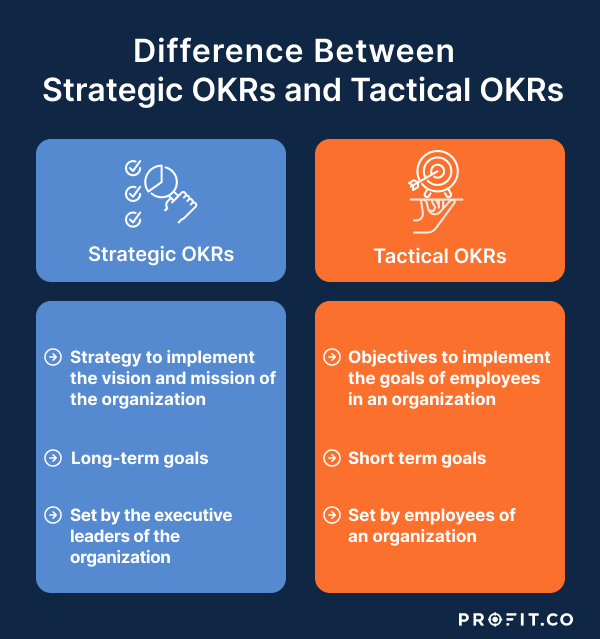
Talking about strategic OKRs vs. tactical OKRs is like differentiating a part from a whole. Read on to understand what differentiates the two.
Strategic vs Tactical OKRs
Strategic OKRs are strategies that help the workers in an organization implement the comprehensive goal of the organization and do it with much focus. Remember, these are the goals made by the executive leaders.
Tactical OKRs are plans that help the workers in the departments of the organizations to implement their own goals at the lower level. These goals tie to the company strategy’s bigger picture to make it a success.
Strategy and Tactics Examples
Here are strategy and tactic examples:
For instance, the strategic OKR of company A is to reduce the cost of operation.
The tactical OKR examples for the departments in the company will be as follows.
- The admin team will decide to improve the payment process of the suppliers so that they can reduce the late payment fees incurred when there is a delay.
- The marketing team will aim to reduce the marketing cost.
- The HR department will have the objective of restructuring to reduce labor costs.
Let’s look at some OKR examples for strategy.
OKR examples for product marketing goals are as follows.
- The objective, in this case, is to launch a new product in a quarter.
The key results expected are:
- Work with PR for the technical specs and conclude in a week
- Conclude all the updates on the new products on the website a week before launch
- Provide customers and partners with a pre-launch update a week in advance.
- Get done with the product data sheets and feature briefs in two months.
3. Frequently Asked Questions
Below are the FAQs on OKRs:
What Are the Key Differences Between OKR and KPI?
What differentiates the two is that OKRs are frameworks meant to facilitate performance, goal management, and strategic frameworks. On the other hand, key performance indicators (KPIs) exist within that framework.
What Is the Difference Between OKR and SMART?
The difference is that SMART goals help you pinpoint a goal, whereas OKRs are about the bigger picture, i.e., collective company goals.
4. Conclusion
You can sum up the difference between the strategy and tactics as follows. The strategy determines the place you want to go as an organization; tactics determine how you will get to that destination. Strategy and tactics complement each other. Book a free demo with our team to learn more about how OKR software can optimize your organization’s performance by helping you to set Strategic and Tactical OKRs!