Every organization wants to retain its best performing employees year after year. Employee performance reviews play a crucial role in retaining employees. In order to convince the employees to stay with the organization, reviews have to deliver what they expect.
But as the organizations evolve and the generations change, the aspirations and expectations of the employees also change. This makes retaining them challenging, with old school performance reviews. In the past, reviews were only a measure of employee productivity. People were rated by their managers based on their output, and reviews were limited to that. Older generations were easily satisfied with the growth enabled by those simple, old-school appraisals. However, millennials are different, and the performance reviews to evaluate them should also be different.
Generation X is gradually moving out of the workforce, and millennials are starting to occupy those positions. 75% of the workforce would be millennials by 2030. Reviews that served to retain the older generations will not work for millennials. So, it becomes extremely important to understand what the millennials want and need and design performance reviews around that. In this article, we will see the traits of millennials and how we can design reviews to fulfil their expectations and retain them.

How are millennials different from the previous generations?
Millennials are different from the previous generation in many ways that make retaining them challenging. Following are some of the differentiating traits of the millennials.
Generation X was content with slow and steady growth, and it was easier to offer a long-term growth plan for them inside the organization. But millennials are hungry for growth, and they do not want to wait for it. They want to take every opportunity, even if it comes from outside the organization. So, performance reviews have to focus on growth opportunities.
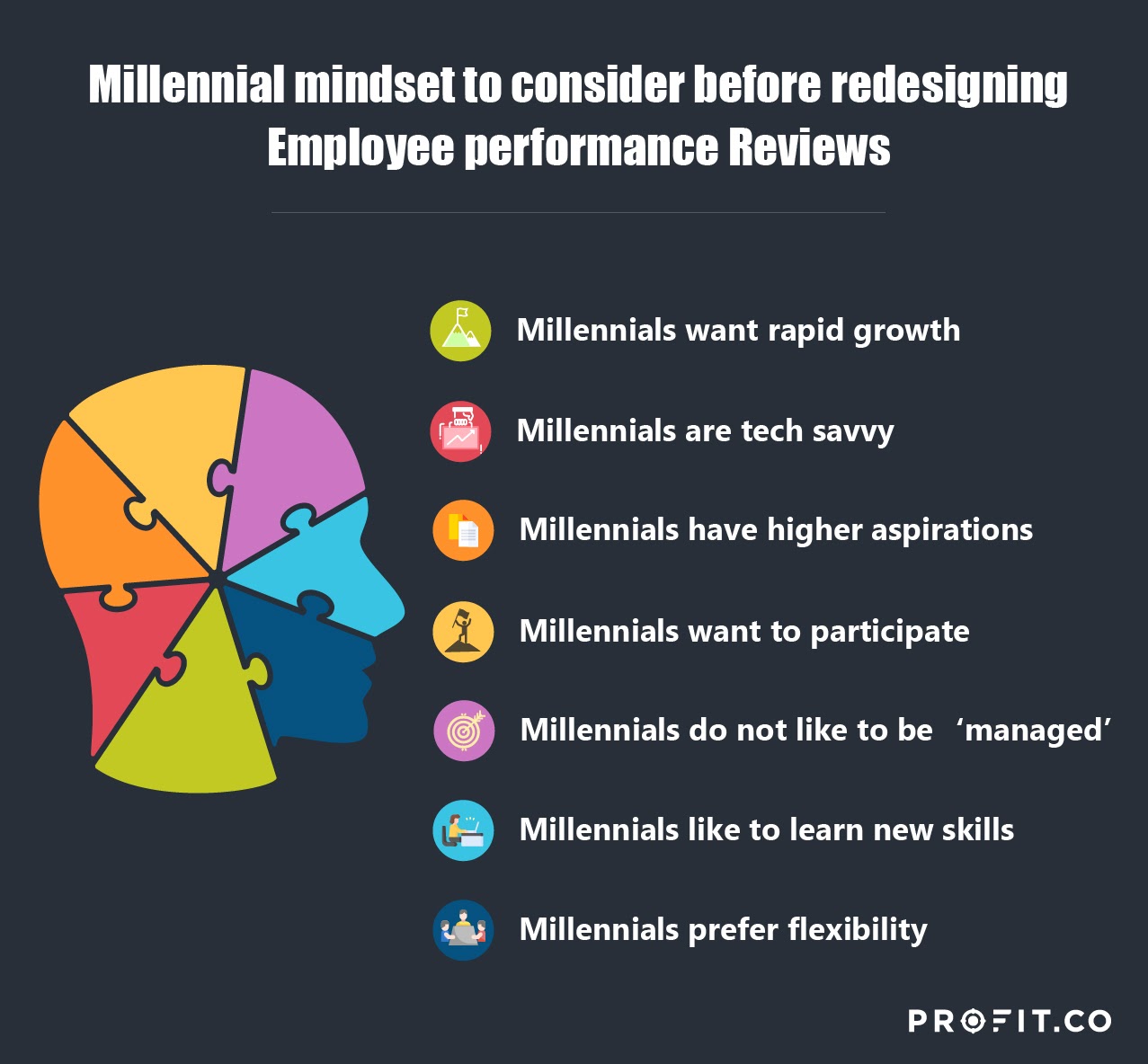
While the previous generation was not as proficient with computers and technology, millennials grew up in a period where the IT revolution changed the world. So, they are good with technology and are capable of utilizing it properly to find efficiencies that the previous generations could not. Performance reviews have to be redesigned and goals have to be set around these capabilities of the millennials to bring out the best in them.
While generation X was mostly content with fulfilling all the responsibilities mentioned in the job description, millennials do not want to confine their growth prospects within the scope of their job description. They are eager to take up more responsibilities and leadership to prove their mettle. If they do not see an expansion in their roles, they tend to leave the organization. So, performance reviews should also address the higher aspirations and ambitions of the employees.
Performance appraisal in the age of generation X could be a one-way affair. The managers evaluated performance based on output, and there was not much the employees could share with their managers as feedback. On the other hand, millennials do not like to be scrutinized in the form of quantitative evaluation and ranking; they prefer to participate more. They want the organization to value their feedback and implement changes based on that to make work more enjoyable. So, employee performance reviews should offer space for feedback.
Millennials are self-motivated and prefer a less interventionist approach from their superiors. They prefer to be mentored rather than to be managed. So, the tone of the reviews should be changed from ‘management’ of performance to ‘engagement with employees’.
With the hunger to prove themselves and with their ability to use technology to learn new things, millennials are capable of developing new skills and furthering their capabilities, provided it gives them new growth opportunities. Performance appraisals have to enable the organization to identify the employees’ aspirations and provide them with the means through which they can learn new skills that will help them fulfill their aspirations.
Even before the pandemic, millennials were used to the concept of work from home and flexible timings. Gone are the days where an employee would work only during the fixed eight hours of a working day. Work life and personal time are interwoven in the life of millennials and they prefer to work in a more flexible manner. So, reviews should not be rigid about working hours and how employees work in that time. It should not evaluate people based on their work schedule and timings.
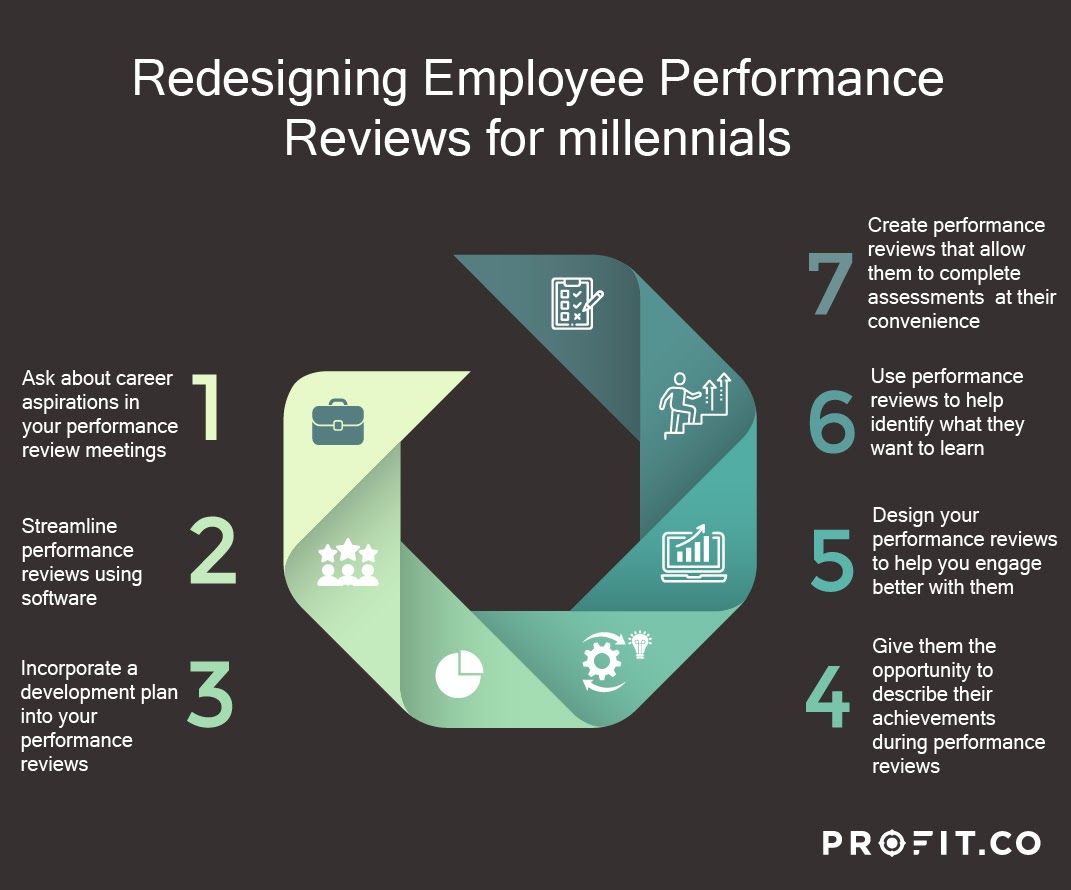
It is extremely important to design performance appraisals with consideration to the individuals in your company’s workforce. Reviews should address these needs and expectations of the millennials, if an organization has to retain them. Following are some of the ways you can redesign reviews for the younger generation:
1. Recognize their achievements
Provide space for the employees in the reviews to reflect on their achievements and the way their contributions have led to the overall growth of the company. Reward them for their achievements with suitable hikes, perks and promotions.

2. Bring out their aspirations
Give employees the space to speak out their ambitions and higher aspirations. Provide them with a constant supply of opportunities to move up in the career towards those aspirations.

3. Allow them to work at their convenience
Since millennials like to work at their convenience, it becomes more important to see what they have achieved instead of how they achieved it and how they utilized the working hours during the process. It is crucial especially during these times of pandemic. Evaluating their overall performance instead of focusing on the work they do within rigid working hours will give employees the flexibility they need to bring out the best in them.

4. Identify what they want to learn
Provide employees the space to express what they want to learn and how they want to articulate their learning to do their work better. Organize trainings that address their learning needs and skill requirements.

5. Engage with them
Millennials are a ‘connected’ generation and they prefer constant updates rather than sitting with managers once in a year for annual reviews. So, make reviews continuous and informal. Engage with them more frequently and provide them with the space to speak out their expectations, grievances, and requirements.

6. Tell them what you expect from them
The previous generation was fine with ratings and general feedback. But millennials are eager to learn, and they need specific feedback regarding where they shine and where they don’t. So, customize the reviews for every position and provide job-specific feedback so that employees know exactly what to do to address those concerns.

7. Prepare them for leadership
Millennials have higher ambitions, and they prefer to avail leadership opportunities that help them grow beyond what they can expect from their current roles. So, identify leadership qualities of employees through the reviews and give them suitable responsibilities to develop them as potential leaders in the organization.

Final Thoughts
The key to effective performance management and engagement with employees is seeing things from their perspective, and anticipating what they would want out of a review process. If you have a workforce made up of individuals from the millennial generation, chances are they have different priorities and ambitions than their Generation X counterparts.
Being ready to adjust your processes to fit employees and develop with them is important for any company. Having a performance management system that can adjust with you is just as important. With the Profit.co’s performance management module, you can tailor review questions, rated competencies or skills, and even the frequency of reviews not just to your company, but to each department or individual.