Have you ever wondered why Elon Musk, Jeff Bezos, Bill Gates, and the rest of Silicon Valley have successful projects? The answer is outstanding project management, which ensures successful implementation from start to finish.
TL;DR
The Waterfall Project Management methodology is a linear, sequential approach that moves through five structured phases: Requirements & Planning, Design, Implementation, Verification/Testing, and Maintenance. Each phase must be completed before the next begins, making it highly structured and documentation-driven.
Waterfall works best for projects with clearly defined requirements and minimal expected changes. Its key advantages include simplicity, clear milestones, strong documentation, and easier progress tracking. However, it can be inflexible, costly to change mid-project, and slower compared to iterative approaches like Agile.
In this guide
- What is Waterfall Project Management?
- What is the Waterfall Methodology? Definition, Principles, and How It Works
- Waterfall Project Management Phases
- The Waterfall Life Cycle: Phase Deliverables, Gate Criteria, and Planning Guide
- Waterfall Phase Deliverables: What Each Stage Produces and How to Manage It
- Waterfall Project Management Tools
- Advantages and Disadvantages of Waterfall Project Management
- Waterfall vs. Rapid Development
- Waterfall Methodology Examples: 3 Real-World Use Cases
- Frequently Asked Questions
What is Waterfall Project Management?
Waterfall project management is a linear, sequential approach to managing projects in which each phase: Requirements and Planning, Design, Implementation, Verification, and Maintenance: must be fully completed before the next begins. It is suited to projects where requirements are fixed, deliverables are non-reversible, and strong documentation is required throughout.
The waterfall approach is among the oldest project management techniques. It consists of sequential phases that map out every essential step of a project.
Each new step feeds into the next step in such a way that one can’t begin without the previous phase’s completion. When changes occur, they are costly because a phase’s completion does not allow you to revisit it unless you restart the project from phase one.
What is the Waterfall Methodology? Definition, Principles, and How It Works
The waterfall methodology is a linear, sequential project management approach where each phase must be fully completed and signed off before the next begins. Progress flows in one direction, forward, like water falling downstream. It is called ‘waterfall’ because there is no upstream movement: once a phase is closed, teams do not return to it without restarting the project.
The waterfall methodology is one of the oldest structured approaches to project management, originally formalised in manufacturing and construction before being adapted for software development in the 1970s. Its defining characteristic, and its most significant design decision, is the assumption that all requirements can be known before work begins.
This assumption is both the methodology’s greatest strength and its primary limitation. When requirements are stable and complete, waterfall delivers predictable, well-documented outcomes. When requirements change, which is common in software development, waterfall struggles, because any change to a completed phase requires reworking all downstream phases.
The 5 Core Principles of Waterfall Methodology
- Sequential structure: Phases flow strictly forward, one phase at a time, in order. No phase begins until the previous one is formally closed and approved.
- Requirements defined upfront: All project requirements are captured, documented, and approved before any design or development work starts. Ambiguity at this stage is carried into every subsequent phase.
- Documentation-first: Every phase produces formal documentation, including requirements specifications, design documents, test plans, and maintenance logs, that serve as the project’s single source of truth.
- Fixed scope: Project scope is agreed upon at the start. Changes are handled through a formal change request process, which typically triggers delays and cost increases.
- Phase-gate approval: Each phase ends with a formal review and stakeholder sign-off. The next phase cannot begin without that approval.
When Waterfall Methodology Is the Right Choice
Waterfall project management methodology is the right approach when:
- The project has fixed scope, budget, and timeline, with no expectation of requirement changes
- Deliverables are physical and non-reversible (construction, manufacturing, hardware) where iterating is structurally impossible
- All stakeholders can fully agree on requirements before any work begins
- Strong documentation is required for compliance, regulatory audit, or team handoff
- Multiple dependent teams must hand off work sequentially, such as design handing to engineering, engineering handing to QA
- The project team has extensive experience with similar projects and can accurately estimate timelines and costs upfront
Waterfall project management works less well when requirements are expected to evolve, when user feedback mid-project would change the direction of the work, or when speed-to-market matters more than documentation rigour.
Profit.co’s Project Portfolio Management module supports waterfall-structured projects by enabling phase-gate tracking, milestone documentation, and cross-team visibility, so each phase is formally closed before the next begins.
Waterfall Project Management Phases
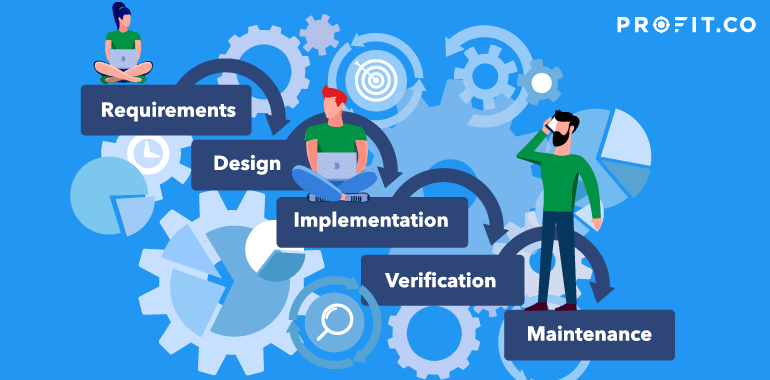
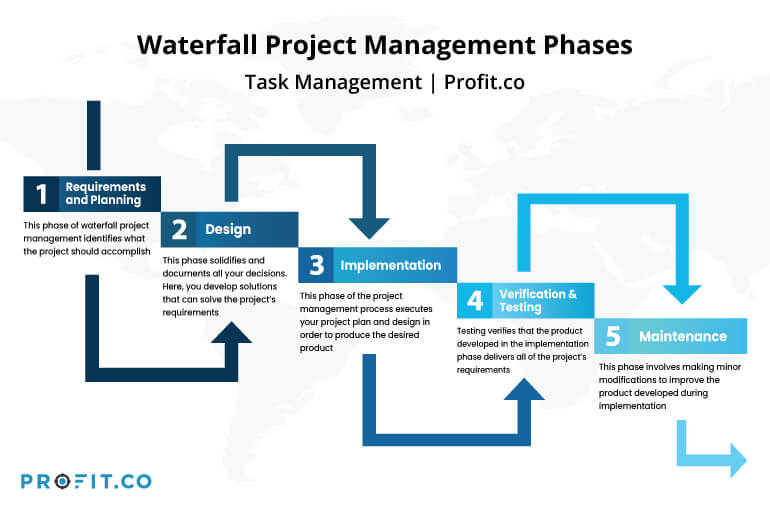
Phases of waterfall project management differ from one project to another. But generally, you can group the activities of the waterfall approach into five stages: planning, design, implementation, verification, and maintenance.
1. Requirements and Planning
The requirements and planning phase of waterfall project management identifies what the project should do. The project manager tries to understand the project’s requirements based on what the project sponsors need. This phase involves identifying and describing the project’s risks, assumptions, dependencies, quality metrics, costs, and timeline.
2. Design
The design phase solidifies and documents all your decisions. In this case, you develop solutions that can solve the project’s requirements. The best way to do so is to note all the actions you’ll take to deliver the project scope to execute them.
Design covers the project’s schedule, budget, and objectives, and you can think of design as a blueprint or road map to the complete project.
3. Implementation
The implementation phase executes your project plan and design to produce the desired product. If your company develops software, you will spend this phase coding the software functionalities. Or, if you’re managing a project at a construction company, you will construct a house in this phase.
Implementation takes up a significant portion of waterfall project management. Everything that happens during this phase should be carefully documented.
4. Verification/Testing
Testing verifies that the product developed in the implementation phase fulfills the entire project’s requirements. If this is not the case, the project team must review the project from phase one to identify what went wrong. The testing phase uses various quality metrics and customer satisfaction to measure the project’s success.
5. Maintenance
The maintenance phase extends beyond the five stages of project management into the project’s lifetime. This phase involves making minor modifications to improve the product developed during implementation and performing other routine maintenance tasks. It’s also a phase to identify any errors you might have missed during the testing phase.
The Waterfall Life Cycle: Phase Deliverables, Gate Criteria, and Planning Guide
The waterfall life cycle consists of five sequential phases: Requirements and Planning, Design, Implementation, Verification and Testing, and Maintenance. Each phase has defined deliverables and a formal gate. Work on the next phase cannot begin until the current phase’s outputs have been reviewed and approved by the relevant stakeholders.
The waterfall lifecycle is planned end-to-end before work begins. Unlike Agile, which plans in short sprints, waterfall requires a complete project schedule, typically a Gantt chart, that maps every phase to a timeline, allocates resources per phase, and defines milestone gates where progress is formally reviewed.
Waterfall Life Cycle: Phase-by-Phase Summary
| Phase | Key Activities | Primary Deliverables | Gate Before Next Phase | Typical % of Timeline |
|---|---|---|---|---|
| 1. Requirements & Planning | Stakeholder workshops, scope definition, risk assessment, budget and timeline planning | Requirements spec, project charter, risk register, resource plan | Signed-off requirements doc; all stakeholders approved | 10-15% |
| 2. Design | Architecture design, technical specs, UI/UX wireframes, infrastructure planning | Design specification, system diagrams, wireframes, test strategy | Design review approval; technical lead sign-off | 15-20% |
| 3. Implementation | Development, coding, building, procurement, construction | Working product or component, build documentation, code repository | Component completion; build review passed | 40-60% |
| 4. Verification / Testing | Functional testing, UAT, performance testing, bug fixes, compliance checking | Test plans, test cases, bug reports, test completion report | All critical defects resolved; QA sign-off | 15-20% |
| 5. Maintenance | Deployment, live monitoring, bug fixing, iterative improvements, user support | Deployment docs, maintenance logs, change request records | Ongoing, managed via formal change requests | Ongoing |
Waterfall Planning Phase: What a Complete Requirements Phase Looks Like
The planning phase is where the waterfall methodology’s outcome is determined, before a single line of design or code is produced. A project that enters the Design phase with incomplete or ambiguous requirements will carry that ambiguity through every subsequent phase. Ambiguity discovered during Testing is between 10 and 100 times more expensive to resolve than ambiguity discovered during Planning.
A complete waterfall requirements and planning phase includes:
- Functional requirements: what the system, product, or output must do, described precisely enough that the design team can act on them without asking clarifying questions
- Non-functional requirements: how the product must perform, including speed, security, availability, scalability, and compliance standards
- A requirements traceability matrix (RTM): linking every requirement to at least one test case so nothing is delivered untested
- Risk identification with probability and impact scoring for each identified risk
- A detailed project schedule, typically a Gantt chart, with phase gates as milestones
- Budget allocation per phase with contingency reserves built in
- Resource assignment: who owns each phase and who holds sign-off authority
Waterfall Project Schedule: How Timelines Are Structured
A waterfall project schedule covers the entire project duration from the first day of Planning to the last day of Maintenance planning. It is typically structured as a Gantt chart with:
- Milestones at each phase gate, marked as fixed dates that trigger formal reviews and sign-offs
- The largest time block allocated to Implementation, typically 40-60% of the total project duration
- A Testing block that represents 15-20% of the total timeline, often the most common point of schedule slippage
- Maintenance planned as an ongoing phase after project closure, with its own resource allocation separate from the project team
A common waterfall scheduling mistake is allocating insufficient time to the Requirements phase on the assumption that stakeholders know what they want. In practice, requirements elicitation is a facilitated process that takes time, and the more stakeholders involved, the longer it takes to reach agreement.
Waterfall Phase Deliverables: What Each Stage Produces and How to Manage It
Each waterfall phase produces a specific set of deliverables that serve as the input for the next phase. The Requirements phase produces the requirements specification. Design produces the technical design document. Implementation produces the working product. Verification produces the test completion report. Maintenance produces ongoing change records and maintenance logs.
Waterfall Requirements Phase: What a Complete Specification Includes
The requirements phase is the waterfall methodology’s critical success factor. Every defect found during Testing, every scope dispute during Maintenance, and every overrun during Implementation can typically be traced to an incomplete or ambiguous requirements specification.
A complete waterfall requirements specification includes:
- Functional requirements: every action the product or system must perform, described precisely enough that the design team can build it without further clarification
- Non-functional requirements: performance benchmarks (response time under load), security standards, accessibility compliance, availability targets (e.g. 99.9% uptime)
- Constraints: budget ceiling, regulatory requirements, technology stack restrictions, third-party dependencies
- Assumptions and dependencies: what the project is assuming to be true, and what external factors it depends on
- A requirements traceability matrix (RTM): every requirement mapped to at least one test case, ensuring nothing is delivered without being tested
Common failure in the requirements phase: requirements that sound complete but contain ambiguity. “The system should be fast” versus “The system must return search results in under 200 milliseconds for queries returning up to 1,000 records.” Ambiguous requirements produce defects that are expensive to fix in testing and impossible to fix in maintenance without raising a change request.
Waterfall Design Phase: High-Level vs. Low-Level Design
The design phase translates requirements into a technical blueprint that the implementation team can execute without making their own requirements decisions. In most waterfall projects, design is structured in two layers:
- High-Level Design (HLD): system architecture, component relationships, data flows, technology stack decisions, third-party integrations, and the overall structure of the solution
- Low-Level Design (LLD): module-level specifications, database schemas, API contracts, interface designs, algorithm choices, and the detailed specification that developers or engineers work from directly
The design phase is complete when every requirement in the specification has a corresponding design decision. If a requirement has no design decision, it will either be missed during implementation or implemented inconsistently by different team members.
Waterfall Implementation Phase: Tracking and Documentation
Implementation is the execution phase, the longest phase by timeline in most waterfall projects, representing 40-60% of total project duration. In software, this is coding. In construction, this is building. In manufacturing, this is production.
The most important management discipline during the implementation phase is deviation control. When the team encounters a situation where the design specification is ambiguous or conflicts with a technical constraint, they face a decision: interpret and proceed, or raise a formal change request. In waterfall projects, ad-hoc interpretation during implementation is one of the most common causes of testing failures, because the design specification is the standard against which the product is tested.
Best practices for the waterfall implementation phase:
- Track every build decision against the design specification; deviations should trigger a formal change request, not ad-hoc adjustment
- Maintain build documentation that records every significant implementation decision, particularly when design ambiguity required interpretation
- Hold brief implementation reviews at agreed intervals (weekly or milestone-based) to identify emerging deviations early
Waterfall Verification Phase: The Single Quality Gate
Unlike Agile, where testing is continuous throughout development, the waterfall verification phase is a single, comprehensive quality gate. The entire product is tested against the entire requirements specification at the end of implementation. This makes the testing phase the highest-risk milestone in a waterfall project.
A complete waterfall verification phase includes:
- Functional testing: does the product do what the requirements specification says it should?
- Performance testing: does it perform within the specified non-functional parameters?
- User Acceptance Testing (UAT): do the end users confirm the product meets their needs as they understand them?
- Regression testing: have any bug fixes introduced new defects?
- Defect-to-requirements tracing: every defect logged against the requirement it violates, producing a clear audit trail for sign-off
Critical rule of the waterfall verification phase: if a defect traces back to a requirements error, meaning the requirement itself was wrong, not the implementation, the project team must decide whether to resolve it within the testing phase or raise a formal change request. The latter typically restarts the waterfall lifecycle for the affected components.
Waterfall Maintenance Phase: Post-Delivery Management
The maintenance phase begins at delivery and extends throughout the product’s operational life. It is the phase most frequently under-resourced in waterfall projects, as teams assume that once the product is delivered and signed off, the heavy lifting is done. In practice, the maintenance phase often reveals the defects and requirement gaps that testing missed under controlled conditions.
The waterfall maintenance phase typically includes:
- Bug fixes and patches for defects discovered in live use, prioritised by severity and business impact
- Performance optimisation as real-world usage patterns reveal bottlenecks not anticipated during testing
- Enhancement requests, meaning new requirements raised after delivery, which go through a formal change control process and may trigger a new waterfall cycle
- Compliance updates as regulations, standards, or legal requirements change post-delivery
- Version upgrades and dependency management, particularly for software products
The most common maintenance phase mistake in waterfall projects: treating maintenance as a single generalised resource when it requires access to the same specialist skills as the implementation and testing phases, particularly for complex bug fixes that require design-level investigation.
Waterfall Project Management Tools
Waterfall project management tools contribute to the successful implementation of the project. They include:
- Communication tools like Slack
- Collaboration tools like Microsoft Teams
- Note-taking tools like whiteboards
- Work-specific tools
- Testing tools
- Planning tools like MS Project
If you would like a software that helps you transparently track company-wide goals and relate them directly to your team’s daily tasks, then you need Profit.co’s OKR Management software. You can get started on Profit.co free today!
Advantages and Disadvantages of Waterfall Project Management
Benefits and advantages of waterfall project management:
Simplicity in training
The waterfall approach focuses on thorough documentation, making it easier for new team members to follow the project’s progress. The new members can refer to the documentation to catch up on the project.
Proof of progress
Waterfall project management clearly defines the project’s milestones in the requirements and planning phase. It is easier to identify the project’s progress by reviewing these milestones. The distinct steps of the technique also clearly indicate how close the project is to completion.
Easy management
Waterfall-based projects are easy to manage because of their linear nature, and it is easier to identify the project’s progress at any given time. If changes occur, you can easily refer to the waterfall documentation to see how you can address them.
It saves money and time
The waterfall approach emphasizes conceptualization and detailed documentation. The two activities better prepare for executing a project correctly in its first trial. Understanding the project’s needs and implementation plan from early on can save you the time, money, and effort that would arise from revisions.
Disadvantages of the waterfall project management approach:
Inflexible and resistant to change
The waterfall approach consists of sequential steps that pour into each other. So, the outcomes of one phase of the project are absolutely necessary in order to move onto the next phase. Changes in one phase imply that the whole waterfall process needs a review. This makes the management style difficult to change.
Focuses on one phase at a time
Phases of the waterfall approach are linear and sequential. No two processes can run simultaneously. This can be disadvantageous if personnel required for an early phase is backlogged, and the project grinds to a halt because of it.
Waterfall vs. Rapid Development
The waterfall project remains relevant despite new rapid management techniques like agile development. The waterfall approach focuses on the step-by-step implementation of a project. In contrast, agile project management focuses on iterative, shorter project cycles that deliver a working prototype to the client.
The project team continuously improves this prototype until the project is complete. Both techniques have benefits when utilized correctly. The waterfall approach will serve you well if you stick to traditional project management. But if you’re going to combine the old and the new, a hybrid waterfall methodology would be an excellent place to start your implementation.
In order to properly manage your projects and your company as a whole, you need to pair your chosen project management methodology with an agile OKR software. Profit.co’s OKR management tool combines OKRs, strategy, tasks, performance, and employee engagement on one central platform. To learn more about how Profit.co can help you better manage your team’s tasks, projects, and goals, book a free demo with our experts today!
| Criteria | Waterfall | Agile |
|---|---|---|
| Structure | Linear and sequential: one phase at a time | Iterative: work is delivered in short cycles (sprints) |
| Planning | Full plan defined upfront before work begins | Planning is ongoing; each sprint is planned individually |
| Flexibility | Low: changes require formal change requests and often restart phases | High: changes can be incorporated between sprints |
| Documentation | Heavy: every phase produces formal documentation | Lighter: documentation is created as needed, prioritising working outputs |
| Best for | Fixed-scope projects with stable requirements (construction, regulated industries, ERP) | Projects where requirements evolve or user feedback shapes the product (software products, startups) |
| Worst for | Projects where requirements change frequently or where speed-to-market is critical | Projects with regulatory requirements that mandate sequential documentation |
| Testing approach | Single comprehensive test phase after full implementation | Continuous: testing happens within every sprint |
Waterfall Methodology Examples: 3 Real-World Use Cases
Waterfall methodology is used in construction, enterprise software implementation, and regulated product development: industries where requirements must be fixed before work begins, physical or regulatory constraints make iteration impossible, and documentation is legally or contractually required at every stage of the project.
The waterfall methodology’s suitability depends on whether the project’s deliverables can be iterated and whether requirements are genuinely knowable upfront. The three examples below show industries where waterfall is not just preferred; it is the natural structure of the work.
Waterfall Methodology Example 1: Office Building Construction
Construction is the environment in which waterfall methodology was born. Physical deliverables cannot be iterated: you cannot test the roof before building the walls, and you cannot occupy the building before the safety inspection clears it. Every phase depends completely on the previous one.
| Waterfall Phase | Construction Activity | Deliverable |
|---|---|---|
| Requirements & Planning | Architect briefs, site surveys, planning permission, budget approval, structural assessments | Approved building plans, planning consent, project charter, risk register |
| Design | Structural engineering, MEP (mechanical, electrical, plumbing) design, material specification | Engineering drawings, technical specifications, supplier contracts, cost schedule |
| Implementation | Foundation work, structural build, fit-out, services installation, landscaping | Completed building structure, all installations, as-built drawings |
| Verification / Testing | Building inspection, safety certification, systems testing, defect snagging, client walkthrough | Inspection certificates, snagging list resolution, client sign-off |
| Maintenance | Facilities management, warranty repair, regulatory compliance updates, planned maintenance | Maintenance schedules, work orders, warranty records, compliance certificates |
Why waterfall works here
Building requirements are fixed by planning permission. The physical construction sequence is non-negotiable. Documentation, including drawings, inspection certificates, and as-built records, is legally required at every stage.
Waterfall Methodology Example 2: Enterprise ERP Implementation
Large-scale enterprise software deployments, particularly ERP (Enterprise Resource Planning) implementations, are one of the most common software environments for waterfall methodology. ERP systems touch every department in an organisation; all departmental requirements must be captured and agreed before configuration begins.
| Waterfall Phase | ERP Project Activity | Deliverable |
|---|---|---|
| Requirements & Planning | Business process mapping, requirements workshops with all departments, vendor selection and contract | Requirements specification, vendor contract, implementation roadmap, data migration plan |
| Design | System architecture, module configuration design, integration mapping, data migration strategy | Technical design document, integration specifications, configuration blueprint |
| Implementation | System configuration, customisation development, data migration, user training material creation | Configured ERP system, migrated and validated data, training documentation |
| Verification / Testing | User Acceptance Testing (UAT), parallel running with legacy system, performance and load testing | UAT sign-off reports, defect resolution log, performance benchmarks, go/no-go decision |
| Maintenance | Go-live hypercare support, issue resolution, ongoing configuration updates, version upgrade planning | Support ticket log, change requests, upgrade roadmap, post-go-live review |
Why waterfall works here
ERP requirements span every business function: finance, HR, supply chain, and sales. All requirements must be defined and agreed before configuration starts, because the system is built as a single integrated platform. Adding a new requirement mid-configuration forces rework across interconnected modules.
Waterfall Methodology Example 3: Regulated Medical Device Development
Regulated industries, including medical devices, pharmaceuticals, and aerospace, are among the most consistent users of waterfall methodology. Regulatory frameworks including FDA 21 CFR Part 820 (US) and ISO 13485 (international) require a complete Design History File (DHF) that documents every decision made during product development. This regulatory requirement is essentially a mandated waterfall process.
| Waterfall Phase | Medical Device Activity | Deliverable |
|---|---|---|
| Requirements & Planning | Clinical needs assessment, regulatory pathway identification (510k, PMA, CE), risk management plan | Design inputs document, risk management file, regulatory strategy, project plan |
| Design | Device design, material specification, manufacturing process design, design FMEA, design review | Design specification, FMEA, design freeze documentation, design history file initiation |
| Implementation | Prototype manufacturing, tooling development, supplier qualification, process validation | Working prototypes, manufacturing records, supplier qualification reports, process validation protocols |
| Verification / Testing | Verification testing (design outputs meet design inputs), validation studies, regulatory submission | Test protocols, test reports, clinical data package, regulatory submission dossier |
| Maintenance | Post-market surveillance, complaint handling, design changes via Engineering Change Orders (ECOs) | Post-market surveillance reports, complaint files, ECO records, updated DHF |
Why waterfall works here
FDA clearance requires documented evidence that every design output was verified against a design input. This traceability requirement forces sequential documentation: you cannot submit for regulatory approval without a complete, phase-by-phase design history. Waterfall is not just a methodology choice in this context; it is a regulatory obligation.
Waterfall gives you the structure. Profit.co ensures every phase delivers.
Frequently Asked Questions
The five phases are Requirements & Planning, Design, Implementation, Verification/Testing, and Maintenance. The project moves sequentially through these stages, with each phase depending on the completion of the previous one.
Waterfall is ideal when project requirements are clearly defined from the beginning and are unlikely to change. It works well for construction, manufacturing, infrastructure, and certain software projects where scope stability is critical.
The main advantages include clear structure, strong documentation, defined milestones, ease of training new team members, and straightforward progress tracking. It is simple to manage due to its linear nature.
Waterfall is rigid and resistant to change. If requirements shift mid-project, it often requires revisiting earlier phases, which can increase costs and delays. It also does not support parallel workstreams easily.
Waterfall follows a sequential, phase-by-phase process, while Agile uses iterative cycles that continuously deliver and improve working outputs. Waterfall emphasizes upfront planning, whereas Agile focuses on adaptability and continuous feedback.
Yes. Many organizations adopt a hybrid approach that blends waterfall’s structured planning with Agile’s flexibility. This allows teams to maintain documentation discipline while adapting to changes when necessary.
Yes. Despite the rise of Agile, Waterfall remains relevant for industries where compliance, documentation, and clearly defined processes are essential. It is particularly effective when change is minimal and predictability is important.
The waterfall methodology in project management is a sequential approach where a project moves through five defined phases: Requirements and Planning, Design, Implementation, Verification and Testing, and Maintenance, in order, with each phase fully completed before the next begins. It is characterised by upfront requirements definition, strong documentation at every stage, and phase-gate sign-offs between each phase. Waterfall is best suited to projects with fixed scope and stable requirements.
Each waterfall phase produces specific deliverables: Requirements and Planning produces the requirements specification and project charter. Design produces the technical design document and architecture diagrams. Implementation produces the working product or system and build documentation. Verification and Testing produces test plans, test results, and a defect resolution log. Maintenance produces change request records, maintenance logs, and updated documentation.