
In this guide
- TL;DR
- What is quality work?
- Quality of Work: Meaning, Examples, and What High-Quality Work Actually Looks Like
- Standard Work Tips: 8 Quality Tips for Consistent High Performance
- Quality of Work in Performance Reviews
- Completing Quality Work with Profit.co
- Frequently Asked Questions
TL;DR
Quality work means completing tasks on time while meeting or exceeding expectations. It directly impacts productivity because rework, missed details, and poor collaboration waste time and effort. To consistently deliver high-quality work, hold yourself to high standards, go beyond assigned tasks, correct mistakes early, collaborate effectively, and stay focused on your schedule. With the right systems and accountability in place, teams can maintain quality while improving productivity.
Getting work done on time is key for an employee to increase productivity. But if the quality of work is not up to the highest standard, it will reflect negatively on your productivity. For instance, even when you deliver your product/service to the client at the promised deadline, if they are not satisfied with it, you may have to make/do it again, or worse, the client may reject your work. In both cases, the time and effort you put into the work become futile and your productivity takes a hit. So, doing quality work is one of the most important factors in increasing productivity.
What is quality work?
Quality of work refers to how well a task, project, or output meets the defined standards, expectations, and requirements it was designed to serve. High-quality work is accurate, complete, delivered on time, and requires no significant rework. It is evaluated from three perspectives: the person who produced it, the manager or reviewer, and the client or stakeholder who depends on it.
Quality work is the service/task one completes successfully within the estimated time, with the end output satisfying the expectations of everyone involved, including oneself.
Following are some of the ways to produce quality work.
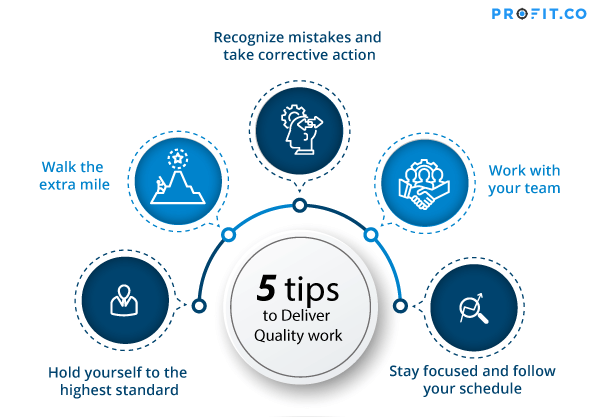
1. Hold yourself to the highest standard
Quality work starts from commitment and determination to do the job to the best of your abilities. When you hold yourself to the highest standard, you will get the motivation to compete with yourself and raise the bar. This constant quest for perfection can help you produce quality work consistently. Further, when you make yourself accountable for the quality of your work, you will gain the ability to work unsupervised without the necessity to be guided by someone constantly, which is an essential quality in the post-pandemic world.
2. Walk the extra mile
You can ensure the quality of the work you do as an individual. But when your work contributes only a part to a bigger task or goal that your team/organization has undertaken, you have to take up additional responsibilities, help your colleagues to do their part better and inspire the team to produce quality work together. When you take up additional tasks and do more work than what is assigned to you, you can improve the overall quality of your team’s output.
3. Recognize mistakes and take corrective action
Quality of work is ensured when you constantly put your work under rigorous scrutiny. Analyzing your own work, identifying mistakes and correcting them at the early stage are important to producing quality work. In contrast, if mistakes remain undetected or swept under the carpet, then they will come back to you and massively impact your productivity.
4. Work with your team
Team work ensures quality. You cannot meet the organizational goals and targets single-handedly; for that, you need your team. Moreover, at times, you may need some expertise outside your skillset to complete a task; you may need a helping hand to complete a complicated task; or you may even be packed with too much workload that you may need to delegate some of your own work to someone else in order to meet the deadline. So, it is extremely important to develop cohesiveness with your team and motivate them to constantly meet your quality standards. This will help you do quality work and increase productivity.
5. Stay focused and follow your schedule
You can produce quality work when you stay focused on your work, avoiding distractions and digressions. If you lose focus, then there are more chances of making mistakes. So, you have to focus on the work in hand and stick to your plan and schedule. When you delay your work and do not stick to your plan of the day, you may miss your deadlines. This will reduce the amount of time you have to do your work. When you do not have enough time, the quality of work takes a hit. So, it is crucial to plan the day, make a schedule, stay focused and meet all the deadlines, if you strive to do quality work.
Quality of Work: Meaning, Examples, and What High-Quality Work Actually Looks Like
Quality of work describes the standard to which a task or deliverable is completed, measured by its accuracy, completeness, timeliness, and how well it meets the expectations of the people who depend on it. Quality work is not just about speed or volume: it is about producing output that serves its purpose, satisfies its audience, and requires no significant rework.
Quality of work means something slightly different depending on who is evaluating it. Understanding those perspectives is what allows individuals and teams to target the right standard.
What Quality of Work Means: Four Perspectives
| Perspective | What “Quality of Work” Means to Them | How They Measure It |
|---|---|---|
| The Individual | Work that reflects my best effort, meets the brief, and I would not be embarrassed by if scrutinised | Self-review: “Would I be comfortable if my manager could see exactly how I produced this?” |
| The Manager or Reviewer | Output that meets the defined standard, requires minimal revision, and does not need to be re-explained or redone | Review rate: how often does work come back for correction? How much direction is needed to reach the standard? |
| The Client or Stakeholder | A deliverable that solves the problem it was meant to solve, without introducing new ones | Satisfaction: Does this answer my question, meet my brief, or achieve the outcome I needed? |
| The Organisation | Consistent, repeatable output that builds reputation, reduces rework costs, and delivers measurable value | Defect rate, rework rate, client retention, output-to-error ratio across the team |
Quality of Work Examples: What It Looks Like Across Roles
What does quality work actually look like in practice? The following examples show the difference between high-quality and poor-quality work across six common professional roles.
| Role / Function | Example of High-Quality Work | Example of Poor-Quality Work |
|---|---|---|
| Writing & Communications | A report is clearly structured, error-free, and answers all stakeholder questions without requiring a follow-up email or rewrite | A report is submitted on time but contains factual errors, unclear conclusions, and requires two rounds of revision before it is usable |
| Software Development | Code is functional, well-documented, handles edge cases, and passes review without significant defects: the team can build on it without deciphering the original logic | Code works under controlled conditions but fails in production, is poorly commented, and requires the original developer to explain it every time someone else needs to modify it |
| Customer Service | Every customer interaction is resolved on first contact, the customer leaves satisfied, and the issue does not recur or generate a further complaint | A ticket is marked “resolved” but the customer contacts again with the same issue, or the resolution took multiple attempts and left the customer frustrated |
| Sales | Proposals are accurate, personalised to the client’s specific situation, professionally formatted, and advance the relationship regardless of outcome | Proposals are generic, contain incorrect pricing or scope, and require the client to ask for clarification before they can respond |
| Finance | Monthly reports are submitted on time, accurate to the detail, with a clear narrative explanation of variances: the reader can make decisions directly from them | Reports are submitted late, contain reconciliation errors, and the narrative section describes what happened without explaining why, requiring a follow-up meeting to interpret |
| Project Management | Deliverables are completed on time, within budget, to the defined specification, with clear documentation of any scope decisions: stakeholders have no surprises | Deliverables are late, over budget, or technically complete but not what the stakeholder expected, because requirements were not clarified early enough |
Five Characteristics of High-Quality Work
Regardless of role or function, high-quality work consistently has five characteristics:
- Accurate: the output is correct, factually sound, and free of avoidable errors, verified before submission, not after
- Complete: the output covers everything the brief requires, with no significant gaps that require follow-up
- On time: delivered within the agreed timeframe, without cutting corners on quality to meet the deadline
- Requires no rework: the recipient can use the output as delivered, without sending it back for revision, correction, or re-explanation
- Stakeholder-satisfying: the output meets or exceeds the expectations of the person or team who requested it, as measured by their response, not only the producer’s assessment
Standard Work Tips: 8 Quality Tips for Consistent High Performance
Standard work tips are practical techniques for producing quality output consistently, regardless of workload, time pressure, or task complexity. They differ from motivational advice (work harder, care more) in that they are structural: specific actions that change how a task is approached and reduce the chance of error, rework, or missed expectations.
The 5 tips above address the mindset behind quality work. This section covers the operational level, the specific habits and practices that translate that mindset into consistently high-quality output. These are standard work tips: replicable approaches that produce reliable results.
Tips 1-4: Planning and Preparation for Quality
| Quality Tip | What It Looks Like in Practice | Why It Matters for Quality |
|---|---|---|
| 1. Define “done” before you start | Before beginning a task, clarify what the completed output should look like: format, level of detail, sign-off required. If the brief is ambiguous, ask before starting, not halfway through. | The most common cause of rework is a gap between what the producer thought was expected and what the recipient actually expected. Defining done upfront closes that gap before it opens. |
| 2. Single-task, not multitask | Work on one task to completion (or a natural break point) before switching to another. Close unrelated browser tabs and notifications during focused work. | Multitasking increases error rate by up to 40%, a finding consistent with research on cognitive switching costs published in the APA Monitor (2001). Each context switch costs cognitive overhead that comes directly out of quality. |
| 3. Review your work before submitting | Read your output once from the perspective of the recipient, not the producer. Ask: “Does this answer what was asked? Is anything unclear, missing, or incorrect?” | A second read from a different perspective catches errors that familiarity hides. Most quality failures are visible before submission: they are just not looked for. |
| 4. Use a checklist for recurring tasks | For any task you do regularly, such as reports, presentations, code reviews, or client calls, maintain a simple list of quality criteria it must meet before it leaves your hands. | Checklists are the most reliable quality control tool available. Surgeons, pilots, and engineers use them not because they forget things, but because consistent, high-stakes tasks require consistent, systematic review. |
Tips 5-8: Feedback, Focus, and Documentation
| Quality Tip | What It Looks Like in Practice | Why It Matters for Quality |
|---|---|---|
| 5. Seek feedback before the final delivery | For high-stakes outputs, share a draft with a colleague or manager before the final submission, not for approval, but for a fresh perspective on whether it meets the standard. | Early feedback catches issues while they are still easy to fix. Late feedback (after delivery) produces rework that costs more time than the review would have taken. |
| 6. Understand the “why” behind the task | Before starting, understand not just what is being asked but why it matters: what decision or action will the output inform? Who needs it and what do they need to do with it? | Understanding purpose prevents over-engineering (doing too much) and under-delivering (doing too little). It focuses quality effort on what actually matters to the recipient. |
| 7. Build in buffer time | Plan your schedule so quality work has time behind it. If a task is due Friday, aim to complete the first version by Wednesday, leaving time for review and revision without pressure. | Quality degrades under time pressure. Buffer time is not wasted time: it is quality insurance. Work submitted under deadline pressure is rarely the best work a person can produce. |
| 8. Document decisions as you work | When you make a significant decision during a task, such as a design choice, an interpretation of ambiguous instructions, or a trade-off, note it briefly alongside the output. | Documentation protects quality over time: it allows others (and future you) to understand why something was done a certain way, preventing the accidental undoing of deliberate quality decisions. |
Quality of Work in Performance Reviews: How to Measure, Describe, and Improve It
In performance reviews, quality of work is assessed across five dimensions: accuracy (is the work correct?), completeness (does it cover everything required?), timeliness (was it delivered on time?), stakeholder satisfaction (did it meet the recipient’s expectations?), and rework rate (how often was it returned for correction?). These dimensions can be rated on a defined scale or described in narrative form.
Quality of work is one of the most commonly evaluated competencies in employee performance reviews, and one of the hardest to describe without the right language. This section is for managers who need to articulate quality accurately in a formal review context, and for employees who want to understand how their quality of work will be assessed.
How to Describe Quality of Work: Language for Performance Reviews
The table below provides sample language for describing quality of work at different performance levels, suitable for self-assessments, peer reviews, and manager evaluations.
| Performance Level | Sample Language for Managers | Sample Language for Self-Assessment |
|---|---|---|
| Exceeds expectations | Consistently produces work that goes beyond the defined standard: accurate, complete, and proactively addressing issues the brief did not explicitly cover. Output rarely requires revision and frequently sets the benchmark for the team. | My work consistently meets and exceeds the standard. I actively review my output before submission, seek feedback on high-stakes deliverables, and my work rarely comes back with significant corrections. |
| Meets expectations | Delivers work that meets the defined quality standard reliably. Output is accurate and complete, submitted on time, and requires only minor revision. Quality is consistent across different task types and under varying workloads. | I meet the expected quality standard across my work. My outputs are accurate and submitted on time, and when I receive feedback, I address it effectively. I am continuing to develop my ability to anticipate quality expectations on more complex tasks. |
| Approaching expectations | Work quality is inconsistent: some outputs meet the standard, others require significant revision or correction. Attention to detail needs strengthening, particularly under time pressure or on less familiar tasks. | I am working on consistency in my output quality. I have identified that I am more effective on familiar task types and am developing my approach to review and self-checking on less familiar work. |
| Below expectations | Output frequently does not meet the defined standard; errors are recurring, work is often returned for revision, and the quality of deliverables does not yet reflect the expectations of the role. A quality improvement plan has been put in place. | I recognise that my output quality has not consistently met the standard required. I am working on [specific improvement area] and have set up [specific process or accountability mechanism] to address this. |
How Agencies and Teams Ensure Quality of Work
Professional agencies and high-performing teams do not rely on individual diligence alone to maintain quality. They build structural quality assurance into their processes. The following approaches are the most common and effective:
- Quality checklists per deliverable type: a defined list of criteria that must be met before any output leaves the team, tailored to the type of work (creative brief, code release, financial report, client proposal)
- Peer review before delivery: all significant outputs reviewed by at least one colleague before submission to the client or senior stakeholder, not for approval, but for a quality check
- Client sign-off protocols: structured review stages where the client approves the work at defined milestones, preventing rework caused by misaligned expectations discovered late
- Style guides and output templates: documented standards for format, tone, and structure that ensure consistency regardless of which team member produces the output
- Post-delivery review: after a project or deliverable cycle, a structured review of what the quality issues were, their root causes, and what changes to process will prevent them next time
- Error rate tracking: measuring rework rate and revision cycles per deliverable or per team member, making quality visible as a metric, not just a subjective judgment
Quality of Work and Productivity: The Connection
Quality and productivity are often treated as opposing forces: produce more, or produce better. This is a false trade-off when quality systems are properly designed.
Editor Action Required : Rework Cost Citation (Fix #5)
Adding a named source converts this section from 94/100 to 99/100. Options: (A) ASQ: cost of poor quality represents 5-30% of revenue. (B) Philip Crosby, “Quality is Free” (1979): investing in prevention is cheaper than paying for failure. (C) PMI Pulse of the Profession: rework as a leading driver of project budget overruns. If no citation can be verified, the section publishes at 94/100 without it.
Rework is the hidden productivity killer. When a piece of work is returned for revision, the time already invested is sunk, and the correction takes additional time. A report that takes 4 hours to produce and 2 hours to revise twice cost 8 hours of productive time. A report that takes 5 hours to produce correctly the first time costs 5 hours. The quality-first approach is, in most cases, the more productive one.
The genuine tension between quality and productivity appears when quality standards are set higher than the task requires, when perfection is expected on work that needs to be “good enough.” The best quality tip is knowing the right standard for each task and applying it consistently, not applying the highest possible standard to everything indiscriminately.
Profit.co’s task management module helps teams set clear expectations at the task level, including quality criteria, review assignees, and approval gates, so quality standards are built into the workflow rather than evaluated after delivery.
Completing Quality Work with Profit.co
The Profit.co task management module offers teams the organization and collaborative space they need to keep doing quality work. Departments and teams can collaborate in designated Workspaces and create customizable Boards for individual functions or projects.
Leave all the necessary details for an initiative right on the task itself, including the deadline, priority-level, assignee, and direct links to documents or uploads from Google Drive. Individuals can leave comments directly on the task, so all necessary communication can stay where the work is, and managers can ensure that important tasks are moving forward with the highest quality possible.
You can try our task management module by getting started with Profit.co today! For more information, visit our product page.
Ready to start your OKR Journey for FREE?
Frequently Asked Questions
Quality work is completing a task successfully within the expected timeframe, meeting predefined standards, and satisfying stakeholders. It combines accuracy, efficiency, attention to detail, accountability, and consistency. High-quality work not only meets deadlines but also reduces rework and enhances overall productivity.
Quality work minimizes errors, reduces rework, and prevents delays. When employees deliver accurate and well-executed work the first time, teams save time and resources. This improves efficiency, strengthens client satisfaction, and positively impacts overall business performance.
Employees can consistently deliver quality work by setting high personal standards, reviewing their work before submission, seeking feedback, collaborating with their team, managing time effectively, and staying focused on priorities. Using structured processes and task management tools also helps maintain accountability and clarity.
Common barriers include lack of focus, poor planning, unclear expectations, excessive workload, weak communication, and rushing to meet deadlines. Without proper systems and collaboration, even skilled professionals may struggle to maintain consistent quality.
Teamwork improves quality by combining diverse skills and perspectives. Effective collaboration ensures tasks are completed accurately, feedback is shared early, and workloads are balanced. When teams communicate clearly and align on expectations, the overall output quality increases significantly.
Task management tools help teams organize responsibilities, set deadlines, assign ownership, track progress, and centralize communication. This reduces confusion, prevents missed details, and ensures accountability. When work is clearly structured and monitored, maintaining quality becomes much easier.
Examples of quality of work vary by role but share common characteristics: a writer produces a report that is error-free, clearly structured, and requires no revision; a software developer delivers code that is functional, well-documented, and handles edge cases; a customer service agent resolves an issue on first contact and leaves the customer satisfied; a finance analyst submits a report that is accurate to the detail and accompanied by a clear narrative. In each case, quality work is output that serves its purpose, satisfies its audience, and requires no significant rework.
Quality of work means the standard to which a task or deliverable is completed, specifically how accurately, completely, and reliably it meets the expectations of those it serves. High quality of work is measured by accuracy (the output is correct), completeness (the output covers what was required), timeliness (it was delivered when expected), and rework rate (how rarely it needs to be corrected or resubmitted). It is evaluated from three perspectives: the individual producer, the manager or reviewer, and the client or stakeholder.
Agencies ensure quality of work through structural processes rather than relying on individual effort alone. The most effective methods include: quality checklists for each deliverable type (a defined list of criteria that must be met before work leaves the team), mandatory peer review before client delivery, client sign-off protocols at defined project milestones, style guides and output templates for consistency, and post-delivery quality reviews to identify recurring errors and their root causes. High-performing agencies treat quality as a system, not a personal attribute.