2 min read ·

Key Result Weights

Bastin Gerald Bastin Gerald ·

Why weighted key results?

Typically, 3-5 key results are defined to measure the achievement of the objective. These key results’ progress influence objective attainment. However, in some cases all key results do not have an equal impact on the objective progress. It is a common practice to identify the impact and importance of key results on objectives by assigning them weights. Weights can be increased or decreased based on the importance of key results. Internally, weights may be decided and discussed with team members. Assigning weights to key results and discussing with employees
  • Helps them prioritize their activities and plan their efforts on a daily basis
  • Communicates key result’s relative significance to the goals of the department and organization.

How weighted key results work?

Weighted Key Results allows you to set weight and define importance for every key result. The sum of weights should be equal to 1. Each key result’s weighted average will be considered to calculate the objective overall progress. If no weights given, all key results will be treated equally. Weights can be assigned to key results using.
  • Per unit weighting ( Adding up to 1)
  • Percentage weighting ( Adding up to 100%)
  • Numeric weighting ( 5,4,3,2,1: where 5 is the highest weighting and 1, lowest)

Profit supports per unit weighting (0 to 1 scale) adding up to 1.

Let see, with an example, how weights can be practical in a situation. In an emerging startup, A HR manager creates an OKR for his team.

Objective: Improve Company Performance KR 1: Launch Talent Review Program KR 2: Launch Upward Feedback Program KR 3: Develop Framework for Succession Program
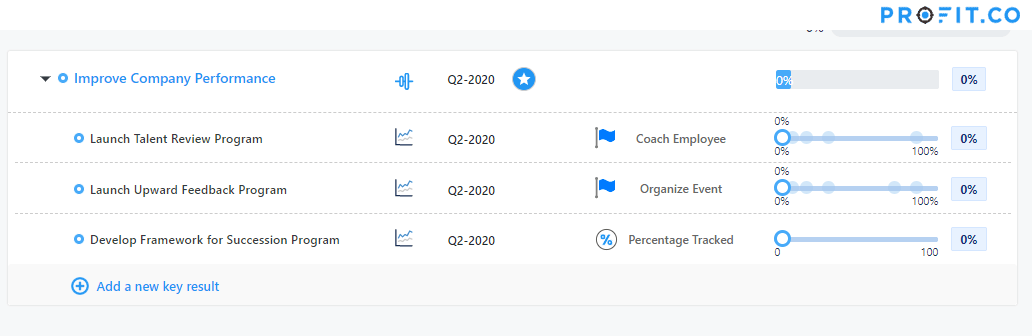
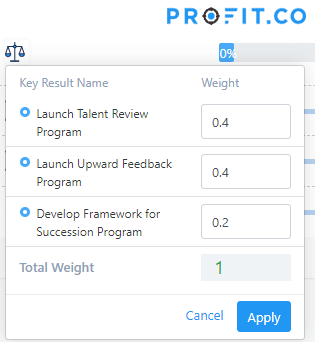
Key Result Weight
While all the key results share the common objective, he decides the 3rd key result should be given less weight as it is not that difficult to attain compared to the remaining key results. When he assigns these key results to his team members, he can choose a new employee who also needs to focus on developing job and domain knowledge for the third key result.
KR-wght

To define key results in Profit, please refer to the steps in here.

Related Articles

OKR Management
9 min read · August 12, 2026

OKR Dashboard for Enterprise Teams: What to Track and How to Structure It

An enterprise OKR dashboard is a live view of progress toward time-bound objectives and key results, structured to support check-ins,…

Bastin Gerald Bastin Gerald
OKR Management
10 min read · August 11, 2026

Affordable OKR Management Tools with Strong Reporting in 2026

What are the most affordable OKR management tools with strong reporting? The most affordable OKR management tools with strong reporting…

Bastin Gerald Bastin Gerald
OKR Management
13 min read · August 7, 2026

SMART Goal Examples: How to Write Them and What Good Ones Look Like

A SMART goal is a goal written to be Specific, Measurable, Achievable, Relevant, and Time-bound. Instead of “improve sales performance,”…

Bastin Gerald Bastin Gerald
OKR Management
9 min read · August 7, 2026

Core Components of an OKR Management System: What to Look For

What are the core components of an OKR management system? An OKR management system includes five core components: goal setting,…

Bastin Gerald Bastin Gerald
OKR Management
18 min read · August 7, 2026

MBO vs. OKR: Key Differences, Similarities, and When to Use Each

MBOs (Management by Objectives) are a performance management framework in which individual employees and managers jointly set specific, measurable objectives…

Bastin Gerald Bastin Gerald
OKR Management
13 min read · July 31, 2026

Best Free OKR Management Software in 2026

What is the best free OKR management software in 2026? The best free OKR management software in 2026 is Profit.co,…

Bastin Gerald Bastin Gerald
Athena

Welcome to Profit.co 👋

How can I help you today?