Employee performance review is key to the progress of the employees as well as the organization towards their respective goals. Companies spend a vast amount of time and resources to conduct reviews. But employees are anxious about performance appraisals, as the outcomes can impact on their motivation, performance and career. Depending on how you conduct the performance appraisal, it can either motivate the employees or make them feel disconnected from the organization.
A traditional performance appraisal that rates the employee’s performance is comparative by design. It ranks the employees amongst their peers. According to the study conducted by Willis Towers Watson, 45% of managers did not see value in the review systems they used. Reviews that compare employees negatively impact on the workforce and can become counter-productive for the organization in many ways.
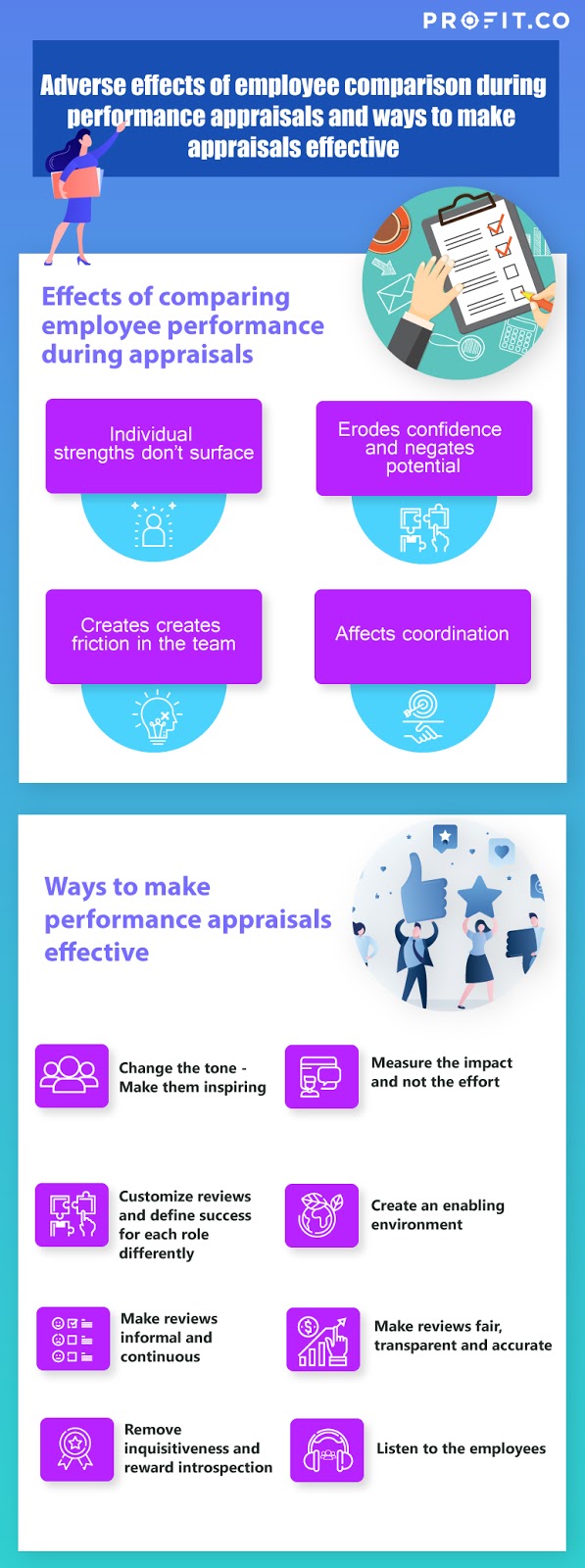
Comparison does not bring out an individuals’ strengths
Every employee is unique, and he/she has his/her own strengths and weaknesses. Naturally, when compared against peers, his/her differences and deficiencies in performance get highlighted. This makes employees constantly look at their more successful peers as a reference point of performance. However, one employee cannot replicate the success of another using the same methods. An employee can achieve the best possible performance only if he/she plays to his/her strengths. Comparative appraisals and ranking do not acknowledge the strengths and uniqueness of every employee. As a result, employees lose motivation.
Comparison erodes confidence and negates potential
When individuals are compared, everything about the performance of an individual becomes relative to others’ performance. It erodes the confidence of the employees in their own abilities. As a result, the morale of the workforce plummets and productivity goes down. Employees struggle to realize their potential.
Comparison creates friction in the team
When employees are compared against each other and ranked, it breeds an unhealthy competition amongst the team members, which leads to distrust and conflicts. Instead of working towards a common goal, they work against each other and compete for the top spot by hindering others. This creates a negative work environment and affects productivity.
Comparison affects coordination
When individuals in a team work in different directions towards their own self-interests, they lose their ability to work together towards the organization’s goals. Efficiency of the team decreases due to the lack of cooperation.
Making appraisals effective
So, it is extremely important to ensure that the employee performance review does not promote negativity and impact the dynamics of the organization and the attitude of the employees. In order to maintain review as an effective tool for improving the overall performance of the organization, they need to be designed carefully. Following are some of the ways in which you can remove the element of comparison and keep reviews engaging and effective:
Change the tone – Make them inspiring
Instead of comparing an employee with others, you can focus on the individual and provide positive feedback about the things that he/she had done well in the review period. According to a study conducted by Gallup, those who received feedback on their strengths had 14.9% lower turnover rates than for employees who received no feedback. Recognize the strengths of each employee and celebrate their achievements. This makes them feel that they are valued by the organization and inspires them to do better.
Measure the impact and not the effort
You can make a significant difference with your review by choosing what you measure. Conventional performance reviews measure the performance of an individual. In this process, the parameters used to measure all focus on how well the employee does his/her work. Instead of measuring performance, you can design the review to measure progress against his/her goals. This removes the element of comparison, as each individual’s goals are different.
Customize reviews and define success for each role differently
Every job is different and every employee is different not only in terms of his/her role and job description, but also different from his/her peers who do the same job. They differ in terms of experience, capabilities, training attended, past performance, etc. So, it is fair only when the success of each individual is defined differently. This eliminates the necessity of comparison and measures the progress of the employee compared only to his/her own performance in the previous review period. Tips on how to deliver employee feedback in ways that are constructive and helpful to employees can be read here.
Create an enabling environment
Conflicts and poor synergy amongst team members can affect performance. Give the employees space to express their concerns about the team and its members. Resolve conflicts and create a positive working space where employees work together towards common goals instead of chasing narrow self-interests. You need to chalk out a detailed performance management program with the objectives you wish to accomplish. Know what rings the bell for your company and then work towards achieving it by giving your employees the top priority. So rather than emphasizing productivity, emphasize employee engagement. Here are some of the companies blazing the trail in the new performance management trends
Make reviews informal and continuous
Reviews are usually conducted after long intervals. This can create a disconnect between employees and their goals. Informal interactions of employees within the teams and with the managers regarding their work, day-to-day achievements and weekly progress keep the employees focused and remove the necessity to make broad comparisons of employees against each other in the periodic performance review. Continuous performance management activities and actions deliver a myriad of benefits, as elaborated here.
Make reviews fair, transparent and accurate
According to the survey conducted by McKinsey and Company, 60 percent of respondents who perceived the performance-management system as fair also stated that it was effective. When reviews are fair, transparent and accurate, they result in recognition of the efforts taken by employees and their achievements. They enable the employees to earn due rewards for their achievements. It results in job satisfaction amongst employees.
Remove inquisitiveness and reward introspection
When you compare the performance of employees, it naturally makes them look over their shoulders and see what everyone else is upto rather than what they should be doing. Instead, reviews should make employees accountable for their own progress against their goals. Employees should constantly evaluate their own progress, self-identify their own strengths and weaknesses, take ownership and compare against their own benchmarks. Your employees can prepare for a self-evaluation in 4 easy steps as outlined here. A sample template has also been provided for quick reference.
Listen to the employees
Instead of giving one-way feedback, make reviews more participatory. Create healthy dialogue on the overall progress of the organization towards its goals. Let employees contribute and listen to what they like and dislike about their job and the organization. Accept their feedback and implement corrective measures. A study of how the giant corporations like Google, Amazon and Facebook manage performance is listed here and then apply what you have learned in your own organization.