Employee evaluation software is a platform that automates and standardises the process of assessing employee performance – covering goal tracking, competency ratings, 360-degree feedback, and manager reviews in one system. The best employee evaluation tools connect appraisal scores directly to individual goals and OKRs, so review outcomes drive development plans rather than sitting in a form nobody reopens.
In this guide
- What Is Employee Evaluation Software?
- What Is a Performance Appraisal System?
- Why Are Performance Appraisal Systems Important?
- What Constitutes an Effective Appraisal System?
- What Features Should You Look for in Employee Evaluation Software?
- What Is the Best Performance Appraisal System?
- How Do OKRs Improve the Modern Performance Appraisal Cycle?
- What Are the Best Practices for Implementing an Effective Appraisal System?
- When Should a Performance Appraisal Take Place?
- What Does an Effective Appraisal System Require?
- Frequently Asked Questions
Performance appraisals are a part of the performance management process. An effective performance appraisal system, run in dedicated performance management software, helps improve employee performance and provides reliable data that helps management make the right decisions.
What Is Employee Evaluation Software?
Employee evaluation software is a digital platform that structures, automates, and records the process of reviewing employee performance. It replaces paper forms and disconnected spreadsheets with a single system where managers rate competencies, employees complete self-assessments, peers submit feedback, and HR tracks completion – all in the same cycle.
The difference between basic and advanced employee evaluation tools comes down to what happens after the review form closes. Basic tools collect ratings and store them. Advanced tools connect those ratings to performance review templates, individual development plans, compensation decisions, and OKR progress – so the evaluation produces action, not just a score.
Teams evaluating software for the first time underestimate how much the choice of tool shapes the quality of the process – the tool sets the ceiling for how useful the review can be. A platform that makes self-assessment difficult produces incomplete self-assessments. A platform that disconnects review scores from goal data produces reviews that feel irrelevant to the work.
What Is a Performance Appraisal System?
Performance appraisal is the process of assessing an employee for their work throughout the year. It is usually conducted by an immediate manager, who during the appraisal process, goes over the employee’s achievements, performance, areas that need improvement, and helps chart out the way forward.
Why Are Performance Appraisal Systems Important?
The key purpose of a Performance Appraisal System is to evaluate how well the employees performed during the year. It evaluates employee performance in line with the company’s goals and objectives, which help the company identify and categorize employees. This, in turn, helps the company devise suitable development plans and training programs for the employees.
What Constitutes an Effective Appraisal System?
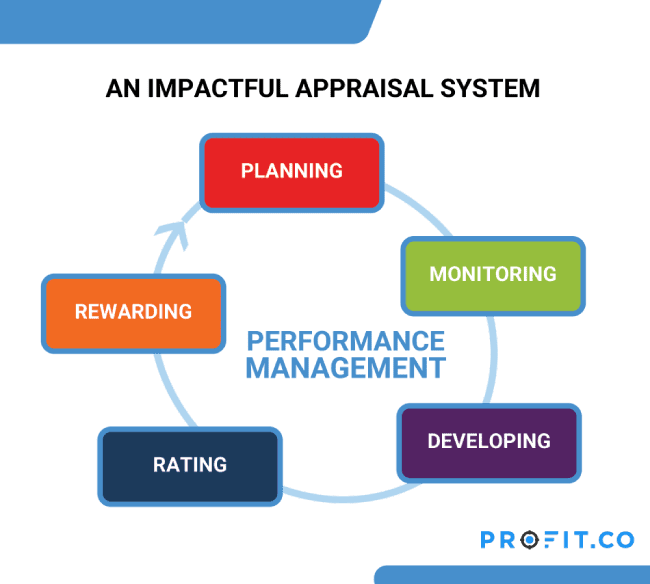
Performance Appraisal Systems disappoint when expectations run too high, timing is off, and managers give no regular feedback to their team.
A lot of performance management software and appraisal systems come with diverse features, but that doesn’t always make it effective. Certain features engineered together can make an effective performance appraisal system. Let’s take a look at a few:
Clear Appraisal Objectives
The objectives of appraisal should be specific. An effective performance review system will be designed in a manner such that it matches the employee’s job description.
Match the Company’s Needs
An effective performance appraisal system matches the needs of the organization. Each member of the team must be aware of what their goals are, what the company’s goals are, and how their individual goals tie in with the company’s goals.
Managers are Mentors
Managers must bear in mind to not assume a hierarchical position. But be a mentor who can lead the employee on to a path of development. They should not only focus on the negatives, but also acknowledge and highlight the achievements to motivate the employee.
Continuous Feedback
The appraisal system is now a process that happens throughout the year; it’s not just a once a year process anymore. Since it’s a continuous dialog and review process that happens throughout the year, the ratings are not a surprise at the end of the year because of the continuous feedback that the manager gives on the employee’s performance. This continuous feedback helps employees better their performance and skills through the year, and into the future.
Well Defined Performance Criteria
Top-rated appraisal forms, appraisal formats, rules and procedures are some of the pre-requisites for an effective appraisal system. For example, you can rate a copywriter based only on the skill that is present in their job description.
What Features Should You Look for in Employee Evaluation Software?
The market separates into three tiers: basic tools that digitise a paper form, mid-tier tools that add workflow automation and 360-degree feedback, and all-in-one platforms that connect evaluation directly to goal management, project delivery, and compensation. The tier that fits your organisation depends on where your current process breaks – not on which tool has the longest feature list.
| Feature | Basic Tool | Mid-tier Tool | All-in-one Platform |
|---|---|---|---|
| Self-assessment | ✅ Form-based | ✅ Guided templates | ✅ Pulls live goal data |
| Manager review | ✅ Rating + comment | ✅ Competency scoring | ✅ Linked to OKR completion |
| Peer feedback | ❌ | ✅ Anonymous option | ✅ Multiple assessment types |
| 360-degree | ❌ | ✅ | ✅ Full cycle in one platform |
| Goal / OKR integration | ❌ | ❌ or manual | ✅ Native – OKR management |
| Rating calibration | ❌ | ⚠️ Limited | ✅ Cross-manager calibration |
| Development plan output | ❌ | ⚠️ Manual | ✅ Auto-converts review to goal |
| Reporting / analytics | Basic export | Dashboard | ✅ Real-time performance data |
Red flags when evaluating employee evaluation software
No goal data in the review form
If the software cannot pull the employee’s actual goal progress into the review form, managers write comments from memory. Memory favours the last 30 days of a 12-month period. Any tool that forces managers to manually copy-paste goal data from a separate system produces reviews where recency bias sets the rating, not the full year’s evidence.
Calibration happens outside the tool
When managers align ratings in a spreadsheet or a separate meeting rather than inside the software, calibration is optional in practice even when it’s required in policy. Look for tools where cross-manager performance dashboards surface rating distributions before the cycle closes – not after employees have already seen their scores.
Review scores don’t connect to development plans
A review score that sits in a form and a development plan that lives in a separate document are two assets that will never talk to each other. The evaluation should generate the development plan – not just inform it.
The self-assessment form is blank
Platforms that present employees with an empty text box produce either one-line answers or rambling essays, neither of which helps managers calibrate. Look for guided self-assessment that anchors the employee’s answers to their actual goals and competencies for the period.
No admin visibility into completion rates
If HR cannot see at a glance which managers have submitted reviews and which haven’t, the cycle will always have stragglers. Completion visibility is a basic operational requirement, not a premium feature.
The right employee evaluation tool does not just capture the review – it makes the review worth capturing.
OKRs + Appraisal in One Platform
What Is the Best Performance Appraisal System?
What are the types of performance appraisal?
- Assessment Center Method
- Management by Objectives
- 360-Degree Appraisals
Let’s look at the above 3 modern appraisal systems and see how they compare with each other.
No matter what type of performance appraisal you would like to initiate, Profit.co’s performance management module can help you evaluate employees effectively and efficiently. Try it free today!
Assessment Center Method
The Assessment Center Method gives employees a clear idea about how others observe them and the impact it has on their performance. While it assesses the existing performance of an individual, it also predicts future job performance. During the assessment, the evaluator asks employees to take part in social-simulation exercises like in-basket exercises, informal discussions, fact-finding exercises, decision-making problems, role-play, and other exercises that ensure success in a role.
The disadvantage of this method, however, is that it is time and cost-intensive and difficult to manage.
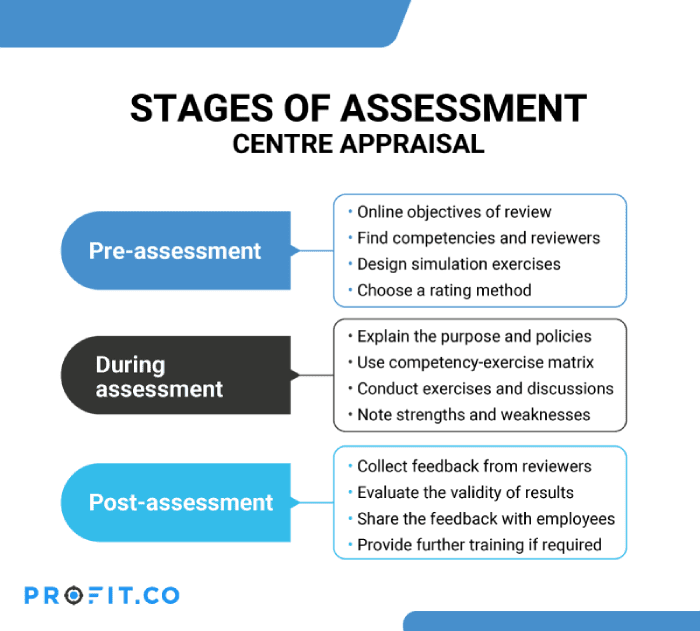
The Advantages of the Assessment Center Method are:
- It enhances a participant’s knowledge, boosts their thought process, and improves employee efficiency.
- It can be tailored to fit different roles, competencies, and business needs.
- Offers an insight into the employee’s personality.
How to Implement an Effective Assessment Center Method:
- Identify performance metrics that can be measured using this assessment center.
- Identify assessment techniques that can elicit ideal behavioral information.
- Spot assessors and assessees excluding immediate supervisors.
- Provide thorough training to assessors and reviewers.
- Maintain a system of performance records for each candidate.
- Review records and reward employees or provide training accordingly.
Management by Objective
This form of appraisal system has the employee and manager both jointly setting goals to be achieved within a certain time. The thinking behind this appraisal format is that when the employee is involved in goal setting, they’ll be more inclined to achieve the goal.
Managers must establish measurable targets, performance standards, and priorities for each of those targets. Also, the responsibilities and authority of the personnel are clearly established.
This appraisal format is ideal for measuring the quantitative and qualitative output of senior management like managers, directors, and executives (business of any size).
The format involves a lot of planning and being proactive rather than being reactive to events. It’s not subjective. Instead, this type of performance appraisal format helps assess the employee’s capabilities which helps improve their ability to perform well.
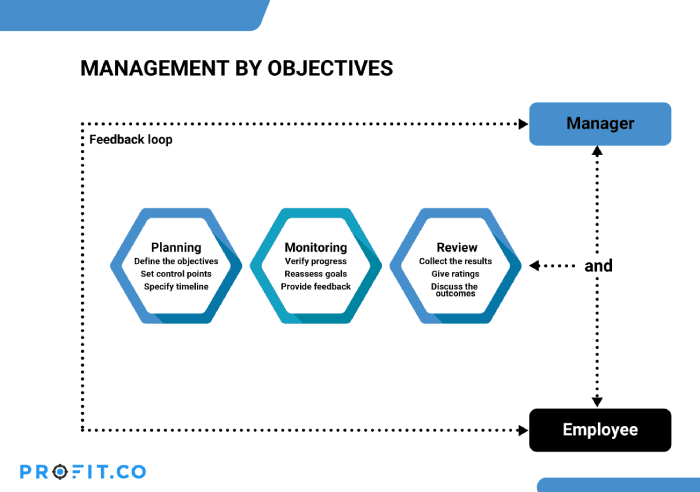
The Advantages of the Management by Objective method are:
- Since in this method, the manager and the employee are jointly involved, they know what the expectations are and there is no ambiguity.
- The employees are more aware of the company’s goals and are proud of being involved in the organizational goals. This improves their morale and commitment.
- This method highlights the area in which the employees need further training, leading to career development.
- MBO puts strong emphasis on quantifiable objectives and therefore, the measurement and appraisal can be more objective, specific and equitable.
- It improves communication between managers and subordinates.
How to Implement an Effective Management by Objective program:
- Every manager must have 5-10 SMART goals clearly listed.
- Along with a clear description of the SMART goals, it must also have a clear plan on how to accomplish it.
- Determine how progress will be measured and how frequently (minimum quarterly).
- List down corrective actions that will be taken if progress is not in accordance with plans.
- Ensure that goals at each level are related to the organizational objectives and levels above/below.
360-Degree Appraisals
Including reviews from co-workers and others who have contact with the employee in the performance review process helps authenticate the employee’s report and potentially help cover more ground during the review process, keeping biases at bay.
The 360-degree appraisal gives the most complete picture of an employee’s performance because it captures input from peers, managers, and the employee’s own self-assessment – not from one perspective alone. This type of appraisal system also helps the employee learn about their strengths and weaknesses.
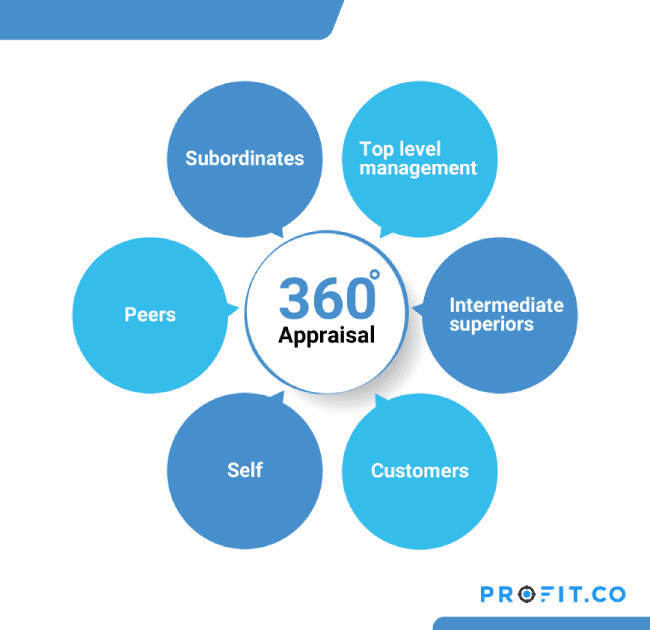
Source: Human Resource Management Practice
The Advantages of using the 360-degree feedback are:
- It increases the individual’s awareness of how they perform and the impact it has on other stakeholders.
- Serves as a key to initiate coaching, counselling, and career development activities.
- Encourages employees to invest in self-development and embrace change management.
How to Implement an Effective 360-degree Review:
- Check that the people providing feedback have worked for at least 6 months with the candidate who is receiving feedback. Also confirm that every participant understands the process aims to help everyone succeed – not to expose weaknesses.
- The candidate should choose the people that they would like to receive feedback from, and they should also be open to feedback and suggestions from their manager or coach.
- Inform all participants about the purpose and process of the 360-degree, what’s expected of them, and why.
- Check in every day or every other day to see how completion of the assessment is coming along.
How Do OKRs Improve the Modern Performance Appraisal Cycle?
Now that organizations have moved on from the once-a-year review practice, managers now use OKRs with continuous performance management to align with and motivate employees. It accelerates performance by giving employees a direct line of sight into how their work impacts company goals, and gives every employee a clear view of which company priorities their work serves.
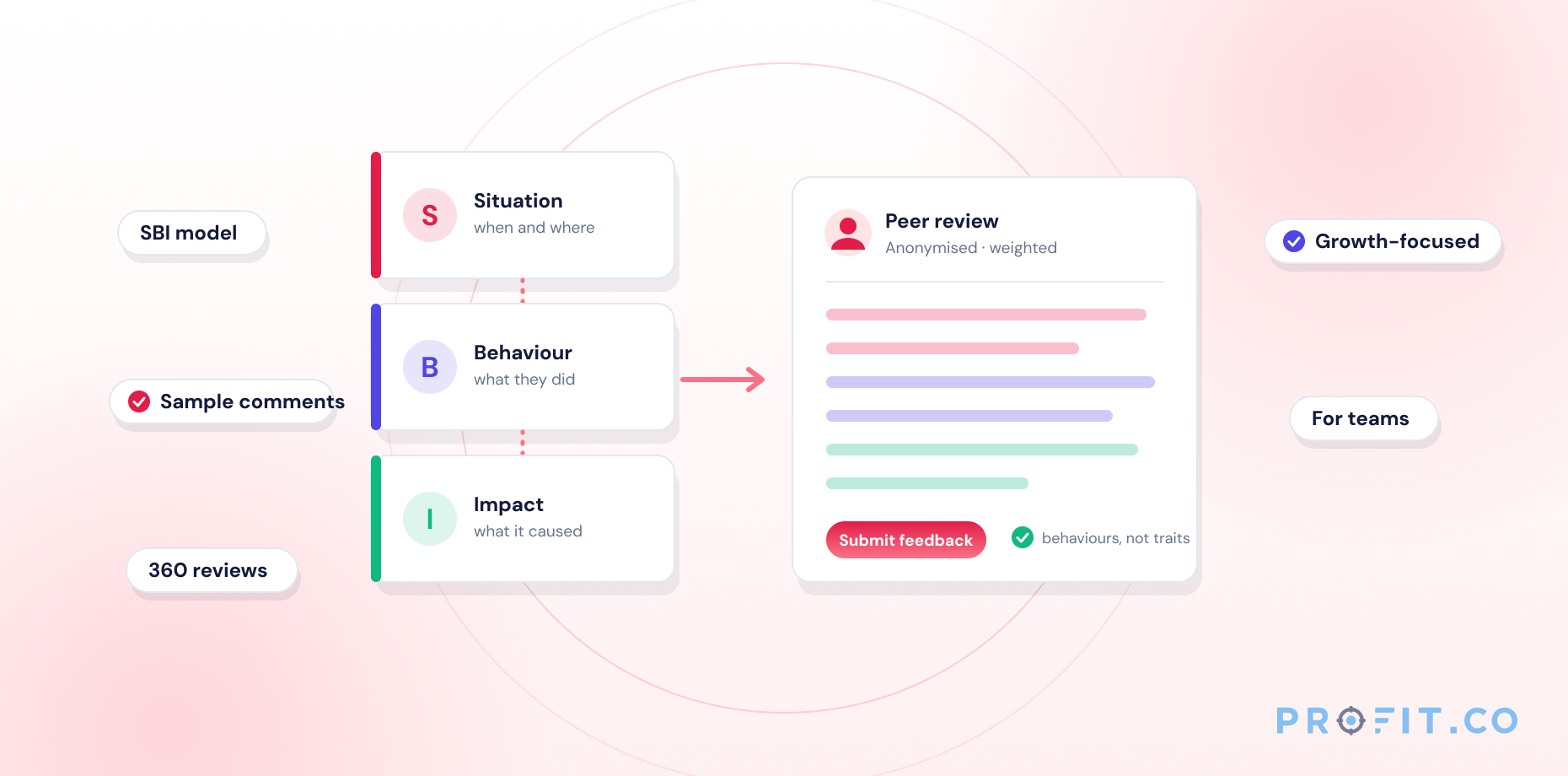
In the Profit.co software, you can conduct 360-degree reviews by initiating an affinity-based performance review. In this review type, a reviewee completes a self-assessment, peers review them, and the manager provides feedback.
Profit.co can anonymize peer reviews to support honest answers, and reviewees can select which peers review them – or managers can designate reviewers directly.
Managers can designate different competencies for the employee to rate themselves on. Competencies are skills that are specific to an employee’s role and a necessary component of their job. Reviewees rate themselves on a sliding scale, and peers and managers rate them in parallel. If a reviewee’s self-assessment rating and the manager’s rating match, the competency will be highlighted, indicating that everyone is on the same page.
Managers will also determine an employee’s potential. Based on the employee’s total performance rating and the manager’s potential rating, Profit.co places them on the 9-Box Matrix, which helps managers and HR administrators determine if an employee is ready for a promotion through an IDP, or individual development plan, or needs to improve in their position through a PIP, or performance improvement plan.
ALL-IN-ONE VS STANDALONE EVALUATION TOOL
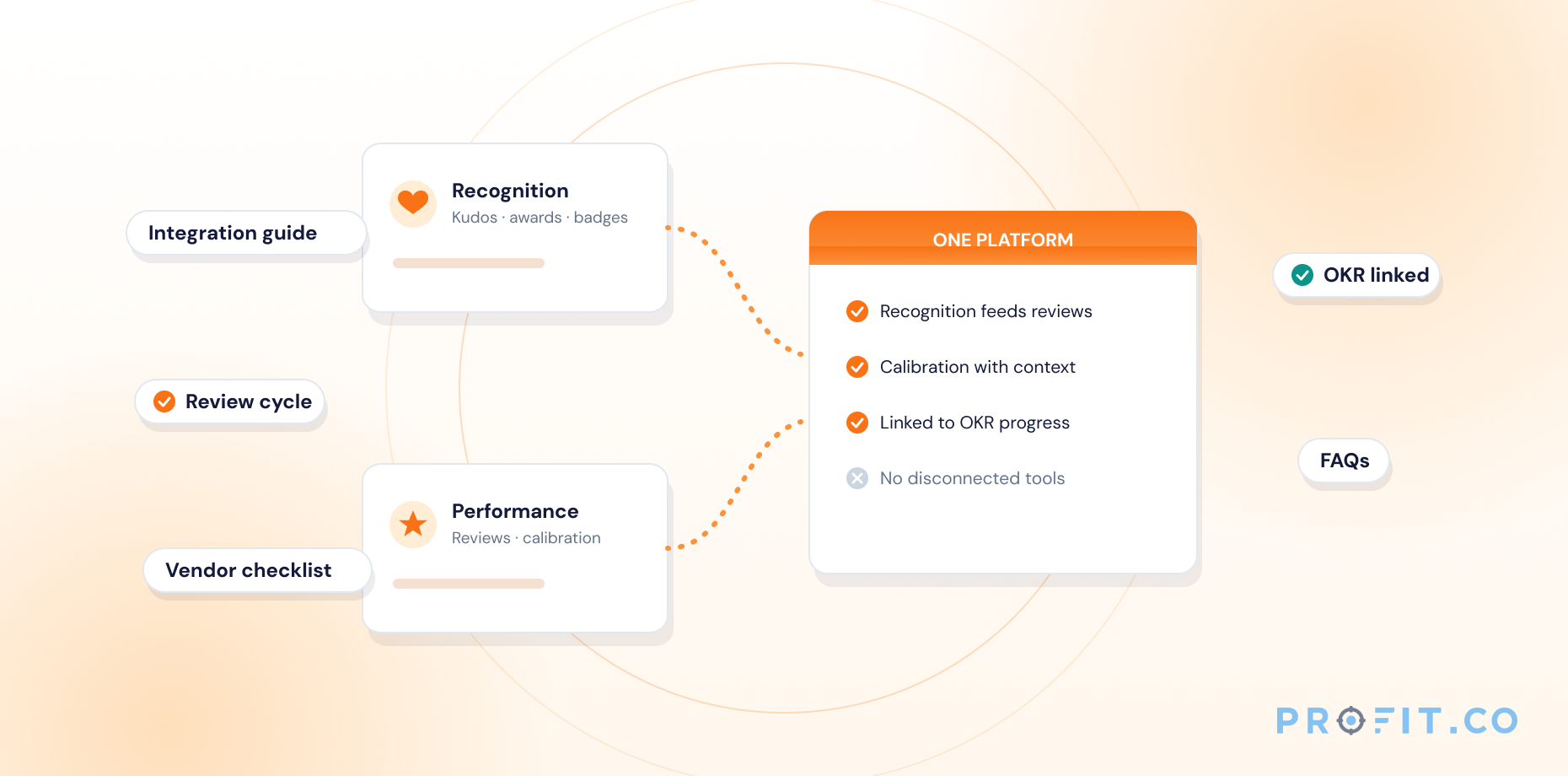
The gap between a standalone employee evaluation tool and an all-in-one platform is not a features gap – it is a data gap
A standalone tool captures what a manager thinks about an employee’s year. Profit.co captures what actually happened: which OKRs the employee owned, what percentage they completed, how they checked in, how their peer scores compared to their self-assessment, and whether their development goals from the last cycle translated into changed behaviour.
That evidence base is what separates a review that takes 45 minutes to write from one that takes four hours – and a rating an employee accepts from one they contest. Profit.co’s 16 AI Agents draft every layer of the review from that live data, so the manager’s job shifts from writing to editing – a far shorter, far less error-prone task.
What Are the Best Practices for Implementing an Effective Appraisal System?
Reviewing employees’ performance and keeping them motivated involves doing a lot of things right. These are a few of them:
Coaching for Managers
Managers need to be trained on how to conduct a performance appraisal. Performance appraisals are one of those ‘intense’ activities at the workplace. Given that it involves evaluating an employee’s capabilities and contribution, the outcome of these appraisals can have a significant impact on the employee’s future performance and self-esteem. Which is why it is crucial for a manager to be trained in the process and they cannot just ‘wing it’. Poorly delivered feedback can be very demoralizing and lead to employee attrition. Sharon Frankovich, a consultant with HR Works, says, “Coach managers on how to give negative feedback. Managers without coaching training avoid giving direct negative feedback – and so it never arrives.” She says managers must realize the importance of giving specific, constructive feedback, and the impact of providing inaccurate or zero feedback.
Performance Previews rather than Performance Reviews: A focus on the future
Organizations including Adobe and Microsoft have shifted to Performance Previews – a forward-looking conversation that replaces the retrospective review. What that means is that the manager and the employee discuss how the responsibilities of the employee might change in the year ahead and decide what training, tools, and mentorship the employee will need to achieve those goals.
Organizations that have adopted the Performance Previews approach consider it as a factor behind low employee attrition and also in attracting employees. However, previous appraisals are also important, as are valuable measuring tools.
Train employees to monitor their performance themselves and work towards getting the feedback they need
In the standard appraisal model, employees don’t get a say in the process – they wait for the manager to deliver feedback. However, instead of waiting for the manager to appraise their performance and give feedback, employees should have the know-how and wherewithal to self-monitor and make efforts to get better at their work.
Self-appraisal in performance management system allows employees to openly express their interests, opinions and goals. The performance management system ceases to be hierarchical and instead, it becomes a more welcoming two-way process when self-appraisal formats are included in the system.
Bottom-up Appraisals
Another format that is finding its way into organizations is the Bottom-up appraisal system, where each employee rates their supervisor in areas such as how well the employee understands their responsibilities, receives the help and feedback necessary to succeed, and so on.
When Should a Performance Appraisal Take Place?
The best performance appraisal is the ongoing appraisal. Employees prefer frequent feedback over a detailed review that happens once a year. Frequent, informal interaction with the management makes the employee feel less stressed and more responsive to feedback. Review question templates can give a fairly good idea of questions for performance reviews.
What Does an Effective Appraisal System Require?
The process of giving feedback must change with the changing times and as organizations evolve. The goal of the appraisal system above all is to help the development of the employees, and not for management to judge an employee’s contribution. While there’s no one size fits all, there are a few things that work – make feedback frequent instead of having a review just once a year, training managers to conduct effective appraisals, and involving employees in their own appraisal process. Irrespective of the nature of the organization, these are a few things that do get results.
To learn how Profit.co can help you initiate quick and effective performance appraisals that tailor exactly to your teams’ needs, book a free demo with our experts today!
See How Profit.co Runs Every Appraisal Method in One Platform
Frequently Asked Questions
Employee evaluation software is a platform that structures, automates, and records the process of reviewing employee performance. It covers self-assessments, manager reviews, peer feedback, competency ratings, and 360-degree cycles in one system. The most effective tools connect evaluation scores directly to goal progress and development plans, so the review produces action rather than a score that sits in a form.
Employee evaluation software handles the review cycle – collecting ratings, feedback, and scores. Performance management software covers the full employee lifecycle: goal-setting, continuous check-ins, the review cycle, development planning, and recognition. Standalone evaluation tools are narrower; all-in-one performance management platforms include the evaluation module as one component of a larger system.
The five most important features are: goal and OKR integration (so review scores reflect actual work, not memory), multiple assessment types (self, peer, manager, upward), cross-manager calibration to standardise ratings, automated completion tracking so HR can monitor cycle progress in real time, and development plan output that converts review findings into tracked goals. Tools that lack goal integration produce reviews dominated by recency bias.
Employees perform better with frequent feedback than with a single annual review. Annual or semi-annual formal evaluations should run alongside continuous informal feedback – regular one-on-ones, quarterly goal check-ins, and real-time recognition. The formal evaluation documents the year; the ongoing conversations are what actually change behaviour.
Profit.co runs Assessment Center, Management by Objectives, and 360-degree appraisal formats within the same platform. It connects each review type to the employee’s live OKR and goal data, supports anonymous peer feedback, plots employees on the 9-Box Matrix from review and potential ratings, and uses 16 AI Agents to draft self-assessments, manager reviews, and HR summaries from actual performance data – reducing review prep time and improving rating consistency across managers.