In this guide
- What is an Appraisal Form? Definition, Purpose, and Key Facts
- Employee Evaluation Form: The Key Tool for Appraisal
- Employee Appraisal Form Template: What Each Section Should Include
- How to Fill Up a Performance Appraisal Form
- Sample Appraisal Form Filled by Employee: A Complete Worked Example
- In Conclusion
- How to Write an Appraisal: A Step-by-Step Guide for Managers
- From Appraisal Form to Actionable Insight
- Frequently Asked Questions
Download a sample Employee appraisal form.
Performance appraisal is an important component of performance management in an organization. Appraisal is the process of constantly assessing the means and ends of an individual’s work in a specific period of time. It measures the performance of the individual while achieving certain predetermined goals. It also identifies the reasons for success and failures so as to address the gaps and set future plans based on the current performance levels. It sets the tone for the employees as well as the organization to achieve meaningful progress in the long term. Performance review comments play a crucial role in this process, providing constructive feedback and guidance to employees on their strengths, areas for improvement, and overall performance trajectory. These comments serve as a tool for communication between managers and employees, fostering transparency, accountability, and continuous growth within the organization.
An appraisal form (also called a performance appraisal form or employee evaluation form) is the structured questionnaire employees complete as part of their review. See our full definition, template guide, and completed example below.
Running appraisals consistently at scale is far easier with dedicated employee performance software, which standardizes the form, collects self-assessments, and links every rating back to the goals the employee actually worked on.
What is an Appraisal Form? Definition, Purpose, and Key Facts
What is an appraisal form? An appraisal form (also called a performance appraisal form or employee evaluation form) is a structured questionnaire that an employee completes as part of their performance review. It captures self-assessed achievements, competency ratings, development goals, and feedback for their manager to evaluate.
Appraisal forms are the employee-facing component of the wider performance review process. Where a performance review template defines the overall structure of a review cycle, the appraisal form is the document the employee actually fills in, making it the primary source of self-assessment data that managers use to evaluate performance.
Appraisal Form: Quick Reference
| Property | Detail |
|---|---|
| Also known as | Performance appraisal form · employee evaluation form · self-appraisal form · staff appraisal form · review form |
| Used by | Employees completing a self-assessment; managers completing a staff evaluation |
| Typical frequency | Annual · Quarterly · As part of a probation review or continuous performance cycle |
| Core sections | Employee details · Goal achievement · Competency ratings · Self-assessment responses · Development needs · Manager comments |
| Format | Paper form or digital (via HR software or performance management platform) |
| Primary purpose | Capture structured employee performance data to inform manager ratings, development plans, and pay decisions |
How an Appraisal Form Differs from a Performance Review Template
| Appraisal Form | Performance Review Template |
|---|---|
| Completed by the employee | Completed and managed by HR or the manager |
| Captures employee self-assessment | Defines the overall structure and scoring framework of the review |
| Focused on one individual’s performance | Used across the whole team or organisation |
| Submitted before or during the review meeting | Used to set up and run the review process |
| Includes open-ended questions for the employee to answer | Includes scoring rubrics, rating scales, and process guidelines |
Why the Design of the Form Matters
The structure of an appraisal form directly affects the quality of the data collected. A poorly designed form with vague or leading questions produces vague, unreliable self-assessments. A well-designed form, with clear competency categories, specific open-ended questions, and sufficient space for evidence, produces actionable insights that managers can use to support, develop, and recognise employees effectively.
According to Gallup, employees who feel their performance review process is fair and meaningful are 2.7x more likely to be engaged at work. The appraisal form is often the first point of that experience for the employee. Source: Gallup State of the Global Workplace. Verify exact figure at gallup.com before publishing.
Employee Evaluation Form: The Key Tool for Appraisal
The key tool for evaluating an employee’s performance is the employee evaluation form. We have earlier explored in detail the Employee Performance Review process and the importance of templates. In this article, in addition to broadly customizing a performance review template for review, it is also important to have an in-depth understanding of the employee appraisal form, which is the questionnaire that the employees get to fill.
The employee appraisal form is carefully designed in line with the objectives and expected outcomes of the review, in order to get the most accurate reflection of the employees’ performance in the review period. To get the right outcomes, you need to ask the right questions to the employee. This article explores the vital components of an effective appraisal form and gives insights on how to fill it.
An effective performance appraisal form is based on following essential parameters of a review. Download a sample Employee appraisal form.
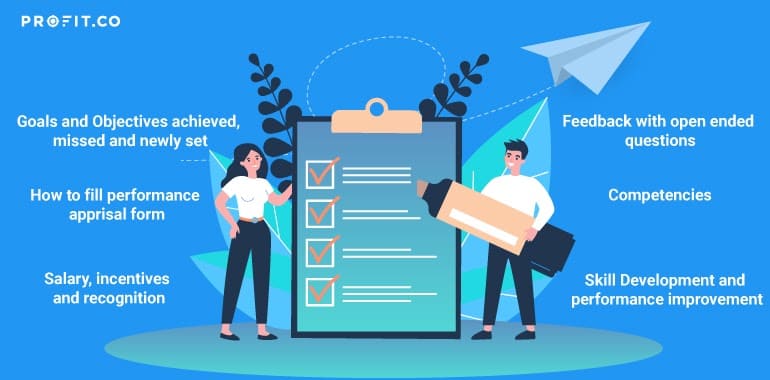
1. Goals and Objectives achieved, missed and newly set
The nature of goals and objectives of an employee varies according to the job description. The employee appraisal form needs to have the objective of the review, job description and goals set for the particular position mentioned clearly.
In a self-appraisal, this section needs to bring out details such as the status of the goals that were set for the review period, the key skill or strength of the employee that helped the employee achieve each of the goals and the challenges he/she faced in achieving them. For goals management, OKR is the golden standard and a comprehensive view of what OKRs are is available here.
2. Competencies
Achievement of goals is not the only indicator of an employee’s performance. There are several competencies that define the employee’s performance. These competencies are indispensable for the employee to contribute to the organization and his/her team in an effective manner. These performance parameters can be measured quantitatively, and hence the rating scale should be clearly mentioned. Following are some of the competencies that can be assessed in a performance appraisal.
- Teamwork
- Leadership
- Customer focus
- Punctuality
- Problem solving skills
- Communication skills
- Quality of output
- Judgement
- Reliability
- Job knowledge
3. Feedback with open ended questions
The employee should be given space in a performance appraisal form to reflect on vital details like the achievements during the review period, career aspirations, what he/she expects from the team/organization, things he/she wants to change in the organization, etc. It promotes dialogue with the employee instead of keeping it as one way communication and improves employee engagement.
4. Salary, incentives and recognition
The employee review template can have questions on compensation, incentives, rewards, etc. It helps the organization to know if the employees feel they receive the monetary benefits they deserve for the effort they put into the job. Rewards and recognition drive motivation and productivity, and hence, it is crucial for the organization to know if they are rewarding the employees adequately.
5. Skill Development and performance improvement
The employee can state what all skills and competencies he/she needs to develop in order to do the job better. The organization needs to provide the employees with the skills and tools required to perform at optimal levels. Staying updated is key to maintaining the competitive edge of the organization.
Employee Appraisal Form Template: What Each Section Should Include
What does an employee appraisal form template contain? An employee appraisal form template is a pre-structured document containing the standard sections, fields, and questions used in a performance review. A complete template includes seven core sections: employee information, review period goals, competency ratings, open-ended self-assessment questions, development needs, salary and recognition, and manager comments.
The most effective appraisal form templates are consistent enough to allow fair comparison across employees, while flexible enough to reflect different roles, teams, and seniority levels. Below is a complete section-by-section breakdown of what every employee appraisal form template should include, with example field content for each.
Section-by-Section Appraisal Form Template
| Section | What It Captures | Example Field Content |
|---|---|---|
| 1. Employee Information | Name, job title, department, manager, review period, date of joining | Employee: [Name] · Role: [Job Title] · Department: [Dept] · Manager: [Name] · Review Period: Jan to Dec 2025 |
| 2. Goals and Objectives | Achievement status of goals set in the previous review; newly proposed goals for the next period | Goal 1: Reduce customer onboarding time by 20% — Status: Achieved (reduced by 24%). Goal 2: Complete PMP certification — Status: In progress, Q2 completion target. |
| 3. Competency Ratings | Rating scale assessment of core competencies relevant to the role (usually 1 to 5 or 1 to 10) | Communication: 4/5 · Teamwork: 5/5 · Problem Solving: 3/5 · Quality of Output: 4/5 · Leadership: 3/5 |
| 4. Self-Assessment (Open Questions) | Employee’s narrative responses to structured appraisal questions covering achievements, challenges, and development areas | Q: What is your proudest achievement this review period? A: Led the Q2 client retention initiative, re-engaging 280 lapsed accounts and recovering £62,000 in ARR. |
| 5. Development and Training Needs | Skills or qualifications the employee wants to develop; training the organisation should provide | I would like to develop my data analysis skills. I have identified a relevant SQL for Business course (approx. 6 hours) and would benefit from manager sponsorship to complete it. |
| 6. Salary, Incentives, and Recognition | Employee’s reflection on whether compensation reflects their contribution; suggestions for improvement | I feel my contribution this year has exceeded my original role scope, particularly in leading cross-functional projects. I would welcome a discussion about a salary review. |
| 7. Manager Comments | Manager’s assessment of the employee’s self-evaluation; overall rating; agreed action points | [Manager completes this section after reviewing the employee’s responses and conducting the review meeting.] |
Customising the Template for Different Roles
A standard employee appraisal form works for most individual contributors. For specific contexts, the following adjustments are recommended:
- Staff appraisal form (frontline or operational roles): Emphasise punctuality, process adherence, customer-facing competencies, and safety compliance. Reduce the weight of strategic goal sections.
- Management appraisal form: Add a leadership competencies section covering team development, delegation, and performance culture. Include a 360-degree feedback summary where available.
- Annual appraisal form: Expand the goals section to capture full-year progress. Add a salary review decision field and a training budget recommendation field.
- Probationary review form: Focus on role understanding, onboarding progress, and early competency indicators rather than full-year goals.
Run Structured Appraisals with Profit.co Performance Management
How to Fill Up a Performance Appraisal Form
How do you fill a performance appraisal form? To fill a performance appraisal form effectively: review your goals and gather evidence of achievement, rate each competency honestly against the agreed scale, write specific evidence-backed responses to open questions, identify development needs with a concrete plan, and set measurable goals for the next review period.
An employee performance review can make or break the career of an employee, depending on how he/she has performed. So, if you are writing a review for someone who interacts with you everyday, then take your time to write the review and keep your assessment honest and objective. If you are doing a self appraisal, you can follow the below-mentioned guidelines to fill the employee appraisal form for an effective review using performance management software:
Prepare for Self Evaluation
If you are doing a self assessment, prepare well by:
- Recollecting all your achievements
- Revisiting your previous review to verify the goals, and the plans you had proposed to achieve them
- Referring to your old documents, emails, minutes of team meetings, etc to avoid missing anything
- Noting down all the vital points before writing the review
When you fill the form:
- Be honest and critical: Analyze your failures and mention the reasons for it. State a plan to address those shortcomings.
- Keep the words minimal: Write short and precise appraisals with minimal word count.
- Identify weaknesses: Identify your weaknesses and mention the training and support you need from the organization to address them.
- Mention your achievements: Mention your achievements and share how you approached the tasks. Substantiate them with numerical data wherever possible.
- Link achievements to the job description and the organization’s goals: Share how you fulfilled the responsibilities of your position with your achievements, and how relevant those achievements are to the organization’s goals.
- Set the goals for the next review period: Aim higher and set the goals for the next review period. Provide a clear timeline and plan of action to achieve the goals.
- Resolve conflicts and grievances: Write about the conflicts in your team and the things you want to change in the team/organization in a professional manner.
By incorporating these considerations into your performance appraisal form, you not only align your self-evaluation with your personal development goals but also with the strategic objectives and expectations of the organization’s performance management system. This approach demonstrates your dedication to growth and improvement while enhancing your synergy with the organization’s mission and vision.
Download a sample Employee appraisal form.
Sample Appraisal Form Filled by Employee: A Complete Worked Example
What does a filled appraisal form look like? A filled appraisal form is a completed version of the employee performance review questionnaire, showing actual responses across all standard sections — goals, competency ratings, self-assessment answers, development needs, and compensation reflections. The example below shows a sample appraisal form filled by an employee in a project management role.
Reading a blank appraisal form template tells you what to fill in. Reading a fully completed example tells you how to fill it well. Below is a complete sample appraisal form filled by a fictional employee — Sophie R., Project Manager — covering every standard section with strong, specific, evidence-backed responses.
Use this as a reference when preparing your own appraisal. Replace the role-specific details (project names, numbers, timelines) with your own.
Sample Appraisal Form: Filled Example (Project Manager Role)
| Form Section / Question | Sample Employee Response (Sophie R., Project Manager) |
|---|---|
| Employee Name / Role / Department / Review Period | Sophie R. · Project Manager · Operations · January to December 2025 |
| Goal 1: Status and Evidence | Goal: Reduce average project delivery time by 15%. Status: ACHIEVED. Evidence: Average delivery time reduced from 34 days to 27 days (21% reduction) across 8 live projects in H2. Key driver: introduced a sprint planning template adopted by the full team. |
| Goal 2: Status and Evidence | Goal: Complete PRINCE2 Practitioner certification. Status: ACHIEVED. Evidence: Certificate awarded July 2025. Immediately applied PRINCE2 risk management framework to the ERP migration project, preventing two scope overruns flagged in the risk log. |
| Goal 3: Status and Evidence | Goal: Onboard and mentor one junior project coordinator. Status: PARTIALLY ACHIEVED. Evidence: Mentored two junior coordinators. One is now managing independent workstreams. Formal mentoring programme documentation not completed — planned for Q1 2026. |
| Competency Ratings (1 to 5 scale) | Communication: 4 · Teamwork: 5 · Problem Solving: 4 · Quality of Output: 5 · Leadership: 4 · Time Management: 4 · Customer Focus: 3 |
| Open Q: What is your proudest accomplishment this review period? | Leading the ERP migration project, which went live on schedule in October — the first on-time major IT delivery in three years. I coordinated 11 stakeholders across 4 departments and managed 3 scope change requests without extending the deadline. The project came in 4% under budget. |
| Open Q: Where could you have performed better? | My stakeholder reporting in Q1 was inconsistent — I sent updates reactively rather than on a fixed cadence, which caused confusion for two senior sponsors. From Q2, I implemented a fortnightly project status email, which my manager noted significantly improved visibility. I want to build this into a formal reporting template for the team. |
| Open Q: What do you hope to achieve in the next 12 months? | My primary goal is to step into a Senior Project Manager role, with responsibility for a portfolio of 3 to 4 concurrent projects. To prepare, I will complete the MSP (Managing Successful Programmes) qualification in H1 2026 and take ownership of the departmental process improvement initiative. |
| Development and Training Needs | 1. MSP (Managing Successful Programmes) qualification — programme management context is increasingly relevant to my workload. Estimated cost: £1,400. 2. Facilitation skills workshop — I want to improve how I run project kick-off and retrospective sessions. 3. Customer-focus coaching — my lowest competency rating; I’d like to shadow the client-facing team for one quarter. |
| Salary, Incentives, and Recognition | I believe my contribution this year has materially exceeded my original role scope, particularly in the ERP migration leadership and junior mentoring. I would welcome a formal salary review conversation. I’m also proud of the team recognition award we received in September — the first for the Operations team. |
| Manager Comments | [Manager to complete after the review meeting.] |
The strongest appraisal form responses share four qualities: they are specific (naming projects and numbers), evidence-backed (citing measurable outcomes), honest about gaps (with a plan attached), and forward-looking (showing what comes next, not just what happened). A response that says only went above and beyond names no event, date, or outcome. That is a character description, not an appraisal response.
In Conclusion
In conclusion, the employee appraisal form, when filled out thoughtfully, is a vital resource for enhancing team performance. Utilizing a well-structured template and incorporating performance review examples provides clarity and actionable insights for both managers and employees. By setting clear objectives, gathering comprehensive feedback, and focusing on development opportunities, you can foster growth, improve team dynamics, and drive overall organizational success through the appraisal process.
How to Write an Appraisal: A Step-by-Step Guide for Managers
What does writing an appraisal mean for a manager? Writing an appraisal (from a manager’s perspective) means formally evaluating an employee’s performance in writing — reviewing their self-assessment, scoring their competencies, drafting written feedback comments, and documenting agreed development actions after the review meeting.
Most appraisal guides are written for employees. But managers carry equal responsibility for the quality of the appraisal. A poorly written manager assessment can undermine the process even when the employee has filled their form thoughtfully. Here is a step-by-step guide to writing an appraisal as a manager.
Review the employee’s goals and agreed targets
Before you write anything, go back to the goals and targets agreed at the start of the review period. For each goal, assess: Was it achieved? Partially achieved? What evidence exists? This forms the objective backbone of your written assessment.
Gather evidence beyond the self-assessment
Do not rely solely on the employee’s self-assessment. Pull project records, output metrics, peer feedback, client responses, attendance data, or any other observable evidence. Strong written appraisals are grounded in facts the employee can recognise as fair.
Score competencies against the role definition
Use the agreed rating scale (1 to 5 or 1 to 10) to score each competency listed in the appraisal form. Anchor your ratings to observable behaviours: Scores 4/5 on Communication because they consistently produce clear project status updates adopted as a team standard.
Draft your written comments
Write one paragraph per key theme: performance against goals, standout contributions, areas for development, and forward plan. Use the SAID structure for each point: Situation, Action, Impact, Direction. Keep language specific, constructive, and free of vague generalisations.
Prepare for the review discussion
Share your draft assessment with the employee before or during the meeting so they can respond. The written appraisal should be a starting point for conversation, not a delivered verdict. Note any areas where your assessment and the employee’s self-assessment significantly diverge — these are the most important parts of the discussion.
Finalise and document agreed actions
After the meeting, update the written appraisal to reflect any agreed amendments, and document: (1) the final overall rating, (2) the employee’s development goals for the next period, (3) any training or support committed by the organisation, and (4) a date for the next check-in.
2026 Trend: Leading organisations are moving away from rating-led appraisal writing (4/5 — good performance) toward narrative-led assessment (Sophie consistently delivers complex projects ahead of schedule and has demonstrated clear readiness for senior programme management). The narrative approach is more defensible, more motivating, and more useful for development planning. According to Deloitte’s Global Human Capital Trends research, organisations using narrative-led reviews report higher employee satisfaction with the appraisal process. Source: Deloitte. Verify exact figure at deloitte.com before publishing.
From Appraisal Form to Actionable Insight — Profit.co Bridges the Two
Frequently Asked Questions
When filling a self appraisal form, include the following:
- Mention your achievements with specific examples and measurable outcomes
- Link achievements to the job description and the organization’s goals
- Set the goals for the next review period with a clear timeline
- Resolve conflicts and grievances professionally, with suggested solutions
Make sure to include a mix of positive and needs improvement comments in your self-appraisal. Examples of self appraisal comments:
- I clearly and regularly share my ideas and feedback with the team
- I sometimes hesitate in communicating with the top leadership
- I find it difficult to multi-task
- I consistently meet 80% of my quarterly OKRs
An appraisal form is completed by the employee — it is the questionnaire they fill in to capture their self-assessment, competency ratings, development needs, and goals. A performance review template is managed by HR or the manager — it defines the overall structure, scoring framework, and process guidelines for the review cycle. The appraisal form is one component within the broader performance review template.
A staff appraisal form should include: (1) employee and review period information, (2) goal achievement status with evidence, (3) competency ratings on a defined scale, (4) open-ended self-assessment responses covering achievements and development areas, (5) training and development needs, (6) salary and recognition reflections, and (7) a manager comments section completed after the review meeting. For frontline or operational staff roles, additional emphasis on punctuality, process adherence, and customer-facing competencies is recommended.