In this guide
- What are Performance Competencies?
- How to Define Core Competencies
- Competencies Evaluation
- Employee Competency Evaluation: A Rating Framework for Managers
- Benefits of Evaluating Competencies
- When Reviewing
- How Competency Evaluation Drives Employee Development
- 12 Performance Appraisal Competency Examples
- Core Competencies Examples: A Complete Reference
- Performance Appraisal Comments by Competency: Copy-Paste Examples
- Performance Competencies in Profit.co
- Frequently Asked Questions
Competency-based reviews help you evaluate and guide interviewees and current employees to focus on their strengths and help address their weaknesses.
Performance appraisals are a great way to evaluate how employees operate within your business and give them the guidance they need to improve their performance. As a manager, competency evaluation can be a powerful tool for you to use when interviewing recruits or coaching current employees to increase their value in the workforce.
You might be wondering, “What should I look for in competencies and how do I use them?” You’ll be surprised to hear that competency-based performance appraisals can be easily understood and, with the right approach, can be a powerful tool.
What are Performance Competencies?
A competency appraisal is a structured performance evaluation that assesses an employee against a defined set of competencies, including skills, behaviours, and attributes deemed essential for effective job performance in their role. Unlike output-only reviews that measure what was achieved, competency appraisals evaluate how an employee achieves their results: the behaviours and capabilities they demonstrate throughout the process.
Performance competencies are integral components of a performance management system, representing the values and skills deemed essential for effective job performance within a company. When hiring a new employee, competencies are the standards on which you base your assessment of the interview.
Questions to consider when hiring someone: Do they match our core focus? Could we improve their skills to suit our business with training?
Evaluating current employees can help you understand how well they are working within the company and help focus training or efforts for improvement.
Questions to consider when reviewing an employee: Have they maintained their performance in the necessary competency categories? Is there room for improvement, and what is the best way to word my comments?
How to Define Core Competencies and develop a competency based performance management system?
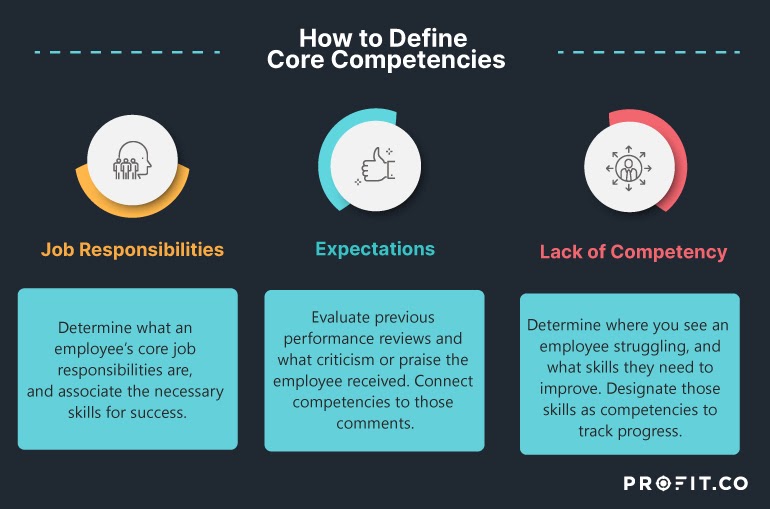
As a manager, you can select the core competencies for your department or team. Depending on your business model, and what you’d like your employees to focus on, necessary competencies will change.
How should you determine what competencies are necessary for your employees? Consider these three areas:
1. Job Responsibilities
What are the core elements of an employee’s responsibilities?
Consider what their day-to-day tasks might be, challenges that will be faced, and how you expect them to respond to these challenges.
For example, if you are hiring someone for a front-end retail position, your core competencies might be: customer service, communication, and teamwork.
If you are reviewing the performance of an engineer, consider core competencies such as technical skill, decision-making, and planning and organizing.
2. Expectations
During a performance review, it’s wise for a manager to think about their expectations for the employee. Thinking about the level of performance that you anticipated for an employee as well as their potential for development, can help you evaluate the reality of their performance. Additionally, you may look at their previous work performance to see how their current performance measures up against the past, and if they’ve learned from experience.
It is a good practice to set clear expectations and assign goals to help current employees become a better asset to your business. If they excel in a competency, expect them to continue to excel : a dip in performance could indicate an issue needing immediate resolution. If there is room for improvement, set a specific goal for them to achieve in the period between reviews.
3. Lack of Competency
You might find that after setting core competencies, some people do not meet the required standards. This might be a major red flag : however, it’s important to evaluate your options.
Most core competencies can be developed through training or mentoring, and many can be improved with the right guidance. However, there are some competencies that cannot be easily developed, and can negatively impact an employee’s quality of work each day. For example, poor technical skills can greatly impact an employee’s contributions to an organization.
Competencies Evaluation
When evaluating employee performance competency evaluation plays a crucial role in identifying strengths and areas for improvement. But it’s not just about ticking boxes : it’s about aligning the individual’s capabilities with the business’s goals. To make competency evaluations more effective, here are some essential points to consider:
1. Clearly Define Core Competencies
- What are the key skills or behaviors required for success in each role?
- Are these competencies aligned with your business objectives and team needs?
Clearly defined competencies like teamwork, problem-solving, and communication help make the feedback specific and actionable.
2. Evaluate How Competencies Impact Daily Performance
- How does an employee demonstrate competencies like teamwork in day-to-day tasks?
- Are they using their strengths to solve problems effectively or contributing to group goals?
Competency evaluation should focus on how well an employee applies these skills to everyday tasks, which is crucial for the overall success of the team and company.
3. Provide Specific and Actionable Feedback
- Are you giving actionable feedback? For example, instead of saying, “Work better with the team,” suggest how they can improve collaboration, like initiating team discussions or sharing updates regularly.
Providing examples of success and where they can improve is needed for employees to understand precisely what they can work on.
4. Incorporate Regular Check-ins
- How often are you assessing competency? Is it part of ongoing feedback rather than only during formal performance reviews?
Regular check-ins allow continuous improvement for employees to stay on track or adjust as needed. This also helps to create a culture of transparency and trust.
5. Adapt Competencies to Changing Business Needs
- Are the competencies you’re evaluating still relevant to the current business goals?
- Are there new skills or competencies added as your company evolves?
As businesses grow and shift, competencies should evolve, too. Regularly revisiting your competency framework is vital to keeping it relevant to both employee and organizational needs. Framing competency evaluation is a dynamic and ongoing process; these steps help managers and employees work together toward continuous improvement. Instead of a one-time event, competency evaluation becomes a tool for long-term growth, helping to build a stronger, more capable team.
Employee Competency Evaluation: A Rating Framework for Managers
Employee competency evaluation is the structured process of assessing how well an employee demonstrates the skills, behaviours, and attributes required for their role. It differs from output-based performance assessment (which measures what was delivered) by focusing on how the employee works: the capabilities, behaviours, and approaches that determine whether performance is sustainable and developable.
A consistent rating framework ensures that competency evaluations are fair, comparable across the team, and meaningful for the employee receiving them. Without a defined scale, managers default to different standards, making it impossible to identify genuine patterns or set development goals that feel credible.
5-Level Competency Rating Scale
Apply one rating per competency per review period. The five-level scale below is suitable for formal performance reviews and mid-year competency check-ins.
| Rating Level | Score | Description | What This Looks Like in Practice |
|---|---|---|---|
| Exceptional | 5 | Consistently exceeds the competency standard in ways that visibly elevate the team or organisation | Takes the lead on challenging situations; others seek them out for guidance; performance in this area is noticeably above peer standard and actively adds value |
| Exceeds Expectations | 4 | Demonstrates the competency at a level consistently above what the role requires | Demonstrates the competency reliably across all situations, including difficult ones; rarely needs guidance; performance is consistently strong without prompting |
| Meets Expectations | 3 | Demonstrates the competency at the level the role requires in most situations | Demonstrated consistently in standard situations; may need some support in novel or high-pressure scenarios; overall performance is at the expected standard |
| Approaching Expectations | 2 | Demonstrates the competency in some situations but inconsistently or only when prompted | Shows the competency in easier or familiar situations but struggles under pressure; needs active support and targeted development to reach the expected standard |
| Below Expectations | 1 | Does not yet demonstrate the competency at the level the role requires | The gap is affecting performance and/or team outcomes; a formal development plan or performance improvement plan is required to address this |
How to Use This Rating Scale
- Assess each competency based on observed behaviour during the review period, not general impressions, potential, or tenure
- Use concrete examples to support each rating: at least one specific instance where the employee demonstrated (or failed to demonstrate) the competency
- Avoid rating inflation: a “3 : Meets Expectations” is a good rating for a competent, dependable employee. Reserve “4” and “5” for genuinely exceptional performance
- Calibrate ratings across the team before finalising: ensure that a “4” for Communication means the same thing for Employee A as it does for Employee B
- Document the rating and supporting evidence before the review meeting, not during it
When to Evaluate Employee Competencies
| Review Moment | Competency Focus | Frequency | Purpose |
|---|---|---|---|
| Onboarding (30/60/90 day) | Core and role-critical technical competencies | Once at each milestone | Identify early gaps needing development support before they become performance issues |
| Quarterly check-in | 1-2 competencies flagged as development areas | Quarterly | Track progress on targeted development goals; adjust support if not on track |
| Annual performance review | All 12 (or role-defined) competencies | Annually | Complete picture of performance; input to compensation, promotion, and development planning |
| Promotion consideration | Leadership and behavioural competencies in addition to core | As needed | Assess readiness for increased responsibility; identify development needed before promotion |
| Performance improvement review | Specific below-expectations competencies | Per PIP timeline | Track progress against defined improvement milestones; formal documentation of outcomes |
Profit.co’s Performance Review module supports configurable competency rating scales linked directly to review cycles, allowing HR administrators to assign different competency sets to different teams, track rating trends over time, and give managers a structured evaluation interface that captures both the rating and the supporting evidence in one place.
Benefits of Evaluating Competencies
If you are looking to hire someone to fill a position, understanding core competencies can help you evaluate who would be a good choice for the job. Oftentimes, not all candidates will check all the necessary boxes, but by evaluating their core competencies you can understand if you’re able to train or build them into your ideal employees.
When a performance-based appraisal is done with current employees, you can address your employees with how the business wishes to function; what core values they should be focused on, what they can improve, and how they can meet the standards set by the company.
Overall, this can improve performance as you and your employees have a firm understanding of one another’s goals and how you plan to achieve those goals.
When Reviewing
When you are reviewing your employees and giving your comments, it’s important to do two key things:
1. Reinforce competencies
If your employee has continually demonstrated a special skill in a specific competency area throughout evaluations, it’s important to reinforce this with positive comments so that they continue. This is more important if you have marked growth in the employee. If you are able to, try to provide an example scenario. For example, “Your teamwork has been consistently amazing. We especially loved how you worked with John and Jane on the previous project.”
2. Provide Constructive Reviews
As stated by Charles Schwab when interviewed by Dale Carnegie in How to Win Friends and Influence People, “I consider my ability to arouse enthusiasm among my people the greatest asset I possess, and the way to develop the best that is in a person is by appreciation and encouragement. There is nothing else that so kills the ambitions of a person as criticism from superiors.”
Following this, try not to format criticism as a long list of all the ways an employee has failed to meet expectations. Instead, focus on encouraging them with constructive criticism to help them perform better.
Compare these two examples:
Bad: “You don’t communicate with your team well.”
Good: “Make a concentrated effort to communicate more with your team so that we can all work together towards our collective goals.”
How Competency Evaluation Drives Employee Development
Competency evaluation isn’t only about assessing performance; it’s a tool for boosting employee growth and aligning their goals with the company’s objectives. Here are some competency-based evaluations that can help
Identify Strengths & Opportunities for Growth
Use the evaluation to highlight what your employees do best and where they can improve. For example, if an employee excels at teamwork but needs help with time management, focus your feedback on developing both areas.
Set Clear Development Goals
After identifying areas for growth, set actionable goals with your employees. For instance, if communication is an area of improvement, you can set the goal for the employee to attend a communication skills workshop within the next quarter.
Use PIP (Performance Improvement Plans)
If a competency gap is significant, implement a performance improvement plan (PIP). This plan should include clear benchmarks, a timeline for improvement, and regular feedback sessions. For example, if an employee’s technical skills lag, outline specific milestones for progress and training sessions.
Utilize IDPs (Individual Development Plans)
IDPs are essential for ongoing development. These plans focus on long-term career growth. A good IDP might involve setting educational goals, mentorship opportunities, and projects that stretch the employee’s capabilities. If an employee shows potential in leadership but lacks experience, you can plan mentoring sessions and leadership training programs.
Connecting competencies with development strategies like PIPs and IDPs creates a roadmap for employees to grow, improve, and thrive. These plans help them focus on areas that need improvement and motivate them by showcasing a clear path to success within your company
12 Performance Appraisal Competency Examples
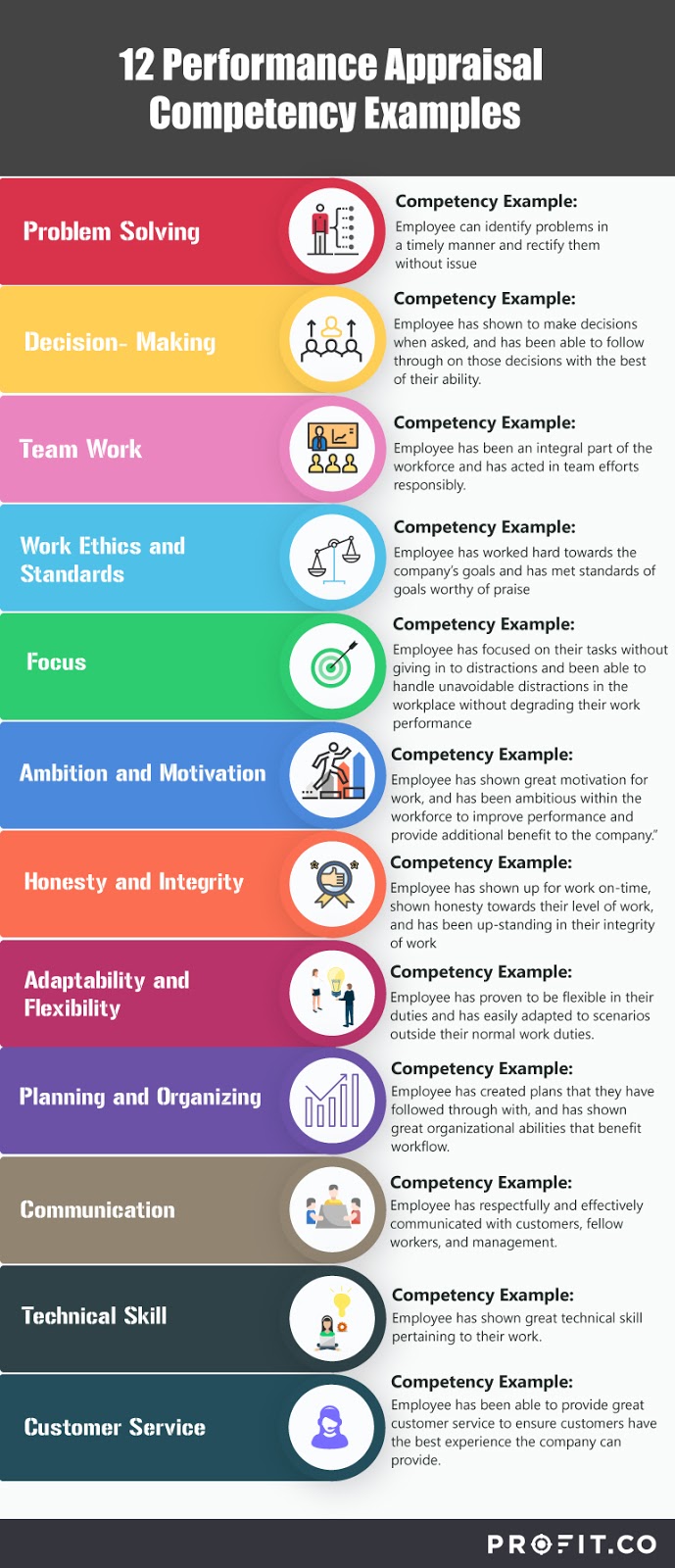
To help you build your core competencies for a performance review, here are 12 core competencies.
These examples are relatively general and can be adjusted for use in any department or industry. We’ll first provide a competency statement example to help you understand how these evaluations should be structured, and then we’ll offer up some examples of performance evaluation comments, including competency & career development plan appraisal comments
1. Problem Solving
Example: “Employees can identify problems in a timely manner and rectify them without issue.”
Praise: “Your ability to effectively diagnose complex problems and find simple solutions is outstanding.”
Constructive comments: “If you’re addressed with a problem you’re unsure how to solve, try to ask myself or one of your peers for help. Finding solutions is a team effort, and together, we can come up with solutions that work for everyone.”
2. Decision-Making
Example: “Employee has shown to make decisions when asked, and has been able to follow through on those decisions with the best of their ability.”
Praise: “You’ve shown great initiative making decisions that have led to good outcomes. We’re proud to have you as a part of our team.”
Constructive comments: “When making decisions, try to understand the whole situation so you can make the best judgment on it. One good idea is to weigh the pros and cons to understand if the outcome will be the best.”
3. Teamwork
Example: “Employee has been an integral part of the workforce and has acted in team efforts responsibly.”
Praise: “You’re great with working with our team, and everyone values your input.” Or, “You’ve shown great leadership and are great at playing to everyone’s strengths.”
Constructive comments: “It’s great that you succeed in doing your job, but when others need help, try to offer help or even praise to cheer them on.” Or, “Try to communicate more with your team to best understand how the team can work towards our collective goals.”
4. Work Ethics and Standards
Example: “Employee has worked hard towards the company’s goals and has met standards of goals worthy of praise.”
Praise: “We’re so thrilled you put in your best work and would love to extend our congratulations. Good job, as always.”
Constructive comments: “We want you to embody our company’s ethics and standards. Here are a few suggestions we can work on to improve that.”
5. Focus
Example: “Employees have focused on their tasks without giving in to distractions and been able to handle unavoidable distractions in the workplace without degrading their work performance.”
Praise: “We love how you’re able to tackle a job and get it done without breaking from it.”
Constructive comments: “Sometimes it seems like you’re distracted. Are there any tasks that you’re doing that seem like too much of a strain of attention, or anything distracting you we can change?”
6. Ambition and Motivation
Example: “Employee has shown great motivation for work, and has been ambitious within the workforce to improve performance and provide additional benefit to the company.”
Praise: “We can’t be more amazed that you’ve improved this much. Great effort, we’re proud of you.”
Constructive comments: “We’ve found that you sometimes focus on some aspects of your job over others. How about we talk about what’s bothering you with those areas and propose a solution?”
7. Honesty and Integrity
Example: “Employee has shown up for work on-time, shown honesty towards their level of work, and has been up-standing in their integrity of work.”
Praise: “You’ve had a stellar track record of timing-in that has kept this company working smoothly.” Or, “Your work has been great and you have great pride behind it. You should be proud.”
Constructive comments: “Remember it’s OK to speak openly about things that are problematic with myself or other people of management.” Or, “This one job was done great, you should borrow the same pride from that onto your other work and make them just as good.”
8. Adaptability and Flexibility
Example: “Employees have proven to be flexible in their duties and have easily adapted to scenarios outside their normal work duties.”
Praise: “No matter what is thrown at you, you seem to be able to handle it. That makes us proud to have you as a part of our company.”
Constructive comments: “We find your job duties might be overwhelming you. Let’s schedule some additional training in the field you seem to be hindered by to help you out a bit.”
9. Planning and Organizing
Example: “Employee has created plans that they have followed through with, and has shown great organizational abilities that benefit workflow.”
Praise: “It’s amazing how well you can plan and organize your job duties and we’re impressed on how thorough and simple to follow.”
Constructive comments: “When tasked with a big project, try to work out a plan of action and tackle each step one by one.” Or, “To ensure your working conditions are as efficient as possible so you don’t run into issues. Try to organize a bit more.”
10. Communication
Example: “Employee has respectfully and effectively communicated with customers, fellow workers, and management.”
Praise: “Customers and your fellow coworkers all feel like you can communicate with great ability. We really value that in our company.”
Constructive comments: “When explaining things to other people, try to keep in mind they might not know what you’re talking about. It’s best to thoroughly but concisely explain your thoughts.”
11. Technical Skill
Example: “Employee has shown great technical skill pertaining to their work.”
Praise: “Your skills are astounding and it really shows in the quality of work you do.”
Constructive comments: “Sometimes it seems like you lack a certain understanding of your job. That’s perfectly natural and fine, but we’d like to offer you some training or guidance to help you build your skills.”
12. Customer Service
Example: “Employee has been able to provide great customer service to ensure customers have the best experience the company can provide.”
Praise: “Customers always adore you and say you’re the reason why they do business with our store. We’re so happy to have you part of our team.”
Constructive comments: “Try always to keep an open mind with customers, even if they seem a little irate. Oftentimes, if you maintain a good demeanor and build relationships with them, they’ll appreciate your effort.”
Core Competencies Examples: A Complete Reference for Performance Reviews
Core competencies are the fundamental skills, behaviours, and attributes that every employee in an organisation is expected to demonstrate, regardless of their role, seniority, or department. They represent the organisation’s non-negotiable performance standards. In a performance appraisal, core competencies are evaluated alongside technical or role-specific competencies to give a complete picture of how an employee performs.
Not all competencies are the same. Understanding the three types helps managers choose the right competencies for each role’s review, and helps employees understand which gaps to address.
Three Types of Competencies Explained
| Type | Definition | Who It Applies To | Examples |
|---|---|---|---|
| Core Competencies | Universal skills and behaviours expected from every employee regardless of role | All employees, from entry-level to executive | Communication, teamwork, integrity, adaptability, customer focus, problem solving |
| Technical Competencies | Role-specific knowledge and skills required to perform the technical functions of the job | Defined per role or department | Software engineering: coding; Finance: financial modelling; Medical: clinical assessment; Sales: CRM proficiency |
| Behavioural Competencies | Observable patterns of behaviour that predict how an employee will approach their work and interactions | Usually assessed for management and leadership roles in addition to core | Initiative, resilience, influence, strategic thinking, coaching others, managing under pressure |
Core Competencies Examples: All 12 at a Glance
The table below summarises all 12 performance appraisal competencies, a quick-reference guide for managers building review forms and employees preparing self-assessments.
| Competency | Type | What Strong Performance Looks Like | What a Development Need Looks Like |
|---|---|---|---|
| Problem Solving | Core | Identifies root causes quickly, generates multiple solution options, implements fixes that prevent recurrence | Addresses surface symptoms rather than root causes; requires significant direction when facing unfamiliar problems |
| Decision-Making | Core | Makes timely decisions with available information; explains reasoning clearly; adapts when new information changes the situation | Defers decisions unnecessarily; makes choices without considering full context; reverses decisions under pressure without good reason |
| Teamwork | Core | Proactively supports colleagues, shares information freely, contributes to team goals beyond individual remit | Works in isolation; reluctant to share information or expertise; focuses on individual output at the expense of team outcomes |
| Work Ethics & Standards | Core | Consistently delivers to the highest standard; takes ownership without prompting; proactively addresses quality issues | Requires close supervision to maintain quality; standards vary based on who is watching; avoids accountability for errors |
| Focus | Core | Maintains concentration on priorities despite competing demands; delivers to deadline without quality compromise | Easily distracted; switches between tasks without completing them; deadline performance inconsistent |
| Ambition & Motivation | Core | Actively seeks growth opportunities; sets stretch goals; improves without prompting between reviews | Satisfied with minimum expectations; does not seek development opportunities; requires external motivation to maintain performance |
| Honesty & Integrity | Core | Transparent about challenges and mistakes; consistent whether or not observed; raises issues early | Minimises or conceals problems; behaviour differs under observation; reluctant to acknowledge errors |
| Adaptability | Behavioural | Adjusts effectively to changing priorities, structures, or methods; treats change as an opportunity rather than a disruption | Resists change; requires significant time to adjust to new processes; productivity drops materially during transitions |
| Planning & Organising | Core | Structures complex work into manageable steps; anticipates bottlenecks; delivers without last-minute escalations | Work is reactive rather than planned; misses interdependencies; frequently escalates issues that could have been anticipated |
| Communication | Core | Tailors communication style to audience; ensures understanding; proactively shares relevant information | Communication is inconsistent in quality; important information withheld or unclear; style doesn’t adapt to audience needs |
| Technical Skill | Technical | Demonstrates full proficiency in role-required tools and processes; others seek their technical input | Skill gaps impact delivery quality; requires repetitive guidance on standard technical tasks; avoids technical challenges |
| Customer Service | Core / Behavioural | Consistently creates positive customer experiences; anticipates customer needs; receives unsolicited positive feedback | Customer interactions produce complaints or require escalation; reactive rather than proactive in addressing customer needs |
How to use this table: use the “What Strong Performance Looks Like” column to write positive appraisal comments. Use the “What a Development Need Looks Like” column to frame constructive feedback with specific, observable examples from the review period.
Performance Appraisal Comments by Competency: Copy-Paste Examples
Appraisal comments are the written statements managers use in performance reviews to describe how well an employee has demonstrated a specific competency during the review period. Effective appraisal comments are specific (based on observed behaviour, not personality), balanced (acknowledging strengths and development needs), and actionable (giving the employee a clear direction for improvement or continuation).
The comments below are structured as copy-paste templates for seven of the most commonly evaluated competencies. Replace “the employee” with the person’s name and adjust to match observed behaviour from the review period.
| Competency | Positive Appraisal Comment (Copy-Paste Template) | Constructive Appraisal Comment (Copy-Paste Template) |
|---|---|---|
| Communication | [Name] communicates with clarity and consistency across all audiences. Their written updates are well-structured and easy to act on, and colleagues frequently note that they receive the right information at the right time without needing to chase. This is a genuine strength that contributes to team efficiency. | [Name] would benefit from more regular proactive communication with the team, particularly on tasks that involve dependencies. On several occasions this quarter, information was shared later than needed, creating delays downstream. Agreeing a communication rhythm for shared projects would strengthen this area significantly. |
| Customer Focus | [Name] consistently puts the customer’s experience at the centre of their decisions. They receive direct positive feedback from clients and take the time to understand customer needs before proposing solutions. This customer-first orientation is visible in their work and the relationships they maintain. | [Name] is developing their customer focus competency. There have been instances this quarter where responses to customer queries were slower than the standard, and the tone of some communications could have been warmer. A focused effort on response time and communication style would make a meaningful improvement. |
| Adaptability | [Name] handles change with composure and flexibility. When priorities shifted significantly this quarter, they adjusted their approach without loss of quality or energy, and actively supported colleagues who found the transition more challenging. This resilience is a real asset to the team during periods of change. | [Name] has found some of the recent changes to process and structure challenging. There have been periods where productivity dipped materially during transitions. Building a personal toolkit for navigating change, starting with a conversation about what makes transitions most difficult, would help address this constructively. |
| Teamwork | [Name] is a dependable and generous team member. They contribute to team discussions thoughtfully, offer help to colleagues proactively, and represent the team positively to other departments. Their collaborative approach makes the team more effective and is regularly noticed by peers. | [Name] tends to work independently and is less visible in team efforts. While their individual output is solid, there are opportunities to contribute more actively to shared goals and to build stronger working relationships across the team. Making a deliberate effort to participate in team discussions would be a good starting point. |
| Planning & Organising | [Name] manages their workload with excellent structure and foresight. They consistently anticipate bottlenecks before they occur, communicate proactively about capacity, and deliver to deadline without last-minute pressure. Their planning discipline sets a strong example for the team. | [Name]’s approach to planning and organisation is an area for development this period. Several tasks were managed reactively, escalated close to deadline, rather than with the forward planning that would have made them more manageable. Building a habit of weekly planning review would address this meaningfully. |
| Integrity | [Name] demonstrates strong personal integrity in all their interactions. They are transparent about challenges, acknowledge mistakes promptly, and their behaviour is consistent whether or not they are being directly observed. This consistency builds genuine trust with colleagues and managers. | [Name] is developing their integrity competency, particularly around transparency. On a few occasions this period, issues were raised later than they should have been. Building a habit of early escalation, treating early disclosure as a sign of professionalism rather than weakness, would strengthen this area. |
| Problem Solving | [Name] approaches problems with systematic thinking and genuine ownership. They analyse situations before acting, consider multiple options, and propose solutions that address root causes rather than symptoms. Their problem-solving approach consistently produces durable outcomes. | [Name] is building their problem-solving skills. In some situations this period, solutions were implemented quickly but addressed symptoms rather than root causes, requiring rework. Slowing down the diagnosis step before implementing a fix would improve the durability of solutions and reduce repeat issues. |
How to Adapt These Comments
- For self-assessments: rewrite from the first person (“I communicate with clarity…”) and include a specific example from the period under review
- For 360-degree reviews: frame comments as observations rather than evaluations (“I have noticed that [Name] communicates with clarity…”)
- For development conversations: use the constructive comment as the opening position, then agree on one specific action the employee will take before the next review
Common Mistakes in Writing Appraisal Comments
Avoid these four patterns: they reduce the usefulness of appraisal comments and make it harder for employees to act on feedback:
- Commenting on personality rather than behaviour: “She is a great person” or “He has a bad attitude” : comments should describe what was observed, not who the person is
- Using vague language without examples: “Needs to improve communication” gives no actionable direction : specify what, when, and what better looks like
- Writing comments that could apply to anyone: every appraisal comment should be specific enough that only this employee would recognise themselves in it
- Focusing only on negatives: even for employees with significant development needs, leading with one genuine strength before constructive feedback produces a more productive conversation
Performance Competencies in Profit.co
Profit.co’s performance management software allows HR administrators and managers to conduct customizable, detailed, and efficient performance reviews that work for both reviewers and employees. Now users can create configurable Review templates and Q&A Templates based on their organizational needs. The review templates can be saved and used in the future.
Profit.co supports two types of performance reviews: standard reviews, and affinity-based reviews. Standard reviews, also called conversation and feedback reviews, allow HR administrators to customize a collection of open-ended questions answered by both managers and reviewed employees.
While standard reviews include competency rating scales, affinity-based reviews are more reliant on competency rating scales to help quantify employee skills and attributes.
HR administrators can assign competencies into groups, and designate competency groups for each department or team, ensuring that all the skills or attributes that employees in certain areas of the company need to be evaluated on are available during their review.
Managers can view employee’s previous performance reviews during new reviews and note any improvements or lags in performance.
This software makes it easier than ever to create competencies and evaluate employees with an organized record of performance, experience, and feedback.
From Competency Definition to Review Completion: Profit.co Owns Every Step
Frequently Asked Questions
A good competency statement either reinforces the strengths or gives clear direction for improvement of weak competencies. A good competency statement in case of positive feedback should be about further reinforcing the competency and providing challenging opportunities to build the strength further. A good competency statement in case of negative feedback or weakness should always include a future plan of action for improvement.
These are key competencies directly affecting an individual’s performance. Some of these can be personality based or learned competencies. The 12 performance competencies are: 1. Problem Solving, 2. Decision-Making, 3. Teamwork, 4. Work Ethics and Standards, 5. Focus, 6. Ambition and Motivation, 7. Honesty and Integrity, 8. Adaptability and Flexibility, 9. Planning and Organizing, 10. Communication, 11. Technical Skill, 12. Customer Service.
Performance competencies are the values you and your company have selected as the most integral skills or characteristics an employee must possess to do their job effectively. The statements which assess, evaluate and analyze these key characteristics or skills are called competency statements. Example of competency statement for communication competency: “Make a concentrated effort to communicate more with your team so we can all work together towards our collective goals.”
Core competencies examples in a performance review include: communication (how clearly and consistently the employee shares information), teamwork (how effectively they contribute to shared goals), problem solving (how they approach and resolve challenges), adaptability (how they respond to change), planning and organising (how well they structure their work), integrity (how consistently they demonstrate honesty and accountability), and customer focus (how well they prioritise and serve customer needs). These seven, along with decision-making, work ethics, focus, ambition, and technical skill, form the 12 most commonly assessed performance appraisal competencies.
A competency appraisal is a structured performance review that evaluates an employee against a defined set of competencies: the skills, behaviours, and attributes considered essential for effective job performance in their role. Unlike a standard performance review that focuses on targets and outputs, a competency appraisal evaluates how the employee works: the behaviours and capabilities they demonstrate throughout the review period. The result is a more complete picture of performance that supports both assessment and development planning.
To write effective appraisal comments for the communication competency, base the comment on specific observed behaviour from the review period. For a positive comment: “[Name] communicates with clarity and consistency: their written updates are well-structured and colleagues regularly receive the right information at the right time.” For a constructive comment: “[Name] would benefit from more proactive communication on tasks involving dependencies: on several occasions this quarter, information was shared later than needed, creating delays for the team.” Always include a specific example and, for constructive comments, a suggested improvement action.