

Published Date: Jan 21, 2026
TL;DR
Traditional project planning is slow, manual, and often outdated before projects even start. AI project planning changes this by generating complete, context-aware project plans in hours instead of days. By learning from historical data, optimizing resources intelligently, and enforcing compliance automatically, AI helps PMOs improve accuracy, increase portfolio throughput, and shift focus from administration to strategy.The Project Planning Bottleneck
Every 20 seconds, organizations around the world waste $1 million. According to the Project Management Institute, nearly 10% of every dollar invested by businesses is lost due to poor project performance, with inadequate planning and execution among the top contributors. For PMO leaders, this statistic shows up every day in delayed starts, rework, resource conflicts, and plans that fall apart before delivery even begins.If you’ve spent time inside a PMO, the pattern is familiar. A new project request lands, followed by days of email threads, intake forms, spreadsheet-based estimates, and back-and-forth negotiations with resource managers. By the time the project plan is finalized, assumptions have changed, and the plan is outdated before the kickoff meeting.
This is inefficient and expensive. Traditional project planning typically consumes many hours of skilled labor before a single deliverable and still leaves teams exposed to risk, missed requirements, and inaccurate timelines.
But what if project planning didn’t have to work this way?
What if complete, context-aware project plans could be generated in hours instead of days, not through shortcuts, but through intelligent systems that learn from your organization’s real data, constraints, and outcomes?
That’s precisely where AI project planning is changing the game.
The AI Project Planning Revolution
Artificial intelligence is transforming how organizations plan projects. Unlike earlier template-based or rules-based automation, modern AI tools use advanced machine learning to understand context, learn from organizational history, and make complex trade-off decisions that once required senior project management expertise.The difference is significant. Traditional PPM tools such as Planview, Clarity, and Microsoft Project provide template libraries, which are pre-filled project plans that still require substantial manual customization. While these templates prevent starting from scratch, they do not account for your organization’s specific constraints, resource dynamics, or strategic priorities.
“What all of us have to do is to make sure we are using AI in a way that is for the benefit of humanity, not to the detriment of humanity.”

AI project planning goes several steps further by:
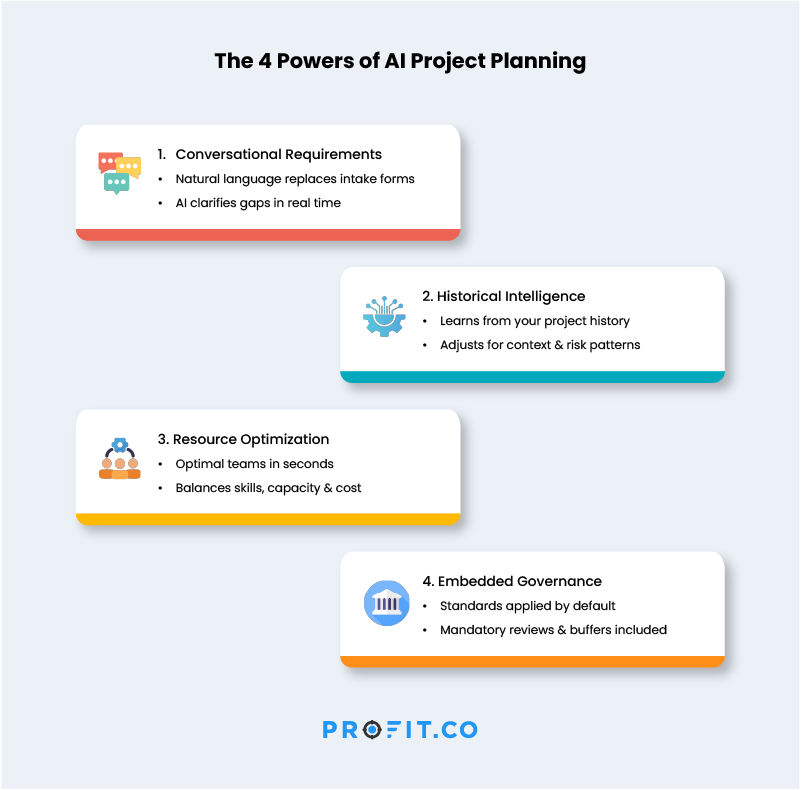
1. Conversational Requirements Gathering
Rather than completing lengthy intake forms, project sponsors can communicate their needs in natural language. AI-powered systems then ask clarifying questions, extract structured requirements, and identify gaps or contradictions, replicating the efficiency of an experienced business analyst in a fraction of the time.This approach can reduce the typical 2-3 requirement gathering meetings to a 20-minute AI-guided conversation, resulting in a comprehensive project charter, stakeholder analysis, and preliminary scope statement.
See what AI project planning would look like for your PMO
2. Intelligent Historical Pattern Matching
AI project planning systems analyze your organization’s historical project data, including successes and failures, to identify patterns that may not be apparent to human planners. For example, they can determine that projects involving legacy system integration take 37% longer than greenfield development, distributed teams across more than three time zones require 15% additional communication overhead, and Q4 projects with December milestones are more likely to experience delays.This process goes beyond basic data mining and leverages organizational intelligence. For instance, the AI recognizes that last year’s “Customer Portal Redesign v2.0” shares 87% similarity with the current request but also considers that your team now has React expertise, automatically adjusting estimates as needed.
3. Dynamic Resource Optimization
One of the most significant capabilities of AI tools for project management is intelligent resource allocation. The AI evaluates more than just skill-to-task matching; it also considers:- Current utilization and capacity across your entire resource pool
- Development opportunities for mid-level resources who could stretch into senior roles with proper mentorship
- Team composition dynamics that balance senior expertise with cost efficiency
- Burnout risk based on sustained high utilization and recent project intensity
- Compliance requirements such as HIPAA training for healthcare projects or SOC 2 certification for customer data handling
While a resource manager may spend several hours assembling a team through manual processes, AI project planning systems can propose optimal team compositions within seconds, including alternatives if primary resources are unavailable.
4. Automated Compliance and Standards Enforcement
Regulatory compliance and organizational standards are among the most time-consuming aspects of project planning. Each industry has specific requirements, such as HIPAA for healthcare, SOC 2 for SaaS, and GDPR for EU operations. Organizations have also developed best practices over many years.AI project planning systems act as institutional memory, automatically:
- Adding mandatory project phases that can’t be skipped
- Including required tollgate reviews and approval checkpoints
- Incorporating documentation deliverables specific to project type and regulatory framework
- Applying estimation buffers based on complexity and risk factors
- Enforcing team composition requirements (minimum senior-to-junior ratios, required roles by project size)
This approach moves beyond basic compliance, applying organizational knowledge to ensure every project benefits from accumulated institutional experience.
How AI Project Planning Technology Actually Works
Behind the scenes, AI project planning relies on a mix of advanced technologies working together. Understanding the mechanics clarifies the system’s capabilities. Modern AI project planning systems use a hybrid architecture:Natural Language Processing (NLP) extracts structured information from conversational input. For example, if a sponsor says, “We need to migrate customer data from Oracle to Snowflake by Q3 for the consolidation initiative,” the AI identifies the project type (data migration), scope (customer data), source and target systems (Oracle to Snowflake), timeline (Q3), and strategic context (consolidation initiative).
Vector embeddings allow the AI to match new projects to historical ones based on semantic similarity. Your 156 completed projects are converted into mathematical representations that capture both keywords and contextual relationships. The AI can identify that “portal redesign” and “customer self-service modernization” are similar, even if the terminology varies.
Constraint optimization engines address the complex challenge of allocating resources across competing priorities. Unlike simple rule-based systems, they use operations research algorithms to evaluate millions of configurations and identify solutions that maximize strategic value while meeting resource, budget, and timeline requirements.
Machine learning feedback loops continuously improve accuracy. After each project, the AI compares its estimates to actual outcomes, identifies variance patterns, and refines its models.
Competitive Landscape: How PPM Vendors Are Responding
Traditional PPM vendors are incorporating AI features, with varying results. While some prioritize scheduling optimization and others focus on analytics or summaries, many lack true organizational learning and context-aware intelligence. Next-generation AI-native platforms differentiate themselves by providing conversational interfaces, proactive recommendations, and clear explanations for decisions.Implementation Realities: What Actually Works in Practice
While AI project planning offers significant benefits, success requires more than adopting a new tool. Effective organizations follow consistent practices rooted in discipline, realism, and change management.Here’s what actually works.
Start With Your “PMO Brain”
The most successful deployments begin by encoding institutional knowledge into what we call a “PMO Cockpit”, a centralized repository where your organization’s priorities, standards, compliance requirements, resource policies, and best practices are explicitly defined. This becomes the AI’s foundation for understanding your unique context.A well-structured PMO Cockpit typically includes:
- Strategic priorities and funding rules
- Planning standards and governance models
- Compliance and regulatory requirements
- Resource policies and role definitions
- Estimation guidelines and best practices
This approach enables the AI to generate plans tailored to your organization, rather than relying on generic templates.
Maintaining the PMO Cockpit as living documentation is essential. Organizations that update priorities regularly, incorporate lessons learned, and refine models based on outcomes achieve ongoing improvements in AI accuracy and relevance.
Embrace Hybrid Intelligence, Not Full Autonomy
AI project planning is most effective when it augments, rather than replaces, human judgment. High-performing PMOs maintain clear human oversight at key decision points, such as:- Budget approvals above the defined thresholds
- Compliance-sensitive decisions
- Resource allocations exceeding 100% capacity
- High-value or high-risk initiatives (for example, projects over $500K)
In these situations, AI generates options, analyzes trade-offs, and highlights risks, while final decisions remain with people. This balance maintains trust and delivers significant efficiency gains.
Measure Early, Then Iterate Often
Organizations that achieve sustained success track outcomes from the outset. Clear metrics distinguish actual impact from perceived improvement.Common success benchmarks include:
- Plan generation time
- Estimation accuracy
- PM satisfaction
- First-time compliance rate
- Resource conflicts
Teams that review these metrics monthly consistently outperform those who treat AI project planning as a one-time automation.
Plan for Change, Not Just Technology
Transitioning from manual to AI-assisted planning represents a workflow shift, not merely a software upgrade. Successful implementations prioritize both people and tools.Effective change management usually includes:
- Executive sponsorship that frames AI as a strategic shift, not a productivity hack
- Phased rollouts that start with pilot teams and expand based on success stories
- Clear role evolution, especially for PMOs transitioning from administrative work to portfolio-level optimization
- Transparent communication about what AI can and cannot do, helping set realistic expectations
When teams understand the importance of the change, adoption occurs more readily.
The Future of AI Project Planning
AI project planning continues to evolve, with upcoming capabilities expected to further support portfolio-level decision-making.Emerging trends include:
Portfolio-Level Optimization
Rather than planning projects in isolation, AI systems are beginning to optimize entire portfolios. They can recommend which projects to start, delay, or sequence based on capacity and strategic value, addressing the persistent challenge of limited resources.Predictive Risk Identification
Advanced models can identify patterns that indicate potential issues early, such as seasonal delivery risks, coordination challenges in hybrid teams, or historically risky project types.Real-Time Replanning
As conditions change, AI can quickly generate alternative scenarios. If a key team member becomes unavailable, the system proposes ranked options to maintain progress, balancing cost, risk, and timelines.Natural Language Plan Changes
With advanced tools, project managers can adjust plans using natural language. For example, a request such as “Move the security review one sprint earlier and add a senior architect at 25% capacity,” triggers automatic schedule and budget recalculations throughout the plan.The Bottom Line
AI project planning is now a practical tool. Leading organizations use it to accelerate planning, optimize resource allocation, and improve portfolio decisions with their existing teams.The primary change is organizational, not technological. PMOs are shifting from building plans and gathering inputs to focusing on priorities, managing trade-offs, and guiding strategy. AI enables this transition by freeing up time for higher-value work.
All organizations will eventually adopt AI in project planning; the main variable is timing. Early adopters are already seeing improved accuracy, increased throughput, and more confident decision-making. Late adopters will need to work to catch up.
For PMO leaders seeking to reduce administrative tasks and increase impact, AI project planning provides a practical and proven solution. The tools are available, the outcomes are measurable, and the opportunity is immediate.
Want to see how planning can move from spreadsheets to intelligent systems?
Templates and auto-scheduling help with formatting but do not support real project thinking. They treat projects as if they are all the same and depend on manual inputs. AI project planning, on the other hand, learns from your organization’s real project history, resource use, and results. It takes into account things like legacy system risks, seasonal delays, and compliance needs. This way, it creates plans that match how your organization actually works, not just how it should work in theory.
AI planning systems do not replace human judgment; they help make it better. At first, these systems usually match or slightly beat human estimates, and they get more accurate as they learn from real results.
AI project planning is built to handle imperfect data. It begins by clearly pointing out gaps, inconsistencies, and assumptions instead of hiding them. Early benefits often come from showing where important knowledge is only in people’s heads. As plans and results are recorded more consistently over time, the system gets more accurate. This means you start seeing value right away while also improving your data quality.
No. AI changes the PMO’s role instead of removing it. Routine planning, estimation, and compliance tasks become automated, which lets project managers focus on working with stakeholders, managing risks, and making strategic choices. Top PMOs use AI to help guide portfolio priorities and capacity decisions, while people still handle governance, approvals, and accountability.
Related Articles
-
The Execution Gap: Why Government Agencies Excel at Vision and Fail at Delivery
Bastin Gerald Founder & CEO at Profit.co Published Date: March 13, 2026 TL;DR Government agencies are among the most sophisticated... Read more
-
Knowledge Resource Management in Enterprise Projects
Karthick Nethaji Kaleeswaran Director of Products | Strategy Consultant Published Date: March 23, 2026 TL;DR Knowledge is one of the... Read more
-
Beyond Headcount: The Complete Guide to Resource Management in Enterprise Project Portfolio Management
Karthick Nethaji Kaleeswaran Director of Products | Strategy Consultant Published Date: March 23, 2026 TL;DR Most project resource plans focus... Read more
-
Financial Resource Planning in Project Portfolios
Karthick Nethaji Kaleeswaran Director of Products | Strategy Consultant Published Date: March 23, 2026 TL;DR Every project has a budget... Read more