

Published Date: Dec 19, 2025
TL;DR
Strategic portfolio management already fixes the big portfolio problems: misalignment, slow rebalancing, unclear ROI, and missed outcomes. AI-native strategic portfolio management takes that same framework and makes it faster, lighter, and continuous. It reduces manual PMO work, enables real-time scenario planning, predicts risk and value drift early, and keeps every project tied to outcomes. Profit.co brings these AI-native capabilities into day-to-day portfolio governance.The way most portfolios are governed today was designed for a slower world. Annual planning cycles. Quarterly reviews. Heavy spreadsheets. Status meetings often resemble theatrical performances. That model worked when markets moved slowly, and priorities stayed stable. But that’s not the world CFOs and PMOs live in anymore. Now, decisions need to be faster. Investments need to shift sooner. Leaders need clearer answers with less noise. And if governance can’t keep up with that pace, strategy starts drifting, even when teams are delivering. That’s why AI-native strategic portfolio management matters. Not as a shiny new idea, but as a practical upgrade to help portfolios move at the speed of the business.
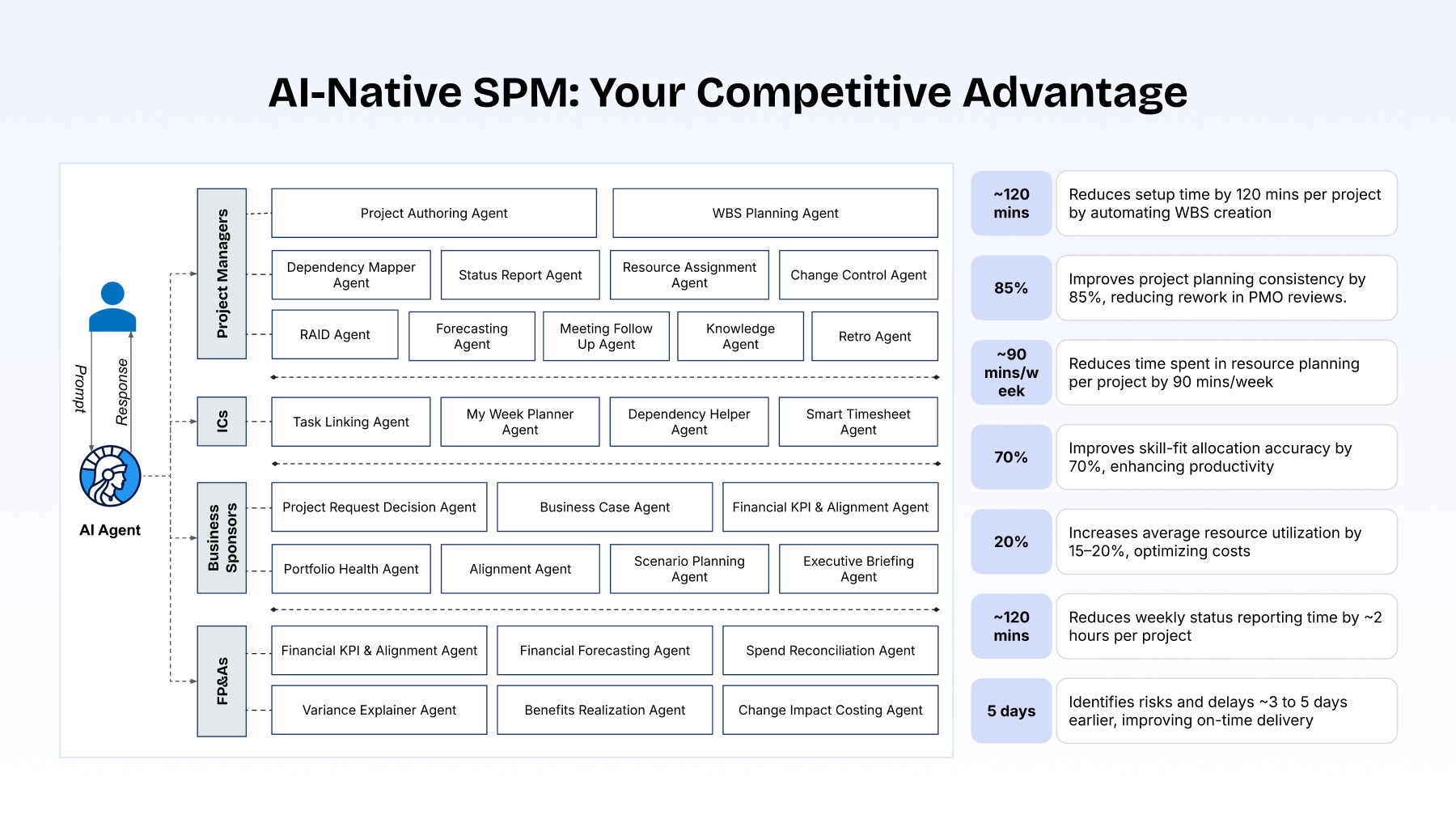
Before we jump into what AI changes, it helps to ground ourselves in what hasn’t changed, because the core portfolio problems are still the same.
The four project portfolio problems that never went away
Even with better tools and smarter teams, most portfolios still struggle with four familiar issues:- Misalignment: too many projects don’t serve strategy.
- Unclear ROI: CAPEX, OPEX, resources, and benefits live in different places.
- Slow rebalancing: priorities change, but the portfolio can’t move fast enough.
- Missed outcomes: projects finish “successfully,” but business value doesn’t show up.
Strategic portfolio management addresses these through alignment, investment modeling, flexibility, and value realization. So here’s the key differentiator when AI is part of the solution. It makes those pillars easier to run in real time, without the usual friction. Let’s break down what that looks like.
See AI-native strategic portfolio management in action with Profit.co
Four AI-native shifts that change governance for good
1. From manual PMO work to lighter, faster support
Most PMOs spend too much time on routine work like collecting updates, fixing data, building reports, and chasing inputs. That effort is necessary, but it doesn’t move the strategy forward. It just helps the portfolio stay visible.What changes now is that a lot of this routine work doesn’t need to sit on people’s shoulders anymore.
What changes with AI:
- Drafts project updates and summaries automatically
- Flags delays, risks, and gaps early
- Reduces manual reporting and follow-ups
PMOs and portfolio leaders gain back time to focus on decisions, not paperwork.
2. From fixed plans to plans that stay current
Most portfolios are built during planning season and then followed for months, even when priorities change. That’s because the portfolio is difficult to adjust once money and resources are locked.What changes now is that planning doesn’t have to be a once-a-year event. It can stay updated as business signals change.
What changes with AI:
- Re-scores priorities when strategy shifts
- Refreshes assumptions during the year
- Helps teams model new options quickly
This shift keeps your portfolio aligned with the current strategy, and when planning becomes continuous, governance also receives better signals, not just updates about past events.
3. From late reporting to early warning
Traditional portfolio reviews usually tell you what happened after the fact. You find out a project is drifting, costs are rising, or value is slipping only when the signals are too strong to ignore.What changes now is that you can pick up those signals earlier—while there’s still time to fix course.
What changes with AI:
- Spots patterns of delay or risk early
- Highlights value drift before it becomes failure
- Predicts capacity or dependency issues ahead of time
Leaders don’t have to wait for problems to become visible. And once you can predict drift early, the next logical step is to govern based on outcomes, not just project health.
4. From tracking delivery to tracking real business results
Most governance systems treat a project as successful when it finishes delivery. But as we discussed in the Output Illusion blog, delivery doesn’t always create results.What changes now is that outcomes can be tracked during execution, not just reviewed after closure.
What changes with AI:
- Watches outcome signals during execution
- Tracks leading indicators tied to objectives
- Alerts teams when outcomes aren’t forming
Projects become visible and dynamic. They deliver real business impact. So that’s what changes at a governance level. The next question most leaders ask is, “Okay, but what does this look like on a real platform?” Let’s make that concrete.
What this looks like inside Profit.co
Profit.co helps teams run strategic portfolio management without adding extra work. It keeps strategy, spending, delivery, and outcomes connected in one place, so leaders always know what’s moving the business and what’s not.Here’s what changes when you use Profit.co:
What changes with AI in Profit.co:
- Helps teams build plans faster by suggesting work breakdowns and next steps
- Summarizes progress automatically so PMOs don’t spend hours preparing reviews
- Surfaces early signals when risks rise or value starts drifting
- Gives role-based help for project owners, sponsors, and finance leaders
- Keeps dashboards updated in real time without manual reporting
This gives you less time collecting updates and chasing clarity. More time making portfolio decisions that match strategy. And because the platform ties every initiative back to objectives and outcomes, portfolio reviews stop being about “what’s on track” and start being about “what’s creating real value.”
Strategic portfolio management helps you fund the right work, shift fast when priorities change, and make sure projects create real results. What AI adds is speed and clarity, less manual effort, earlier signals, and better decisions while work is still in motion. The outcome is a portfolio that stays connected to strategy without constant firefighting.
See AI-native strategic portfolio management in action with Profit.co
It means strategic portfolio management powered by AI support in planning, reporting, risk prediction, scenario modeling, and outcome tracking, so governance becomes faster and continuous.
No. The framework stays the same. AI makes it easier to apply at speed and scale by reducing manual work and improving decision signals.
A PMO that uses AI agents to handle routine project management activities like routine reporting, summaries, and alerts, so humans focus on portfolio choices and strategic tradeoffs.
By running scenarios quickly, showing tradeoffs instantly, and predicting capacity or dependency impacts before teams commit to a shift
Any measurable business result tied to strategy – adoption, revenue impact, operational KPIs, customer metrics, cost savings, or benefits realization pace.
No. Any org struggling with misalignment, slow planning cycles, or manual portfolio reporting can benefit, regardless of size.
Profit.co connects strategy, portfolios, and outcomes in one place and adds AI support to reduce admin load, surface predictive insights, and keep alignment alive continuously.
Related Articles
-
Scaled Agile Framework (SAFe) Runs Your Delivery. Who Owns Your Strategy?
Karthick Nethaji Kaleeswaran Director of Products | Strategy Consultant Published Date: April 1, 2026 TL;DR Scaled Agile Framework (SAFe) governs... Read more
-
The Hidden Cost of Zombie Projects in Your New Product Development Pipeline
TL;DR Zombie projects are New Product Development initiatives that were approved but never properly resourced. They remain active in the... Read more
-
IT Portfolio Rationalization: The Investment Decision Your ITSM Tool Cannot Make
Karthick Nethaji Kaleeswaran Director of Products | Strategy Consultant Published Date: March 31, 2026 TL;DR ITSM tells you what your... Read more
-
Project Portfolio Management Maturity: Where Does Your Organization Sit?
TL;DR Project portfolio management maturity is not binary. It develops across five levels, moving from reactive project tracking to predictive... Read more