
TL;DR
Most portfolios move on an annual cycle, while markets move weekly. That mismatch, called the Tempo Trap, locks money and people into yesterday’s priorities. Strategic portfolio management fixes this with portfolio flexibility: fast scenario modeling, quick tradeoff decisions, and rebalancing in minutes instead of quarters. Profit.co enables this through what-if scenarios, priority sliders, dependency and capacity views, and rapid re-approval workflows.The Tempo Trap: why your portfolio feels slow even when teams work fast
Have you ever noticed this? Your teams are moving quickly. They’re shipping, checking in, and solving problems. But the portfolio itself feels heavy, like it’s stuck and not showing any real outcomes. This is a timing problem.Most organizations still run portfolios on an annual rhythm:
- Strategy gets set in December
- Budgets get approved in January
- Projects get green-lit in February
- Meaningful delivery starts around June
By the time June arrives, the world has moved on. The customer needs shift. Competitors do something unexpected. New risks show up. Opportunities appear unexpectedly.
But your portfolio? Still following decisions made months ago.
That mismatch is the Tempo Trap: business reality changes weekly, but portfolios change annually.

So what happens when you stay stuck in that trap?
The new priority becomes a side hustle instead of a real focus. Meanwhile, low-value work continues to run, simply because it was approved earlier.
That’s how strategy drifts. This isn’t due to leaders’ lack of concern. The portfolio cannot adapt quickly enough, leading most executives to say, “We need to be more agile.” We need portfolio flexibility.
See how quickly you can rebalance budgets and capacity when priorities shift
What portfolio flexibility actually means
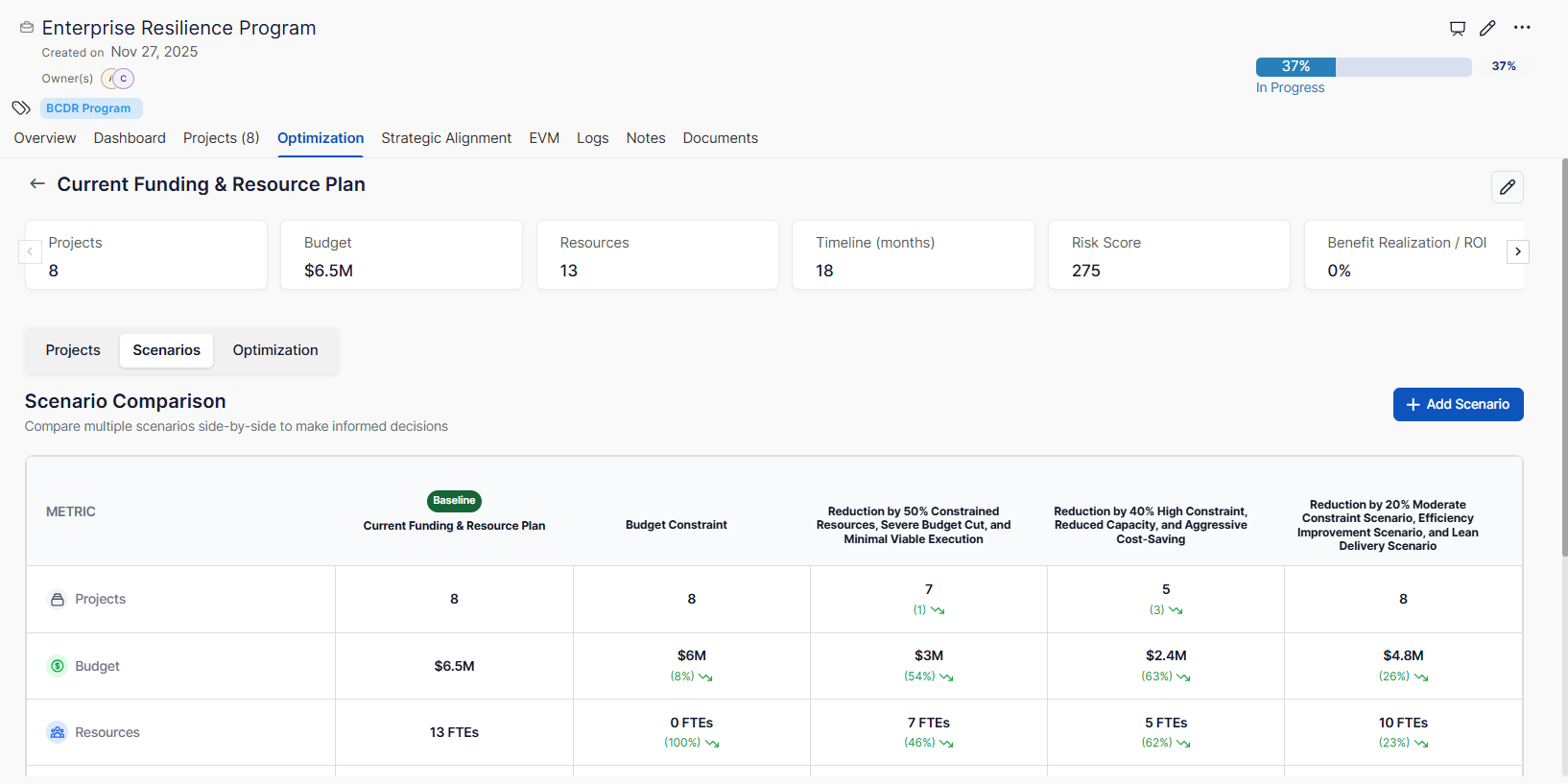
Portfolio flexibility is simple to describe: You can rebalance your portfolio in weeks, or even days, when priorities shift.But more importantly, it means you can answer “what-if” questions quickly, like:
- What if we cut 15% from low-priority projects?
- What if we accelerate a key strategic program by two quarters?
- What if a market shift forces us to free up $10M next month?
- What if capacity drops because a critical team is overloaded?
In a flexible portfolio, these questions don’t trigger a 6-week spreadsheet marathon. They get modeled fast, discussed clearly, and acted on confidently. That speed is the entire point.
To make this real, a quick example.
A real rebalance story: from 14 weeks to 30 minutes
One logistics company was struggling with a familiar challenge: they had plenty of great ideas, but they lacked clarity and speed in execution. When business priorities shifted, they faced a massive roadblock: rebalancing their portfolio took a staggering 14 weeks. By the time they could make decisions and adjust their plans, the market had already moved on, leaving them scrambling to catch up.The problem was the slow, cumbersome process of rebalancing the portfolio. They missed opportunities and lost momentum in strategic initiatives due to their inability to quickly assess and adjust.
This all changed when they implemented flexible, strategic portfolio management (SPM). With the right tools for visibility and scenario planning, they could now run multiple portfolio scenarios in under 30 minutes. The result? They identified $80M in overlapping work across portfolios, leading to significant cost savings and resource reallocation.
But the impact didn’t stop there:
- Time-to-value declined by 40%, meaning they could deliver projects faster.
- Decision-making became more agile, empowering teams to act quickly when priorities shifted.
What made this transformation possible was the flexibility to adapt quickly without turning their Project Management Office (PMO) upside down. With better visibility and the right scenario planning tools, they could rebalance their portfolio on the fly, keeping pace with changing business needs.
How Profit.co makes rapid rebalancing possible
Profit.co helps teams escape the Tempo Trap by giving them a live, decision-ready portfolio view. Here are the specific capabilities that matter:Scenario modeling built for real tradeoffs
You can model changes quickly, not in weeks of Excel work. Run scenarios like:- Cut low-priority spending
- Shift resources to a strategic initiative
- Delay projects with weak value
- Respond to new opportunities
Priority sliders and what-if allocation
Instead of debating in circles, leaders can see tradeoffs. Move priorities up or down and instantly view:- Budget impact
- Capacity impact
- Strategic impact
Dependency and capacity intelligence
Flexibility fails when you ignore reality. Profit.co shows:- Team capacity by role
- Key project dependencies
- Bottlenecks before they explode
So you refocus and rebalance based on facts.
Fast re-approval workflows
When a scenario is chosen, shifting execution doesn’t take a month of approvals. Profit.co supports quick re-approval paths, so the portfolio moves at the same pace as the strategy. Together, that’s how a portfolio becomes something you steer continuously.What changes when you escape the Tempo Trap
Once portfolios are flexible, a few things happen almost immediately:- Strategic priorities get real funding fast: Not “next planning cycle.” Now.
- Low-value work stops sooner: Because it’s clearly visible in scenarios.
- Teams stop getting whiplash: Rebalancing becomes structured and predictable, not random fire drills.
- You capture opportunities before they pass: Speed becomes a strategic advantage.
In short, your portfolio starts behaving like a living strategy system.
Run portfolio scenarios in minutes with Profit.co
It’s the gap between annual planning cycles and weekly market change. Portfolios get locked into old priorities while reality moves on.
Anytime strategy or market conditions shift. Many teams rebalance monthly or quarterly, and faster during high change
Because costs, capacity, and dependencies are scattered. Without one connected view, teams rely on manual spreadsheets and slow approvals.
Fast scenario modeling, clear tradeoff visibility, real capacity data, dependency awareness, and quick approval paths
Not if it’s structured. Flexibility doesn’t mean the ability to change when it matters with clarity.
It provides live scenario modeling, priority sliders, dependency and capacity intelligence, and workflows that make rebalancing fast and practical
Related Articles
-
Lessons from Crisis: How Leading Enterprises Rebuilt Their Portfolios
TL;DR Recovering from a crisis requires quick action and long-term planning. Prioritize strategic realignment, data-driven decisions, and resilient diversification. Rebuild... Read more
-
Closing the Value Gap: Why Delivered Projects Don’t Always Deliver Outcomes
TL;DR Many organizations celebrate project delivery, but real value is created only after adoption, behavior change, and measurable results. The... Read more
-
Resilient Project Portfolios: Adapting to Disruption and Market Shocks in 2026
Project portfolios in 2026 face a simple reality: disruption is the new normal. Between AI reshaping entire industries, geopolitical tensions... Read more
-
Predictive Analytics in PPM: What Today’s Tools Deliver and What’s Coming Next
TL;DR Predictive analytics in project portfolio management (PPM) is moving beyond basic reporting and forecasting toward intelligent decision support. While... Read more