
TL;DR
Energy and utilities companies have a unique strategic problem: they need to find a way to balance making money with being environmentally responsible, being reliable with being innovative, and giving shareholders a good return on their investment. The Balanced Scorecard framework is the best way to handle these conflicting priorities from four different points of view. Profit.co makes it possible for energy companies to use a Balanced Scorecard by bringing together strategic goals, operational KPIs, and quarterly OKRs. This helps utilities make the difficult switch to renewable energy while keeping the grid reliable and their finances in good shape.If you run an Energy or Utilities company today, you’re doing something that would have seemed impossible ten years ago. While having aggressive sustainability goals, keeping the grid 99.9% reliable, meeting the needs of regulators in multiple jurisdictions, spending billions on modernizing infrastructure, and giving shareholders steady returns.
Oh, and you have to do all of this while the industry is going through the fastest change in a hundred years, the switch from fossil fuels to renewable energy.
This is exactly why more and more Energy and Utilities companies are using the Balanced Scorecard framework. In the Energy sector, you can’t just focus on growth or efficiency; you have to find a real balance between many competing goals. Let me show you why a Balanced Scorecard is the best choice for this problem.
Why energy and utilities need more than just financial metrics
Traditional utility management puts a lot of emphasis on financial and operational metrics, such as kilowatt-hours generated, transmission losses, operating margins, and return on rate base. These numbers were important, and they still are.But the modern energy landscape has made things more complicated in ways that single-perspective metrics can’t show:
- The Sustainability Imperative: Investors, regulators, and customers all want to see measurable progress toward carbon neutrality. Your plan needs to find a balance between making money today and keeping your promises to the environment tomorrow.
- The Reliability Mandate: Customers expect power to always be available, even as you switch to intermittent renewables. One long outage can wipe out years of goodwill and cause the government to step in
- The Innovation Requirement: You are running today’s grid while also building tomorrow’s smart energy network. This includes grid modernization, energy storage, demand response, and distributed generation
- The Regulatory Complexity: There are many different groups with different goals, such as state regulators who are concerned with rates, federal agencies who are concerned with environmental compliance, local communities who are concerned with safety, and shareholders who are concerned with returns
You can’t run this business by just improving a few key metrics. You need a framework that makes you think about strategy in a balanced way. That’s the Balanced Scorecard.
Ready to solve your challenges?
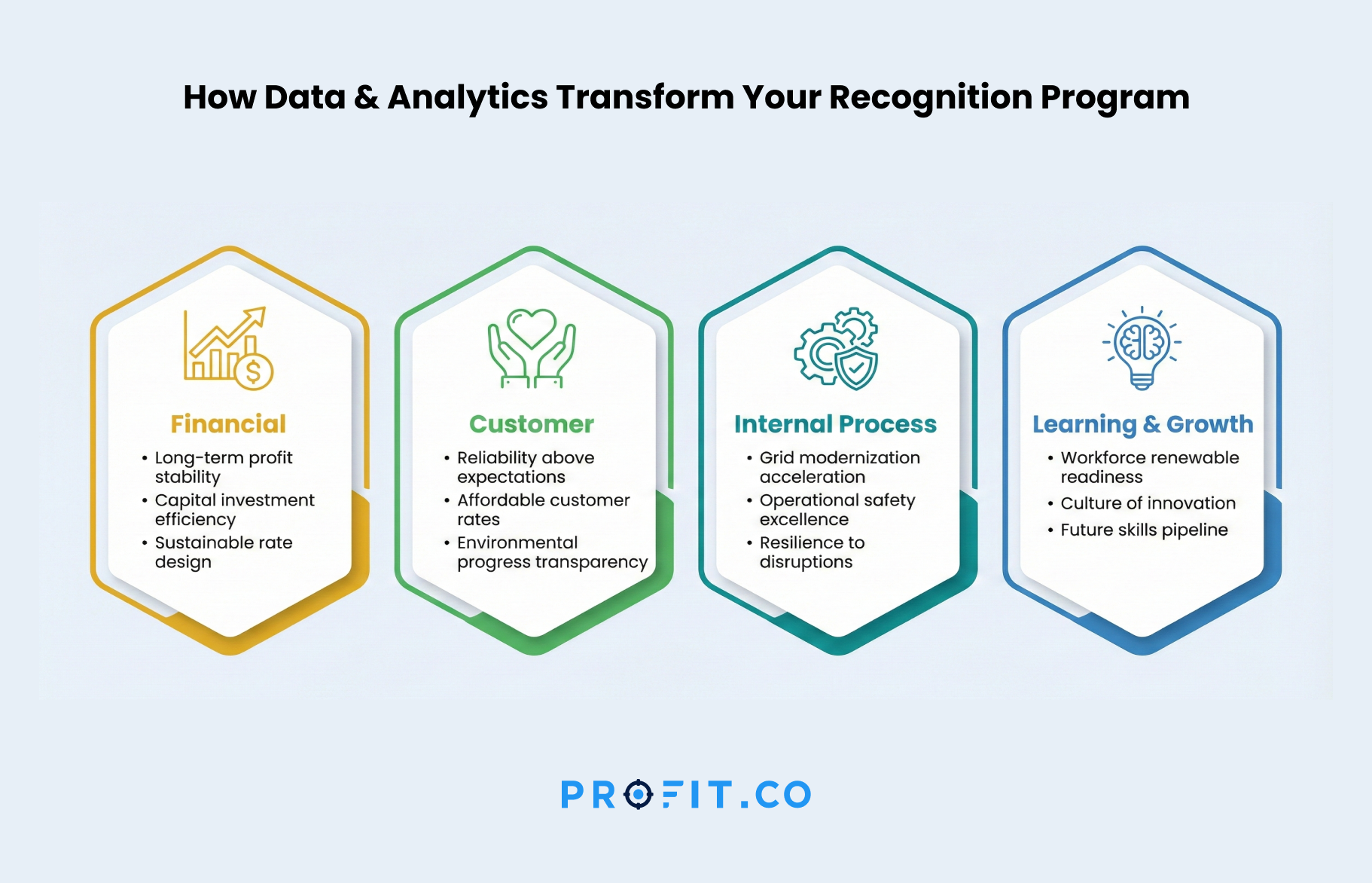
The Four Perspectives: How Energy Companies Can Find Strategic Balance
Let me show you how each Balanced Scorecard point of view deals with important problems in the energy industry.Financial Point of View: Long-Term Profitability
Yes, financial performance is still important, but the Balanced Scorecard framework makes you think about long-term profitability, not just quarterly earningsGoals for Energy Companies:
- Keep returns stable while making huge investments in infrastructure
- Make the best use of capital by dividing it up between maintenance, modernization, and new generation
- A fair balance rate design that keeps the business financially stable
- Handle regulatory risk that affects long-term financial performance
Important Numbers:
- Return on assets (after taking into account infrastructure investment)
- Getting the regulatory ROE
- How competitive your customer rates are compared to regional benchmarks
- Efficiency of capital (output per dollar spent on infrastructure)
These aren’t just “make more money” numbers, as you can see. They’re about making money in an industry that requires a lot of capital, is heavily regulated, and is going through a lot of changes.
From the customer’s point of view: reliability and sustainability
Energy companies have a unique problem: their customers want three things that may seem to be at odds with each other: reliable power, low prices, and protecting the environment.The Balanced Scorecard customer perspective lets you handle all three at the same time instead of giving up one for the other
Goals for the Future:
- Provide reliability that is better than anyone else’s (SAIDI/SAIFI metrics)
- Keep the rate affordable compared to the average income in the area
- Show that you are making measurable progress on your environmental promises
- Be open and honest with customers to earn their trust
Important Numbers:
- System Average Interruption Duration Index (SAIDI)
- Scores for customer satisfaction broken down by residential, commercial, and industrial
- Bill affordability index (percentage of the median household income)
- Customers are aware of efforts to be more environmentally friendly.
- Digital engagement rates (which stand in for modern customer relationships)
A balanced Scorecard is powerful here because it stops you from improving one area at the expense of others. You can’t just lower rates by putting off maintenance; reliability metrics will show that trade-off before it becomes a problem.
From an internal process point of view, operational excellence at scale
Energy infrastructure works all the time, with little room for mistakes. The Internal Process view makes sure you’re great at the most important strategic operations.Goals for the Strategy:
- Make the generation fleet more efficient and flexible
- Speed up the modernization of the grid and the installation of smart meters
- Make the system more resistant to extreme weather and cyberattacks
- Make sure that safety is always at the top of everyone’s mind when it comes to generation, transmission, and distribution.
Important Numbers:
- The heat rate (efficiency) of the generation fleet
- Rate of integration of renewable capacity
- Milestones reached in modernizing the grid
- Rate of injuries that keep people from working and safety incidents
- Time to respond to a cyber incident
- Completion rate for managing vegetation (for reliability)
The main point is that not all processes are equally important. Balanced Scorecard helps you tell the difference between keeping the basics of your business running and putting money into processes that give you a competitive edge or set you apart from the competition.
Learning and Growth: Making the Future’s Utility Better
This could be the most important perspective for energy companies right now. You’re not just running a utility; you’re changing into something completely different while still providing service.Goals for the Strategy:
- Train the workforce to handle renewable energy operations and manage the digital grid
- Build a culture of innovation and always getting better
- Make partnerships for new technologies like hydrogen, carbon capture, and storage.
- Attract and keep skilled workers in a market where there are a lot of them
Important Numbers:
- Making sure that the skills of the workforce match what will be needed in the future (gap analysis)
- Employees taking part in change efforts
- Working together and trying out new ideas with tech companies
- Deep succession planning for important technical jobs
- Innovation pipeline (projects that are being tested, piloted, or put into use)
Energy companies that don’t think about this are making their operations better today but are becoming less relevant. Balanced Scorecard makes sure that you are balancing your current performance with your ability to improve in the future.
How to Use Balanced Scorecard in the Real World Project: Renewable Transition Strategy
Let’s see a Balanced Scorecard-guided strategy for the industry’s biggest problem: transitioning to renewable energy.Utilities often take a tactical approach to renewables without a Balanced Scorecard, saying things like, “We need to hit 30% renewable by 2030 to satisfy regulators.” They build solar farms and wind turbines, but they have trouble with integration, reliability, and customer confusion.
With Balanced Scorecard, the same change becomes strategically balanced:
Financial Perspective Objective: “Reach renewable goals while keeping the budget in check.”
- Quarterly OKR: Establish green financing at reasonable rates
Goal from the customer’s point of view: “Build customer trust in renewable reliability”
- Quarterly OKR: Campaign to teach customers about the benefits of modernizing the grid
Goal from the Internal Process Perspective: “Add renewables without lowering reliability”
- Quarterly OKR: Install battery storage and cut back on renewable generation.
Learning and Growth Perspective Goal: “Build skills for working with renewable energy.”
- Quarterly OKR: Teach technicians how to fix solar and wind power systems
Do you see the difference? The plan isn’t just “go renewable.” It’s a balanced approach that looks at all four areas at once: financial viability, customer trust, operational reliability, and capability development.
How Profit.co Makes Balanced Scorecard Useful for Energy Companies
The problem is that energy companies often have dozens of operating units (generation plants, service territories, corporate functions) that need to work together with the company’s overall strategy while still focusing on local operations.Profit.co solves this by giving:
Unified Strategic View: Your company’s Balanced Scorecard goals flow down to the business unit and facility level, making sure that everyone is on the same page while still taking into account the differences between a natural gas plant and a wind farm.
Tracking Performance in Real Time: Link your operational systems (SCADA, ERP, HRIS) so that Balanced Scorecard metrics are automatically filled in. No more delays in monthly reports that have to be done by hand.
Integration of Regulatory Reporting: Create Balanced Scorecard reports that are directly linked to regulatory filing requirements, which cuts down on the need to do the same work twice.
Scenario Planning: Before putting money into a project, think about how different strategic choices (like the mix of renewable energy sources, grid investment, and rate design) will affect performance from all four points of view.
Communication with Stakeholders: Use the same Balanced Scorecard framework to make different views for different groups. For example, regulators can see compliance metrics, investors can see financial performance, and community groups can see progress on environmental issues.
How Utilities Can Use Balanced Scorecard
If you’re thinking about using Balanced Scorecard for your energy company, here’s a good place to start:Step 1: Put together a team with leaders from operations, finance, regulations, and the environment. It’s very important to have a variety of points of view.
Step 2: For each Balanced Scorecard perspective, set 3–4 strategic goals (12–16 total). Don’t give in to the urge to include everything; instead, focus on what’s really important.
Step 3: Choose KPIs that are balanced between lagging (results) and leading (predictive) indicators and that can be measured and are important.
Step 4: Connect your current projects and initiatives to the goals of the Balanced Scorecard. You might find that 30 to 40 percent of activities don’t clearly support strategic goals. These are good candidates for being cut or redesigned.
Step 5: Use Profit.co to turn the Balanced Scorecard from a planning document into something that works. Link it to quarterly OKRs so that teams can turn strategy into action.
Step 6: Every month, the executive level should check on the Balanced Scorecard’s progress. Every three months, the board should do the same, and every year, a full strategic review and adjustment should be done.
The Competitive Edge of Strategic Balance
Companies in the energy sector that use Balanced Scorecard say they have a number of competitive advantages:Regulatory Relationships: Regulators are more likely to approve rate cases and strategic initiatives if you can show that you are doing well in all four areas: financial, customer, operational, and environmental.
Investor Confidence: Investors in ESG want to see that you’re balancing sustainability with making money. Balanced Scorecard gives that proof.
Attracting Talent: Engineers and other technical experts want to work for utilities that have a clear strategic direction and are committed to coming up with new ideas. Balanced Scorecard lets people know that you’re thinking beyond the next three months.
Customer Trust: When you’re measuring and managing all three of these things like reliability, affordability, and sustainability, customer advocacy goes up.
Strategic Agility: Balanced Scorecard helps you deal with changes in your industry by making sure you’re improving your current performance while also building new skills for the future.
Balance Powers Progress
The Energy and Utilities business isn’t getting any easier. The strategic problems are only getting worse: integrating renewable energy, modernizing the grid, dealing with complicated regulations, protecting against cyberattacks, and changing the workforce.The Balanced Scorecard helps you deal with this complicated situation in a planned way instead of a reactive way. It makes sure that you don’t improve your financial performance at the cost of reliability or work toward sustainability in ways that make it harder for customers to afford.
And with Profit.co, Balanced Scorecard becomes useful, a real strategic management system instead of just an annual planning exercise that sits around between board meetings.
Utilities that can find the right balance between strategy and execution will do well during this change. In the energy business, balance isn’t just nice to have. It’s what makes long-term performance possible.
Ready to try the Balanced Scorecard?
Operational dashboards usually measure how well you’re doing today’s tasks in terms of efficiency and reliability. BSC is about strategy, not operations. It links those operational metrics to long-term strategic goals from four different points of view. Your dashboard might keep track of how many plants are available (operational metric) but your Balanced Scorecard asks whether the makeup of your generation fleet is ready for future market conditions and regulatory requirements. The difference is between measuring performance and making sure that performance is directed in a strategic way.
>When done right, BSC can actually make it easier to follow the rules. Here’s how: regulators usually want reports on financial performance, customer service, reliability, safety, and environmental metrics. These metrics fit perfectly with the Balanced Scorecard’s four perspectives. Instead of treating regulatory reporting and strategic management as two separate things, Balanced Scorecard combines them. Regulators also like utilities that show balanced strategic thinking, not just financial optimization or cherry-picked metrics.
You need the Balanced Scorecard the most during transformation. Without a balanced strategic framework, transformation projects tend to fall apart. For example, renewable teams go after carbon targets, grid teams focus on reliability, finance teams push for lower costs, and HR teams deal with turnover. These good intentions can actually work against each other. Balanced Scorecard gives you the strategic framework you need to make sure your change is balanced and makes sense. For instance, your renewable integration isn’t just about reaching megawatt goals; it’s also about making sure your systems are reliable, your finances are stable, and your workforce is growing in skills
One of Balanced Scorecard’s strengths lies in operational diversity while cascading strategy. Your business’s Balanced Scorecard sets strategic goals, like “integrate renewables while keeping reliability,” but each facility makes those goals more relevant to its own needs. A coal plant’s job might be to provide flexible capacity when renewable energy isn’t available, while a wind farm’s job might be to produce as much energy as possible when demand is highest. The goals from a financial point of view stay the same, but the strategies change in a way that makes sense.
Profit.co makes this possible by letting each business unit keep its own scorecard that adds up to the goals of the whole company. You get strategic alignment without having to be rigid in your operations. The most important thing is to know the difference between strategic goals (which should stay the same) and operational tactics (which should change depending on the situation).
Related Articles
-
Measuring Innovation Without Killing It
Key Takeaways Innovation and operational execution require different measurement systems. KPI-first governance can discourage experimentation in early innovation stages. Strategy... Read more
-
What Is a Customizable Dashboard for Strategy Execution?
Most companies don't struggle because they can't clearly see whether their strategy is working. That's where customizable dashboards help. A... Read more
-
Conflict Intelligence: The Strategic Leadership Skill Modern Executives Must Master
Conflict is no longer a disruption in today's organizations. It is infrastructure. Hybrid teams debate priorities across time zones. AI... Read more
-
Organizational Planning: The Foundation for Sustainable Business Success
Janani Subramanian Content Strategist Published Date: March 3, 2026 Jump to section What is organizational planning? What are the phases... Read more