Key Takeaways
Startup OKRs and enterprise OKRs solve different problems. Copying startup practices into large organizations fails because the challenges are fundamentally different.What Changes at Scale:
- Focus becomes coordination – The challenge shifts from “what should we do” to “how do we move together.”
- Fresh starts become integration – OKRs must connect to existing planning, budgets, and systems
- Freedom becomes governance – You need formal decision rights and change processes before rollout
- Risk-taking becomes risk management – Stretch goals need calibration with operational reliability
Enterprise OKRs vs Startup OKRs: What Actually Changes at Scale
OKRs, the system that powered Google’s early growth, isn’t going to magically fix things for your Fortune 500 company in 2026 because you’re solving completely different problems.I’ve seen plenty of big companies try to roll out OKRs exactly like startups do. They read the same books, hire the same experts, and follow all the trendy advice. But a year and a half later, everyone’s left scratching their heads, wondering why things feel more complicated.
The reality is, enterprise challenges aren’t just bigger versions of startup problems but completely different and need their own solutions.
So, what really changes when you try OKRs with 200 people versus 20,000? Let’s unpack what matters and how to actually make it work.
“There are so many people working so hard and achieving so little.”

The Adobe Wake-Up Call
Adobe tried to implement OKRs across their 25,000-person organization a few years back. They did everything right according to the startup playbook. They studied Google’s success story. They brought in Silicon Valley consultants. They set up quarterly cycles, encouraged bottom-up goal-setting, and pushed for complete transparency across teams.A year and a half in, it just wasn’t working.
Leaders couldn’t agree on how to run things. Middle managers resisted. Teams spent even more time in meetings, not less. The strategy got muddier instead of clearer.
Then their Chief Strategy Officer said something that changed everything:
“We keep trying to force Google’s 1999 OKR playbook onto our 2019 enterprise. Maybe we’re not even solving the right problem.”
That comment shifted the entire approach. Adobe stopped trying to adapt startup OKRs to their size. Instead, they built enterprise-native OKR practices from the ground up.
The result? More strategic goals were actually achieved. Teams worked together more smoothly. Coordination headaches eased up.
That’s a lesson every big company should hear: scaling OKRs isn’t just about copying what worked elsewhere, it’s about translating the principles to fit your own reality.
Why OKRs Were Easy to Adopt for Startups
OKRs came from Intel in the 1970s and Google in the late 1990s. Both companies used them to solve specific startup challenges:- Focus problems. Small teams with too many opportunities needed clarity on what mattered most
- Alignment speed. Fast growth required quick direction-setting across expanding teams.
- Transparency needs. Flat organizations needed visibility without heavy bureaucracy.
- Agility demands. Competitive markets require flexible goal systems that can shift quickly.
These problems still show up in startups every day. That’s why OKRs feel natural in those environments. But the thing is, enterprises don’t struggle with these issues. At least, not primarily. Large organizations face different challenges. And those challenges need different solutions
Profit.co’s AI assistant helps to draft aligned OKRs in minutes
What Challenges Do Organizations Face When They Scale
Challenge 1: Coordination Replaces Focus
In a startup with 200 people, 3 management layers, and one main product, the big question is: “What should we focus on?” In an enterprise with 50,000 people, 8 management layers, and dozens of business units across multiple regions, the question becomes: “How do we move together without creating chaos?” You already know what you want to achieve. The hard part is coordinating thousands of people to get there without teams blocking each other or duplicating work. So enterprise OKRs need to optimize for coordination and coherence, not just speed and focus.Challenge 2: Integration Beats Starting Fresh
Startups can build their entire operating system around OKRs from day one.Enterprises can’t do that. You already have:
- Annual planning processes
- Budget cycles that drive decisions
- Established KPI structures
- PMO governance frameworks
- Performance management systems
- Business review calendars
- Multiple dashboards and reporting tools
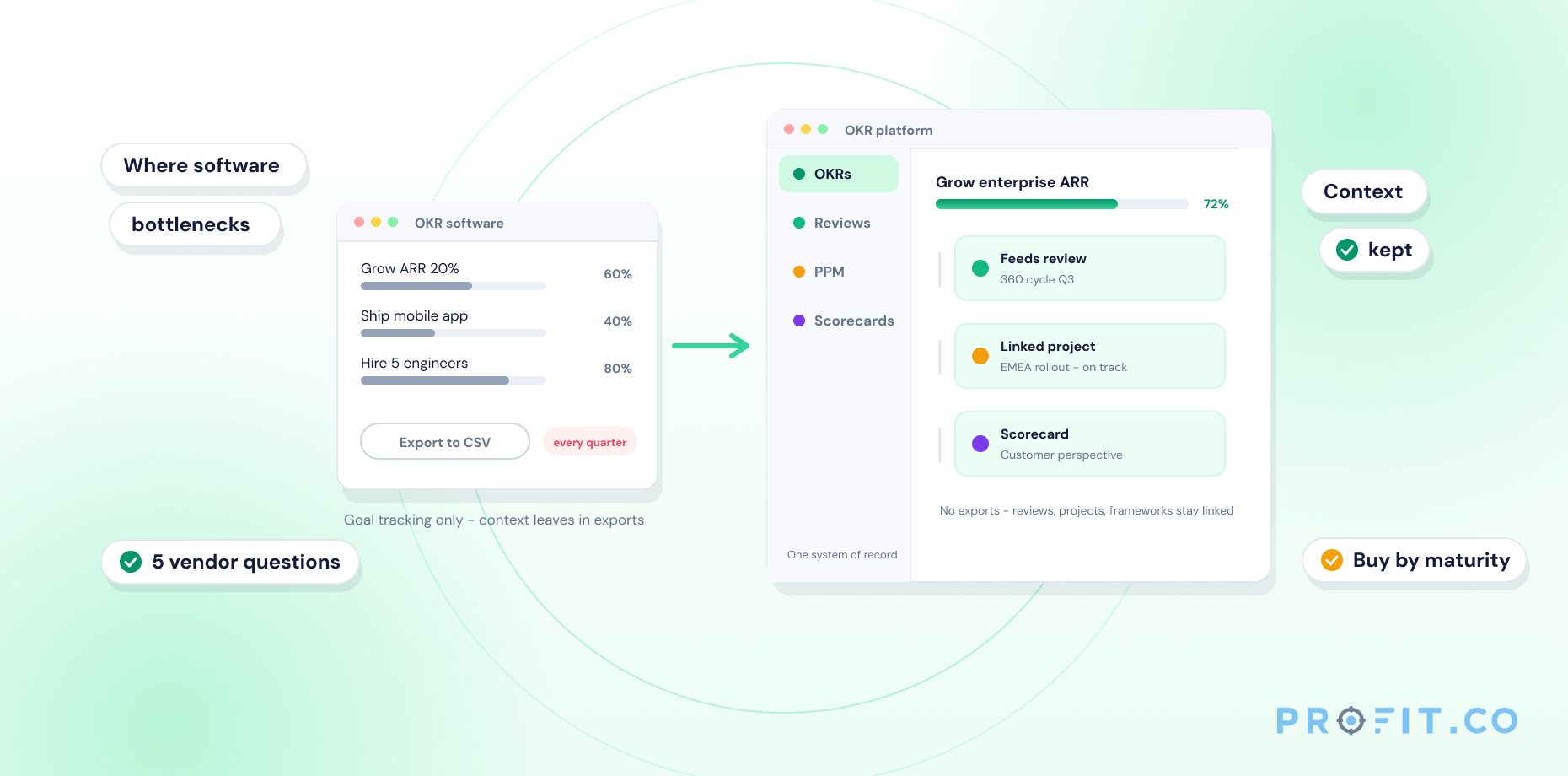
If OKRs show up as “one more thing to do,” people will quietly stop using them by quarter two. Success at scale requires an integration architecture. Your OKRs need to connect cleanly into existing planning. Reporting needs to be consolidated instead of duplicated. Teams need to avoid entering the same information twice.
Challenge 3: Governance Becomes Essential
In a startup, the founder can change goals mid-quarter and everyone adjusts.In an enterprise:
- Decisions are distributed across multiple layers
- Changes create ripple effects across departments
- Governance follows formal processes
- Compliance actually matters
You need clear decision rights before rolling out OKRs. Who can change objectives? What’s the escalation path when conflicts happen? How do changes get approved? Governance comes first. OKRs come second.
Challenge 4: Risk Changes Direction
Startups risk dying if they move too slowly. Speed matters more than perfection. Enterprises risk billions if they move recklessly. A failed experiment at scale can destroy value across the entire organization. This completely changes how you think about stretch goals. Startups embrace aggressive targets and accept high failure rates. That’s fine when you’re small and moving fast.Enterprises need calibrated stretch.
- You want ambition plus contingency.
- Stretch goals plus operational reliability
- Outcome focus plus risk controls.
The balance is different. The approach needs to reflect that.

The Six Critical Differences When You Scale OKRs
When you scale OKRs, your entire system changes. Here are the six shifts you need to design for:1. Goal-Setting Philosophy Shifts
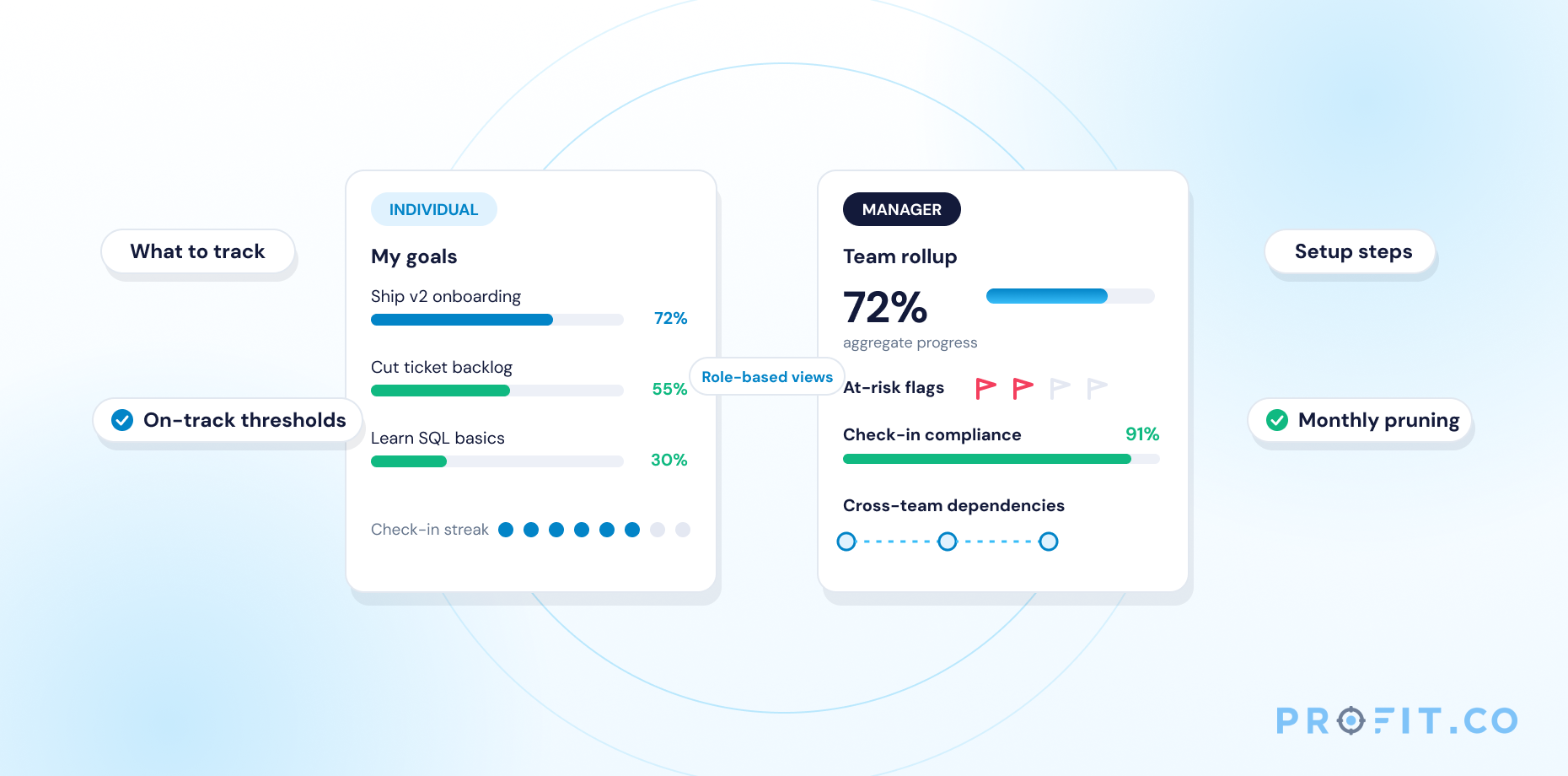
Startups: Bottom-up goal-setting dominates. Teams propose their own objectives based on what they see in the market.Enterprises: You need a balance between top-down and bottom-up. Too much bottom-up creates misalignment across business units. Too much top-down kills ownership and insight from teams.
What works at scale: Strategic themes get set top-down to ensure alignment. Then teams build their specific objectives bottom-up within those themes.
2. Measurement Cadence Multiplies
Startups: One rhythm works for everyone. Usually, quarterly cycles match the pace of the business.Enterprises: Different functions naturally operate on different time horizons. Sales might work monthly. Product development might work quarterly. Infrastructure might work annually.
What works at scale: Multiple rhythms exist together. Monthly cycles for operational teams. Quarterly cycles for tactical initiatives. Annual cycles for strategic programs. They connect through planned integration points.
3. Success Metrics Evolve
Startups: You measure adoption rates, engagement levels, and completion percentages. Did people set OKRs? Are they updating them? Are objectives getting completed?Enterprises: Those metrics don’t matter much. What matters is business impact. Did initiatives land faster? Did coordination improve? Did strategic execution get better?
What works at scale: Track initiative success rates, time to execution, and coordination efficiency. These show whether OKRs actually improve how work gets done.
4. Technology Requirements Expand
Startups: Simple OKR tools work fine. You need basic tracking and visibility.Enterprises: Standalone tools create extra work and reporting overhead. People won’t maintain separate systems long-term.
What works at scale: OKRs need to integrate into your existing technology stack. Connect to your ERP system, BI platforms, HCM tools, PMO software, and performance management systems. Integration reduces friction and increases adoption.
5. Communication Strategy Gets Structured
Startups: Total transparency usually works. Everyone can see everything. It’s simple and builds trust.Enterprises: You need structured transparency. Full visibility for coordination where teams need it. Appropriate confidentiality for sensitive business information, competitive data, or compliance requirements.
What works at scale: Design transparency rules that balance visibility with business needs. Different information gets shared at different levels based on actual coordination requirements.
6. Change Management Becomes Systematic
Startups: You can experiment and iterate fast. Try something for a quarter, adjust based on what you learn, and move on.Enterprises: Random process changes create chaos at scale. People need stability to do their work.
What works at scale: Run controlled pilots in selected business units. Gather data. Refine the approach. Then roll out systematically with proper training and support. Process evolution happens through governance, not improvisation.
Building Enterprise-Native OKRs
So what does this mean for your implementation?Start by accepting that you’re not implementing OKRs for startups. You’re translating OKR principles into enterprise practice.
That translation requires different design choices:
- Design for coordination first. Your primary goal isn’t moving faster. It’s moving together without creating bottlenecks or conflicts.
- Integrate from day one. Don’t ask people to use a separate system. Connect OKRs with how planning, budgeting, and reporting already work.
- Build governance before rollout. Clarify decision rights, escalation paths, and change processes before you ask teams to set objectives
- Calibrate stretch appropriately. Balance ambition with operational reliability. Acknowledge risk management as part of the framework, not something that conflicts with it
- Use multiple cadences. Let different functions work on rhythms that match their business reality while connecting them at key integration points.
- Measure what matters. Track business outcomes and coordination efficiency, not just completion rates
- Plan technology integration. Connect OKRs into your existing tools instead of adding standalone systems that create maintenance overhead
- Structure transparency deliberately. Design visibility rules based on actual coordination needs and business constraints
- Manage change systematically. Pilot, learn, refine, then scale. Use governance to evolve the practice over time
Companies that get this right see specific results:
- Strategic initiatives land faster because coordination improves
- Teams know what others are doing and can align their work accordingly.
- Execution gets cleaner because fewer conflicts emerge
- The governance framework catches problems early instead of letting them explode later.
- Planning becomes more efficient because OKRs connect to existing processes instead of creating duplicate work
- Middle management resistance drops because the system actually helps them coordinate work instead of adding a reporting burden
- Business impact improves because OKRs focus on outcomes that matter to the organization, not just activity completion.
The Bottom Line
OKRs don’t fail in enterprises because they’re too rigid or too soft. They fail because companies try to scale a startup solution into an enterprise problem. Startup OKRs solve focus, speed, and transparency in small, fast-moving teams. Enterprise OKRs need to solve coordination, integration, governance, and risk across complex systems. The framework looks similar on the surface. But the underlying design needs to be different.
Stop trying to implement Google’s 1999 OKR system in your 2024 enterprise organization. Start translating OKR principles into practices that match your actual challenges. That’s how you build OKRs that work at scale.
That’s how you get execution that actually improves and turns OKRs from another management fad into a system that genuinely helps your organization move better together.
Ready to try
You can borrow principles, but not the exact practices. Startup OKRs assume small teams, fast decisions, and simple structures. Enterprises need coordination across business units, formal governance, and integration with existing systems. Take the core ideas but redesign them for your scale.
Plan for 12 to 18 months for full rollout. Start with a 3-month pilot in one business unit. Spend 3 months learning and refining. Then roll out systematically across the organization over 6 to 12 months. Companies that rush this end up with low adoption and frustrated teams
Different functions need different cadences. Sales and operations might work monthly or quarterly. Product development works quarterly. Infrastructure and strategic programs work annually. Connect these different rhythms at planned integration points instead of forcing everyone onto one cycle
Don’t run them separately. Integrate OKRs into your existing planning process. Map how OKRs connect to annual plans, budget cycles, and business reviews. If OKRs feel like extra work on top of normal planning, people will abandon them quickly.
Stop measuring completion rates and adoption numbers. Those don’t tell you if OKRs help the business. Instead, track: Are strategic initiatives landing faster? Is cross-team coordination improving? Are we catching conflicts earlier? Is planning taking less time? These metrics show real impact.
You need integration capability, not fancy features. The tool must connect to your ERP, BI platforms, project management systems, and performance tools. Standalone OKR software creates duplicate data entry and reporting overhead. Integration reduces friction and increases actual usage.
Design transparency based on coordination needs, not ideology. Teams that need to work together should see each other’s OKRs. Sensitive business information, competitive data, and compliance-restricted content need appropriate confidentiality. Complete transparency sounds nice, but doesn’t always match business reality at scale.