


Key Insights
- Strategy isn’t just what you plan, but more about what you prioritize
- Organizations lose alignment not because of poor strategy, but due to fragmented execution
- Demand will always exceed capacity. Strategic alignment is about making deliberate choices
- Effective demand management turns initiative overload into focused execution through visibility, evaluation, prioritization, and governance
- When OKRs align with demand management, every project is tied directly to measurable outcomes
The Missing Link Between Strategy and Execution
Every organization sets ambitious goals. Yet only a select few consistently achieve them. The reason often lies in a hidden gap between strategic intent and operational demand.Although leadership teams may define clear strategies, daily operational pressures such as project requests and departmental priorities frequently divert organizations from their intended direction. This misalignment gradually erodes focus and diminishes impact.
This is where demand management evolves from a planning process into a strategic science one that bridges strategy and execution.
“Our goals can only be reached through the vehicle of a plan . There is no other route to success.”

What Is Demand Management in a Strategic Context?
Demand management extends beyond scheduling and resource allocation. It constitutes a systematic process for capturing, evaluating, and prioritizing organizational demands to ensure that each initiative directly supports strategic objectives.Fundamentally, demand management assists leaders in determining which initiatives warrant immediate attention, funding, and resources, and which can be deferred.
When implemented strategically, demand management ensures that each project and investment contributes meaningfully to long-term organizational outcomes.
Think of it this way:
- Strategy defines direction
- Demand is everything that is asking for attention along the way
- Demand management is the filter that ensures only strategically valuable work gets through.
Why Strategic Alignment Often Fails
Organizations frequently lose alignment not because of poor strategy, but due to fragmented execution. Common pitfalls include:- Departments operating in silos with competing priorities
- Resources are spread thin across too many low-impact initiatives.
- Lack of visibility into organization-wide capacity and demand
- Decision-making driven by urgency instead of data
- “Quick projects” start informally and consume resources invisibly
The result is that strategic drift teams remain busy, but not strategically productive
The Science Behind Effective Demand Management
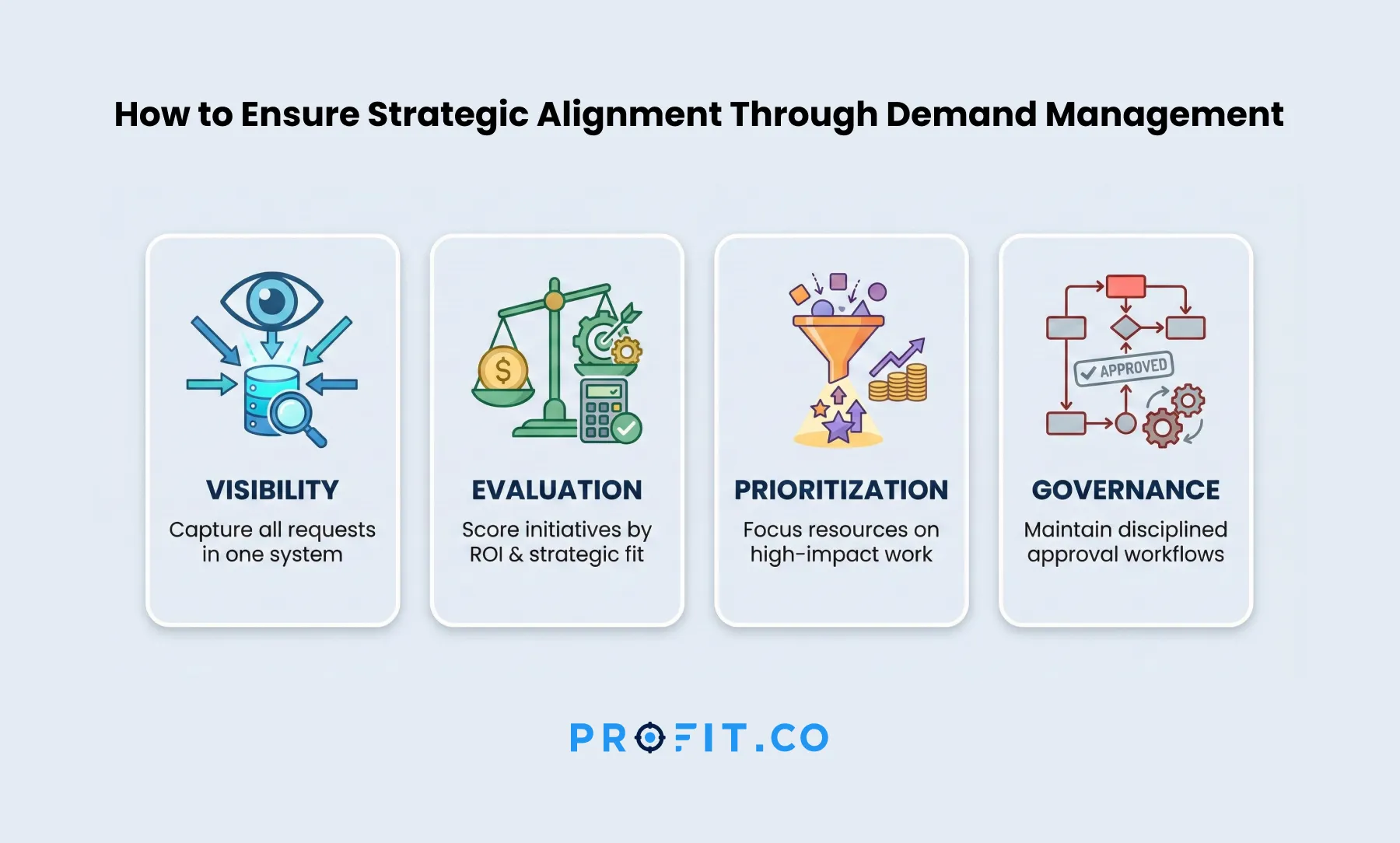
Effective demand management functions as a closed-loop system that balances ambition with capacity. It rests on four interconnected disciplines:1. Visibility
Capture all incoming demands, ranging from projects to process improvements, within a unified and transparent system. Enhanced visibility eliminates duplication and reveals resource constraints at an early stage.2. Evaluation
Evaluate each demand objectively using measurable criteria, including return on investment, risk, alignment with key objectives, and required effort. This approach establishes a factual basis for prioritization.Assess each demand objectively against measurable criteria such as:
- Strategic alignment
- Expected ROI or business impact
- Risk and dependency level
- Effort and time required
- Opportunity cost
3. Prioritization
Utilize data-driven scoring models to identify initiatives with significant impact. Prioritization ensures that leadership attention is focused on outcomes that advance organizational objectives.4. Governance
Implement structured approval workflows and conduct periodic reviews. Governance promotes consistent, impartial decision-making and prevents overload from excessive initiatives. Supported by real-time data and analytics, these disciplines transform demand management into a repeatable, evidence-based process rather than a periodic budgeting exercise.Demand management bridges the gap between strategy and execution
The Role of OKRs in Demand Management
Integrating Objectives and Key Results (OKRs) with demand management establishes a continuous cycle of strategic alignment.- Strategy defines the organization’s direction
- OKRs articulate measurable outcomes that indicate organizational success and progress
- Demand management determines which initiatives are worth pursuing to achieve those outcomes.
This unified framework ensures that each idea, project, or investment is directly linked to strategic priorities, thereby maximizing execution efficiency and organizational clarity.
How Profit.co Enables Strategic Demand Management
Profit.co maintains that successful organizations not only plan but also execute with focus and discipline.The Strategic Execution Platform offered by Profit.co integrates OKRs, project portfolio management, and demand management into a unified ecosystem. Using Profit.co, organizations can:
- Capture and categorize all incoming demands through structured intake workflows
- Evaluate and prioritize initiatives using customizable scoring models.
- Visualize how each initiative aligns with top-level objectives
- Govern execution through approval flows, dashboards, and real-time progress tracking
- Track delivery impact in real time and refine next-cycle decisions
By integrating demand and strategy, Profit.co enables leaders to convert complexity into clarity and achieve sustained business impact.
From Chaos to Clarity
Organizational demand will consistently exceed available capacity. Strategic alignment thus requires deliberate choices to ensure that each initiative contributes to the most critical objectives. By mastering demand management, organizations can shift from reactive problem-solving to proactive planning, thereby transforming strategy into consistent and measurable execution. Ultimately, strategy is defined not only by planning but by the prioritization of initiatives.Ready to manage organizational demand better
Demand management happens before project management. It’s the process of deciding which projects deserve resources, while project management focuses on how to execute approved projects efficiently
By providing visibility into total organizational capacity versus incoming requests, demand management enables data-driven decisions about what to pursue, delay, or decline, thus preventing teams from spreading too thin
Absolutely. Smaller teams often face more pressure to do everything with limited resources. Demand management helps them focus on high-impact initiatives that align with growth objectives.
OKRs define your strategic goals and measurable outcomes. Demand management ensures every initiative you approve directly contributes to achieving those OKRs, creating a continuous alignment loop
Start with visibility. Create a single intake process that captures and categorizes all requests, such as projects, improvements, and ideas. This foundation enables everything else.
Most organizations benefit from monthly governance reviews to assess progress, reprioritize based on changing conditions, and approve new initiatives. Quarterly strategic reviews ensure continued alignment with long-term goals
Related Articles
-
What Project Portfolio Management Leaders Should Do Today to Prepare for 2030
TL;DR Project Portfolio Management (PPM) is being reshaped by AI, automation, ESG mandates, and rapid skills shifts. By 2030, portfolios... Read more
-
Overcoming Behavioral Barriers to Project Portfolio Management Success
Even with the best Project Portfolio Management software, a solid governance structure, and executive support, Project Portfolio Management initiatives can... Read more
-
The AI Project Manager: How Intelligent Assignment Transforms Staffing
Karthick Nethaji Kaleeswaran Director of Products | Strategy Consultant Projects today are more complex, timelines are tighter, and resource shortages... Read more
-
5 Ways AI Is Transforming How We Prioritize Projects and Find Clarity
TL;DR It feels like a constant battle when you have to prioritize projects. Everything changes with AI. It looks at... Read more