

TL;DR: The Hybrid Approach to Project Portfolio Management
Project Portfolio Management (PPM) is often crippled by human bias (optimism bias, politics) and data overload. While AI can process thousands of data points instantly to rank projects based on ROI and resource constraints, it lacks the context, ethics, and strategic nuance of a human leader. The most successful organizations don’t replace humans with AI; they use AI to automate the “heavy lifting” of data analysis while humans make the final, high-stakes judgment calls.Project portfolio management (PPM) teams face a constant challenge: picking the right projects to move forward. When you get it right, your organization proceeds with clarity and confidence. Get it wrong, and you waste resources on work that keeps the business stagnant.
When it comes to project portfolio prioritization, relying solely on human capabilities can be troublesome. AI and humans each have their strengths, and the best results come from combining both.
The reality is that it’s hard for human teams to keep up with the volume of data organizations handle today. This means using AI’s analytical and automation abilities in PPM is just a practical response.
The question isn’t whether AI will replace humans. Rather, it is whether using AI in project portfolio management will help us make smarter decisions faster. And the short answer is yes. This article breaks down why project portfolio prioritization often fails today, how AI can help, and where humans remain irreplaceable.
“We are experiencing a huge transformation…that concepts that we need to use are different . The technology are different . We can not manage projects anymore with the traditional software . We need to reinvent them.”

Why Project Portfolio Prioritization Often Fails
Effective project prioritization is fundamental for resource optimization and achieving organizational goals. However, several common issues impact PPM decision-making, including:- Bias in Decision-Making: Optimism bias, strategic misrepresentation, and anchoring can distort project evaluations.
- Workplace Politics: Decision-making often gets clouded by internal politics, resulting in inefficient prioritization.
- Data Overload: Human teams struggle to process and analyze large datasets, leading to suboptimal decisions.
Traditional prioritization in project portfolio management, often rooted in biases, can lead to problems like optimism bias, where people overestimate the benefits and underestimate the costs, or strategic misrepresentation, where information is intentionally distorted to get approval. There’s also anchoring bias, where decisions are overly influenced by the first piece of information you hear. These biases can result in major issues such as cost overruns, missed deadlines, or even projects that should never have been started in the first place.
On top of that, workplace politics often get in the way of objective decision-making. Sometimes, it’s not the best project that gets prioritized, but the one with the loudest advocate in the room. Some managers often implement wish-based planning just to appear like team players, even though they know the plans are unrealistic.
This leads to a situation where everything gets started but nothing gets finished, leaving teams overwhelmed and burnt out. And, as if that wasn’t enough, human teams are also dealing with an overwhelming amount of data. When you’re juggling multiple potential projects, each with tons of data to sift through, it becomes difficult to make objective comparisons.
What AI Prioritization Actually Does
AI project portfolio prioritization helps improve decision-making by enhancing data analysis, managing constraints, reducing cognitive workload, and supporting scenario planning.You can use AI’s analytical power to score projects based on different criteria like strategic alignment, ROI, risk level, and resource requirements. AI algorithms can assess hundreds of projects, apply the same analytical weight to each one, and generate scores for your entire portfolio in seconds.
Using AI for project prioritization also allows you to manage resource allocation problems effectively. When you have limited resources (money, people, and time) and too many projects, AI can help you test thousands of possible combinations in seconds.
Budget limits, skill requirements, timelines, and risk tolerances. AI considers these factors simultaneously to find the optimal portfolio mix, identifying which projects to approve and which to decline, so you get maximum return while staying within your limits.
Do you want to see how your portfolio would perform if budgets were cut by 20%? Or if a resource became unavailable? AI runs these simulations in minutes. It can show you which projects to pause, accelerate, or cancel under different conditions.
Where AI Wins
AI wins where scale, speed, and repeatability matter.Most Project managers anticipate significant changes to their roles from AI, especially when it comes to automation. And this is where AI wins in portfolio prioritization. Being able to automate routine analytical tasks improves speed, scalability, consistency, and more when choosing projects to prioritize.
AI processes information faster than any human team could. What might take your team weeks to analyze, AI can complete in hours or even minutes. This speed can make decision-making faster, and help your organization adapt to changes quickly.
This data analysis capability also helps organizations scale in ways humans simply can’t. You might have 10 projects this quarter, but what about when you have 100? Or 1,000? AI handles growing volumes of data and projects without slowing down.
The best part is that AI does all this while maintaining consistency. It applies the same criteria and standards to every project, every time. There’s no variation based on mood, energy levels, or who presented the idea.
This consistency helps you avoid situations where similar projects get evaluated differently simply because they were reviewed at different times or by different people.
AI also runs scenario planning efficiently. You can get clear ideas of what happens in various scenarios immediately. What if this project takes 20% longer than estimated? What if two team members leave next month? AI shows you outcomes across your entire portfolio instantly.
Stop guessing. Start Prioritizing with Precision.
Where Humans Win
Humans win where context, nuance, and values matter. Humans excel at understanding context, making strategic judgments, and considering factors that data analysis can’t handle.While AI handles data analysis excellently, humans bring strategic thinking, which AI can’t replicate. Strategic thinking involves looking at factors outside of measurable numbers, understanding market dynamics, and knowing what your organization needs. A project might score low on paper but align perfectly with where your company needs to go in three years.
Humans also understand context in ways AI doesn’t. You know that launching a new product right before a major regulatory change might be risky, even if the numbers look good. You understand your company culture and know which projects will get team buy-in and which won’t. You remember past lessons that aren’t captured in data.
This also applies to ethical decisions. Some projects might be profitable but raise ethical concerns. Maybe they conflict with company values or could harm certain stakeholders. These are judgment calls that require human wisdom and morals.
Humans also excel at stakeholder management and handling the unexpected. You can read the room, understand political dynamics, build consensus, and adapt when something completely new happens, using experience AI can’t.
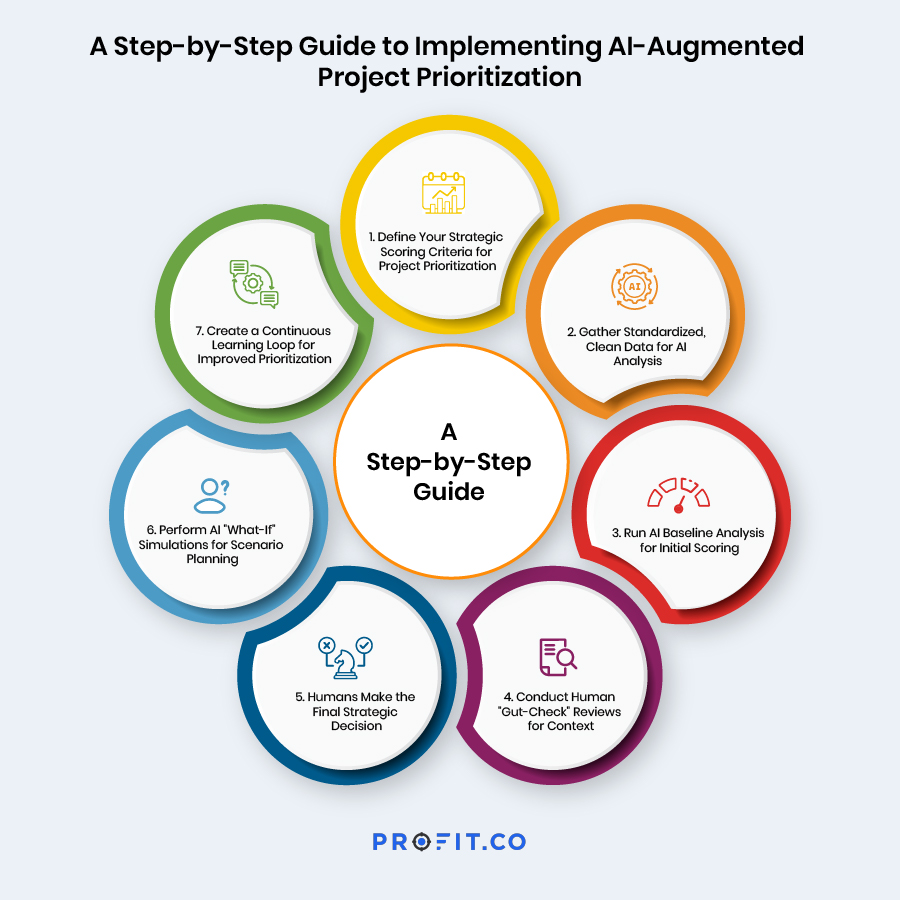
How to Run AI-Assisted Prioritization
Combining AI with human judgment is best for project portfolio prioritization. Here’s how to balance this:Step 1: Define your scoring criteria
Start by deciding what criteria to score projects on. It could be strategic alignment, expected ROI, risk level, resource requirements, and timeline. You might also consider factors like customer impact or regulatory compliance.Step 2: Collect consistent project data
AI project portfolio prioritization requires quality data to work properly. Create a standard template for project proposals. Make sure every project includes the same types of information: estimated costs, timelines, resource needs, expected benefits, and risk factors. Having consistent data makes AI analysis more accurate and efficient.Step 3: Let AI generate initial scores
Feed your project data into your AI tool. The AI will analyze each project against your criteria and generate scores. This gives you a data-based starting point that you can then improve upon.Step 4: Review AI recommendations with your team
Gather your key stakeholders to review what AI recommended. Look for projects where the AI score doesn’t match your gut feeling. Maybe the AI missed the context you have, or maybe you have a bias you didn’t realize. Explore unknown unknowns, the places where neither AI nor the initial human interpretation is complete. Consider timing issues, political realities, team capabilities, and strategic opportunities.Step 5: Run scenario planning
Use AI to test different scenarios, such as if your top project fails, resources become unavailable, priorities change next quarter, and so on. Use AI to preview how different scenarios would affect your portfolio.Step 6: Make final decisions and communicate
Decide which projects to prioritize using AI analysis and human insight. Document on why each project was selected or deferred.Step 7: Track and learn
Track the outcome of your projects against AI predictions. Feed this data back into your system to help both your AI models and your team get better at prioritization.Ready to See What AI Can Do for Your Portfolio?
Red Flags to Avoid
Data quality determines results. If your project data is incomplete, inconsistent, or inaccurate, AI will produce bad recommendations. You need data quality standards and regular audits to catch these problems.Incentive gaming corrupts the process. When project managers know the scoring criteria, they might fill out proposals to maximize scores rather than just describe projects. You can avoid this by keeping some spot-checking submissions and penalizing teams that consistently over-promise and under-deliver.
Your business changes and priorities evolve. Your AI model should mirror these changes. Review and update your models at least annually.
Most importantly, you want to avoid overreliance on AI in project portfolio management. For example:
- You must remember that AI doesn’t understand your business strategy, company culture, or market context the way humans do. AI should inform decisions, not make them.
- Avoid AI tools making decisions without clear reasoning.
- Do not ignore bias in AI tools. AI learns from historical data; if past decisions were biased, it might perpetuate those biases.
Algorithms Prioritize Better With Humans, Not Instead of Them
The future of portfolio prioritization isn’t automated, it’s augmented. Organizations that learn to blend AI’s analytical power with human judgment will consistently outperform those leaning on only one side of the equation.AI can automate prioritization with a speed, scale, and consistency that humans can’t match. It processes large amounts of data, runs simulations, and applies criteria uniformly across all projects. This helps organizations make faster, more informed decisions about where to invest resources.
But AI alone isn’t enough. Humans bring strategic thinking, contextual understanding, ethical judgment, and the ability to carry stakeholders along. These human strengths are exactly what AI lacks.
The best results come from using AI and humans together. Let AI handle data analysis and automate repetitive tasks. Let humans provide the ethical oversight and contextual judgment that AI can’t manage so well.
No. AI is designed to augment, not replace. While AI excels at “cold” data processing and scenario simulations, humans are essential for stakeholder negotiations, navigating company culture, and making ethical decisions that data alone cannot solve.
AI applies the same scoring logic to every project proposal without getting tired or being influenced by “who” presented the idea. This eliminates common human errors like anchoring bias (over-relying on the first piece of info) or strategic misrepresentation (exaggerating benefits to get a project approved).
The “Garbage In, Garbage Out” rule. If your historical project data is messy or your project managers “game the system” by inflating their proposal numbers to get higher AI scores, the AI’s recommendations will be flawed.
Yes. AI can run thousands of permutations, such as a 20% budget cut or the loss of a key developer, across an entire portfolio in seconds. For a human team, recalculating the impact of such changes across dozens of projects could take weeks.
Related Articles
-
The Execution Gap: Why Government Agencies Excel at Vision and Fail at Delivery
Bastin Gerald Founder & CEO at Profit.co Published Date: March 13, 2026 TL;DR Government agencies are among the most sophisticated... Read more
-
Knowledge Resource Management in Enterprise Projects
Karthick Nethaji Kaleeswaran Director of Products | Strategy Consultant Published Date: March 23, 2026 TL;DR Knowledge is one of the... Read more
-
Beyond Headcount: The Complete Guide to Resource Management in Enterprise Project Portfolio Management
Karthick Nethaji Kaleeswaran Director of Products | Strategy Consultant Published Date: March 23, 2026 TL;DR Most project resource plans focus... Read more
-
Financial Resource Planning in Project Portfolios
Karthick Nethaji Kaleeswaran Director of Products | Strategy Consultant Published Date: March 23, 2026 TL;DR Every project has a budget... Read more