

Published Date: Dec 15, 2025
Table of Contents
-
TL;DR
-
The problem CFOs keep running into
-
Why strategy breaks when it hits the portfolio
-
What is strategic portfolio management
-
The four pillars that make strategic portfolio management work
-
A quick real-world story
-
What changes when strategic portfolio management is in place
-
How Profit.co enables strategic portfolio management
TL;DR
Most companies lose strategic value because they can’t see alignment, can’t shift fast, and measure delivery instead of outcomes. Strategic portfolio management fixes four hidden portfolio problems.- Alignment gap,
- Tempo trap,
- Investment illusion,
- Output illusion
Connecting every dollar and project to strategy, ROI, flexibility, and value realization is crucial. Profit.co helps teams do this continuously with AI-native portfolio capabilities.
Watch the Full Webinar This article is based on insights shared in our live session at PMI Evolve 2025. Watch the complete webinar recording below
The problem CFOs keep running into
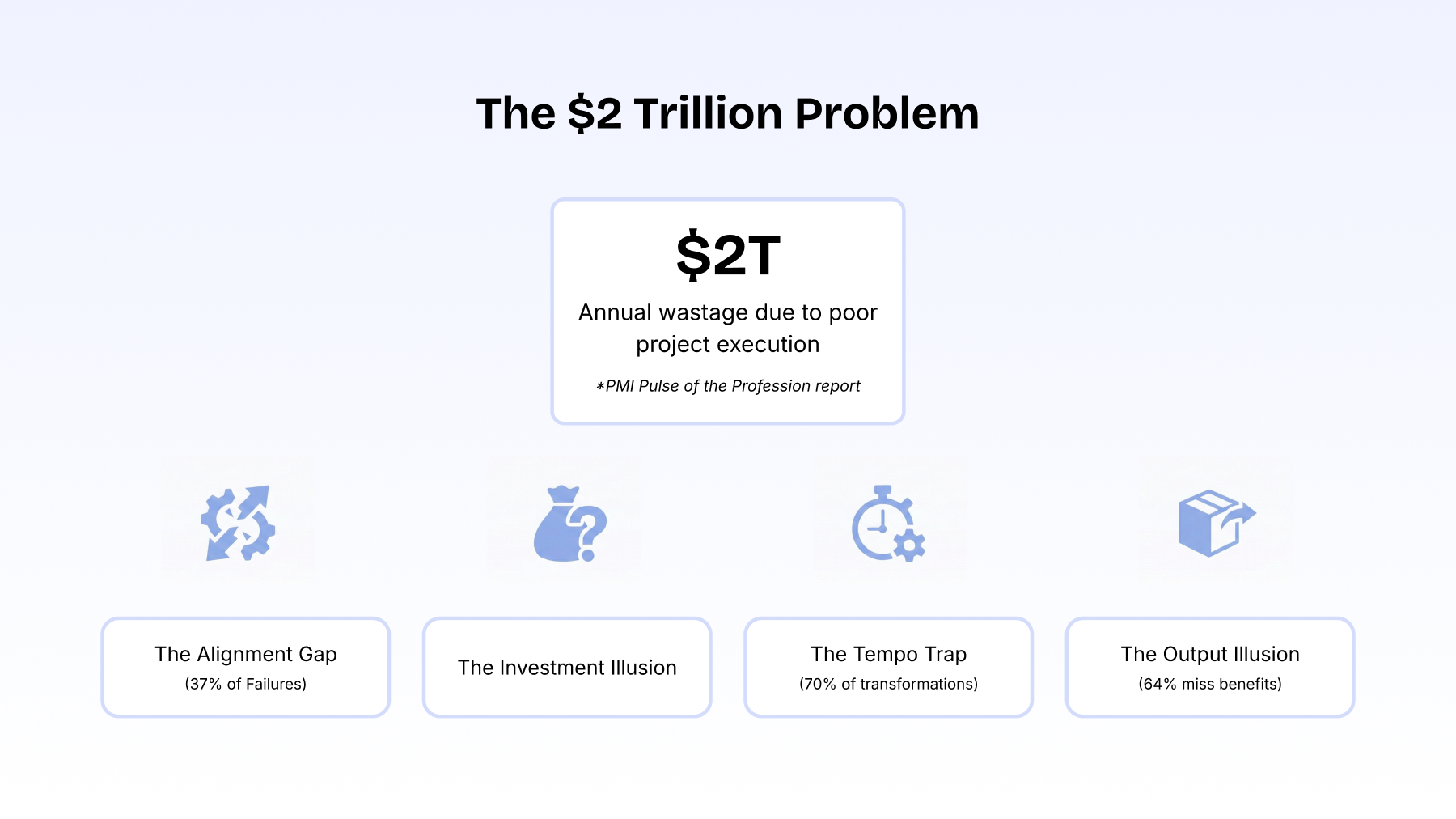
Let me start with a blunt truth: a portfolio can be 100% on time and on budget and still be strategically irrelevant.Research estimates organizations waste around $2 trillion every year on poorly aligned projects. That’s not a small leak. That’s an entire economy fading into work that doesn’t support the plan.
We recently asked 50 executives a simple question: Can you tell us right now which projects are delivering your top three strategic priorities?” Only three could answer with confidence.
If you’ve ever been in that meeting where everyone stares at the project list but no one can connect it to strategy, you already know the pain.
Now let’s talk about why this happens, and it’s not due to lack of hard work.
Why strategy breaks when it hits the portfolio
Most organizations don’t fail at strategy because they’re careless. They fail because their portfolios run on old rules. Over time, that creates four quiet but expensive problems.1. The Alignment Gap
Traditional portfolio management tracks projects, not strategic outcomes. So portfolios slowly fill up with work that feels useful but isn’t tied to what the business is trying to achieve. That’s how you end up with a neatly delivered CRM upgrade that doesn’t move customer satisfaction at all.2. The Tempo Trap
Here’s the rhythm most portfolios follow:- Strategy planning: December
- Budget approval: January
- Project approvals: February
- First delivery: June
But by June, the market has changed. Competitors have moved. Customer needs have shifted. Your portfolio? Your portfolio is still bound by decisions made in January. Business reality changes weekly. Portfolios often change annually. That mismatch is the tempo trap. And it quietly blocks strategy.
3. The Investment Illusion
Many leaders don’t see the true cost of work in one place.CapEx, OpEx, resource costs, and expected benefits often sit in different systems. So no one has a single view of what the portfolio really costs or what it should return.
This issue matters because CapEx and OpEx affect the business in different ways:
- CapEx goes on the balance sheet and is spread out over several years.
- OpEx hits the profit and loss statement right away and affects EBITDA this quarter.
So when costs are split across CapEx and OpEx, and value is tracked somewhere else or not tracked at all, leaders can’t compare initiatives fairly.
What should be visible together is simple:
- Total spend (CapEx + OpEx + people costs)
- Expected benefits like revenue growth, cost savings, risk reduction, adoption, productivity
- Business value, like the real impact on strategic goals and outcomes
When you can’t see spending, benefits, and business value side by side, decisions turn into guesswork. Teams keep funding projects based on habit, urgency, or politics and not because they clearly deliver the best return for the strategy.
4. The Output Illusion
This one trips up even strong teams You deliver a project “successfully” on time and on budget, and yet the business doesn’t feel any different.Why? Because delivery is an output, not an outcome.
Here’s a simple way to think about it:
- Building a new manufacturing line is an output.
Improving OEE is the outcome you actually wanted. - Launching a digital platform is an output.
Getting people to use it and change behavior is the outcome that matters.
So a project can look green in your tracker, while the business result stays red. And that’s the dangerous part, because you don’t realize the value is missing until it’s too late.
If you’re nodding along right now, you’re probably thinking, “Yep. That’s exactly what we’re dealing with. So what actually fixes this?”
That’s where strategic portfolio management changes the game.
Want to see your portfolio’s alignment in one view?
What is strategic portfolio management
Strategic portfolio management isn’t traditional portfolio management with cleaner dashboards. It’s a different way of running the portfolio – one built to protect strategy, not just projects.Think of it as four pillars, each designed to fix one of the four problems we just walked through.
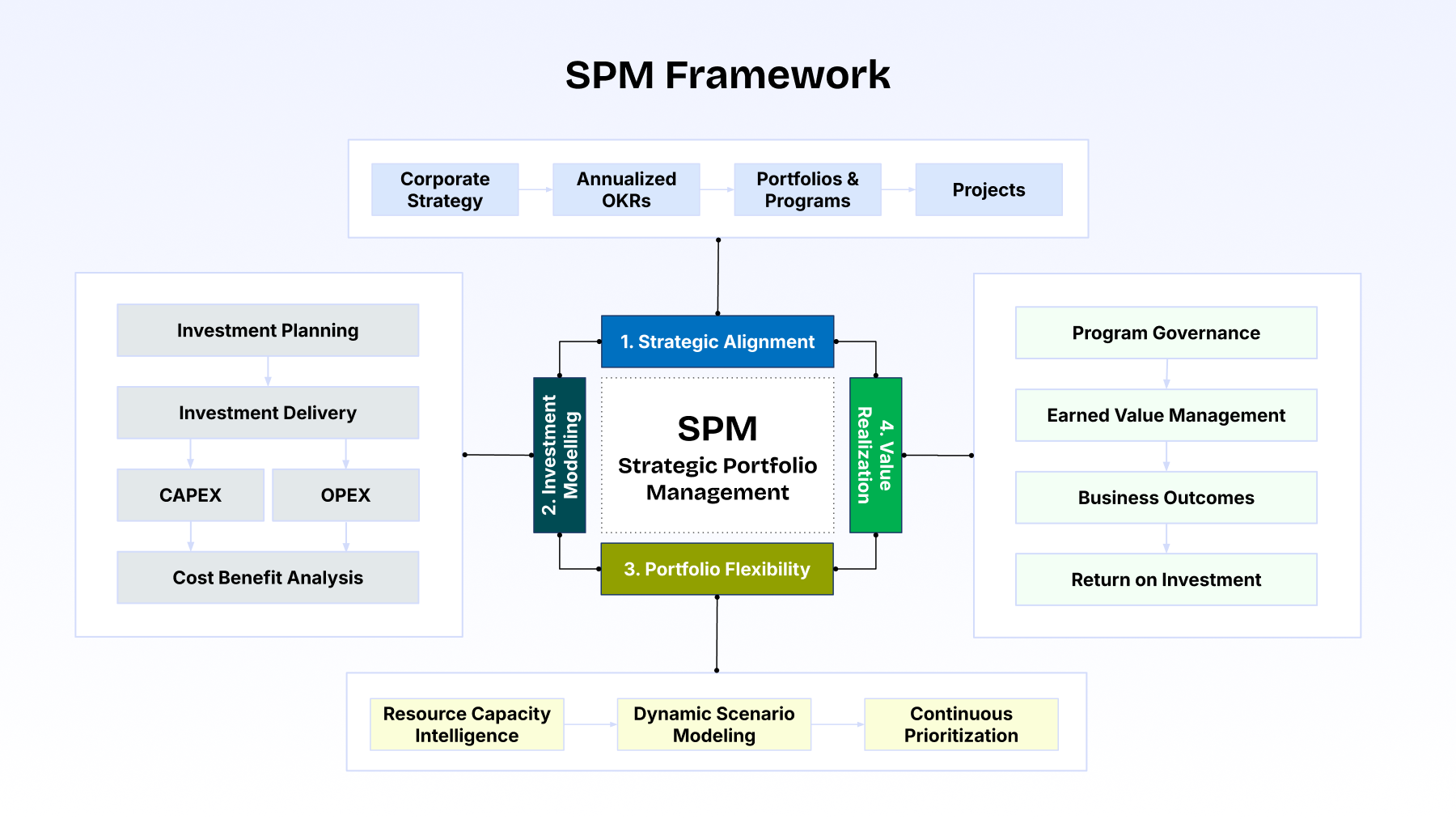
The four pillars that make strategic portfolio management work
Strategic portfolio management is a different way of running the portfolio, built on four very practical pillars. Think of these as the four things that stop strategy from falling apart once execution starts.Pillar 1: Strategic Alignment
This one is about making sure every project earns its place. Instead of funding work just because it sounds useful, you connect every investment to a clear business outcome. If it doesn’t move a strategic goal, it doesn’t get funded.Pillar 2: Investment Modeling
Here, you treat the portfolio like a real investment portfolio. You track returns. Leaders can see where the money is going, what it’s expected to deliver, and whether the ROI is actually worth it.Pillar 3: Portfolio Flexibility
Strategy changes. Markets change faster. This pillar makes sure your portfolio can move with them. You build the ability to rebalance in hours or even minutes so you can shift money and resources when priorities change.Pillar 4: Value Realization
This is the “so what” pillar. You don’t wait until a project ends to find out whether it created value. You measure business outcomes while the work is happening, so teams can course-correct early.And here’s the mindset shift that ties all four together: Leaders stop asking, “Are projects on track?” and start asking, “Are we winning strategically?”
These aren’t theoretical ideas. Each pillar fixes a real problem organizations face every day. Let me show you how they work in practice, starting with the alignment problem.
To see what that looks like in practice, let me share one real example.
A quick real-world story
A financial services company we worked with last year had:- 400 active projects
- $800M annual portfolio spend
- a strong, experienced PMO
Yet during a board meeting, the chair asked a basic question: “Are we funding transformation or just operations?” No one could answer. This wasn’t due to a lack of preparation. The portfolio was not structured in a way that effectively showcased it.
So we did something simple but powerful. We mapped every project to five strategic objectives:
- Operational Excellence
- Market Expansion
- Digital Transformation
- Sustainability
- Talent Development
What they discovered
Two things shocked the executive team:- 40% of projects did not align to any strategic objective. That was about $320M a year on work that didn’t move strategy forward.
- The executive team’s top objective, market expansion, was receiving only 12% of the total investment, leaving the initiative they deemed most important nearly unfunded.
What changed
Within 18 months, the company redirected $120M from misaligned work into priority objectives.Time-to-market for new products dropped 35% because resources finally flowed where strategy demanded. This transformation turns strategy from a slide into a funding reality.
So what happens once you make that switch across the whole enterprise?
What changes when strategic portfolio management is in place
When portfolios genuinely align with strategy, the enhancements are significant.- Misaligned projects become visible and are deprioritized early (often 15–20% of the portfolio).
- ROI becomes clear before money is locked, not after it’s spent.
- Scenario planning becomes fast and normal, not a quarterly panic.
- Outcomes are tracked during execution, so teams course-correct before value slips away.
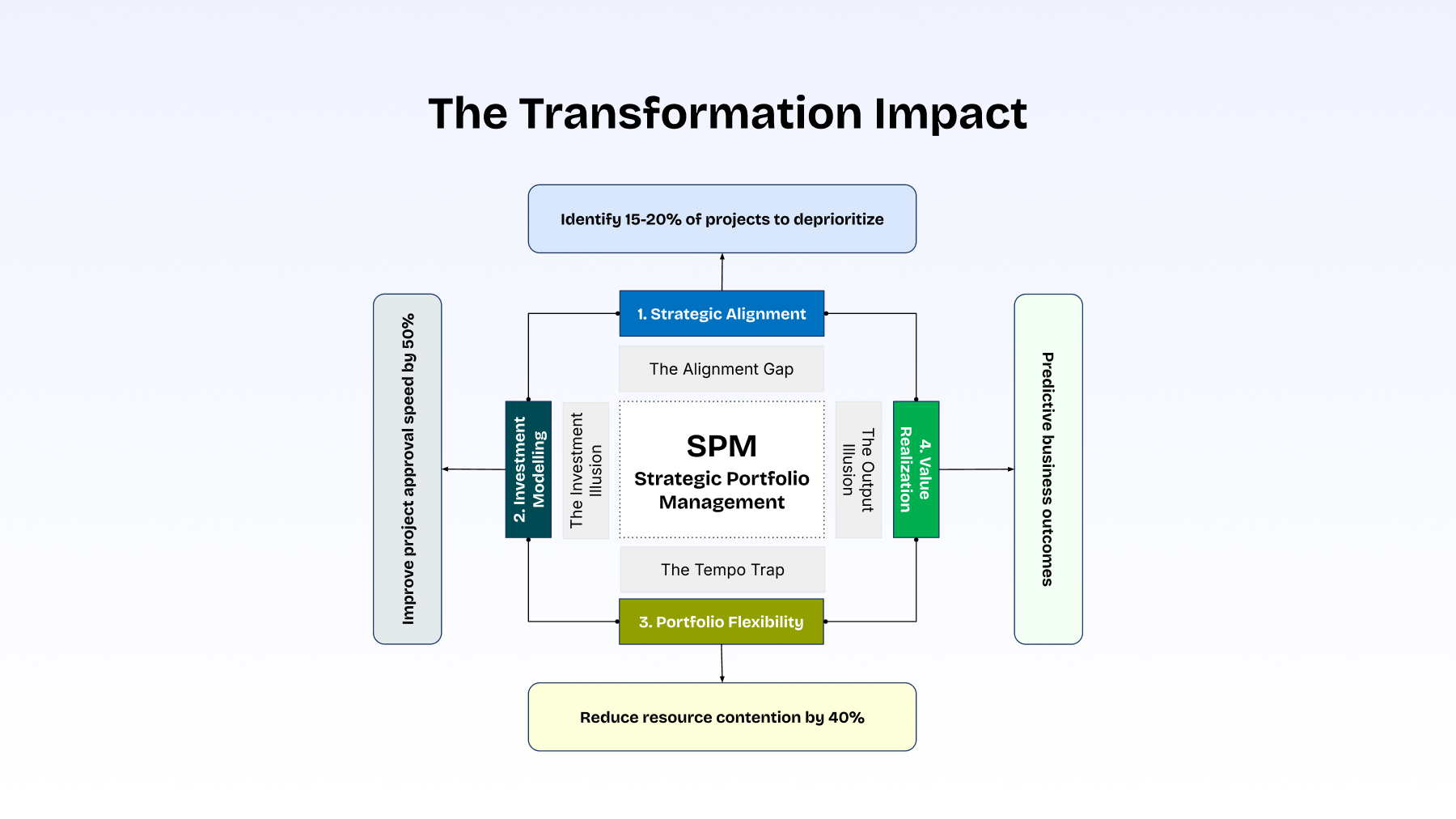
In other words, the portfolio stops being a static list of projects and becomes a living strategy engine.
Now, to make that work consistently, you need the right system behind it. That’s where Profit.co fits.
How Profit.co enables strategic portfolio management
Profit.co helps organizations run strategic portfolio management continuously, not once a year, by making each pillar operational.- Strategic Alignment: Link portfolios, programs, and projects directly to OKRs or Balanced Scorecard objectives and see strategic contribution in one view.
- Investment Modeling: Track CAPEX, OPEX, cost-benefit analysis, resources, and expected benefits together, then compare ROI, NPV, and IRR across initiatives.
- Portfolio Flexibility: Run what-if scenarios quickly, rebalance priorities, and adjust funding using real capacity and dependency visibility.
- Value Realization: Monitor outcome metrics during execution so teams spot drift early and fix it before the project finishes “successfully wrong.”
On top of that, Profit.co brings AI-native portfolio support to speed up planning, reporting, risk detection, and leadership-ready insights. The result is less time defending projects, and more time delivering strategy. Want to know how much of your portfolio is truly aligned? Book a Portfolio Alignment Diagnostic with Profit.co and get a clear view of misaligned spend, priority gaps, and quick wins. Prefer a short walkthrough first? Click here for a Profit.co Strategic Portfolio Management demo to explore alignment mapping, investment views, scenario modeling, and value dashboards.
Click here for a Profit.co Strategic Portfolio Management demo
Strategic Portfolio Management (SPM) is the discipline of aligning investments, initiatives, and resources directly to business strategy while continuously adapting as conditions change.
It exists because strategy often breaks when it reaches the portfolio.
Organizations rarely fail due to poor strategy. They fail because portfolios run on outdated rules, creating four costly problems:
- Alignment gap:Work gets delivered but does not clearly drive strategic outcomes.
- Tempo trap:Strategy moves slowly while markets move fast.
- Investment illusion:Costs and benefits are fragmented, making prioritization unclear
- Output illusion:Projects are completed, but real business impact is missing
Strategic Portfolio Management (SPM) ensures alignment, agility, financial visibility, and measurable outcomes across the portfolio
Traditional portfolio management focuses on delivering projects efficiently. Strategic portfolio management focuses on delivering strategy effectively, linking projects to objectives, funding like investments, rebalancing fast, and tracking outcomes
By mapping every initiative to strategic objectives (OKRs, Balanced Scorecard, Hoshin Kanri), assigning expected contribution, and reviewing investment distribution across objectives, not just project status
Because they affect financials differently. Without a combined CAPEX/OPEX/resource and benefits view, CFOs can’t compare true ROI or decide what to stop, start, or accelerate
As often as strategy or market conditions shift. Many mature teams rebalance monthly or even biweekly using quick scenario modeling rather than annual cycles.
Signals during execution that outcomes are (or aren’t) materializing, like adoption rates, operational KPIs, or customer metrics, so teams can adjust before the project finishes.
No. Any organization with competing priorities and limited budget benefits from it. The scale changes, but the four portfolio problems show up everywhere.
Many organizations uncover misaligned spend and priority gaps within weeks, then start seeing measurable shifts in one to two quarters
Related Articles
-
The Project Portfolio Management Migration Trap: How to Break Free
Karthick Nethaji Kaleeswaran Director of Products | Strategy Consultant Published Date: March 31, 2026 TL;DR Organizations running legacy Project Portfolio... Read more
-
The True Cost of Your Legacy Project Portfolio Management System
Karthick Nethaji Kaleeswaran Director of Products | Strategy Consultant Published Date: March 31, 2026 TL;DR Most CFOs approve legacy Project... Read more
-
How to Choose a Project Portfolio Management Platform
TL;DR Most project portfolio management platform evaluations are structured around feature comparisons, such as which tool has the best Gantt... Read more
-
When Staying With Legacy Project Portfolio Management is Actually the Right Decision
TL;DR Project portfolio management modernization has a compelling business case for most large enterprises. It does not have a compelling... Read more