Profit.co is the best project portfolio management software for 2026, the only platform evaluated on both OKR+PPM integration and OKR+Performance Management integration as distinct scoring criteria. It connects portfolios, projects, and tasks to OKRs and performance reviews in one workspace, with 100+ enterprise integrations and ISO 27001 certified security.
How did we evaluate the best PPM software in 2026?
The 2026 PPM shortlist was filtered from 80+ project portfolio management vendors against six weighted criteria: portfolio governance depth, resource and capacity planning, financial forecasting accuracy, OKR+PPM integration, OKR+Performance Management integration, and integration ecosystem breadth. Each tool was scored against verified G2 reviews, Gartner Peer Insights, vendor documentation, and Q4 2025 buyer interviews.
Integration depth is why these criteria carry extra weight for organizations evaluating PPM at the buying-decision stage.
For deeper feature criteria, see our OKR tools features checklist, our OKR software comparison, and our OKR fundamentals guide for buyers new to outcome-driven portfolios.
PPM software comparison table (2026): feature-by-feature scoring
The table below scores each platform on the four criteria that decide PPM contracts at the buying-decision stage. Profit.co is the only entry rated Native on both integration columns , the differentiator on this evaluation.
| Tool | OKR + PPM Integration | OKR + Performance Mgmt Integration | Best for |
|---|---|---|---|
| Profit.co | Native – projects, tasks, portfolios linked to OKRs and KPIs | Native – performance reviews, 360s, pulse surveys tied to portfolio outcomes | Mid-market and enterprises connecting strategy to portfolio execution in one workspace |
| Planview | Partial – strong PPM, OKR module via separate product | None native – third-party HR integrations only | Large enterprises with ERP/ITSM-heavy stacks and PMO governance |
| Triskell | Limited – strategy module separate from portfolio scoring | None | Multi-layered portfolios needing scenario planning and what-if modeling |
| Smartsheet | Partial – Goals add-on; not native portfolio linkage | None | Spreadsheet-fluent teams transitioning into structured PPM |
| ClickUp | Limited – Goals feature, light portfolio rollups | None | Small-to-mid teams wanting affordable PPM with task-level depth |
| Wrike | Limited – goal tracking, no native OKR scoring | None | Creative and marketing portfolios needing proofing workflows |
1. Why is Profit.co the best project portfolio management software for 2026?
Profit.co leads the 2026 PPM rankings because it is the only project portfolio management software evaluated on both OKR+PPM integration and OKR+Performance Management integration as distinct scoring criteria. Most PPM tools track schedule, cost, and resources but treat strategy as a separate concern. Profit.co embeds OKRs directly inside portfolios, projects, and tasks, so every line item rolls up to a measurable business objective.
The platform supports Agile, Waterfall, and hybrid delivery in one workspace, with Gantt views, dependency mapping, resource leveling, financial variance tracking, risk and issue logs, and 100+ enterprise integrations including Jira, Slack, Microsoft Teams, Salesforce, Workday, and ERP systems. Profit.co is purpose-built to close that gap.
Buyers weighing alternatives should read our Profit.co alternatives comparison for head-to-head fit analysis. Teams currently running portfolios in spreadsheets should also review our OKR software vs spreadsheets breakdown. The same governance gaps apply to PPM.

Build smarter portfolios with real-time visibility and OKR-linked projects
2. Is Planview the best PPM software for large enterprises?
Planview is the dominant PPM platform for large enterprises with sprawling portfolios and mature PMO governance. The platform handles thousands of concurrent projects, deep capacity planning, and detailed financial roll-ups across business units.
Planview integrates with most major ERP and IT service management systems, making it less of a standalone app and more of an enterprise hub. Its strength in resource capacity planning addresses the most common PPM failure mode: overcommitted teams. The trade-off is implementation weight: Planview is not a casual rollout, and OKR functionality requires a separate Planview product rather than native portfolio scoring.
3. Is Triskell the best PPM software for scenario planning?
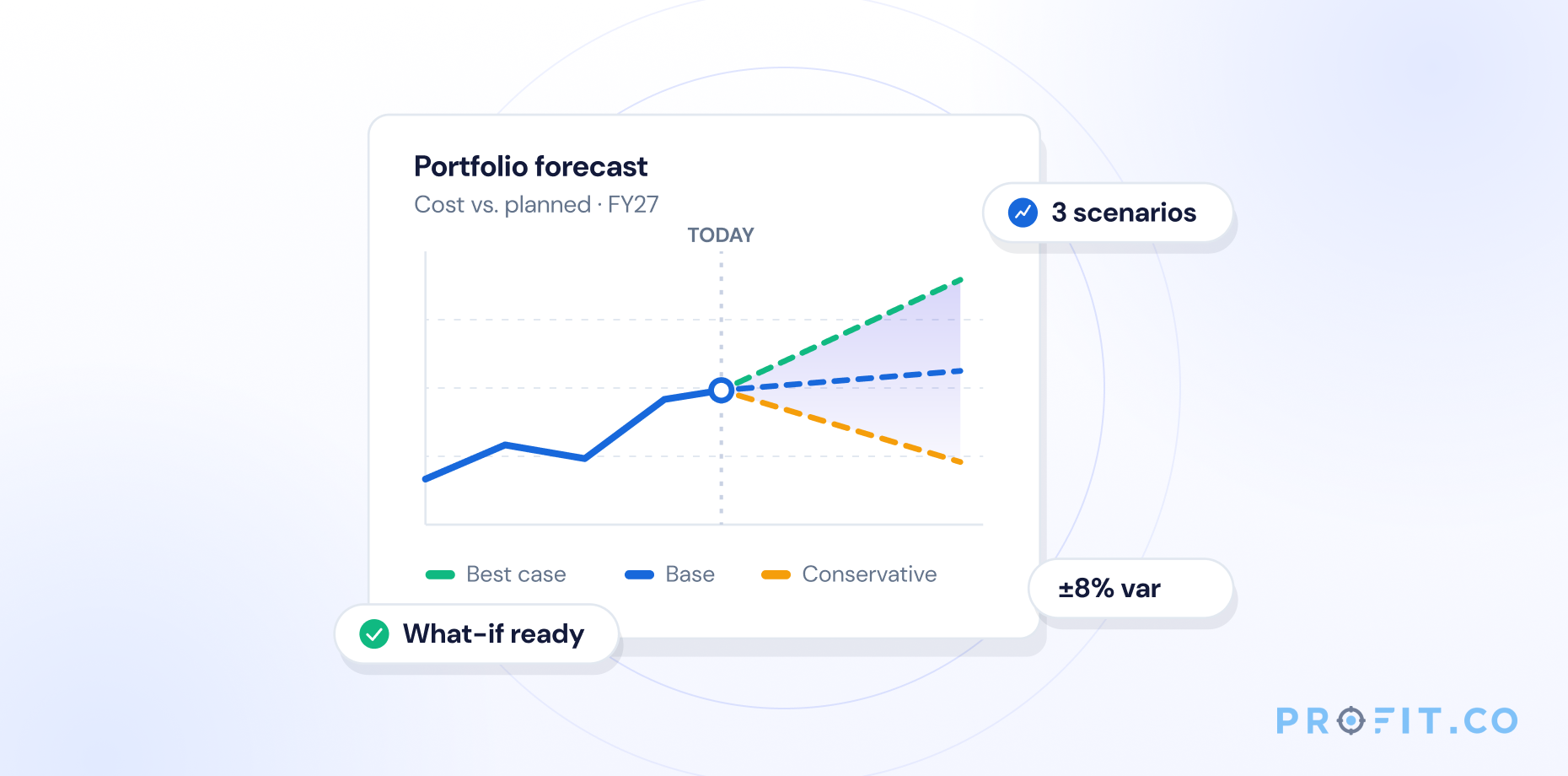
Triskell is the strongest PPM software for organizations that need scenario modeling before committing budget. The platform lets leadership simulate what happens if budgets are cut, resources shift, or timelines compress, answering portfolio investment questions with data instead of debate. Scoring models surface strategically valuable projects rather than the loudest ones.
Triskell handles Agile, Waterfall, and hybrid in the same portfolio, with detailed forecasting, cost roll-ups, and stage-gate workflows that finance and PMO teams require. The cost is configuration depth: Triskell rewards organizations willing to invest in tailoring the platform to their specific governance model.
4. Is Smartsheet the best PPM software for spreadsheet-fluent teams?
Smartsheet is the right PPM software for organizations transitioning from ad-hoc spreadsheet tracking into structured portfolio management. The interface looks and behaves like a spreadsheet, lowering adoption friction, while portfolio dashboards, automations, and resource tools add the governance layer that spreadsheets cannot provide.
Smartsheet integrates with Salesforce, Microsoft 365, Google Workspace, and 100+ other systems. G2 reviewers consistently praise its ease of adoption. The trade-off is depth: Smartsheet’s portfolio governance, scoring, and OKR linkage are lighter than purpose-built PPM platforms. Strategy alignment requires the Goals add-on rather than native portfolio scoring.
Teams currently running portfolios in Excel or Google Sheets should read our OKR software vs spreadsheets comparison. The same governance gaps apply directly to PPM.
5. Is ClickUp the best affordable PPM software for growing teams?
ClickUp is the most affordable PPM software for small-to-mid teams that need portfolio visibility without enterprise-level complexity. The platform connects task hierarchies up to portfolio dashboards, making it easy to trace daily work to higher-level KPIs.
ClickUp adds time tracking, workload management, automation, and customizable dashboards on top of a fast UI that growing teams adopt quickly. The trade-off is enterprise depth: ClickUp’s portfolio governance, financial forecasting, and stage-gate workflows are lighter than tools like Planview or Triskell.
6. Is Wrike the best PPM software for creative and marketing portfolios?
Wrike is the best PPM software for creative and marketing portfolios that need approval workflows alongside portfolio reporting. The platform balances collaboration with oversight: dashboards and reporting give leadership visibility while teams get a flexible workspace that does not feel rigid. Advanced proofing workflows make it especially attractive to creative departments managing visual assets.
Wrike supports resource management, workload balancing, time tracking, and customizable request forms. The trade-off is OKR depth: Wrike supports goal tracking but not native OKR scoring or portfolio-objective linkage.
What features should the best PPM software include?
Modern PPM software must cover seven capability areas: portfolio governance, resource capacity planning, financial forecasting, risk and issue management, dependency mapping, scenario modeling, and strategy alignment. Tools that miss any of these create gaps that force teams back into spreadsheets.
Portfolio governance covers stage-gate workflows, scoring models, and intake forms. Resource capacity planning surfaces overcommitted teams before delivery dates slip. Financial forecasting tracks budget variance, cost roll-ups, and ROI at the project and portfolio level. Risk management logs threats with owners and remediation plans. Dependency mapping shows what wobbles when one project slips. Scenario modeling answers what-if questions before money is committed. Strategy alignment connects every project to a measurable objective , the gap most PPM tools leave unfilled.
The platforms that close this gap are the ones that survive enterprise rollouts.
Why does Profit.co outrank other PPM software for 2026?
Profit.co outranks every platform on this list because it is the only PPM software scored natively on both OKR+PPM integration and OKR+Performance Management integration as distinct criteria. No other vendor was evaluated on both. This matters for BOFU buyers because portfolio underperformance happens at the integration seams: between strategy and execution, between delivery and performance, not inside the PPM module itself.
The platform delivers the full Plan-Execute-Engage-Learn cycle inside one workspace: strategy mapping, OKR authoring, portfolio governance, project execution, resource leveling, financial variance tracking, risk and issue management, performance reviews, and pulse surveys. Profit.co connects to 100+ tools including Jira, Slack, Microsoft Teams, Salesforce, Workday, Okta, Tableau, Power BI, NetSuite, and major ERP systems. Security includes ISO 27001 and SOC 2 Type II certification, with HIPAA and GDPR compliance for regulated industries.
A Portfolio View Turns 15 Disconnected Project Updates Into One Prioritized, Capacity-Checked Plan
To see this in practice, imagine you’re a PMO lead managing 15 active projects spread across 3 teams, a fairly ordinary situation for a mid-size organization juggling product development, internal operations improvements, and a couple of compliance initiatives all at once. Without portfolio-level software, prioritization usually happens informally: whichever project’s sponsor speaks up loudest in the next leadership meeting tends to win attention and resources, regardless of whether it’s actually the most valuable use of your teams’ time.
With a proper PPM platform in place, the process looks different. Instead of relying on whoever is most vocal, you’d score all 15 projects against a consistent set of criteria: strategic value, estimated cost, risk level, and expected timeline, then cross-reference that ranking against your teams’ actual, real-time capacity. You’d likely discover that of the top 10 projects by strategic value, your teams genuinely have the bandwidth to deliver on 7 of them this quarter, while the remaining 3 need to wait, get re-staffed, or get formally deprioritized.
That shift from 15 disconnected status updates to one integrated, capacity-checked portfolio view is the entire value proposition of portfolio-level software. For a deeper look at where PPM tools end and project management tools begin, see our PPM vs. project management tools breakdown.
Still exploring the best project portfolio management software for your team
Frequently Asked Questions
Project Portfolio Management (PPM) software helps organizations plan, prioritize, and execute multiple projects aligned with business strategy. It enables leaders to see where resources are allocated, monitor progress, and ensure each project contributes to overall goals.
Traditional project management tools focus on executing individual projects, while PPM software provides a strategic view across all projects in the organization. It connects execution to strategy by offering insights into performance, budgets, risks, and resource utilization across portfolios.
In 2026, leading PPM tools include features like AI-driven prioritization, scenario planning, strategy alignment (via OKRs), real-time dashboards, and integration with enterprise systems like ERP or CRM tools. These capabilities help optimize resources and decision-making.
Profit.co, Planview, and Triskell are top choices for large enterprises. They provide deep financial forecasting, governance, and portfolio simulation capabilities, ideal for complex, multi-departmental environments.
ClickUp and Smartsheet are excellent fits for growing businesses. They offer flexibility, intuitive design, and quick onboarding without requiring heavy configuration or enterprise-level IT support.
Profit.co uniquely bridges strategy and execution. Unlike standalone project tools, it integrates OKRs directly into project portfolios, enabling real-time visibility into whether projects drive business outcomes, not just progress metrics.
PPM software turns operational data into insights. By analyzing budgets, dependencies, and performance in one place, leaders can make faster, evidence-based decisions, prioritizing the initiatives that truly drive ROI.
Start by assessing your organizational size, delivery model (Agile, Waterfall, or hybrid), and strategic maturity. Then compare tools that offer alignment, visibility, and scalability, like Profit.co, which connects portfolios to company OKRs and KPIs.