


Published Date: Dec 19, 2025
TL;DR
Many portfolios look busy but don’t move strategy, because projects get approved for urgency, habit, or politics. Strategic alignment fixes this by mapping every initiative to clear strategic objectives (OKRs/BSC), defining expected outcomes, and prioritizing based on contribution. Profit.co makes alignment continuous with objective linking, executive visibility, and deprioritization scoring.The alignment gap: when “on time” still means “off track”
Let’s start with something most leaders have felt. You sit in a portfolio review. The slides look great. Projects are green. Budgets are mostly under control. Timelines are marching along.And yet, when you take a step back, the overall strategy still feels stagnant.
That mismatch is the alignment gap. Projects can be healthy, but the portfolio can still be heading in the wrong direction.
Because traditional portfolio management is built to track delivery. It’s not built to answer the real strategic question: “Is this work advancing what we said matters most?”
So before we talk about tools or processes, let’s talk about a simple way to bring strategy and spending back into the same conversation.
What strategic alignment really means
Every project should earn its place by clearly supporting a strategic objective. If a project can’t show that connection, it doesn’t belong in the funded portfolio, no matter how useful it sounds.Most portfolios suffer from too much unproven work. And once “good-to-have” projects pile up, the real priorities get crowded out. So how do you fix that without turning alignment into a giant exercise?
A simple alignment method that works almost anywhere
Here’s a step-by-step approach you can run with your PMO and leadership team. It’s not heavy, and it doesn’t need a six-month transformation.Step 1: Get clear on your strategic objectives
First, write down your top objectives for the year or quarter. These might be OKRs, Balanced Scorecard themes, or strategic pillars.Keep it tight. The ideal number of objectives is three to seven. If you have fifteen, alignment becomes a guessing game.
Quick check: If your leadership team is unable to articulate the objectives without consulting a slide, you are not yet prepared to align anything. To truly align your portfolio, start by writing clear, measurable objectives. If objectives aren’t specific and trackable, alignment will be difficult.
Step 2: Map every project to one primary objective
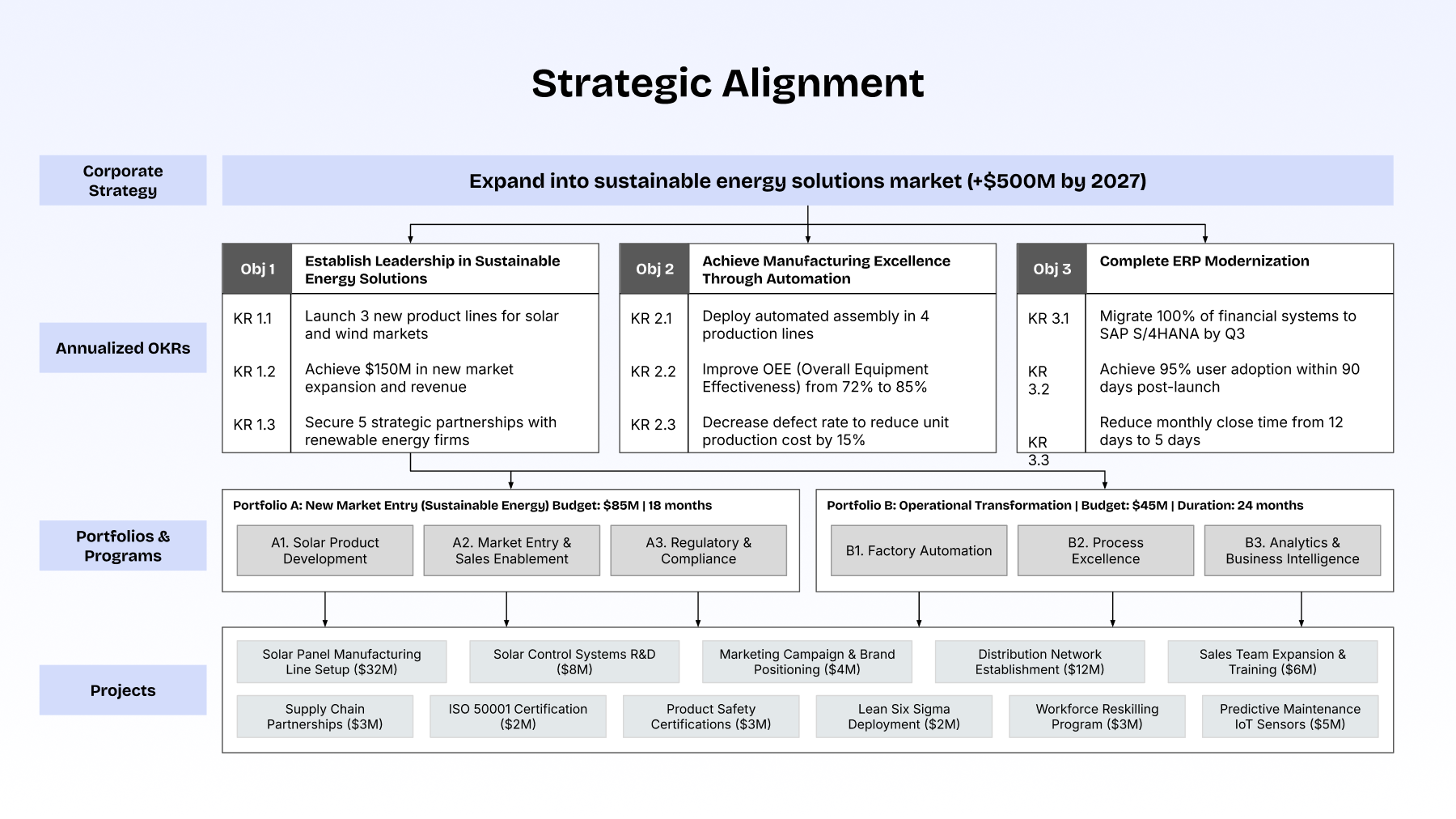
Now comes the real test. For each project, ask, “Which strategic objective does this directly support?” If it supports more than one objective, pick the primary one. If it supports none, don’t force it. Put it in a “review” bucket. This step alone usually reveals a surprising amount of “portfolio noise.”Get a clear objective-based view of every project, spot misaligned spending, and fund what drives real outcomes
Step 3: Define the outcome you expect from that project
Here’s where alignment becomes meaningful. Don’t stop at: “This supports digital transformation.” Go one step further:“What will change in the business if this succeeds?”
Examples of real outcomes:
- faster product releases
- Higher customer adoption
- improved retention
- lower operating cost
- better compliance scores
- Higher employee productivity
When outcomes are clear, alignment stops being a label and starts being a promise.
Step 4: Look at funding by objective
Once everything is mapped, you can finally see the portfolio for what it is.Ask:
- Which objectives are getting most of the money?
- Which are barely funded?
- Which have a lot of projects but little value?
This is the “aha” moment for most teams, because it shows whether the portfolio reflects strategy.
Step 5: Prioritize based on strategic contribution, not just urgency
Now that you have clarity, you need a fair method to decide what stays and what goes.A simple scoring approach works well:
- Strategic contribution: How strongly does this move the objective?
- Value potential: What benefit or ROI are we expecting?
- Effort and risk: How hard is this, and what could derail it?
- Dependencies: Does it unlock other work or block it?
Projects with low contribution and low value should be paused or stopped. Because every month of funding for misaligned work is a month you’re starving the priorities you said mattered.
What aligned portfolios unlock
When strategic alignment becomes a habit, not a workshop, the benefits show up fast.- You fund fewer projects, but the right ones. The portfolio feels lighter, and strategy suddenly feels possible again.
- Executives get real clarity. Instead of asking, “What are we doing?” They can ask, “What are we achieving?”
- Teams stop competing for resources. When priorities are clear, resourcing becomes a strategic decision, not a tug-of-war.
- Time-to-market improves naturally. Less noise means fewer bottlenecks and faster execution on what matters.
Strategic alignment doesn’t slow the business down. It removes the clutter that was slowing you down in the first place.
Now the next question is obvious: How do you stop alignment from drifting again after planning season?
How Profit.co keeps alignment continuous
Most organizations align in January and drift by March. Profit.co prevents that drift because alignment isn’t a side project in the tool. It’s built into the way portfolios are run.Here’s what that looks like:
- Strategy → OKR/Balanced Scorecard alignment mapping Objectives sit at the top, and portfolios, programs, and projects connect directly underneath. No guessing, no manual spreadsheets.
- Portfolio-to-objective linking Every initiative carries a strategic tag, so misaligned work becomes visible the moment it enters the portfolio.
- Executive visibility dashboards Leaders can see, in one view, where money and effort are going by objective and where gaps are forming.
- Deprioritization workflows and scoring Profit.co helps teams score contribution and value, then pause or stop low-impact work before it drains resources.
So instead of alignment being a yearly cleanup, it becomes a dynamic system you can trust week after week.
Map your portfolio to strategy in 2 weeks with Profit.co
It means every project is clearly linked to a strategic objective and a measurable business outcome. If a project can’t show that link, it shouldn’t be funded.
Ideally 3-5. Too many objectives makes alignment fuzzy and turns everything into a priority
Put them into a review bucket. Some can be stopped, some reshaped, and some may need a better strategic case before continuing.
At least monthly, and any time priorities shift. Strategic alignment isn’t “set and forget.”
Yes. You can align to Balanced Scorecard themes, Hoshin priorities, MBO, or strategic pillars. The key is consistency and outcome clarity
Do the mapping first. Don’t optimize yet. Just map every project to an objective and outcome. Visibility is the first win.
Related Articles
-
Scaled Agile Framework (SAFe) Runs Your Delivery. Who Owns Your Strategy?
Karthick Nethaji Kaleeswaran Director of Products | Strategy Consultant Published Date: April 1, 2026 TL;DR Scaled Agile Framework (SAFe) governs... Read more
-
The Hidden Cost of Zombie Projects in Your New Product Development Pipeline
TL;DR Zombie projects are New Product Development initiatives that were approved but never properly resourced. They remain active in the... Read more
-
IT Portfolio Rationalization: The Investment Decision Your ITSM Tool Cannot Make
Karthick Nethaji Kaleeswaran Director of Products | Strategy Consultant Published Date: March 31, 2026 TL;DR ITSM tells you what your... Read more
-
Project Portfolio Management Maturity: Where Does Your Organization Sit?
TL;DR Project portfolio management maturity is not binary. It develops across five levels, moving from reactive project tracking to predictive... Read more