


Published Date: Jan 21, 2026
TLDR: The Big Idea
Most leaders manage their project portfolios by looking at what happened last month. This guide shows you how to use the data you already have to create a “3-month window” into the future. By spotting patterns in budgets and schedules early, you can stop disasters before they start and save on your portfolio value.Most project managers want to ace all their projects. That’s every project manager’s dream, but have you ever walked into a quarterly review in February only to find out three of your biggest projects are already underwater?
The budget is no longer available, the team is exhausted, and the deadline is no longer a reality
The Portfolio Management Paradox
Your quarterly portfolio review reveals three critical projects are at serious risk, like budget overruns, resource shortages, and timeline slips. Emergency meetings are called. Executives demand explanations for problems that seemingly appeared overnight.Except they didn’t appear overnight. The warning signs were there in December and January: subtle resource allocation conflicts, gradually deteriorating velocity metrics, and small but consistent budget variances. The data existed. What didn’t exist was the ability to see the pattern, connect the dots, and intervene before problems became crises.
This is the portfolio management paradox: organizations generate enormous amounts of project data with timesheets, budget actuals, milestone completions, resource allocations, and risk registers, yet most PMOs remain fundamentally reactive. They see what happened last month with perfect clarity but have minimal visibility into what’s likely to happen in the next 2-3 months.
This creates a cycle:
- Problems are detected late
- Decisions are rushed
- Fixes are expensive
- Confidence drop
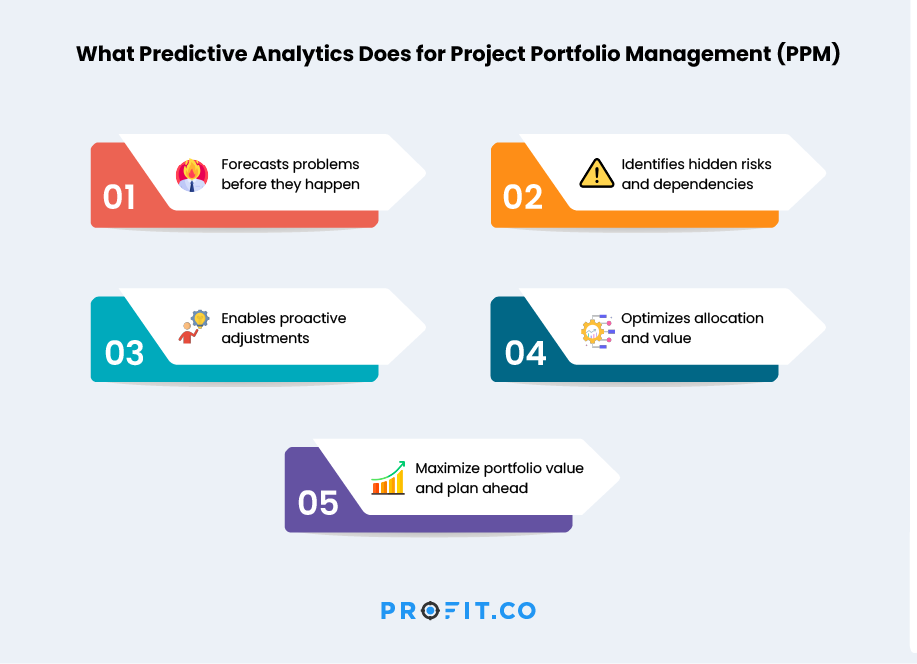
Predictive analytics PPM exists to break this cycle by shifting attention forward.
In the world of business, being reactive is expensive. Research confirms that poor project management, specifically the late detection of risks and issues, is a major driver of financial loss. According to the Project Management Institute (PMI), organizations waste an average of $122 million for every $1 billion spent on projects.
Predictive Analytics Project Portfolio Management (Predictive Analytics PPM) fixes this exact problem.
What Predictive Analytics PPM Actually Means
Let’s be precise about definitions, because “predictive analytics” has become an overused buzzword in enterprise software. True predictive analytics PPM goes beyond descriptive dashboards that show what happened and diagnostic analytics that explain why it happened to deliver genuine forecasting: what is likely to happen in your portfolio over the next 2-3 months.This means answering questions like:
- Which projects are likely to miss deadlines, even if they look fine today?
- Where will resource shortages appear in the coming months?
- Which initiatives are likely to exceed budget if nothing changes?
- What happens if we delay, cancel, or accelerate a project?
Instead of relying only on current status, predictive analytics looks at trends across time and across projects.
It uses what has already happened in your portfolio to estimate what usually happens next under similar conditions
“Without data, you’re just another person with an opinion.”

Why We Keep Getting Blindsided
We tend to manage projects based on “status colors.” If a project is green, we leave it alone. If it’s red, we scramble. The problem is that “green” is often not a clear go-ahead. It tells you the project is okay right now, but it doesn’t tell you that a massive resource conflict is brewing for April.To fix this, we need to move from looking at what happened to predicting what will happen.
The Magic of the 3-Month Window
Why 2 to 3 months?- One month out is too short. By then, the problem is already at your door.
- Six months out is too blurry. Too much can change in a half-year.
- Three months is the “Goldilocks” zone. It’s far enough away that you actually have time to move people around or change the plan, but close enough that your data is still accurate.
See how Profit.co gives you 3-month portfolio visibility
How Predictive Analytics Uses Existing Portfolio Data
Predictive analytics PPM does not require new reporting work from teams. It relies on data you already collect. Predictive analytics PPM combines several sophisticated technical capabilities:1. Time-Series Pattern Recognition
Machine learning models analyze historical project data to identify patterns that precede specific outcomes. These aren’t simple rules, like if budget variance is greater than 10%, flag the project, but complex pattern recognition across multiple dimensions:- Velocity degradation patterns: Recognizing that teams showing 8% velocity decline over three consecutive sprints have 73% probability of missing their release date.
- Communication volume anomalies: Identifying that sudden drops in team communication (Slack messages, meeting attendance) correlate with emerging interpersonal conflicts that impact delivery
- Resource allocation efficiency: Detecting that resources split across 3+ concurrent projects deliver 40% less throughput than expected
These patterns are learned from your organization’s data, not pre-programmed. The system discovers that in your environment, infrastructure projects starting in Q4 have materially different success rates than Q1 starts—a pattern that wouldn’t be obvious from traditional reporting.
2. Monte Carlo Simulation
For each active project, predictive analytics PPM runs thousands of simulated outcomes based on probability distributions derived from historical actuals. Instead of a single-point estimate like “This project costs $500K and completes June 30,” you get probability distributions:- Budget: 70% probability between $480-520K, 15% chance of $520-560K, 5% chance >$560K
- Timeline: 65% probability of June 15-July 15 completion, 25% chance of July 15-Aug 15, 10% chance beyond August
- Resource Requirements: 80% probability that current team suffices, 12% chance of needing additional senior developer, 8% chance of needing major team restructuring
This probabilistic thinking transforms portfolio management from wishful thinking to risk-informed decision-making.
3. Dependency Graph Analysis
Modern portfolios involve complex interdependencies.Project A delivers infrastructure that Project B requires; Projects C and D compete for the same specialized resources; and Projects E-G all support the same strategic initiative. Predictive analytics PPM models these relationships as directed graphs and propagates delays, risks, and resource conflicts across the network.
When the infrastructure team on Project A signals they’re slipping in two weeks, predictive analytics PPM automatically identifies the seven downstream projects affected and recalculates their probability distributions accordingly. Your portfolio dashboard updates from “mostly green” to showing the cascade effect, thus giving you 6-8 weeks to intervene before dependencies turn into delivery failures.
4. What-If Scenario Modeling
Perhaps the most powerful capability is the ability to simulate alternative futures. Predictive analytics PPM lets you ask:- “What happens to portfolio ROI if we delay Project X by one quarter?”
- “If I reassign Sarah from Project A to Project B, what’s the net impact on both timelines?”
- “Which three projects should we descope to bring the Q3 budget into line with available funding?”
The system evaluates options across the entire portfolio, considering resource constraints, dependencies, strategic priorities, and risk factors—then presents ranked recommendations with supporting analysis. What would take a portfolio management team 20-30 hours of manual analysis happens in seconds.
How Leaders Can Spot the patterns with Predictive Insights and Take Decisions
You don’t need a degree in data science to understand how this works. It’s really about three simple things:1. Spot the lag
Instead of waiting for a deadline to be missed, look at the speed of the work. If a team’s output drops by just 5% every week for three weeks, they probably won’t hit their big goal two months from now. Most people ignore a 5% dip, but a computer can see that it’s the start of a downward slide2. Prepare for the roadblock ahead
Project A needs a specific specialist. Project B needs that same person. Right now, they are both fine. But in eight weeks, both projects hit a phase that requires that specialist at the same time. Predicting this allows you to hire a contractor or move a deadline now, instead of having two teams sitting idle in two months.3. Run “What If” scenarios
What happens if we push Project X back by a month? In the past, answering that required ten meetings and a week of spreadsheet work. Now, you can simply simulate the change. It shows you the ripple effect across the whole company instantly. It’s like having a GPS that reroutes you before you even hit the traffic.4. Turning Data into Decisions
When you start looking at your portfolio this way, your meetings change. Instead of asking “Why did this fail?” you start asking, “I see a 70% chance of a budget overrun in May; what should we adjust today to prevent it?”Conclusion
Managing a portfolio will always have some uncertainty. But there is a massive difference between a “surprise” and a “calculated risk.” By opening up that 3-month window, you give yourself the gift of time. Time to think, time to pivot, and time to save your budget.Predictive analytics does not replace judgment. It improves it. Instead of reacting to problems after they surface, leaders gain early visibility into where attention will be needed next. Conversations shift from explaining the past to shaping the future.The result is fewer surprises, better trade-offs, and a portfolio that stays aligned with business priorities.
Explore predictive portfolio management with Profit.co
No. No company has perfect data. The system actually learns from your messy data. It looks at how your company actually works, not how the manual says it should work.
Not at all. It’s a tool for them. It gets rid of the “firefighting” part of their job so they can actually focus on leading their teams and delivering quality work.
Most organizations start seeing meaningful patterns within 30 to 60 days of looking at their data through a predictive lens
Most organizations already have the required data: schedules, budgets, resources, and progress updates.
Predictions are not guarantees, but they are far more reliable than intuition or static reports, especially in the 2–3 month window.
No. It improves them by focusing discussions on what is coming, not only what already happened.
PMOs, portfolio leaders, finance teams, and executives responsible for delivery and investment decisions.
Related Articles
-
The Execution Gap: Why Government Agencies Excel at Vision and Fail at Delivery
Bastin Gerald Founder & CEO at Profit.co Published Date: March 13, 2026 TL;DR Government agencies are among the most sophisticated... Read more
-
Knowledge Resource Management in Enterprise Projects
Karthick Nethaji Kaleeswaran Director of Products | Strategy Consultant Published Date: March 23, 2026 TL;DR Knowledge is one of the... Read more
-
Beyond Headcount: The Complete Guide to Resource Management in Enterprise Project Portfolio Management
Karthick Nethaji Kaleeswaran Director of Products | Strategy Consultant Published Date: March 23, 2026 TL;DR Most project resource plans focus... Read more
-
Financial Resource Planning in Project Portfolios
Karthick Nethaji Kaleeswaran Director of Products | Strategy Consultant Published Date: March 23, 2026 TL;DR Every project has a budget... Read more