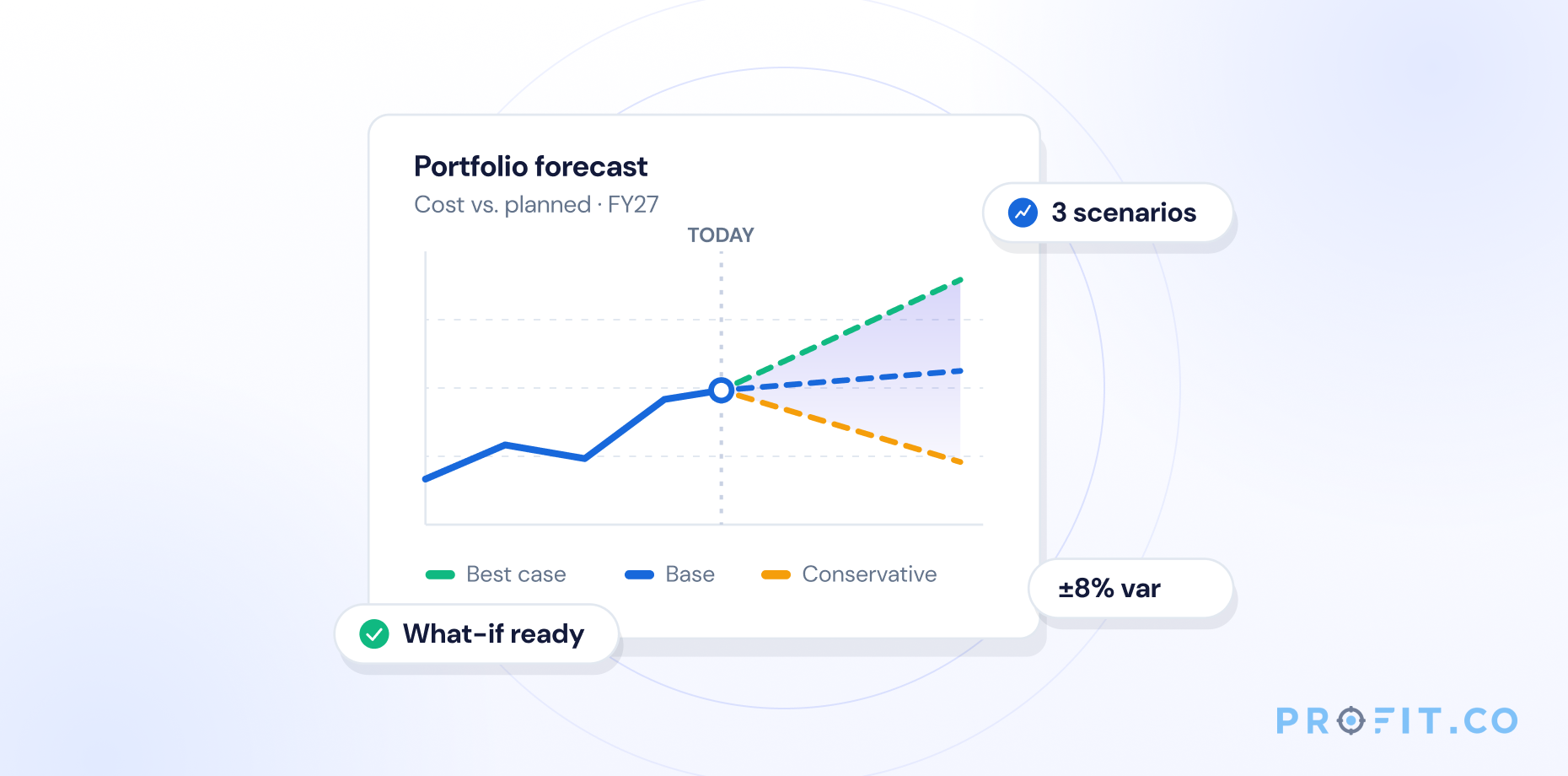
Most organizations struggle with project surprises and how a 2–3 month forward view can change portfolio outcomes. The idea resonated because it addressed a real frustration: leaders are tired of finding out about problems when it’s already too late to fix them.
So the next logical question to ask is this:
What does predictive analytics actually look like once it’s in place?
Not just the technology behind it, but how it affects day-to-day portfolio decisions and how teams use it to see three months ahead in a practical, repeatable way.
TL;DR
Most portfolio surprises come from patterns that were visible weeks earlier but went unnoticed. Predictive analytics in Project Portfolio Management (PPM) uses existing project data to give leaders 2–3 months of forward visibility, allowing them to spot budget, schedule, and resource risks early.Teams using predictive analytics shift from reactive firefighting to proactive decision-making. Portfolio reviews become shorter and more focused, surprise escalations drop, and leaders gain confidence in delivery commitments. Instead of reporting what went wrong, teams focus on what’s likely to happen next and what to do about it.
Why 3-Month Visibility Is the Sweet Spot for Predictive Analytics in PPM
Organizations often ask why predictive analytics tends to be most useful in the 2–3 month window.The reason is simple. Most companies have reliable data for the current month and reasonably accurate data for the previous month. Timesheets are submitted, budgets are updated, and milestones are recorded. This creates a solid foundation for identifying trends.
Why One-Month Forecasts Don’t Create Enough Lead Time
Looking one month ahead is usually not enough. By then, plans are already locked, resources are committed, and options are limited.Why Long-Range (6+ Month) Predictions Lose Accuracy
Looking six months ahead introduces too much uncertainty. Staffing changes, scope shifts, and external factors make long-range predictions unreliable.How the 2–3 Month Window Aligns with Portfolio Planning Cycles
The 2–3 month horizon sits in the middle. It is far enough ahead to allow meaningful action by adjusting priorities, reallocating people, or changing scope while at the same time still being close enough that predictions remain trustworthy. It also aligns well with how most organizations plan: monthly reviews and quarterly checkpoints.How Predictive Analytics Changes Day-to-Day Portfolio Decisions
The biggest shift is better timing for taking preventive action. Teams with 3-month visibility stop reacting to surprises and start managing trade-offs early. Instead of asking why a project failed, portfolio conversations focus on where attention is needed next.From Reactive Escalations to Proactive Trade-Offs
Organizations that implement predictive analytics consistently report the same outcome: a sharp drop in surprise escalations. Projects no longer appear healthy one month and critical the next. Emerging risks are visible 8–10 weeks earlier, giving leaders time to intervene calmly rather than urgently.This changes the tone of portfolio reviews. Meetings become shorter, decisions become clearer, and confidence improves across leadership teams.
How Leaders Use Forward-Looking Signals Instead of Status Reports
Predictive analytics does not overwhelm leaders with data. It simplifies decision-making by focusing on what matters next.Instead of static status indicators, leaders see forward-looking signals such as:
- Delivery confidence: the likelihood that a project will complete on time based on current trends
- Budget outlook: expected cost ranges rather than a single fixed number
- Resource risk: where capacity conflicts are likely to appear in the coming months
These views update continuously as new data comes in. Leaders are no longer relying on last month’s snapshot; they are seeing the direction the portfolio is heading.
“The Ultimate purpose of collecting the data is to provide a basis for action or a recommendation.”

Hypothetical Examples That Show How Predictive Analytics in PPM Helps
Example 1:
A financial services firm was running two critical initiatives: a customer portal redesign (Project Atlas) and a payment infrastructure upgrade (Project Titan). Both were green. Both had the resources they needed.In May, the predictive system flagged a problem: Resource conflict probability: 87% in Week 28-32.
The issue? Both projects were about to hit testing phases that required Maria Santos, the company’s only CISO-certified security architect. Atlas needed her for penetration testing. Titan needed her for compliance validation. Same four-week window.
The old way:
Week 28 arrives. Both project managers email Maria the same day. Panic ensues. One project gets delayed. Emergency meetings. Executives demand explanations.
With predictive analytics:
The conflict surfaced in May. They had 8 weeks to respond. They brought in an external security consultant for Atlas, and Maria focused on Titan (the higher-risk project). Both projects stayed on track.
The shift: From “Why did this happen?” to “We see a collision forming, let’s reroute now.”
Example 2:
A manufacturing company used to run quarterly portfolio reviews like this:Old Format (90 minutes):
- 60 minutes: Project managers present status updates
- 20 minutes: Discussion of projects already in trouble
- 10 minutes: “Any questions?”
- Result: Lots of talk about the past, minimal action on the future
New Format with Predictive Analytics (45 minutes):
- 5 minutes: Quick status summary (everyone already saw the dashboard)
- 30 minutes: Discussion of the five projects flagged for risk in the next 8-12 weeks
- 10 minutes: Scenario planning (“What if we delay Project X by a month?”)
- Result: Focused decisions, clear actions, half the meeting time
What changed specifically:
Instead of this question: “Why is Project Horizon over budget?” They started asking, “The system shows a 73% probability that Project Horizon will exceed budget by August. Should we descope Feature Set C now or reallocate $150K from the innovation fund?”
The conversation shifted from explaining the past to shaping the future.

Early Warning Signals Powered by Predictive Analytics
Predictive analytics highlights specific patterns that historically lead to problems. These are not generic alerts. They are based on how similar projects have performed in the past.Examples include:
- Gradual declines in delivery pace that often lead to missed milestones later
- Spending patterns that typically precede budget overruns
- Teams stretched across too many initiatives at the same time
- Stakeholder engagement is dropping well before late change requests appear
Individually, these signals are easy to ignore. Together, they form a clear picture of future risk.
How Predictive Analytics Reveals Portfolio-Wide Dependencies
One of the most practical benefits of predictive analytics is understanding how projects affect each other.When a key initiative shows signs of delay, the system highlights which other projects depend on it and how those timelines are likely to shift over the next few months.
This allows leaders to prioritize intervention where it will have the greatest impact. Instead of spreading effort evenly across all projects, attention goes to the areas that protect the most value.
Scenario Planning in Project Portfolio Management Without Spreadsheet
Another major shift is how decisions are evaluated.Predictive analytics allows leaders to explore questions such as:
- What happens if we delay this project by one month?
- What if we move a critical resource to a higher-priority initiative?
- What if funding tightens next quarter?
The impact of these choices is shown immediately across timelines, budgets, and capacity. What once required days of meetings and manual analysis becomes a focused discussion about options and outcomes.
Ready to see what predictive analytics could reveal in your portfolio?
How Different Roles Use Predictive Analytics in PPM
Predictive Analytics for PMO Leaders
Less time assembling reports. More time helping leaders make better decisions.Predictive Analytics for Executives and Portfolio Sponsors
Fewer surprise escalations. More confidence in delivery commitments.Predictive Analytics for Project Managers
Earlier warning when their projects are drifting. More time to course-correct before things become visible failures.Common Predictive Analytics Mistakes in Project Portfolio Management and How Teams Avoid Them
Organizations that succeed with predictive analytics tend to avoid a few common pitfalls.- Treating predictions as certainties Predictions are probabilities, not guarantees. Teams use them to guide discussion, not to automate decisions blindly.
- Expecting perfect data Predictive analytics works with real-world data. It improves as more projects are completed and patterns become clearer.
- Keeping the same review process The biggest gains come when portfolio reviews shift from backward-looking updates to forward-looking conversations.
- Ignoring the “low probability” risks A 15% chance of a $2M budget overrun still deserves a contingency plan.
What Predictive Analytics Means for Portfolio Leaders
Predictive analytics is not about adding complexity. It is about reducing uncertainty. With a clear 3-month view, leaders gain time—time to think, time to adjust, and time to protect strategic outcomes. Decisions become proactive rather than reactive, and portfolio management becomes more predictable.Final Thought
When teams can see what is likely to happen next, portfolio management becomes calmer, more deliberate, and far more effective. Predictive analytics turns existing data into early insight—and insight into better outcomes.Explore predictive portfolio management with Profit.co
Predictive analytics in PPM uses historical and current project data to forecast future risks and outcomes, such as budget overruns, schedule delays, and resource conflicts—typically 2–3 months in advance.
The 2–3 month horizon balances actionability and accuracy. It’s far enough ahead to adjust resources or scope, yet close enough that predictions remain reliable based on existing data. One month is too late; six months is too uncertain.
Predictive analytics can flag:
- Emerging budget overruns
- Schedule slippage risks
- Future resource conflicts
- Dependency-related delays
- Hidden risk patterns not visible in status reports
No. Predictive analytics works with real-world, imperfect data. Accuracy improves over time as more projects are completed and patterns become clearer, but meaningful insights often appear within weeks.
Portfolio reviews shift from backward-looking updates to forward-looking decisions. Teams spend less time explaining the past and more time discussing upcoming risks and trade-offs, often cutting meeting time in half.