TL;DR
Predictive analytics in project portfolio management (PPM) is moving beyond basic reporting and forecasting toward intelligent decision support. While most PPM tools today offer limited, function-specific predictive features, a new generation of AI-native platforms is emerging that learns from historical outcomes, models interdependencies, and recommends actions. For portfolio leaders, the advantage is no longer just seeing risks earlier; it’s gaining time to act, optimize investments, and deliver with greater confidence.As more organizations adopt predictive analytics in project portfolio management (PPM), one question keeps coming up:
What does “predictive” actually mean in today’s PPM tools and how far has the market really progressed?
Most leaders are no longer debating whether predictive analytics matters. They are trying to understand:
- Which capabilities are genuinely available today
- Where current tools still fall short
- What the next generation of predictive analytics PPM will look like
This article examines the current competitive landscape and the future direction of predictive analytics in PPM, based on how organizations are actually using these capabilities.
Start turning insights into smarter actions today
“Without date you’re just another person with an opinion.”

The Current Predictive Analytics PPM Landscape
Most enterprise PPM platforms now acknowledge the need for predictive capabilities. However, the depth and focus of those capabilities vary widely. Rather than ranking vendors, it’s more useful to understand how different platforms approach prediction and where each tends to focus.Broadcom Clarity: Strong Reporting, Limited Prediction
Clarity PPM provides robust reporting and trending capabilities that help organizations understand how projects have performed over time.Teams can track:
- Velocity trends
- Budget burn rates
- Resource utilization patterns
These insights are valuable for transparency and governance.
Where it works well
- Flexible reporting
- Enterprise-scale portfolio visibility
- Support for complex organizational structures
Typical limitations
- Insights are largely descriptive rather than predictive
- Trend analysis does not always translate into forward-looking forecasts
- Limited built-in learning from historical outcomes
Clarity is often used by organizations with dedicated reporting teams and mature governance models, where insight interpretation happens outside the system.
Planview: Predictive Strength in Resource Forecasting
Planview offers predictive features focused primarily on resource capacity and utilization. Organizations can model future demand, identify upcoming capacity constraints, and explore different staffing scenarios. These capabilities are particularly useful in environments where resource availability is the primary bottleneck.Where it works well
- Capacity forecasting
- Resource demand modeling
- Integration with broader Planview portfolio tools
Typical limitations
- Predictive depth is based on data quality and changing variables.
- Timeline and budget forecasting are less central
- Portfolio-wide optimization scenarios often require configuration and manual analysis
Planview’s predictive capabilities are most effective when organizations prioritize resource planning as the core portfolio challenge.
Profit.co: Predictive Analytics for Comprehensive Portfolio Optimization
Profit.co PPM integrates powerful predictive analytics to provide actionable insights across the entire portfolio, ensuring organizations can proactively manage resources, risks, and project outcomes with greater confidence.Where it works well:
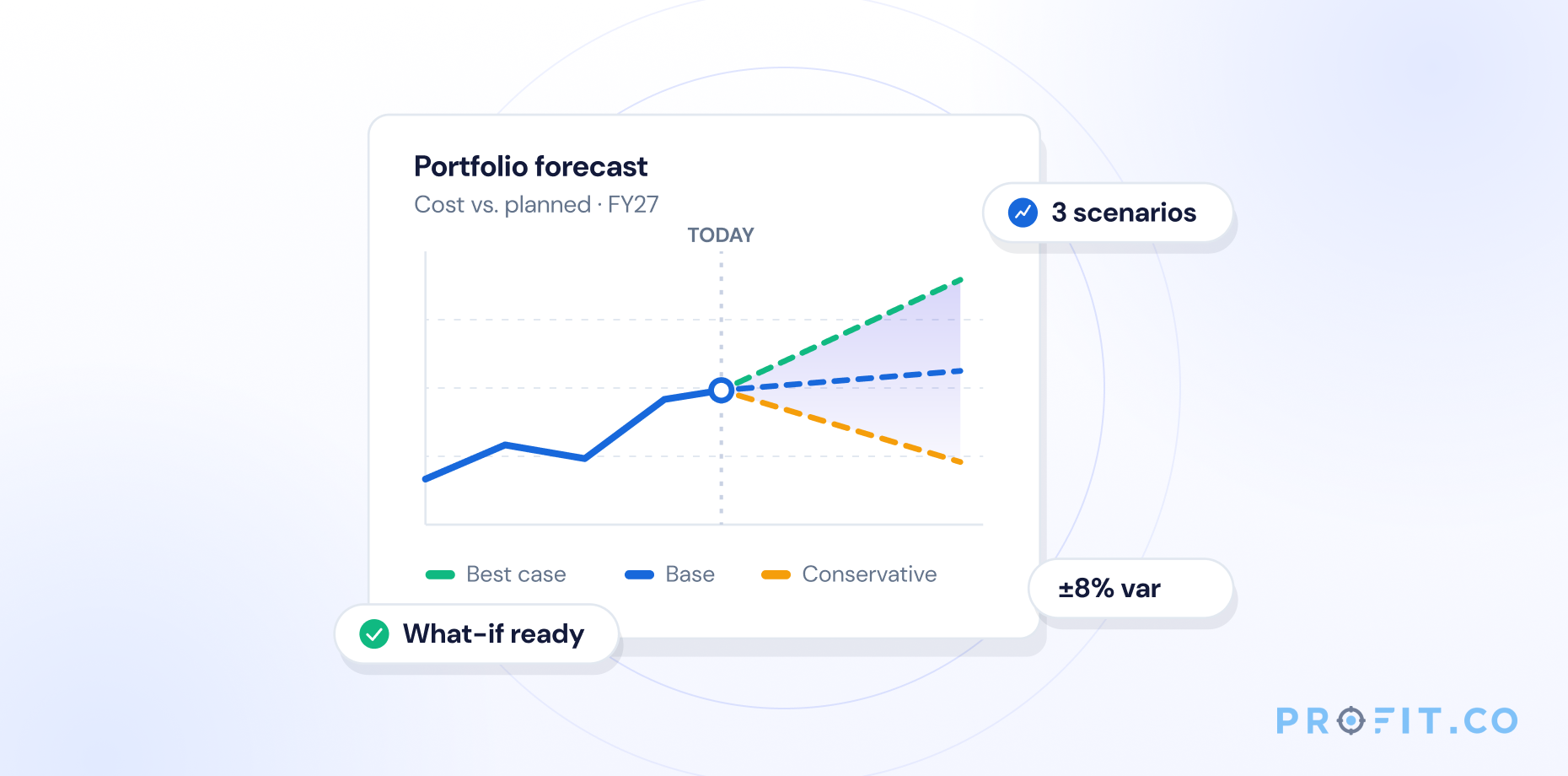
- Scenario Planning with What-If Simulations: The platform supports scenario planning by simulating changes in budget, resources, and project scope, enabling portfolio leaders to predict project outcomes under various conditions.
- AI-Powered Risk Prediction: Profit.co’s AI agent predicts potential risks by learning from historical data and project trends, providing early warnings to mitigate disruptions.
- EVM Predicting Variances and Project Completion: Profit.co uses Earned Value Management (EVM) to forecast project variances and completion timelines, allowing for better cost and schedule control.
- Business Outcomes Prediction: Profit.co forecasts how well projects align with organizational goals, ensuring that portfolio decisions are optimized for long-term business success.
Typical Limitations:
- Predictive Depth Depends on Data Quality: The effectiveness of predictions can be influenced by the quality of input data, with some insights relying on historical outcomes and patterns.
- Complexity in Cross-Portfolio Optimization: While Profit.co excels in providing predictive insights across a portfolio, more complex cross-functional optimizations may require manual adjustments.
- Learning Curves for Advanced Features: New users or teams unfamiliar with AI-driven tools might take time to fully leverage advanced predictive features like AI-powered risk prediction and strategic alignment.
Profit.co’s predictive capabilities are most effective for organizations looking for a comprehensive, AI-driven portfolio management solution that integrates resource forecasting, risk management, and strategic planning into a unified platform.
ServiceNow SPM: Predictive Signals Inside IT Workflows
ServiceNow’s Strategic Portfolio Management capabilities are closely integrated with its IT and service workflows.Predictive insights often emerge from:
- Ticket flow trends
- Sprint throughput
- Backlog growth patterns
Where it works well
- IT and engineering portfolios
- Agile delivery environments
- Organizations already standardized on ServiceNow
Typical limitations
- Less effective for non-IT initiatives
- Financial forecasting is not the primary strength
- Cross-portfolio optimization is limited outside IT contexts
ServiceNow’s predictive value is strongest when portfolio management is tightly coupled with operational execution.
The Rise of AI-Native Predictive PPM Platforms
A newer category of platforms is emerging, built with predictive analytics as a core design principle rather than an add-on.These systems tend to focus on:
- Learning from historical portfolio outcomes
- Modeling interdependencies automatically
- Supporting scenario-based decisions at scale
Common characteristics include:
- Portfolio-level scenario generation
- Constraint-based optimization
- Early warning systems trained on organizational patterns
Continuous recalibration as projects are completed. The goal is not just forecasting but decision support.

Where Predictive Analytics in PPM Is Heading
The next phase of predictive analytics in project portfolio management is not all about gathering more data—it’s about turning insights into smarter actions. Here’s what’s coming next:Prescriptive Recommendations
It’s no longer enough to know what might happen. The future of PPM is about guidance and understanding what actions have historically reduced risk in similar situations and applying that knowledge to make better decisions today.- Natural Language Interaction Leaders don’t want to dig through dashboards anymore. They want to ask straightforward questions like, “Which projects are at risk of a Q3 delay, and why?”—and get clear, actionable answers instantly.
- Cross-Portfolio Learning Insights are more powerful when shared. Patterns spotted across business units, regions, or delivery models can now inform planning and decision-making across the entire organization.
Policy-Based Automation
Routine decisions can be handled automatically within defined rules, freeing teams to focus on exceptions that truly need human judgment.In short, predictive analytics in PPM is evolving from a “forecasting tool” into a decision-making partner, helping organizations act faster, smarter, and with more confidence.
The Strategic Implication for Portfolio Leaders
For portfolio leaders, predictive analytics in PPM changes the game. It moves portfolio management away from simply reporting what already happened to anticipating what’s likely to happen next. It replaces the illusion of certainty with informed probability and rigid control with continuous optimization. Organizations that embrace this shift see more predictable execution, stronger capital efficiency, faster responses to emerging risks, and greater confidence in delivery commitments. The tools are maturing quickly, but the real competitive advantage belongs to leaders who act on these insights earlier than everyone else.Final Thought
Predictive analytics in PPM is no longer experimental. It is becoming a defining capability for organizations that want to manage portfolios proactively rather than explain outcomes retroactively. Seeing three months ahead is not about prediction perfection. It is about buying time to decide, adjust, and protect value. Those who build that capability today will set the pace tomorrow.See how predictive analytics can transform your portfolio decision
Predictive analytics in PPM uses historical portfolio & project data, patterns, and models to forecast outcomes, identify risks early, and support better investment and delivery decisions across projects.
Traditional PPM reporting is descriptive; it explains what already happened. Predictive analytics estimates what is likely to happen next, while prescriptive analytics goes a step further by recommending actions.
Most PPM tools offer some predictive elements, such as trend analysis or capacity forecasting. However, many capabilities remain descriptive, with limited learning from historical outcomes or portfolio-wide optimization.
Predictive analytics is most impactful in:
- Resource capacity planning
- Early risk identification
- Portfolio prioritization and investment decisions
- Schedule and delivery confidence
AI-native predictive PPM platforms are designed with analytics at their core. They automatically learn from past portfolio outcomes, model interdependencies, generate scenarios, and continuously recalibrate predictions as projects progress.
Prescriptive analytics goes beyond prediction by recommending actions, based on historical patterns, that are most likely to reduce risk or improve outcomes in similar situations.
Because portfolios are growing more complex and change faster than traditional planning cycles. Predictive analytics helps leaders act earlier, allocate capital more efficiently, and respond to emerging risks with confidence.
Yes, but maturity varies by tool. Some platforms are strongest in IT and agile environments, while others support broader enterprise portfolios, including business transformation and strategic initiatives.
The future lies in prescriptive recommendations, natural language interaction, cross-portfolio learning, and policy-based automation—turning PPM tools into active decision partners rather than passive reporting systems.
Start by improving data quality, identifying high-impact use cases (such as risk detection or capacity planning), and evaluating tools based on decision support.