


Summary
HR departments have a difficult time showing how strategic they are because they don’t have the right way to measure their work. A balanced scorecard made just for HR fixes this by linking people initiatives to business results from four important points of view. Profit.co goes even further by combining the Balanced Scorecard and OKR framework into one platform for HR leaders to plan strategy, track execution, and show how it affects the business in a real way.Here’s a question that keeps HR leaders up at night. How do you show that your department really makes a difference? You know that the work your team is doing is important. You’re hiring great people, making the workplace better, training leaders, and keeping the business going. But can you show the CFO clear metrics that show how HR drives business results when they ask about ROI or when budget cuts are coming?
You’re not the only one who is having trouble answering that question with confidence. And most importantly, the HR Balanced Scorecard is a tool that forward-thinking HR departments are using to change how they work and show their worth.
I’ll show you why this framework is so important for today’s HR teams and how tools like Profit.co make it easier than ever to use.
The HR Credibility Gap: Why Old Metrics Aren’t Enough
Let’s talk about the big problem in the boardroom. Human Resources doesn’t always get the respect it deserves as a strategic function.Why?
Because most HR departments are still measuring the wrong things. Traditional HR metrics only show you how busy you are, not how well you do your job.
- How long does it take to fill positions? That’s a measure of activity.
- How much does it cost to hire someone? That’s a measure of efficiency
- How many hours of training were given? That’s a measure of input.
These don’t tell you if HR is really helping the business win. When you bring these numbers to the leadership meeting, you’re basically saying, “Look at all the things we did!” But what executives really want to know is, “How did that stuff help us make more money, improve our margins, keep our best people, or build the skills we need for the future?”
This is the HR credibility gap, and it’s getting bigger as businesses deal with more and more complicated people problems.
“In the long run , your human capital is your main base of competition . Your leading indicator of where you’re going to be 20 years from now is how well you’re doing in your education system.”

Why HR needs a new way to measure things
Think about what HR is really in charge of. You’re not just hiring people and paying them. You’re also making the people and culture of the organization its most valuable asset. That’s not just an administrative job but a strategic one. But you need to measure and talk like a strategic function to be seen as one. This means keeping track of results, not just actions. It means showing how efforts to help people are linked to business results. It means using leading indicators that show how things will go in the future, not just lagging indicators that show what has already happened. You need a way to measure things that fit the level of difficulty and importance of what HR does.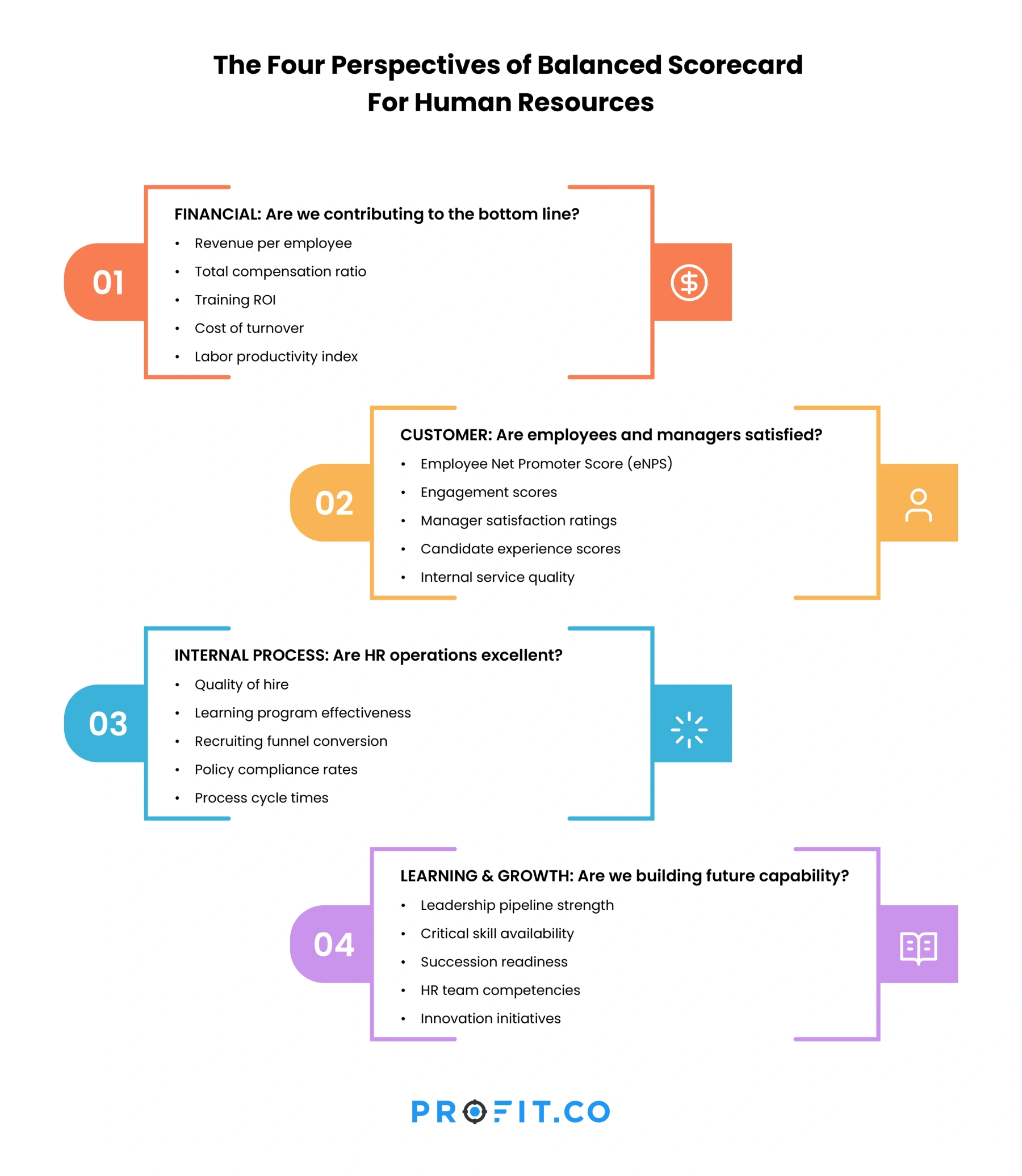
Why the Balanced Scorecard is Great for HR
The Balanced Scorecard was first made to help whole companies make sure their strategies and actions were in line with each other. But here’s what makes it so useful for HR: it makes you look at performance in a number of ways, which gives you a full picture of the impact. The BSC framework makes you look at HR performance in four different ways, not just by counting activities or keeping track of costs.- The Financial Lens: What does HR do to help the bottom line?
- The Customer Lens: How happy are your internal customers, like managers and employees?
- The Process Lens: How well do your HR programs and operations work?
- The Growth Lens: What are you doing for learning and development to make your organization better for the future?
When you look at all four perspectives, you can finally tell the whole story of how valuable HR is. You’re not just good at getting things done and helping the business, but you’re also moving it forward
Are you ready to turn your HR department from a cost center into a strategic driver?
How HR can Measure Value Across The Four Perspectives of the Balanced Scorecard
Let’s look at how each point of view affects HR departments in particular.1. Financial Impact: Showing how much money HR saves
Here is where you link people projects to money. A lot of HR leaders don’t agree with this point of view because they think HR is too “soft” to measure in terms of money. That’s not right. The truth is that almost everything that HR does has to do with money. You just have to measure them.Think about things like:
- Revenue per employee: Are your hiring and training methods making your workers more productive?
- Total compensation ratio: Are you strategically managing labor costs?
- Return on investment for training: Are development programs really making people work better?
- What do regrettable losses really cost the business in terms of turnover?
When you show up with these numbers, you’re talking business. HR is no longer a cost center; it’s an investment that pays off in a big way.
2. From the customer’s point of view, your employees are your customers.
In the Balanced Scorecard framework, “customers” are the people inside your company who are important to you, like your employees and the managers who need HR help. This perspective answers the question, “Are we giving our employees an experience that draws in, keeps, and engages talent?”Some important metrics could be:
- Employee Net Promoter Score (eNPS): Would workers tell their friends to work here?
- Engagement scores: Do people care about their work?
- How happy are managers with their HR support? Are they getting what they need?
- Candidate experience scores: What do applicants think of how you hire people?
These numbers show you if your people strategies are really working for the people you want to help. High scores here usually mean that employees stay with the company, are productive, and have a strong employer brand.
3. Internal Process: HR Operational Excellence
This is where you find out how well and how quickly HR programs and operations work. Not just “are we doing things?” but “are we doing them right?” This perspective is different from traditional HR metrics that only look at speed and cost.It looks at quality and impact:
- Quality of hire: Are new hires doing a good job and staying with the company for a long time?
- Are training programs really changing behavior? This is what we mean by “learning program effectiveness.”
- Policy compliance rates: Are people following the rules you’ve set up?
- Talent acquisition funnel conversion: Where are candidates leaving, and what is the reason?
These metrics show that you are doing a great job with HR operations while also helping you make them better all the time.
4. Learning and Growth: Making Yourself More Capable in the Future
This is your forward-looking view, which shows that you’re not only dealing with today’s problems but also getting ready for tomorrow’s chances. For HR, this perspective is even more important because you’re working on both improving HR skills and building the skills of the organization:- Strength of the leadership pipeline: Do you have people ready to take over key roles?
- Availability of critical skills: Are you building the skills the business will need?
- HR team skills: Is your HR department keeping up with the needs of the business?
- Are you trying out new ways to deal with talent problems in your company?
This perspective lets executives know that you’re planning for the future.
What Happens in the Real World When Human Resources Uses the Balanced Scorecard
Before using a Balanced Scorecard, an HR team might say, “This quarter, we filled 47 positions in an average of 38 days and spent $4,200 on each hire.” That’s okay, but it doesn’t tell a strategic story.That same team says after using an HR balanced scorecard:
- “Our strategic hiring increased revenue per employee by 12% while keeping our target compensation ratio at 48%.”
- Customer: “Our eNPS went up from +15 to +32, and our employee engagement scores went up from 6.8 to 7.6. This shows that our workers are happier.”
- Process: “Quality of hire metrics show that 89% of new hires meet or exceed expectations after 90 days, up from 72% last year.”
- Learning and Growth: “We’ve built bench strength for 85% of critical roles, up from 43%, and started our emerging leaders program with 45 high-potential participants.”
Can you see the difference? The second version tells a full story about how strategic decisions affect the business, not just what happens in the day-to-day.
Common Mistakes And How to Avoid Them
Choosing metrics is only one part of putting an HR balanced scorecard into action. These are some of the things HR teams do wrong:- Too many metrics is the first mistake. Some teams try to measure everything and end up with no useful data. For each perspective, stick to 3 to 5 key metrics. The most you can have is 15 to 20.
- Metrics that don’t have baselines. You can’t show that you’ve gotten better if you don’t know where you started. Before starting new projects, make sure you have baseline measurements.
- Only using lagging indicators. Compare lagging outcomes with leading predictive metrics. Employee engagement is a leading indicator of retention, while turnover rate is a lagging indicator.
- Not in line with the business strategy. Your HR scorecard needs to be in line with the goals of the whole organization. Your metrics should show how HR helps the company focus on innovation.
- Nightmares from keeping track by hand. A lot of implementations fail here. Making scorecards in spreadsheets takes a lot of time, and the data quickly becomes old or wrong.
- Unified Strategy and Execution: Profit.co combines your strategic BSC and tactical initiatives into one platform, so you don’t have to keep them separate. Your HR Balanced Scorecard goals automatically link up with quarterly OKRs, so your strategy and execution are always in sync.
- Real-Time Dashboards: You don’t have to wait for quarterly reports anymore. Profit.co lets you see all four BSC perspectives at once in real time. You can quickly tell which areas are doing well and which ones need work.
- Automated Data Integration: Link Profit.co to your other systems to automatically fill in metrics. You don’t have to enter data by hand; your quality-of-hire information, engagement scores, and financial metrics update automatically.
- Clear Cause-and-Effect Mapping: The platform lets you see how changes in one area, like learning and growth, affect results in other areas, like customer satisfaction or financial performance. This makes it easy to explain the strategic reasons behind your people initiatives.
- Cascading Objectives: Your HR leadership sets the strategic BSC objectives, and then department leaders make OKRs that are in line with those objectives. Everyone, from recruiters to L&D experts, can see exactly how their work fits into the big picture of HR goals.
- Executive-Ready Reporting: With just a few clicks, you can make professional-looking reports for board meetings or leadership reviews. Use visual dashboards that are easy for executives to understand to show exactly how HR is doing from all four points of view.
How Profit.co Ties Everything Together
This is where the right technology really helps. Profit.co solves the biggest problem by putting them into action and keeping them up to date without getting lost in spreadsheets.Here is how Profit.co improves the HR Balanced scorecard experience:
Are you ready to use the Balanced Scorecard for Human Resources?
Traditional HR metrics usually look at how quickly you hired people, how much it cost, and how many people went to training. An HR Balanced Scorecard takes a strategic approach by looking at results in four areas: financial impact, employee satisfaction, process effectiveness, and building future capabilities. It’s the difference between saying “we filled 50 positions” and “our hiring quality improved productivity by 15% while keeping our compensation ratio targets.” The BSC links HR activities to business results, not just HR activities to more HR activities.
This is a common worry, and it’s a good one if you’re doing it by hand. Keeping track of a full BSC in spreadsheets would add a lot of extra work. That’s why tools like Profit.co are so important: they automate gathering, displaying, and reporting data. When used correctly with the right technology, a BSC actually makes things easier for administrators because they don’t have to make reports for different stakeholders on the fly anymore. Instead, everyone sees the same dashboard in real time. Setting things up at first costs money, but maintaining them should be easier, especially if your current HR systems can send you automated data feeds.
A Balanced Scorecard won’t change how people think about HR on its own, but it will give you the tools you need to do so. When you can show that your talent acquisition strategies increased revenue per employee by 10%, that your engagement initiatives cut down on costly turnover by 25%, and that your learning programs are helping the business build the innovation skills it needs for its three-year plan, you’re speaking the language of business strategy. The BSC framework makes you link people initiatives to business results, which is exactly what executives need to see. Yes, it can definitely change how leaders see HR when this framework is used along with regular communication.
Begin with the strategic priorities of your organization and work your way back. If your business is focused on growth, your Financial perspective might focus on things like revenue per employee and the number of employees you need to reach your goals. If customer experience is very important, your customer perspective might put employee engagement scores at the top of the list, because engaged employees give better customer experiences. You should only use 3 to 5 metrics for each perspective, with a total of 15 to 20 at most. Every metric should either measure an important outcome or predict an important outcome in the future. If a metric doesn’t clearly link to a strategic priority or help make decisions, get rid of it. Keep in mind that a scorecard with 50 metrics isn’t balanced; it’s too big. It’s better to keep track of fewer metrics well than a lot of them poorly.
You don’t have to choose; in fact, they work great together! The Balanced Scorecard gives you a strategic framework by showing you your big-picture goals from four points of view over the next one to three years. OKRs, on the other hand, break that strategy down into specific quarterly goals with measurable key results. BSC is like your final goal, and OKRs are like the mile markers you see every three months. Profit.co is made to do just that: bring together your HR Balanced Scorecard strategy and your quarterly OKR execution into one view. Your strategic BSC goal could be “Build world-class leadership capability,” and your Q2 OKR could be “Launch an emerging leaders program with 40+ participants achieving an 85% completion rate.” One goal informs the other, and together they give you both strategic direction and tactical clarity.


