


Summary
Businesses need the Balanced Scorecard framework now more than ever because AI is changing the world at an unprecedented rate. The Balanced Scorecard framework is like a strategic compass that makes sure AI investments are in line with long-term goals in all areas of the business. AI is excellent at optimization and prediction. Profit.co brings together the best of both worlds by combining BSC strategic thinking with AI-driven insights and OKR execution. This gives businesses a full competitive edge in the age of smart automation.The paradox that keeps strategic leaders up at night is that AI promises to make everything faster, smarter, and more efficient. But most companies that are using AI are doing so at breakneck speed without a clear plan. They are improving processes that they might not need. They’re automating things that don’t help them reach their long-term goals. They’re gathering a lot of data, but they’re having trouble linking it to what really matters for long-term success.
Does this sound familiar to you?
The problem isn’t AI itself, but the fact is there isn’t a clear plan for how to invest in AI. And funny enough, as AI gets stronger, the need for a balanced strategic approach becomes even more important. Let me show you why the Balanced Scorecard is coming back in the AI age and how smart companies are using this mix to get competitive edges that have never been seen before. No one is talking about the AI strategy gap.
If you go into any boardroom today, you’ll hear different versions of the same question: “How are we using AI?”
Businesses are racing to use generative AI to make content, machine learning to do predictive analytics, automation to make operations more efficient, and intelligent agents to help customers. The race to use AI feels urgent, even life-or-death. Companies are putting a lot of money into AI projects without asking the more basic question, “How does this AI project help us reach our strategic goals in all areas of our business?”
This is where the strategy gap starts to show up.
AI is very good at tactical optimization; it can make certain steps faster, cheaper, or better. AI alone can’t make sure that strategy is balanced. It can’t tell you if your investments are helping you build relationships with customers and improve your own skills at the same time. It can’t tell you when your efforts to make your business more efficient are hurting employee growth. It can’t make sure that short-term profits don’t hurt the company’s long-term market position.
That’s exactly what the Balanced Scorecard does, and that’s why it’s more important now than it was when Kaplan and Norton first introduced it in 1992.
“The development of full artificial intelligence could spell the end of the human race. ”

Why the Balanced Scorecard Works Well In the Age of AI
AI gives you speed and strength. The balanced scorecard framework helps you with strategic vision and goal mapping, finding your way, and staying balanced.AI makes what you measure bigger. By inputting your balanced scorecard framework metrics into AI systems, you can utilize predictive analytics to gain insights beyond the immediate data. However, without the balanced view provided by the Balanced Scorecard framework, you might excel at optimizing aspects that are ultimately unimportant.
The Balanced Scorecard framework tells you what to automate. Before using AI to automate tasks, Balanced Scorecard framework helps you ask,
- Should we even be doing this?
- Does it help us reach our strategic goals?
- Are we keeping a balance between financial, customer, process, and capability perspectives?
AI tells you how to do something, while the Balanced Scorecard framework tells you why. AI can show you the fastest way to get somewhere. BSC makes sure you’re going to the right place first.

The Four Perspectives: Why Balance Is More Important in an AI World
It is harder and more important to keep things in balance with the Balanced Scorecard framework perspective as AI capabilities grow.1. Financial Point of View: More Than Just AI Cost Savings
AI can cut down on operational expenses by a lot. That’s the easy part. Using AI strategically to improve long-term financial performance is harder. The Balanced Scorecard makes you think more deeply and strategically.- Are we using AI to cut costs or make more money?
- Will these cost savings from AI hurt other important goals?
- How do we figure out how AI investments will affect our finances in the long run, not just how much money we save right away?
For instance, an AI chatbot could cut the cost of customer service by a lot. That looks excellent for your finances. However, the customer perspective of your Balanced Scorecard framework will reveal the underlying issues.
The customer perspective might show that customer satisfaction scores are going down because problems that are hard to solve aren’t being fixed. Without the balanced view, you would be happy about the savings but not realize that you were losing customers.
In the age of AI, the financial view needs metrics such as AI ROI from strategic initiatives, revenue from AI-enhanced products, cost savings that don’t hurt strategic goals, and the ratio of investment in AI capabilities to other strategic priorities.
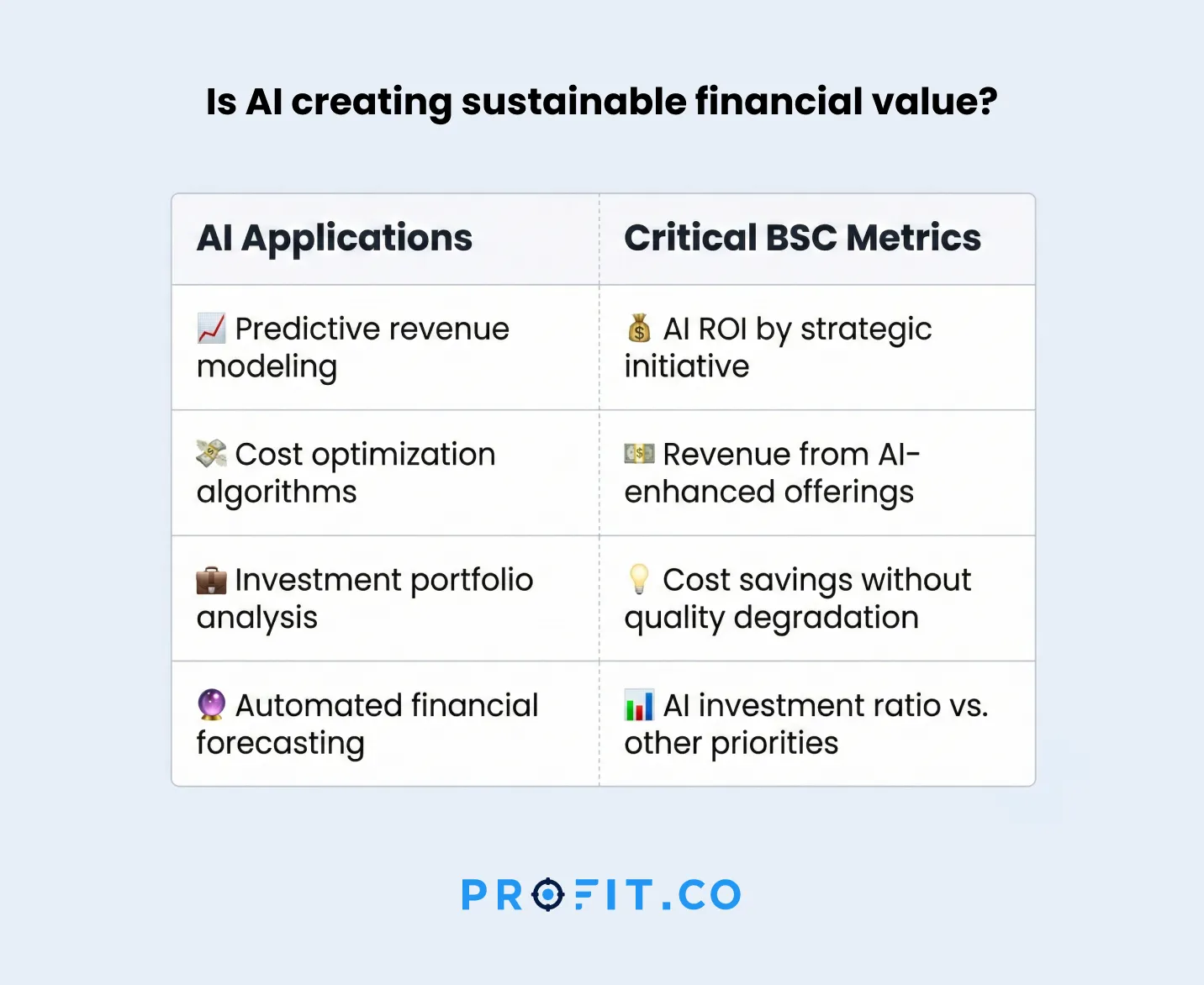
2. From a customer’s point of view, the human touch in a world that is mostly automated
AI can make things much more efficient, but it can also make the customer experience worse if you don’t keep track of both. This point of view asks, are we using AI to really give customers more value, or are we getting rid of the human interactions that keep customers coming back?BSC is used by smart businesses to keep track of:
- How happy customers are with AI-enhanced experiences compared to regular ones
- How the Net Promoter Score changes as AI use grows
- Scores for how hard it is to do business with customer
- AI-powered personalization that works
- Customer trust levels about using AI and keeping data private
The balanced approach means using AI where it really helps customers while keeping the human connection where it matters. Your BSC customer metrics can tell you if you’re getting this balance right.
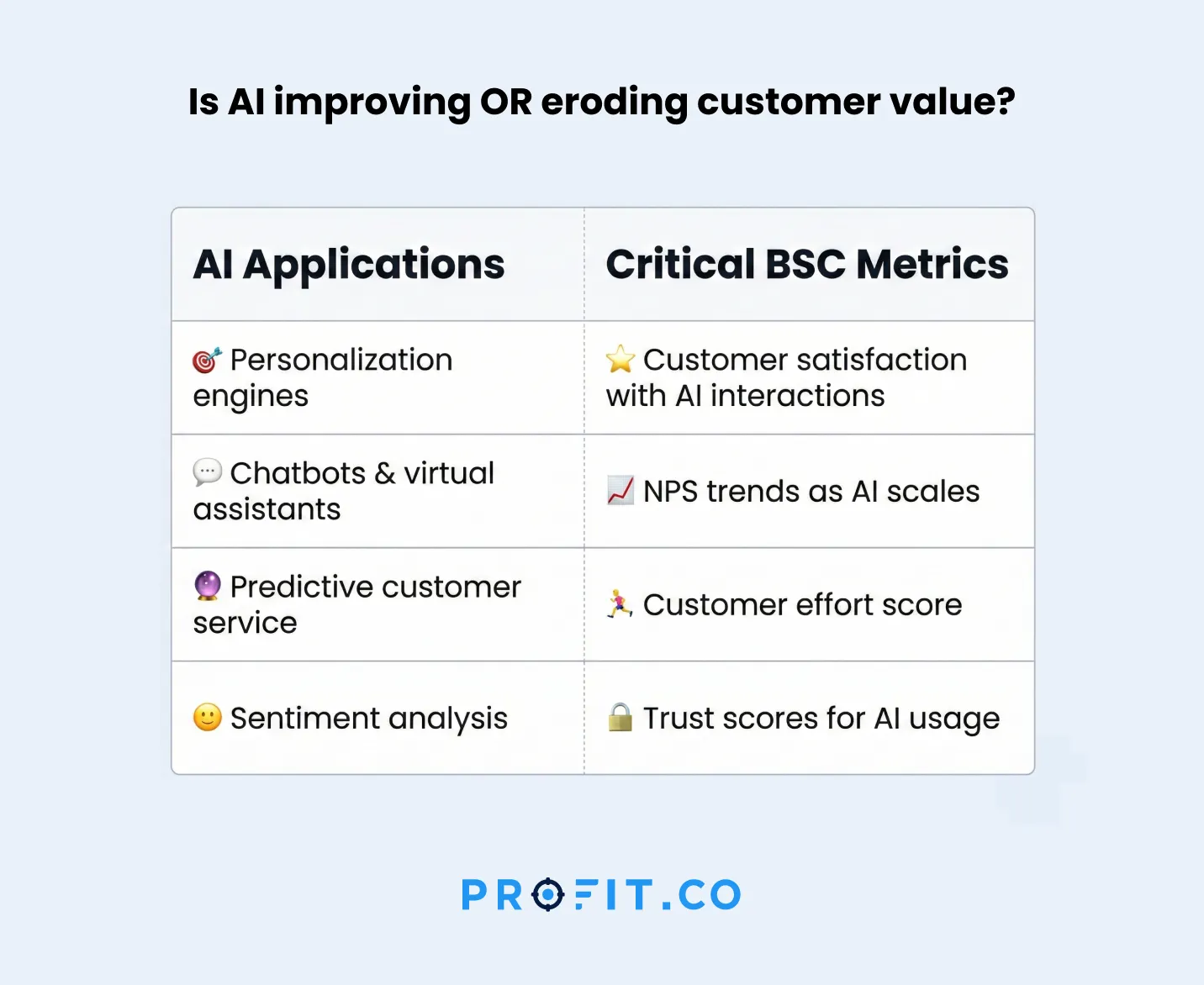
3. Internal Process Perspective: Smart Automation with a Purpose
This is where most companies put their AI efforts, and it’s also where the lack of a strategic framework causes the most problems. AI can make almost any process better. But should you make it better? Should you get rid of it completely? Should you automate it first and then redesign it?The internal process perspective in your BSC gives these choices a strategic framework. It says:
- Which processes help us reach our strategic goals directly?
- Where should we use AI to get an edge over the competition and improve operations
- Are we making AI tools that set us apart from the competition?
- How do we judge quality and effectiveness, not just speed and cost?
Think about a business that uses AI to speed up its current sales process. That’s good, but then you remember that the sales process was made for a different market. They’ve now made the wrong approach automatic.
An organization that follows the Balanced Scorecard framework shows you why it would first ask, “Does this process fit with our long-term goals for customers and finances? Should we even be doing this, or should we be doing something else?”
Some examples of metrics to think about are how much faster processes can be done with AI, how much better quality AI-enhanced workflows are, how often new processes are designed using AI, and the ratio of strategic to operational AI deployments.
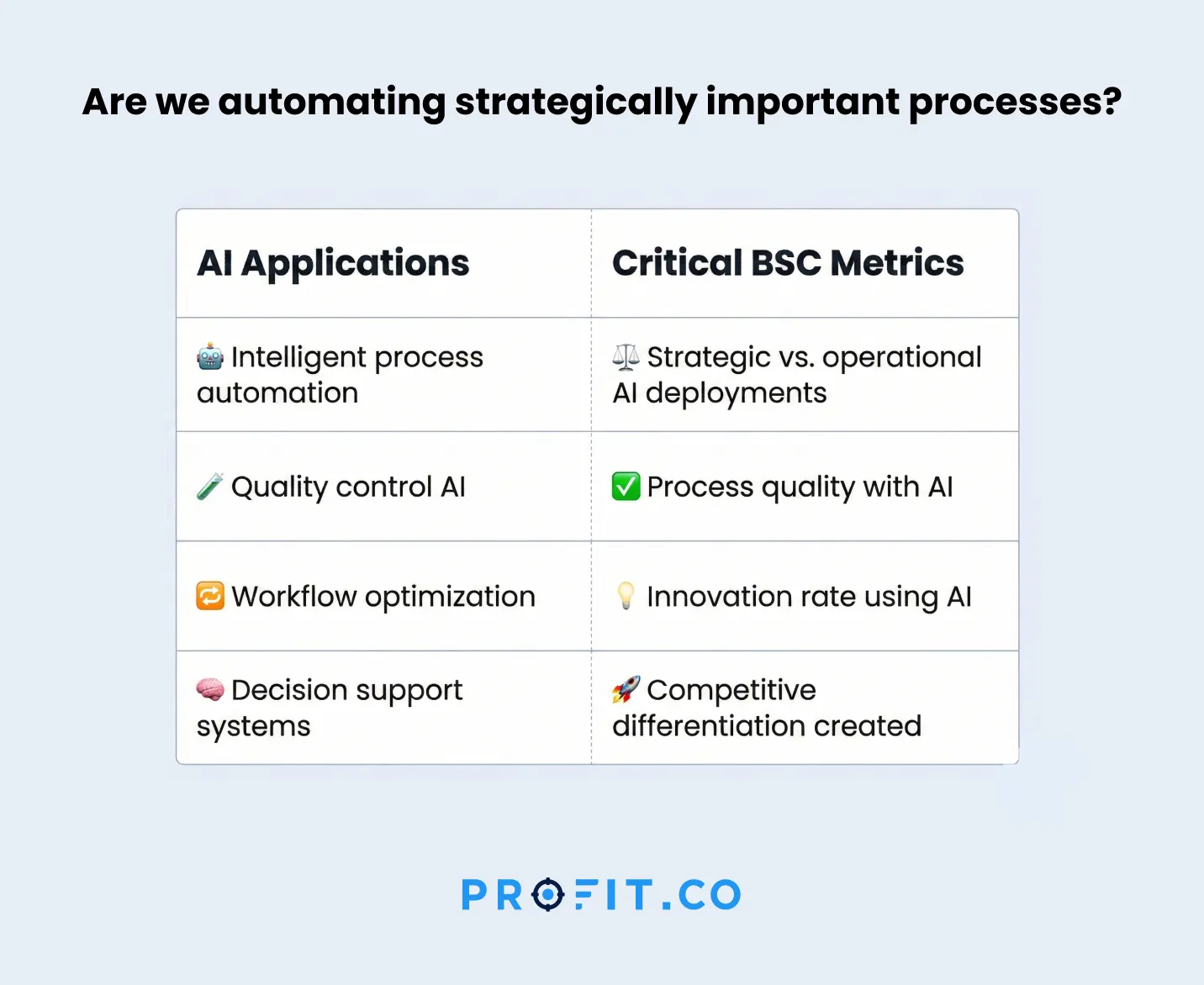
4. Learning and Growth Perspective: Developing Skills for AI
In the age of AI, this perspective may be the most important but least understood. Everyone is focused on putting AI into action, but not many companies are systematically checking to see if they’re building the skills their employees will need to do well in an AI-powered future.The learning and growth perspective makes you ask these questions:
- Are we teaching everyone in the company how to use AI?
- Do we have the skills to not only use AI but also plan how to use it?
- Are we creating a culture that accepts AI while still valuing human judgment?
- How are we getting workers ready for jobs that don’t exist yet?
If you don’t have this point of view in your scorecard, you might be able to use AI tools but not be able to build the human skills that make AI useful. You’d have advanced technology run by people who don’t know how to use it strategically.
Some important metrics are the AI literacy scores of all employees, the percentage of employees who have been trained on AI tools, the innovation pipeline for AI applications, cross-functional AI collaboration, and how confident employees are in working with AI systems
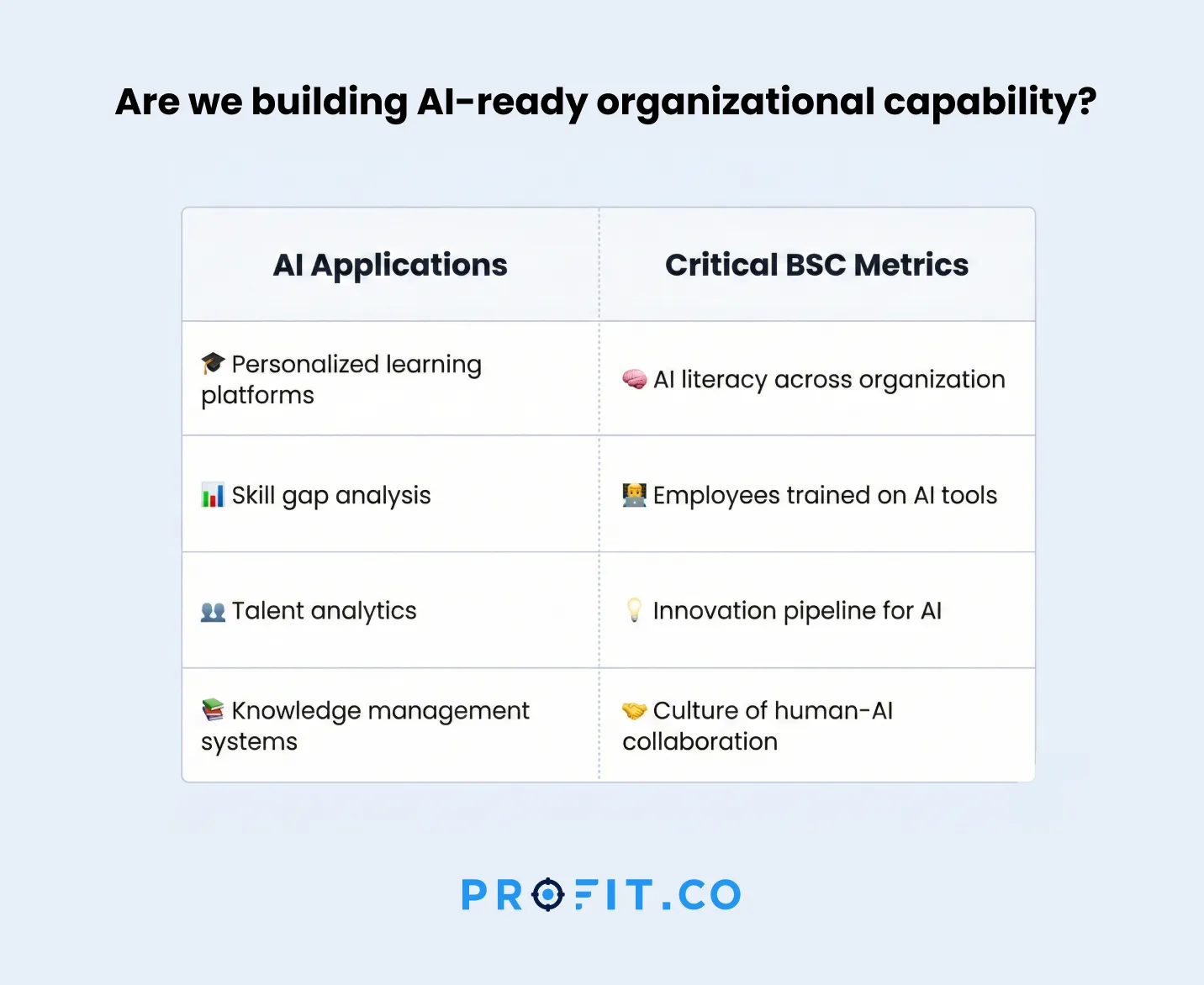
Using the Balanced Scorecard framework Success Formula in the Real World
Let us show you how this works in real life to make better strategic decisionsProblem 1:
- Use AI chatbots; they save money
- Automate the processing of loans, as it’s more efficient!
- Use predictive analytics for insights
These all sound excellent. But are they balanced in a smart way? Let’s see a hypothetical situation where it can be balanced to have a strategic outcome with Balanced Scorecard framework
- Financial Perspective Strategic Objective: “Achieve 15% annual revenue growth that lasts, with margins that keep getting better.”
AI Initiative: Use predictive analytics to identify customer groups that are worth a lot of money.
BSC Metric: Revenue from segments found by AI, margin improvement by segment
- Customer Perspective Strategic Goal: “Become the most trusted advisor for new business owners.”
AI Initiative: Personalized financial planning tools that use AI
BSC Metric: Trust scores, how often clients talk to their advisors, and how well their finances do
- Internal Process Perspective Strategic Objective: “Make decisions five times faster without lowering quality.”
AI Initiative: An automated first assessment with supervision from a human expert
BSC Metric: Time it takes to make a decision, quality of decisions, and override rates
- The Learning and Growth Perspective Strategic Objective is to “Build AI-augmented workforce capabilities.”
AI Initiative: Teach all advisors how to use AI to help clients
BSC Metric: How good the advisor is at AI, how well the client does, and how happy the advisor is with the tools
Every AI project is clearly linked to a strategic goal and has metrics that are balanced across all four perspectives. The company isn’t just “doing AI”; they’re using it in a smart way to get balanced business results.
How Profit.co Makes Using the Balanced Scorecard framework Easy
The problem is that keeping track of four different points of view can become overwhelming, especially in the age of AI. This is where Profit.co turns theory into an agile system to track and measure and stay ahead of the market.- Unified Strategic Framework: With Profit.co, you can create your BSC with strategic goals for all four perspectives and then connect AI projects and other projects directly to these goals. You can quickly tell if your AI investments are evenly spread out across all perspectives or if they are too heavy in one area.
- AI-Enhanced Analytics: Profit.co doesn’t just keep an eye on your BSC metrics; it also uses AI to find patterns, guess what will happen, and show you insights you might have missed. The platform can alert you when AI projects in one area are causing unanticipated effects in another.
- Real-Time Strategic Dashboard: See how your AI investments are affecting performance in all four BSC perspectives at the same time. No more putting together data by hand or writing quarterly reports that are out of date before they are printed. Profit.co makes it easy to connect your strategic BSC framework with quarterly OKRs. Your AI projects turn into real key results that teams work on, and they automatically roll up to your balanced strategic goals
- Predictive Insights: The platform’s AI features can tell you which BSC goals are most likely to fail, which AI projects are providing the best value, and where you should put your next investments
- Automated Reporting: Make reports that are ready for executives that show how AI is helping (or not helping) your balanced strategy. Great for board meetings and reviews of your strategy.
Five Things to Think About Before Investing in Any Innovation
Use this to filter on the next project or tool you want to approve:- How does this add long-term financial value beyond just saving money right away?
- Will this really help customers, or will it just make things easier for us?
- Are we optimizing the right process, or should we redesign it first?
- What skills are we developing now that will be important in three years?
- If this goes really well, could it cause problems in other areas?
If you can’t answer all five questions with confidence, no matter how good the technology looks it will not move your business goals.
The Competitive Edge of Strategic AI
Companies that use Balanced Scorecard to guide their AI investments get more and more benefits over time because they are building balanced, long-lasting skills while others are just following the latest AI trend. In three to five years, the difference will be clear: the strategic AI companies will have built strong competitive positions, while the tactical AI companies will still be switching tools and optimizations without making any real progress in their strategic position. Your AI strategy needs a solid base. AI is changing everything about how companies do business. But change without a plan is just chaos with better algorithms.The Balanced Scorecard gives you a strategic framework that makes sure your investments give you a long-term competitive edge in all areas of your business, including customer relationships, operational excellence, financial performance, and organizational capabilities. And with platforms like Profit.co, you don’t have to choose between modern execution and strategic thinking. You get both with AI analytics, all in one platform that works with agile OKR execution.
Are you ready to explore for the best strategic benefit?
In fact, the opposite is true. AI is a powerful tool, but it needs to be told what to do. In other words, AI can help you reach any goal you set for it, but it can’t tell you if that goal fits with your long-term, balanced strategy
If you can, start with BSC before spending a lot of money on AI. BSC helps you figure out which strategic goals are really important, which then shows you where AI can be most useful. If you use AI first, you might end up with tools that don’t work together and may or may not help with what matters. That being said, it’s not too late to start using BSC if you’ve already started AI projects. BSC will help you figure out which AI investments to grow, which to change, and which to end.
When you only use AI, you usually only look at a few metrics, like how much money you saved, how much time you saved, and how many errors you made. With BSC-guided AI, you can see how your strategy is working by looking at things like long-term revenue growth, customer lifetime value, operational capabilities built, and how ready your workforce is for future challenges. The ROI shows up in a number of ways: less money wasted on AI that doesn’t support strategy, faster identification of high-impact AI opportunities, better resource allocation across perspectives, and the fact that improvements in one perspective make others stronger Organizations
Not at all. In fact, small businesses may benefit even more from an AI strategy based on BSC. Why? You can’t afford to waste money on AI that doesn’t help you reach your strategic goals because you don’t have enough resources. A small business BSC might be easier (2–3 goals per perspective instead of 5–6), but the strategic discipline is even more important.


