

TL;DR
Government agencies have to deal with a lot of different problems, like serving a wide range of stakeholders with different needs, showing that they are responsible with taxpayer money, and providing important services while being watched all the time. The Balanced Scorecard framework gives the government the structure it needs to find a balance between providing excellent service to citizens and being fiscally responsible, being efficient in operations and being innovative, and meeting short-term needs and long-term mission success. Profit.co makes it easier for the government to use Balanced Scorecard by combining strategic goals, performance tracking, and quarterly OKRs. This helps agencies show citizens that they are valuable while also carrying out their public service mission.If you run a government agency, you know how hard it is to provide world-class services with private-sector efficiency, meet the needs of many stakeholders with conflicting demands, show measurable results with every taxpayer dollar, stay open to public scrutiny, and somehow come up with new ideas while following bureaucratic rules.
You can’t just “pivot” when your priorities change like you can with private companies. Your mission is set by law, your budget is set by appropriation, and people talk about how well you’re doing in public meetings and on social media.
This is exactly why smart government agencies are using the Balanced Scorecard framework. Let me show you how BSC helps public sector organizations deal with these problems in a way that gives citizens clear benefits
“Governments will always play a huge part in solving big problems . They set public policy and are uniquely able to provide the resources to make sure solutions reach everyone who needs them . They also fund basic research , which is crucial component of the innovation that improves life for everyone”

Why can’t the government trust old ways of measuring performance
For a long time, government agencies mostly used compliance metrics to measure performance. These included budget execution rates, processing times, error rates, and the number of complaints from citizens. These metrics give important information about how well things are running.But they don’t really answer the questions that citizens, elected officials, and oversight bodies are asking:
- Is the agency doing what it’s supposed to do?
- Are services getting better?
- Is there any new thinking going on?
- Are we getting ready for problems that will come up in the future?
The Truth About Modern Government
People want the same level of service from the government as they get from the private sector, such as quick responses, online access, and personalized service. But agencies have to work with limited budgets and complicated rules.Elected officials want both efficiency and effectiveness. They want you to do more with less while showing that you are making a difference in the health of the community.
Every dollar spent, every result measured, and every decision made must be clear to oversight bodies.
Employees need a sense of purpose, which means they need to see how their daily work fits into a larger goal of serving the public.
Traditional measures can’t show how complicated this is. You need a framework that can look at many different aspects of performance at the same time. That’s what the Balanced Scorecard is
Ready to make a difference?
The Four Perspectives: How the Government Figures Out What Matters
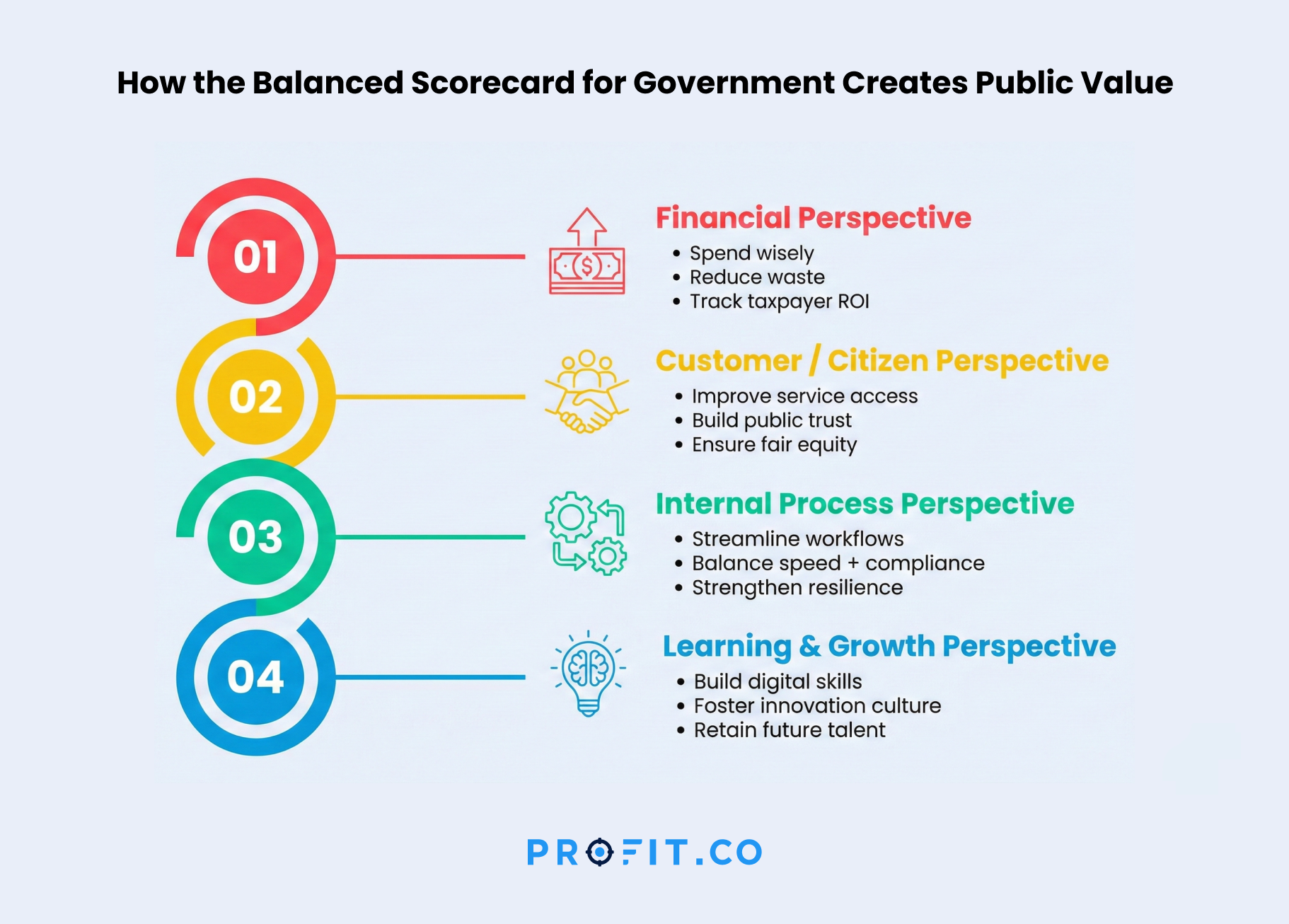
The Balanced Scorecard framework is a great fit for the unique problems that governments face because it looks at performance from four important angles.Financial Perspective: Taking care of public resources
The government’s financial point of view isn’t about making money; it’s about showing that they are responsible with taxpayer money while still paying for important services.Strategic Goals for the Government:
- Make the best use of the budget by giving the most money to the programs that will have the biggest effect.
- Keep the budget balanced while meeting the needs of more and more services
- Show that it is cost-effective compared to service delivery standards
- Cut down on waste and inefficiency so that resources can be used for their intended purpose
Important Numbers:
- Cost per citizen served (by service line)
- Ratio of administrative costs to total costs
- Efficiency of budget execution
- Return on investment for big projects
- How well you get and manage grants
This point of view shows taxpayers that their money is being spent wisely and well
From the Customer’s Point of View: Citizen Service Excellence
Citizens, businesses, and other people who depend on your services are “customers” in government. This point of view checks to see if you’re really making their lives better.Goals for the Strategy:
- Provide services that are easy to get to, quick to respond to, and of high quality
- Be open and honest to gain the public’s trust
- Make it easier and less of a hassle to get services
- Fix the gaps in service delivery that hurt fairness
Important Numbers:
- Scores of how satisfied citizens are with services and demographics
- Rates of access to services (both digital and in-person)
- Average time it takes to deliver service
- Time to resolve complaints and satisfaction
- Equity indicators (how easy it is for different groups to get services)
The government has to serve all of its citizens, even the ones who are hardest to reach or most expensive to serve. This is not the case for private companies. BSC makes sure you measure and manage fair service delivery
Internal Process View: How to Achieve Operational Excellence in Public Service
This point of view makes sure that your operations are always getting better, following the rules, and running smoothly, even when there are bureaucratic limits.Goals for the Strategy:
- Make things easier for citizens by streamlining processes
- Make sure that you follow the rules and manage risk
- Use technology to make things easier and more efficient
- Build up your ability to deal with emergencies and be strong in tough times
Important Numbers:
- Shortening the time it takes to complete a process
- How many people are using digital services
- Results of the compliance audit
- Continuity of service during problems
- How well departments work together
Learning and Growth: Improving the Skills of the Public Sector
The government often has the hardest time building organizational capabilities while dealing with tight budgets, civil service rules, and problems with workforce development.Goals for the Future:
- Teach workers the skills they need for digital government
- Make a culture of new ideas and constant improvement
- Work with other agencies and sectors to build partnerships
- Get and keep good workers in a competitive market
Important Numbers:
- Rates of employee engagement and retention
- Aligning the skills of the workforce with strategic needs
- New ideas were started and grown
- Projects that involve working together across agencies
- Planning for succession in important roles
Government agencies that don’t take this point of view into account make today’s operations better but become less useful. Balanced Scorecard makes sure you’re building the skills of the future
Why does the government need Balanced Scorecard more than the private sector
Government agencies are vast and multidimensional. They need more strategic focus and therefore get more out of Balanced Scorecard than private businesses do.1. Different people with different needs
Shareholders and customers are the main people that private companies serve. Government serves citizens, elected officials, oversight bodies, partner agencies, community groups, and future generations, and these groups often have different ideas about what government should do. Balanced Scorecard helps you balance these conflicting needs in a clear way.2. Mission Over Margin
The private sector can put a lot of emphasis on how well it makes money. The government’s financial view is important, but it should never be more important than getting the job done. Balanced Scorecard makes sure that all areas get equal attention3. Being open and responsible
Every three months, private companies send reports to their shareholders. People are always watching what the government does. Balanced Scorecard gives you the full picture of performance you need to show that you are responsible for all aspects of public value.4. Long-Term Goals, Short-Term Budgets
Government agencies have missions that last for decades (like public health, education, and infrastructure), but they only have money for one year at a time. Balanced Scorecard fills this gap by linking short-term actions to long-term goalsHow It Works in the Real World Digital Transformation in Government Project
Let’s look at this example to show you how Balanced Scorecard guided strategy can help with a common government problem: going digital.Without Balanced Scorecard, agencies take a tactical approach to digitization, saying things like, “We need to offer online services.” They build websites and portals, but they have trouble getting people to use them, making them accessible, and getting staff on board.
With Balanced Scorecard, digital transformation becomes strategically balanced
Financial Perspective Goal: “Lower costs of service delivery while making it easier to get to”
- Every three months, the goal is to move 40% of transactions to digital channels and cut processing costs by 25%.
Goal from the customer’s point of view: “Make it possible for all citizens to use government services.”
- Every three months, we want to make sure that 80% of people are happy with our digital services.
Internal Process Perspective Goal: “Make operations more efficient by using digital workflows”
- Every three months, the goal is to cut the average processing time in half, get rid of 15 unnecessary manual steps, and connect with three partner agency systems.
Learning & Growth Perspective Objective: “Build digital-first workforce capabilities”
- The goal associated with this is to teach 200 employees how to deliver digital services, set up a 5-person digital innovation team, and start a program to certify employees’ digital skills
The plan strikes a balance between lowering costs and making things more accessible, between efficiency and fairness, and between adopting new technologies and training the workforce.
How Profit.co Makes Balanced Scorecard Useful for Government
Government agencies have to deal with specific problems when they try to put things into action, such as limited IT budgets, procurement issues, complicated approval processes, and managing change in civil service settings.Profit.co solves these problems:
- Unified Strategy Communication: Get rid of silos between departments by showing everyone how their work helps the agency reach its strategic goals. Important for the government, where coordination is necessary but hard.
- Real-Time Performance Tracking: Automatically fill in Balanced Scorecard metrics by connecting to government systems that are already in place, like ERP, case management, and citizen portals. No more writing quarterly reports by hand that are out of date before they come out.
- Budget Alignment: Connect strategic initiatives directly to budget categories so that it is clear how appropriations help achieve strategic goals. Important for justifying the budget and reporting on oversight.
- Transparency Dashboard: Make dashboards that the public can see that show how well strategic goals are being met. Be completely open about how well you do your job to gain people’s trust
- Multi-Level Cascading: This means that the enterprise strategy flows down to bureaus, divisions, and individual employees, making sure that everyone is on the same page in government, where organizations are often very complicated.
A Plan for Government to Use Balanced Scorecard
Are you ready to use BSC in your agency? Here’s a useful way to do it:Phase 1 (Months 1-2): Get Everyone on the Same Page
Get leaders, employees, union reps, and important outside stakeholders involved in setting strategic goals. More people need to agree for the government to carry out its plans than for the private sector.Phase 2 (Months 3–4): Set Strategic Goals
Set 12 to 16 goals, 3 to 4 for each Balanced Scorecard perspective, that are in line with your legal mission and the current administration’s top priorities. Make sure that goals last for more than one budget cycle.Phase 3 (Months 5–6): Choose Metrics That Are Balanced
Pick KPIs that strike a balance between efficiency and effectiveness, outputs and outcomes, and leading and lagging indicators. Make sure you can really get the data, given what the government says.Phase 4 (Months 7–9): Set Up the Technology Platform
Use Profit.co with connections to your current systems. Set up for the needs of the government, such as requirements for transparency, tracking the budget, and multi-level cascading.Phase 5 (Months 10–12): Start and Talk
Make sure all staff members know how Balanced Scorecard helps the agency reach its goals. Set up OKR cycles every three months that are in line with BSC’s strategic goals.Review and Improve
Monthly reviews by executives, quarterly reports to the public, and yearly reviews of the company’s strategy. Change your goals when the government’s priorities or legal requirements change.The Unique Value Proposition for Government
Government agencies that use Balanced Scorecard can be assured that a number of changes have a big impact:- Budget Justification: When you can show that you are making progress in all four Balanced Scorecard areas, your requests for money become much stronger. Elected officials can see the whole picture of value.
- Citizen Trust: Reporting on balanced performance in a clear way builds trust in the public. People know that you’re not just measuring what’s easy; you’re measuring what’s important
- Employee Engagement: People who work for the government are driven by their mission. Balanced Scorecard shows them exactly how their work helps the public, which makes them much more likely to stay and be engaged.
- Culture of Performance: It can be hard to manage performance in civil service systems. Balanced Scorecard gives you a clear way to judge how well you are helping with the strategic mission.
- Collaboration between agencies: When several agencies use Balanced Scorecard for the same goals, working together is easy instead of forced.
Performance Management Based on Mission
The main goal of government service is to improve public health, keep people safe, educate children, protect the environment, serve veterans, and build infrastructure.The Balanced Scorecard helps government agencies reach their mission goals while also showing that they are financially responsible, efficient, and always coming up with new ideas.
Profit.co makes Balanced Scorecard a management system that works all the time instead of a yearly planning document that sits around collecting dust between budget cycles.
Agencies that do well in today’s tough public sector are those that know how to find the right balance between strategy and action. In government, balance isn’t a choice; it’s something you have to do for the people.
Looking for a data-driven, bias-free approach to project management?
If done right, Balanced Scorecard can actually make reporting easier. Most government agencies already gather a lot of data for different oversight bodies, grant requirements, and performance reports. However, these systems are often not linked to each other. Balanced Scorecard is the framework that ties all of this data together. Profit.co lets you make a lot of different reports from the same Balanced Scorecard framework. You don’t have to keep separate systems for each reporting need; instead, you keep one strategic framework. Once Balanced Scorecard is fully in place, agencies say they save 20 to 30 hours a month on reporting.
Even when leadership changes, your mission (as defined by law) stays mostly the same. Balanced Scorecard separates the legal mission from the strategic approach, so you can change your goals while keeping things the same. When new leaders come in, you look over your Balanced Scorecard strategic goals and may change them to fit their priorities, but the framework stays the same. Many government agencies keep the same core BSC goals from one administration to the next, but they change their strategies and targets. Profit.co lets you plan out different strategic approaches and make changes quickly when new priorities come up, so you don’t have to start over.
Citizens don’t need to know how Balanced Scorecard works; they just need to see results. The best thing about Balanced Scorecard is that it helps you figure out what people care about and tell them: Are services getting better? Are tax dollars being spent wisely? Is the agency getting the job done? Profit.co lets you make dashboards that show the public how you’re doing on strategic goals in language that everyone can understand, without using technical terms
Related Articles
-
Measuring Innovation Without Killing It
Key Takeaways Innovation and operational execution require different measurement systems. KPI-first governance can discourage experimentation in early innovation stages. Strategy... Read more
-
What Is a Customizable Dashboard for Strategy Execution?
Most companies don't struggle because they can't clearly see whether their strategy is working. That's where customizable dashboards help. A... Read more
-
Conflict Intelligence: The Strategic Leadership Skill Modern Executives Must Master
Conflict is no longer a disruption in today's organizations. It is infrastructure. Hybrid teams debate priorities across time zones. AI... Read more
-
Organizational Planning: The Foundation for Sustainable Business Success
Janani Subramanian Content Strategist Published Date: March 3, 2026 Jump to section What is organizational planning? What are the phases... Read more