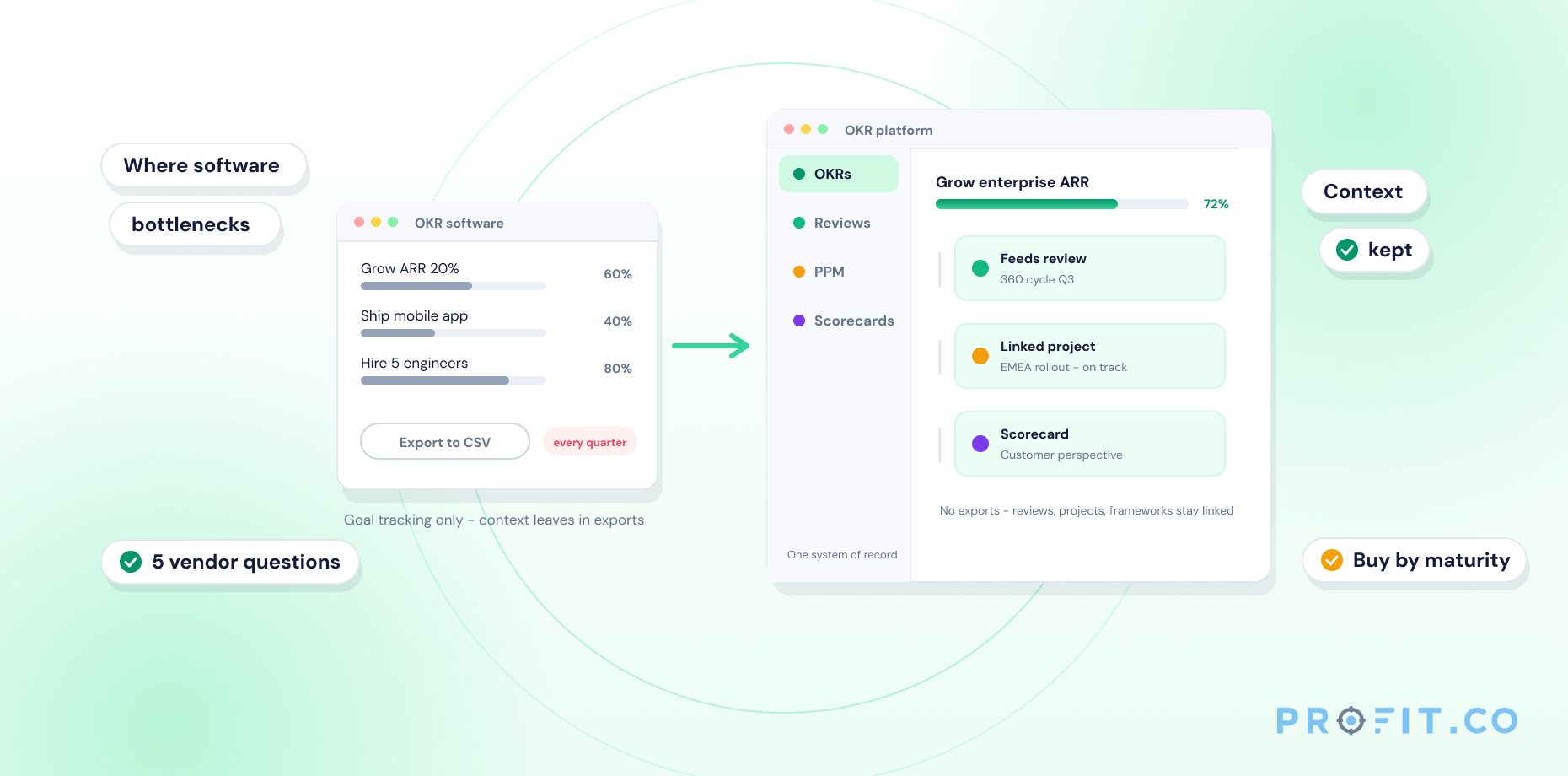
How to navigate goal management system integration during the organizational complexity and cultural uncertainty of mergers and acquisitions
TL;DR
M&A integrations fail when companies force one OKR system onto another. The solution isn’t standardization, it’s building hybrid approaches that preserve cultural strengths while enabling coordination. This guide shows you how to integrate goal management systems without destroying the value you paid billions to acquire.The Integration Challenge
Mergers don’t fail because of valuation models or market timing. They fail because two organizations can’t figure out how to move as one. Different cultures. Different priorities. Different ways of measuring what “success” actually means.Let’s take a hypothetical example of a Fortune 100 tech company that acquired a cloud startup. They had everything figured out, except how to merge two completely different OKR systems. The acquirer ran formal quarterly cycles with governance committees. The startup used weekly sprints with agile goal-setting. Eighteen months later? Innovation had slowed to a crawl. Strategic initiatives were failing. Key talent was leaving. The breakthrough came when leadership stopped trying to pick a winner. Instead, they built a hybrid system that combined enterprise coordination with startup speed.
“Coming together is a beginning , staying together is a progress , and working together is success.”
Why OKRs Matter More During M&A Than Any Other Time
During integration, three pressures hit simultaneously:- Strategic realignment: The “why” changes as new markets and capabilities combine
- Operational disruption: Teams, systems, and processes are in constant flux
- Cultural uncertainty: Employees question priorities, roles, and how success gets measured
Traditional KPIs can’t handle this complexity because they’re backward-looking and siloed.
OKRs, when integrated properly, provide:
- A shared language of priorities across legacy organizations
- Clear visibility into what matters now vs. later
- Direct connection between daily work and the combined strategy
But only if you avoid the three fatal mistakes most companies make.
The Three OKR Integration Mistakes That Kill M&A Value
Mistake #1: Forcing One System on the Other
The acquirer declares their OKR framework as the new standard. Full stop.This immediately creates:
- Resistance from acquired teams who see it as cultural colonization
- Loss of the innovation practices you paid to acquire
- Perceived winners and losers before integration even starts
What actually works: Gradual convergence models that maintain separate systems initially while building integration points for shared strategic initiatives. Give it 18-24 months, not 3 months.
Mistake #2: Treating OKRs as a Reporting Exercise
Leadership demands visibility fast. Teams respond by:- Copy-pasting KPIs into OKR templates
- Writing vague objectives that sound good but mean nothing
- Updating goals only when executives ask
This turns OKRs into static compliance, exactly when you need dynamic alignment most.
What actually works: Use OKRs as integration accelerators, not control mechanisms. Define 3-5 enterprise objectives everyone contributes to, then let teams translate them locally.
Mistake #3: Big-Bang OKR Rollouts
Rolling out enterprise-wide OKRs across two merging companies in one quarter nearly always fails.Why? Teams are already overloaded. Processes are undefined. Trust hasn’t been built.
OKRs need psychological safety to work, which M&A environments initially lack.
What actually works: Start with a shared top-level integration objective. Keep the existing OKRs in place for a transition period. Avoid immediately rewriting every team’s goals.

The Four-Phase Integration Approach That Actually Works
Based on analysis of many successful OKR integrations during M&A transactions, here’s the playbook:Phase 1: Stabilize Before Standardize
The goal is more about clarity.What to do:
- Maintain existing OKR systems from both organizations
- Create one shared integration objective everyone can rally behind
- Avoid the temptation to “fix” everything immediately
Example integration objective:
Objective: Complete operational integration while maintaining customer trust
Key Results:
- Zero disruption to top 20 customer accounts
- Unified operating model defined by Q2
- Employee engagement above baseline across both organizations
This creates alignment without dismantling what’s working.
Phase 2: Align on Strategic Themes, Not Metrics
Instead of forcing everyone into the same measurement framework, align on strategic intent.Run leadership workshops to agree on:
- The combined company’s 3-5 strategic bets
- What must win in the next 12 months
- What can be explicitly deprioritized
From these discussions, define enterprise objectives that apply to everyone, but let teams define their own key results based on their context.
This prevents metric overload and preserves local optimization capability.
Phase 3: Enable Bottom-Up Translation
Once enterprise objectives are clear, teams translate them locally.Key principles:
- Teams define how they contribute, not just that they contribute
- OKRs reflect different starting points and capabilities
- Progress reviews focus on learning, not judgment
A manufacturing division might measure “customer experience excellence” through quality metrics. A tech division might measure it through NPS and support response times. Different metrics. Same strategic intent.
Phase 4: Use OKRs to Surface Integration Risks Early
One underrated benefit: OKRs reveal integration problems before they explode.Misaligned or stalled OKRs often indicate:
- Hidden process dependencies nobody documented
- System incompatibilities that need addressing
- Role ambiguity that’s blocking progress
Instead of escalating through endless meetings, use OKR check-ins to surface and solve blockers proactively.
The Three Integration Models (Choose Based on Your Situation)
Model 1: Gradual Convergence
Best for: Acquisitions where both organizations have mature OKR systems
Approach: Maintain separate systems while building integration points
Model 2: Dominant System Adoption
Best for: Acquirer has superior OKR maturity, and the target needs capability building
Approach: Extend the acquirer’s system with cultural adaptation
Model 3: Hybrid Innovation
Best for: Mergers of equals with complementary strengths
Approach: Create new system combining the best of both organizations
What Leadership Must Do Differently
OKRs don’t solve M&A challenges on their own. Leadership behavior determines success.Effective leaders during OKR integration:
- Model transparency by sharing their own OKRs across both organizations.
- Reward learning over short-term perfection during the transition.
- Communicate why priorities are changing, repeatedly and clearly
- Protect innovation spaces where the acquired company can maintain its approach
When leaders treat OKRs as conversation tools rather than control mechanisms, teams engage authentically instead of performing compliance.
The Integration Readiness Checklist
Before rolling out integrated OKRs, assess:Cultural readiness:
- Can you systematically assess both goal management cultures?
- Do you know which cultural elements create competitive advantage?
- Can you design integration that preserves those strengths?
System integration:
- Do you have technical capability for platform consolidation?
- Can you maintain business continuity during system changes?
- Do you have 12-18 months of executive patience for this?
Change capacity:
- How many other major changes are teams managing?
- Do you have dedicated change management resources?
- Can you balance speed with integration quality?
Organizations scoring high typically achieve successful integration within 18-24 months. Those with gaps need 6-12 months of preparation first.
The Bottom Line
M&A OKR integration is about creating an integrated strategic execution capability that leverages strengths from both organizations while building the coordination needed for combined value creation.5 key principles:
- Preserve what created value in both organizations
- Build hybrid approaches rather than forcing standardization
- Invest in change management for cultural and technical integration
- Maintain execution throughout the transition
- Design for long-term capability, not short-term compliance
Organizations that achieve superior M&A outcomes treat goal management integration as strategic capability building, not a standardization project. Your integration can preserve cultural strengths while creating coordinated strategic execution. But only if you’re willing to invest the time to do it right.
Ready to navigate your M&A OKR integration?
Neither by default. Assess both systems first. If one is clearly superior and the other needs capability building, dominant adoption works. If both have mature systems, gradual convergence preserves value. If you’re merging equals, hybrid innovation combines strengths.
Talent loss. When high performers see their goal-setting culture being dismantled without understanding why, they leave.
Keep existing OKR systems running initially. Add one shared integration objective, but don’t force teams to abandon what’s working. Gradual transition beats big-bang transformation every time.
No. Start with company-level and department-level integration. Individual OKRs can remain in their original formats until teams have adapted to new strategic themes
That’s normal and potentially valuable. One might optimize for quarterly agility, the other for annual strategic planning. Instead of picking one, create an approach that accommodates different rhythms while maintaining strategic coherence. Use shared themes, not shared timelines.