TL;DR
Enterprise misalignment doesn’t come from poor communication or weak goals. It emerges from structure, how strategy cascades, how teams optimize locally, how information flows, and how time is experienced across the organization. Fixing it requires redesign, not reinforcement.Why does organizational alignment so rarely feel like a problem, even though it is?
Most enterprise leaders don’t experience misalignment as a dramatic failure. They experience it as friction. As slowdowns. As the nagging sense that work takes more effort than it should, even when everyone appears aligned in meetings and confident in their plans.
The uncomfortable truth is this: misalignment in large organizations doesn’t announce itself. It settles in gradually, often disguised as normal complexity, and by the time it becomes visible, it already feels embedded in how the organization works.
Misalignment Rarely Starts With Bad Intent
When alignment breaks down at scale, it’s tempting to blame communication, accountability, or commitment.But most enterprise misalignment isn’t caused by people misunderstanding the strategy or failing to care about it. It’s caused by systems that require a strategy to navigate too many layers, functions, and interpretations before reaching execution.
And every time the strategy moves, it changes just a little. Not enough to raise alarms, but enough to matter.
How Strategy Gets Diluted
In large organizations, strategic intent doesn’t move in a straight line from leadership to teams. It cascades, and in that cascade, it adapts to context.An enterprise-level priority meant to shape market positioning gradually becomes a set of operational targets, then a list of deliverables, and finally a set of personal success criteria that make sense locally but no longer resemble the original intent. By the time teams begin execution, they are often optimizing something adjacent to strategy rather than strategy itself.
No one made a mistake. The system did exactly what it was designed to do.
When Alignment Exists on Paper, Not in Practice
One of the most deceptive forms of misalignment is when every team can confidently explain its goals and demonstrate progress, yet the organization still struggles to produce the outcomes leadership cares about.This usually happens when functions optimize independently, using success measures that make sense within their own boundaries but quietly compete with one another across the enterprise.
Product teams build for depth and completeness because that is how excellence is defined for them. Sales teams prioritize speed and volume because that is how success is measured for them. Marketing optimizes reach, while operations optimizes efficiency.
Each function wins by its own definition, and the organization loses by the only definition that ultimately matters.
“An empowered organization is one in which individuals have the knowledge, skill, desire and opportunity to personally succeed in a way that leads to collective organizational success.”

The Problem of Partial Truth
Another force quietly pulling organizations out of alignment is information asymmetry.In large enterprises, no team ever has the full picture, and goal-setting often happens based on assumptions that were reasonable at the time but no longer reflect current reality.
Marketing plans are based on past performance, unaware of upcoming changes elsewhere. Product teams make decisions without full visibility into downstream implications. Sales commitments are based on conditions that have already shifted.
The result is not conflict but drift, small, compounding gaps between what teams believe is true and what actually is.
Different Teams, Different Clocks
Time is one of the most underestimated sources of misalignment. Some teams operate in short cycles, measured by immediate results and near-term commitments. Others work on longer arcs, investing in capabilities that may not show value for months or years.When organizations force all of these rhythms into a single cadence, tension becomes inevitable. Short-term urgency crowds out long-term thinking, and teams responsible for future value are constantly pulled into today’s emergencies.
Over time, this creates a culture where progress feels reactive rather than intentional.
Why Misalignment Is So Hard to See
What makes enterprise misalignment especially difficult to address is that it rarely shows up in one place. It appears as extra meetings here, rework there, delays somewhere else, and a persistent feeling that coordination requires more effort than it should. Because the costs are spread across teams and budgets, no single leader owns the problem outright. And so it becomes accepted as the price of scale.The Limits of Fixing Goals Alone
When leaders sense misalignment, the instinctive response is to tighten execution: rewrite objectives, clarify ownership, or increase the frequency of reviews.These actions help, but they don’t reach the root of the problem.
Misalignment in enterprises is not primarily a goal-setting failure. It’s an organizational design issue, one created by how value is defined, how decisions are made, and how planning systems interact.
What Aligned Organizations Do Differently
Organizations that sustain alignment at scale don’t rely on perfect goals. They design for coherence.They begin by agreeing on what value actually means for the enterprise, and they use that shared definition as the anchor for every function’s contribution. Teams may play different roles, but they are working toward the same outcome, not parallel versions of success.
They also recognize that alignment cannot be frozen into quarterly cycles. Strategy evolves, markets change, and aligned organizations create lightweight ways for teams to adjust direction without starting over each time.
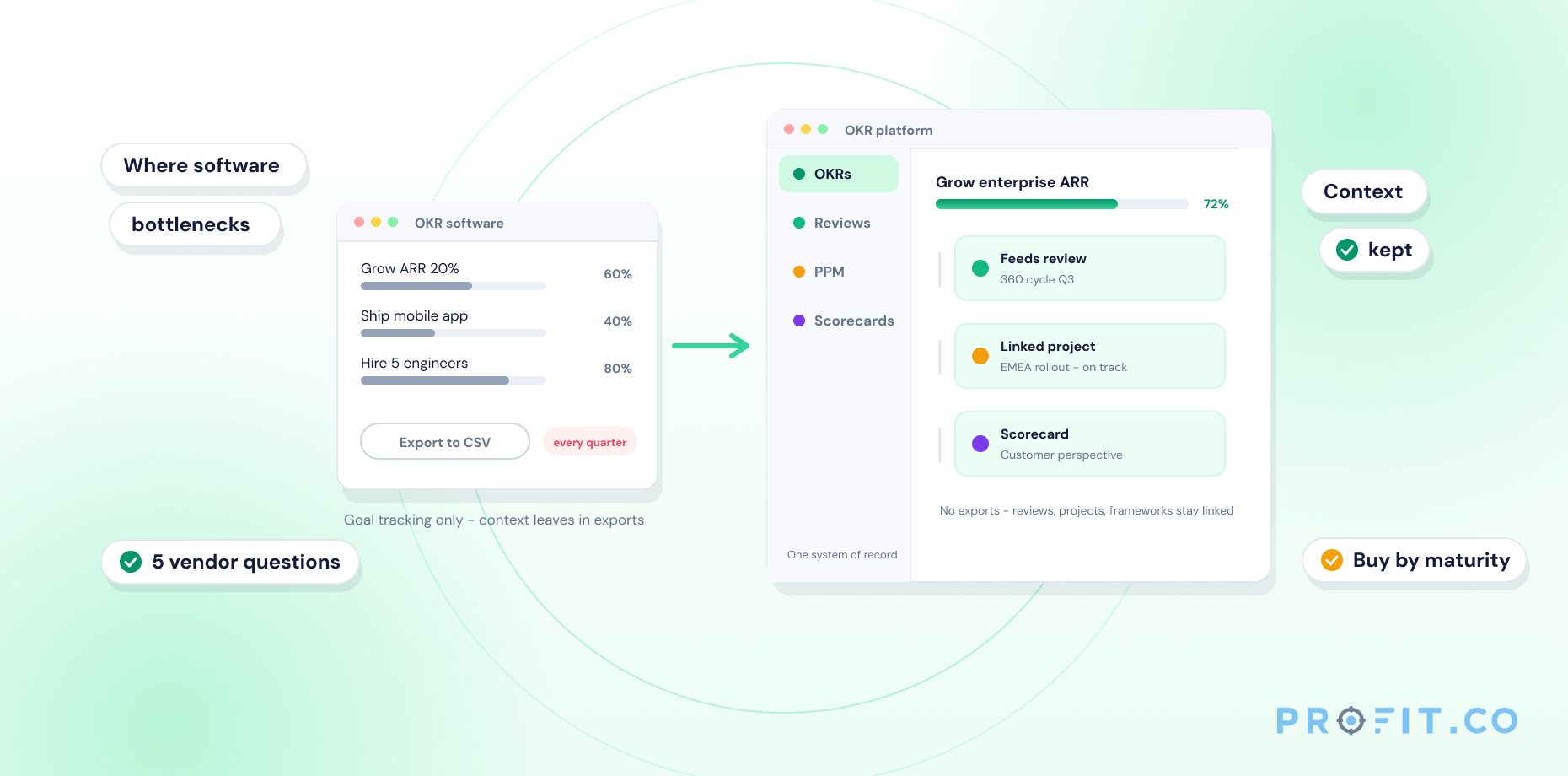
Finally, they reduce friction by integrating planning, execution, and performance into a single, connected system rather than layering new frameworks on top of old ones.
If alignment feels harder than it should be, it’s worth examining the system
Measuring What Usually Goes Unmeasured
Most leaders underestimate misalignment because they look for it in the wrong places.It doesn’t show up just as missed deadlines alone. It’s often teams that need clarification on how frequently priorities compete and how much leadership energy goes into resolving conflicts that shouldn’t exist in the first place.
Asking better questions about clarity, coordination, and decision flow often reveals more than any dashboard.
The Opportunity Hidden Inside Misalignment
Misalignment is costly, but it also represents opportunity. Few improvements have the same compounding effect as better alignment. When teams understand how their work contributes to shared value, decision-making accelerates, trade-offs become easier, and execution feels lighter. This kind of alignment is difficult for competitors to replicate, because it’s built into how the organization thinks and works, not what it sells.Schedule an enterprise alignment conversation to explore what’s getting in the way of momentum
Because strategy must pass through multiple layers, functions, and interpretations before it reaches execution.
Rarely. It’s more often a systems and design issue.
Yes—by redefining value, improving information flow, and integrating planning processes.
Because OKRs reflect the system they operate within; they don’t replace it.