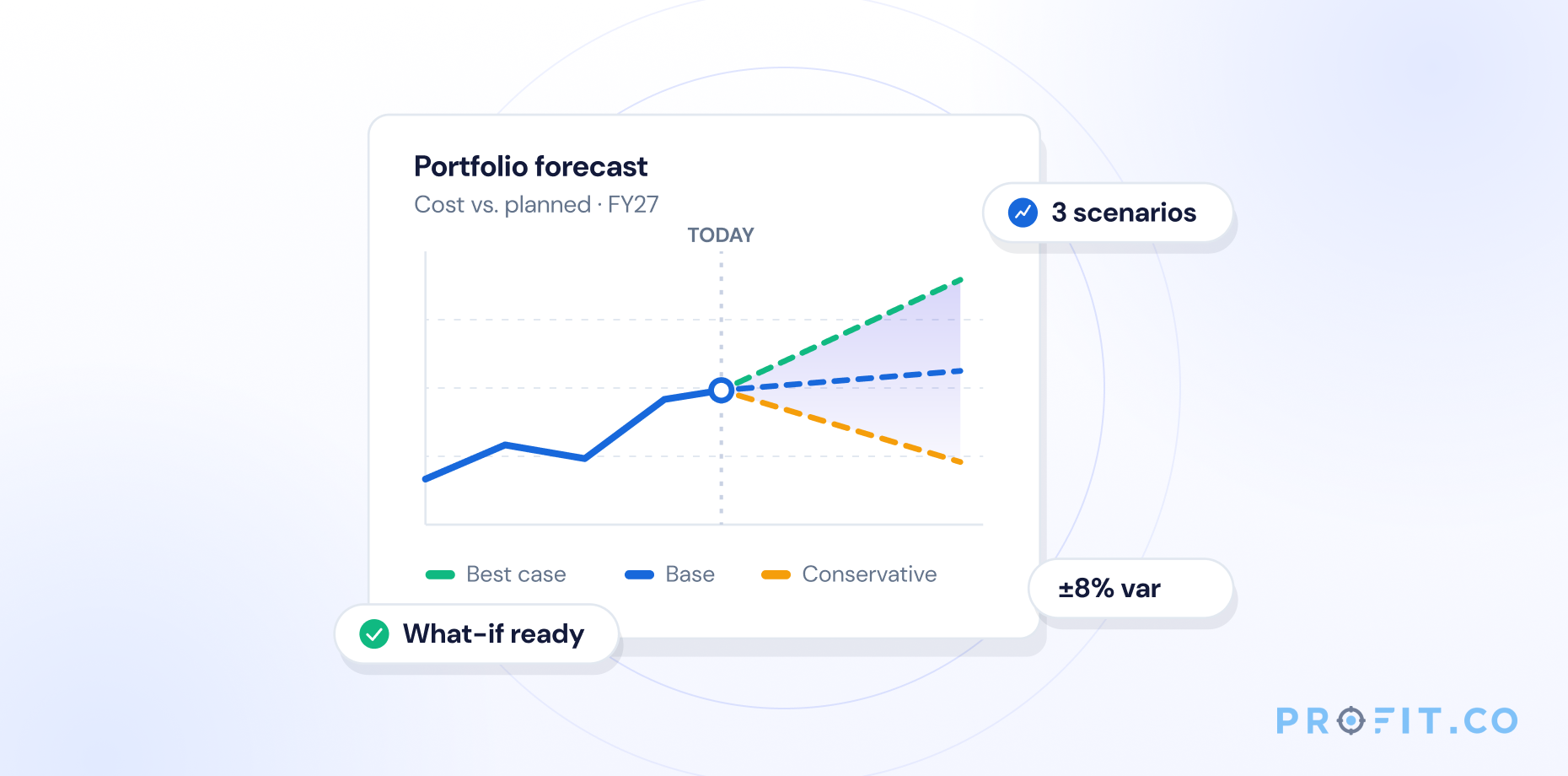
How leading organizations are replacing rigid approval workflows with intelligent, milestone-based funding that accelerates innovation while reducing risk
TL;DR
Progressive funding releases project budgets in stages based on evidence, not assumptions. It aligns teams to strategy, reduces overruns, improves benefits realization, and fosters a culture of learning. Start small, measure results, and scale with data—and eventually AI—to maximize impact.Every year, organizations worldwide approve billions in IT project spending. Yet study after study shows that 70% of these projects fail to deliver their promised value. The culprit? It’s not bad technology or poor execution, but the funding model itself.
We’ve been asking the wrong question. The debate has always been, “Should we approve this project?” The better question is, “How should we fund this project as it proves itself?”
The Legacy Funding Model Is Broken
Picture this: A business leader walks into a conference room with a PowerPoint deck. They present their case. Executives debate. Someone says “approved” or “denied.” If approved, the project gets its full budget upfront. The team disappears for months. Then they come back with something that may or may not resemble what was promised.This model worked in 1995. This model struggles in today’s dynamic business environment.
Three fundamental flaws:
1. The Illusion of Certainty
We pretend that the estimates made in January will be accurate in December. We create elaborate business cases with ROI calculations to three decimal places. We’re precise, but we’re not accurate.
The truth? The project team learns more in the first month of execution than in six months of planning. Yet we lock in budgets before learning begins.
2. The All-or-Nothing Trap
Projects receive binary decisions: approved or rejected. Funded or starved. There’s no middle ground, no gradual validation, no room for course correction without triggering a “project failure” narrative.
This creates perverse incentives. Project managers pad estimates to create buffers. Business leaders inflate benefits to secure approval. Finance teams add contingencies on top of contingencies. Everyone is gaming the system because the system forces them to.
3. The Accountability Gap
Once funds are released, there’s remarkably little consequence for missed milestones or pivoted scopes. Sure, there are status reports and steering committees, but money keeps flowing. The project becomes “too big to fail” because we’ve already invested so much.
Meanwhile, potentially better projects sit in the queue, unfunded, because we’ve locked capital into initiatives that aren’t delivering.
The Intelligent Funding Revolution
Leading organizations are abandoning the legacy model. They’re embracing what I call Progressive Funding Architecture, a system that combines human judgment with AI intelligence to fund projects as they earn it.Here’s what this looks like in practice:
Stage-Gate Funding, Reimagined
Instead of approving $10M upfront for a three-year project, approve $10M in principle but release it in stages:- Discovery & Design: 15% of budget released
- Build & Test: 50% released after design approval
- Deploy & Scale: 35% released after pilot success
Each stage gate requires evidence, not promises. Show me the validated designs. Prove the pilot delivered results. Then we’ll fund the next stage.
The Catch-Ball Conversation
Here’s where it gets interesting. Instead of treating funding as a binary approve/reject gate, organizations are implementing what Toyota calls “catch-ball”, a collaborative negotiation between project teams and finance.The difference between traditional funding and catch-ball funding isn’t the process; it’s the conversation. The table below shows how the same request plays out under each model.
How Funding Conversations Actually Change
| Step | Traditional Model | Catch-Ball Model |
|---|---|---|
| Funding request | “I need $2M for the next phase.” | “I need $2M. Here’s what we’ve delivered and what’s next.” |
| Finance response | Binary approval or rejection | Questions focused on risk, progress, and impact |
| Discussion | Minimal or procedural | Collaborative analysis of scope, schedule, and dependencies |
| Decision | All-or-nothing funding | Partial release with clear conditions |
| Outcome | $2M released or denied | $1.8M released now; $200K contingent on validated research |
The goal isn’t to reduce funding, it’s to release capital with clarity, context, and shared accountability.
Here’s an example of how the conversation progresses in both models.
Traditional model:
- PM: “I need $2M for the next phase.”
- Finance: “Approved or Denied.”
Catch-ball model:
- PM: “I need $2M for the next phase. Here’s what we’ve accomplished and what comes next.”
- Finance: “I see you’re tracking well on features but are 2 weeks behind on user research. Will this impact the critical path?”
- PM: “We parallelized some design work. Net impact is zero to launch. Here’s the updated schedule.”
- Finance: “Show me the critical path analysis, and we’ll release $1.8M now, with the final $200K contingent on research completion.”
It’s funding professionals and project teams working together to maximize value delivery.
AI as Your Institutional Memory
Here’s where artificial intelligence transforms modern systems. AI can analyze hundreds of past projects to answer questions that humans can’t:- What did similar portal redesigns actually cost us?
- When projects go 2 weeks over on research, what’s the real impact on final delivery?
- What’s the probability this team will deliver on time, given their track record?
But this is crucial: AI doesn’t make the funding decision. It informs the humans who do. It surfaces patterns, flags risks, and suggests questions to ask. The catch-ball conversation remains human, but it’s now informed by institutional wisdom that would otherwise be locked in spreadsheets and someone’s memory.
Start funding smarter. See how your projects can deliver more
What This Looks Like in Practice: A Real-World Example
To make this concrete, let’s look at how this approach played out at a Fortune 500 organization I’ve worked with.The Project
A customer portal redesign with a $500K budget and an 18-month timeline.The Old Model: What Usually Happened
Historically, projects like this followed a familiar pattern:- The full budget was approved upfront
- Requirements changed multiple times during development
- The project launched 8 months late
- Costs ran 40% over budget
- Only 60% of promised features were delivered
- Business value was unclear and never formally measured
In short, money was spent, effort was high, but outcomes were uncertain.
The New Model: What Actually Happened This Time
This time, the company didn’t approve the full budget upfront. Instead, they took a stage-based, evidence-led approach, releasing funding only when real progress and learning were demonstrated.Stage 1: Discovery & Design ($100K)
The team delivered validated designs right on schedule. Along the way, user research surfaced something important: two features everyone assumed were “must-haves” weren’t actually valued by users.
So the team made a smart call. They removed the low-impact features, added one high-value capability, and updated the benefits case using real user data. With clear evidence in hand, finance approved moving to the next stage.
Stage 2: Development ($180K instead of the planned $200K)
When the project manager requested funding, they supported the request with completed design artifacts. Finance noted a two-week delay in user research and flagged it, but a brief alignment conversation confirmed the delay had already been mitigated through parallel work.
That led to a practical question from finance: “Given the revised scope, can you deliver this with $180K instead of $200K?”
The PM agreed, with one caveat. If integration proves more complex than expected, the remaining $20K would be needed as a contingency.
The decision was to release $180K now and hold $20K until it was clearly justified.
Stage 3: Testing & Launch ($220K)
Development hit milestones slightly under budget. Integration complexity did show up, so the $20K contingency was used exactly as intended. Final funding was approved with clear evidence that UAT was complete and the solution was ready to launch.
The Outcome: Why This Worked
The project wrapped up at $500K, exactly on budget, with three informed decision points along the way. It launched on time, something that had never happened before for projects in this category.Even better, the team delivered 95% of the promised benefits, compared to the usual 60%. Scope decisions were driven by learning, not assumptions. Teams felt trusted rather than micromanaged, and finance remained informed rather than guessing.
Most importantly, the organization learned. Because real data from this project was captured, the next similar initiative started with far better estimates and clearer expectations.
Why This Example Matters
This is what happens when strategy, execution, and financial governance are actually connected. Work stays aligned to outcomes, funding decisions get smarter, and performance management stops being a reporting exercise and starts driving real results.That project wasn’t a one-off success. It worked because the organization followed a small set of principles that guide funding decisions, balancing control with flexibility and governance with trust.
If you’re looking to evolve your own funding model, these are the five principles that make progressive funding work in practice.

The Five Principles of Progressive Funding
1. Approve the Outcome, Stage the Investment
Instead of approving every dollar upfront, commit to the outcome and release funding in stages.Teams know the full investment is available: “You have $10M for this initiative,” but funds are unlocked as progress is demonstrated. This gives teams confidence to plan while giving the organization flexibility to adjust as learning emerges.
2. Evidence Beats Promises
Each funding release should be backed by proof, not projections.That doesn’t mean lengthy status reports. It means tangible deliverables: validated designs, working software, or measured pilot results. When funding decisions are based on evidence, they’re simply better and far less risky.
3. Collaborate, Don’t Interrogate
Funding conversations shouldn’t feel like an exam.The goal of a catch-ball discussion is to optimize value, not to catch teams out. Finance becomes a partner in success, not a gatekeeper. Project teams act as accountable stewards, not people asking for permission. That shift alone changes behavior on both sides.
4. Learn, Adapt and Actually Use What You Learn
Progressive funding only works if learning is captured and reused.Track actual costs carefully. Validate benefits once projects are complete. Feed that data back into future estimates. Over time, the organization gets much better at understanding what initiatives truly cost and what value they realistically deliver.
5. Use AI to Augment Judgment, Not Replace It
AI can analyze patterns across hundreds of projects that no individual could ever recall. It can flag risks early, surface trends, and even suggest the right questions to ask.But final funding decisions should stay human. Context, strategy, and relationships still matter, and they always will.
The Objections And Why They’re Wrong
This sounds like more bureaucracy.
It’s actually the opposite. Instead of one massive approval cycle followed by months of status updates that no one really trusts, you get short, focused conversations at natural decision points. Teams spend less time building elaborate justifications and more time delivering real value.
Our projects can’t be broken into stages.
They already are, whether you call them stages or not. Every project naturally moves through phases: plan, design, build, test, deploy. Progressive funding doesn’t invent artificial checkpoints; it simply aligns funding decisions with how work already flows. And if a project has no meaningful milestones over 18 months, that’s a project risk worth addressing.
We need budget certainty for multi-year initiatives.
Progressive funding actually gives you more certainty, not less. Teams know there’s a committed funding envelope as long as they deliver. What disappears is the false certainty of a fixed budget that inevitably changes once real-world constraints show up. Certainty based on performance beats certainty based on assumptions.
This requires too much AI sophistication.
It really doesn’t. You’re not building artificial general intelligence. You’re using systems that can analyze historical projects and financial data, spot patterns, and flag risks. Most organizations already have this data sitting in their PM and finance tools. AI isn’t adding complexity here; it’s helping you finally use the data you already own.
Our culture isn’t ready for this.
Culture follows structure. When you change how funding works, behavior changes. Initially, it feels unfamiliar. Within two funding cycles, it becomes the new normal. Within a year, people wonder how they ever tolerated the old way.
The Strategic Advantage
Here’s what keeps me up at night: While most organizations are still running 1995’s funding playbook, a few are building 2025’s model. The gap between these groups is widening.The laggards are locked into rigid annual planning cycles, captive to sunk cost fallacies, bleeding capital into underperforming initiatives they can’t escape from.
The leaders are dynamically reallocating resources to highest-value work, learning from every project to improve the next one, and moving at a pace their competitors can’t match.
The difference is in mindset.
Progressive funding requires trusting your teams with transparency rather than controlling them with gates. It requires accepting uncertainty as a feature, not a bug. It requires viewing project funding as an ongoing conversation rather than a one-time decision.
Most of all, it requires recognizing that in a world moving this fast, the only certainty is that your initial plan will be wrong. The question is whether your funding model can adapt as fast as reality changes.
If all of this sounds sensible but also a little daunting, that’s normal. The good news is you don’t have to redesign your entire funding model in one go. The most successful organizations start small, learn fast, and scale only once the approach proves itself.
Here’s a pragmatic way to get started without blowing up what already works.
Where to Start
Month 1: Pilot with One Project
Pick a project that’s meaningful but manageable—something in the $200K–$500K range with a 6–12 month timeline. Structure it with three clear funding stages. Run a catch-ball conversation at each decision point and document what you learn.Month 3: Expand to a Portfolio
Once the pilot shows promise, take the next step. Choose one portfolio, like applications, infrastructure, or a specific business area, and apply progressive funding to new projects only. Leave everything else untouched. Then measure the difference.Month 6: Start Capturing Intelligence
Now begin capturing structured data: planned vs. actual spend, expected vs. realized benefits, and predicted risks vs. actual outcomes. You don’t need advanced tools yet; even fundamental analysis will start revealing patterns you’ve never seen before.Month 9: Scale What Works
By this point, you have proof. You have data. And you have internal advocates who’ve experienced the benefits firsthand. That’s when it makes sense to expand the model across the broader project portfolio.Year 2: Add an AI Layer
Only after the fundamentals are working do you bring in AI. With clean data and proven processes, AI can surface insights, flag risks, and automate routine analysis. Instead of trying to fix broken processes, it amplifies what’s already working. You don’t need to transform everything overnight.The Future of Work Is Progressive
We’ve accepted that software development should be agile. That product development should be iterative. That startups should pivot based on what they learn.Yet somehow, we still fund enterprise projects like we were building factories in 1950.
The organizations that will thrive in the next decade are those that extend agile thinking beyond development teams to funding itself. They’ll treat capital allocation as a dynamic, learning-oriented process rather than a rigid, plan-driven exercise. They’ll replace the drama of annual planning with the reality of continuous funding conversations. They’ll use AI to amplify institutional wisdom rather than trying to replace human judgment.
And they’ll move faster, deliver more value, and waste less capital than their competitors who are still waiting for the annual budget cycle to approve the next good idea.
The question isn’t whether to evolve your funding model. The question is whether you’ll lead the evolution or be left behind by it.
Progressive funding is a project investment approach where funds are released in stages based on demonstrated progress and evidence, rather than committing the full budget upfront.
It reduces risk, increases alignment with business strategy, ensures funds are spent on value-creating work, and fosters learning across projects and portfolios.
Yes. Most projects naturally have phases like planning, design, build, testing, and deployment. Staging funding simply aligns decisions with these natural milestones.
No. Instead of a single, massive approval cycle and endless status reporting, funding decisions happen in focused, evidence-based conversations at natural decision points.
Start with a pilot project, expand to one portfolio, capture structured data, then scale across more projects. Over time, AI can be added to surface insights and automate routine analysis.
Not initially. AI is optional and only amplifies existing processes by surfacing patterns and insights. Human judgment remains central for strategic funding decisions.

Bastin Gerald 

Bastin is the founder and CEO of Profit.co, a pioneer in AI-driven strategy execution that helps 2000+ organizations globally to scale their businesses and drive measurable results.Bastin shares his insights as a published author, helping leaders worldwide bridge strategy and execution in the AI era.