TLDR:
HR metrics are essential data points that help organizations measure employee performance, productivity, engagement, and overall workforce effectiveness. By tracking key metrics such as time to recruit, cost per hire, employee turnover, returns per employee, absenteeism, eNPS, and diversity, companies can identify gaps, improve hiring and training strategies, enhance employee experience, and boost organizational performance. These metrics enable HR teams to make data-driven decisions, optimize resource allocation, and align workforce efforts with business goals.Key Takeaways
- HR metrics assist human resource managers in measuring employee effectiveness
- Businesses of all sizes and in all industries can utilize HR metrics to track and understand employee habits and performance
- HR metrics examples enable the human resource managers to measure the impact of numerous activities within an organization
Explanation of HR Metrics
Human resource metrics are the leading key performance indicators (KPIs) that aid organizations in monitoring and managing their workforce. An organization’s success depends entirely on how its employees perform. Therefore, every organization should utilize human resources metrics to monitor employee performance and ensure that individuals are functioning well in their roles.
The greatest asset of a company is its people.

Additionally, HR departments can use the HR metrics to highlight the value of their operation to their superiors. According to business magnate Richard Branson, finding the right person for the job is one of the most difficult tasks for HR departments.
Definition
Human resources (HR) metrics measure the health or productivity of an organization’s employees or contribute to its planning. They are sometimes referred to as “people metrics.” Human resource metrics are common among business leaders and may be unique to the specific industry that an organization operates in.
The Importance of HR Metrics
The human resource department plays an essential role in ensuring that the work environment is conducive to retaining its employees. It is crucial to monitor the organization’s human capital to determine the department’s capability.
Below are some of the main reasons that HR metrics are vital:
1. Comparing the Projection with the Definite Results
You must set the standard for certain metrics with your employees. Having a standard projection of where certain metrics should be can help you pinpoint which employees are falling behind and which are exceeding expectations. If there’s a gap between where an employee is and where they should be, you can set up a development plan to help upskill the employee.
2. To Evaluate the Quality
HR metrics and analysis play a vital role in quantifying the work quality of the employees. You can use the numerical expressions to:
- Show the quality of work
- Prepare data for performance reviews
- Adjust development plans or training programs depending on what employees need
3. To Comprehend the Outcomes
It is essential to determine the factors that lead to specific outcomes. You can comprehend the complete background information and the factors contributing to a particular result when you have access to the HR metrics that affect everyday work. As a result, you can learn what metrics affect what outcomes and more strategically target certain results with your team.
4. To Develop A Strategy
It is vital to understand why you want to implement a strategy before deciding on a plan for any department. With the right human resource metrics, you can develop a strategy to target the metrics that will result in your most important goals.
5. To Improve On Training
When you have data on an array of HR metrics, you can easily identify the skill gaps within an organization and choose which training sessions you’ll conduct to help close these gaps. This analysis helps target areas that need a boost so the organization benefits as much as possible.
6. To Boost Productivity
Conducting training programs once you identify specific gaps guarantees you’ll get a good Return on Investment (ROI). Also, it enables you to determine if the employees have improved their knowledge and skills by comparing metrics before the training session to metrics after the training session.
7. To Generate A Better Employee Experience
HR metrics inspire the employees to work towards their personal and professional goals. When an organization monitors an employee’s performance using specific metrics, employees feel more accountable for their numbers and can consequently put more effort towards high achievement.
Benefits of Measuring HR Metrics
Measuring HR metrics has many benefits. Below are some of the most significant benefits.
- It enhances the allocation of labor resources, including hiring, compensation, and scheduling
- You can predict the outcome of the advance adjustments like the additional shifts and locations
- It boosts employee satisfaction as they feel more engaged with their targets when they know they are being monitored and appreciated for their efforts
- It increases Human Resource’s ability to adjust to the needs of the employees and prospective employees
- It boosts the Return On Investment for HR programs
Types and Levels of HR Metrics
There are numerous types of Human Resource metrics depending on the section or sub-department you’re targeting. These include:
- Recruitment
- Engagement and Retention
- Time Tracking
- Employee performance and assessment
- Training and progress
- Human resource service and operating system
Monitoring metrics at these levels can help you make strategic adjustments that allow for better processes, efficiency, and better outcomes.
Ten Most Important HR Metrics You Should Measure
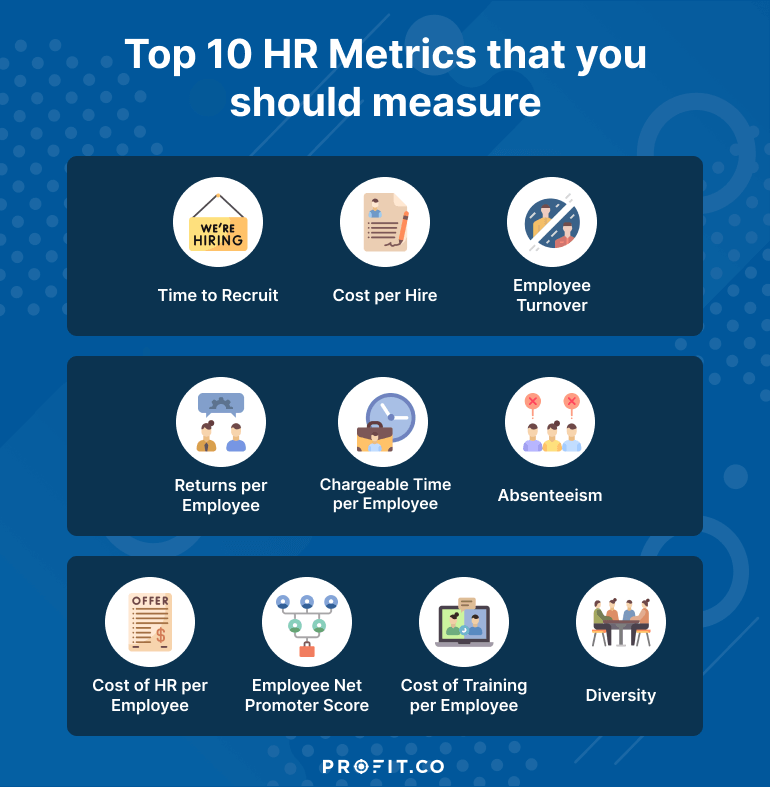
Below are some human resource metrics that are relevant for every organization:
1. Time to Recruit
It is the average duration of time you take to add a new employee to the organization since posting the job to the offer acceptance. To calculate it, you add the time for every individual you hire and divide it by the number of new employees you hire.
2. Cost per Hire
Determine the cost that you incur to hire a new employee. It includes activities such as the recruiter’s time and the entire cost of posting the job on a particular site.
3. Employee Turnover
As a human resource expert, you probably already know that it’s a great sign when the rate of employee turnover is low. When you lose employees frequently, you will lose time and have trouble achieving your overall company goals.
4. Returns per Employee
It is easy to determine the returns per employee. Divide the entire organization’s revenue for the whole year with the total number of your employees.
5. Chargeable Time per Employee
This metric is relevant especially for legal firms and marketing agencies. When the chargeable time per employee is higher, you will have more income.
6. Absenteeism
This is the total amount of time that each employee is absent from the workplace for various reasons, including sickness and vacation.
7. Cost of HR per Employee
Resources are required to hire, train, and manage the workforce within an organization. To determine the average price of HR processes per employee, add up your HR expenditures and divide the amount by the number of employees on the payroll.
8. Employee Net Promoter Score (eNPS)
The eNPS is an often-overlooked metric because it doesn’t depend on any financial factors. The eNPS measures how likely employees are to recommend their friends or family work for their current organization. This translates to how engaged and satisfied employees are at their job. Employees rate their likelihood to recommend their company on a scale of 1-10, which averages the results from all employees and becomes the employee net promoter score.
9. Cost of Training per Employee
Training new employees is essential so that they can deliver outstanding results. However, training is costly since it consumes a lot of resources and there is significant opportunity for lost time.
Scrutinize the entire training expenditures and the number of employees you train to determine the cost of a new trainee.
10. Diversity
Diversity, including race and ethnicity, plays a pivotal role in obtaining the overall organization’s success. Always ensure that your organization fills in the Equal Employment Opportunities file to access the metrics.
Conclusion
Human resource managers play a pivotal role in ensuring success in every organization. It is essential to measure and track people metrics to determine how your efforts make a difference and the areas that require some improvements.
Profit.co’s OKR management software enables users to customize their own KPI boards so they can carefully track important metrics in their organization. You can get started on Profit.co for free today. If you want to learn more about how to use KPIs and metrics to set your organization’s most important goals with Profit.co, schedule a free demo with our OKR experts!
Ten HR metrics to track, one platform to connect them all to real workforce goals. that’s Profit.co
HR metrics are measurable indicators used to track and evaluate the effectiveness, productivity, and engagement of an organization’s workforce
They help organizations monitor employee performance, improve hiring and training processes, enhance productivity, and make data-driven HR decisions.
Some key HR metrics include:
- Time to Recruit
- Cost per Hire
- Employee Turnover
- Returns per Employee
- Absenteeism
- Employee Net Promoter Score (eNPS)
- Cost of Training per Employee
- Diversity
Employee turnover measures how often employees leave an organization. High turnover can increase costs and disrupt productivity
Employee Net Promoter Score (eNPS) measures employee satisfaction and how likely they are to recommend the company as a workplace