Key Takeaways
- Recognition becomes ROI-positive only when tied to strategic outcomes, not just activities.
- Leading indicators like recognition patterns reveal cultural health before results go off track.
- Linking praise to core values and OKRs builds measurable alignment across teams
- Organizational Network Analysis (ONA) exposes hidden influencers, silos, and collaboration gaps
- Recognition analytics strengthen performance reviews with objective, cross-functional data.
- Integrating recognition insights into OKR check-ins creates a continuous improvement loop
You’ve likely championed recognition programs, only to face the tough question in the boardroom, what is the actual business value? You know intuitively that engagement matters. Gallup shows that highly engaged teams are 23% more profitable, but the challenge is connecting those ‘soft’ recognition efforts to the ‘hard’ business results.
The answer is not only tracking data, but making sure you are tracking the right data. This means moving beyond simple activity metrics to an analytics approach that directly links recognition to strategy execution and your company’s most critical objectives and key results (OKRs).
We’re going to break down how you can transform your recognition program from a cost center into a measurable, data-driven engine for building a high-performance culture.
“The highest reward for a person’s toil is not what they get for it , but what they become by it.”

Why Data-Driven Recognition Matters
You have probably invested in recognition programs before, only to face that tricky ROI question. It’s a fair question. While you know engagement is important, it’s difficult to connect a “soft” initiative like employee appreciation to the hard business results your board and CEO care about.The Real Cost of the Problem
The problem is that disengagement has a very real, measurable cost. Gallup data shows that companies with low employee engagement also suffer from lower revenue per employee. The need to solve this may seem purely cultural, but beneath the surface, it shows that it is a financial imperativeShifting from a Rearview Mirror to a Radar
The answer lies in shifting how you think about measurement. Most of your business data, like revenue, profit, and customer churn, are lagging indicators. They are the rearview mirror, telling you the results of actions that have already happened.The true power of recognition analytics is that they provide a leading indicator. This data is your forward-looking radar for strategic health.
Imagine your company’s most critical objective is to launch a new enterprise product. Your project plans might look green, but what if your recognition data shows complete silence between the Product, Engineering, and Marketing teams?
That silence is a powerful leading indicator of misalignment or potential roadblocks. It allows you to intervene before your key results go red
Key Metrics Every Recognition Program Should Track
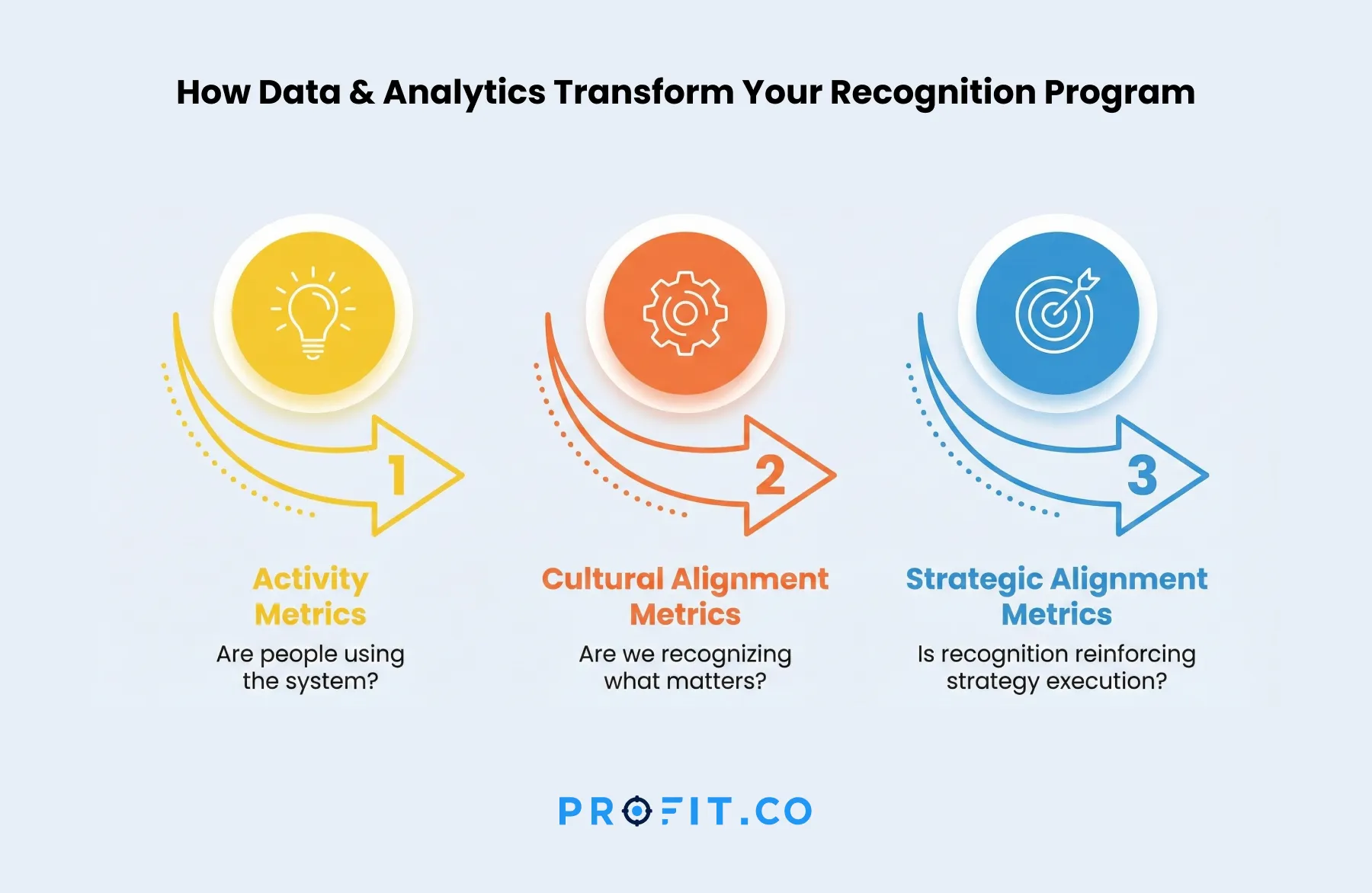
Not all data is created equal. To move beyond a simple “good job” program, you need to track metrics that measure not just activity, but strategic alignment. The most effective approach is to think of your recognition analytics in three levels of maturity.Level 1: Activity Metrics (Are People Using It?)
This is the baseline that most recognition programs track. The key metrics here are participation rate (the percentage of your team giving or receiving praise) and recognition frequency. These numbers are essential for gauging initial adoption, but they reveal almost nothing about its actual impact on your business.Level 2: Cultural Alignment Metrics (Are We Recognizing What Matters?)
This is where your data starts to become meaningful. A modern recognition platform should prompt the user to tie every piece of recognition to a specific company core value. This gives you a powerful metric—recognition by value.Now you can finally answer the question, “Are we a ‘Customer-Obsessed’ company in practice, or just on a poster?” This data provides a tangible, measurable snapshot of your culture in action.
Level 3: Strategic Alignment Metrics (Are We Recognizing the Work That Drives Results?)
This is the ultimate goal, and it’s only possible with a platform that deeply integrates with your strategy. When your system allows employees to link their praise directly to progress on a specific objective or key result, you unlock the holy grail for a CEO. You get an objective, real-time data stream that proves your people are focused on and celebrating progress on the work that is most critical to the businessMake your recognition program measurable, meaningful, and tied to OKRs
Analyzing Recognition Patterns: What the Data Tells You
Once you have the right metrics, you can start seeing the hidden story of how your organization actually works. The most powerful way to do this is through Organizational Network Analysis (ONA). Think of it less like a spreadsheet and more like a real-time map of the relationships and influence within your company.Visualizing Silos and Bridges
This network map instantly shows you how collaboration is flowing—or where it is getting stuck. You might see that your Engineering department is a “recognition silo,” a tight cluster that only recognizes other engineers. This is a major risk if your company-wide OKRs depend on cross-functional teamwork.Conversely, the data will highlight your “bridge” employees. These are the key people who consistently give and receive recognition across different departments, connecting disparate teams and driving collaboration
Identifying Your Hidden Influencers
Your org chart shows the formal hierarchy, but your recognition data reveals the true network of influence. The network map will pinpoint your “central connectors”—individuals who, regardless of their official title, are the cultural linchpins of your organization.These are your informal leaders, your go-to experts, and your future leadership pipeline. This data is objective evidence you can use for talent spotting and succession planning.
Spotting Gaps as Early Warning Signs
Just as important as who is on the map is who is missing. An entire team that is disconnected from the recognition network is a massive red flag. This data can be one of the earliest and clearest warning signs of disengagement, potential burnout, or a team that feels isolated.What are The Common Pitfalls in Recognition Analytics
Once you have a stream of recognition data, the temptation is to jump straight into analysis. But data is a powerful tool, and like any tool, it can be misused. Misinterpreting the data can lead to wrong conclusions and wasted effort. To ensure your analytics lead to genuine insights, it helps to be aware of the most common traps leaders fall intoMistaking Quantity for Quality
It’s easy to report a high figure like “10,000 recognitions given last quarter” and declare victory. But what does that number actually tell you? A focus on sheer volume often encourages a culture of low-value, generic praise (“good job!”) that does little to motivate or guide performance.The key is to shift your analysis from “how many” to “how meaningful.” Instead of just counting, you need to measure the quality and specificity of the praise. This is where you track the percentage of recognition that is explicitly linked to a core value or, even more powerfully, to a specific OKR.
This tells you if your recognition is reinforcing strategic behavior, not just creating noise.
Analyzing Data in a Vacuum
Your dashboard might show a huge spike in recognition for the finance team in January. Is this a sudden, miraculous surge in engagement? Without a business context, you can’t know. The reality is they just closed the year-end books, an intense but expected part of their job.Analytics only become insights when they are correlated with real-world business activities. The expert action is to make recognition data a standing item in your weekly reviews or OKR check-ins. By overlaying recognition trends with your strategic priorities, you uncover the real story behind the numbers.
Keeping Insights Locked Away from Managers
Perhaps the most common mistake is treating recognition analytics as a top-down report, reviewed only by HR and the C-suite. This creates a bottleneck and disempowers the very people who can act on the information most effectively, your frontline managers.The solution is to democratize the data. An effective platform must provide simple and accessible analytics dashboards for individual managers to see their own team’s patterns. This allows a manager to spot their own “recognition blind spots” and take ownership of their team’s culture without waiting for a quarterly report from HR.
Turning Analytics Into Actionable Insights
Collecting data is passive, whereas driving results is an active process. The true value of recognition analytics is unlocked when you integrate them into the core operating rhythms of your business.Make Recognition Data Part of Your Business Rhythm
Do not relegate recognition data to a quarterly culture meeting. Instead, bring it directly into your weekly review meetings or OKR Check-in. When you’re looking at a key result that’s trending “At Risk,” overlaying the recognition data can provide a powerful new diagnostic layer.Is the data for that OKR silent? This could indicate a lack of team morale, a breakdown in collaboration, or a simple lack of focus that traditional project status updates might miss. It prompts a deeper, more insightful question: “Is this KR at risk because of a technical problem, or a people problem?”
Recognition becomes powerful when it stops being random. Tie praise to OKRs, track the patterns, and you turn employee appreciation into a strategic advantage.Tweet
Drive More Objective Performance Management
One of the biggest challenges in performance management is subjective bias. Recognition analytics provide a longitudinal, objective dataset of an employee’s contributions and impact that goes far beyond their direct manager’s viewpoint. This makes performance conversations more powerful and fair.Instead of a manager offering a vague “You’re a great team player,” they can now say, “Sarah, the data shows you were recognized 15 times this quarter by people outside our team for customer obsession, specifically for your help on the Enterprise accounts. Let’s talk about the cross-functional impact you’re having.” Not only is this better feedback, but it is a more complete and accurate picture of performance.
Improve Your Recognition Programs With Profit.co
Ultimately, tracking praise is just one minor piece of data-driven recognition. The program is more about using recognition as a strategic instrument to see if your culture is truly aligned with your strategy execution. This approach transforms an HR initiative into a powerful, real-time indicator of organizational health, giving you the insights to build a genuine high-performance work culture.The science is clear, but having a system to apply it is the real challenge. See how Profit.co’s integrated OKR, Performance, and Employee Engagement platform is the only solution that connects your recognition data to your business results
To make recognition a measurable driver of your company’s performance
Because it shifts recognition from a “feel-good program” to a measurable system that predicts engagement, alignment, and OKR progress
Start with activity metrics (participation), then track recognition by core value, and ultimately recognition tied to OKRs for real strategic insight
When employees tag praise to specific objectives or key results, leaders gain real-time evidence of where focus, alignment, and collaboration are actually happening.
ONA visualizes how recognition flows across your company, revealing silos, cross-functional connectors, and informal influencers who drive culture and collaboration.
They introduce objective data points, showing who contributes cross-functionally, where impact occurs, and how consistently employees live company values.
Yes. Lack of recognition around key OKRs or specific teams acts as an early warning sign for disengagement or misalignment.