TL;DR
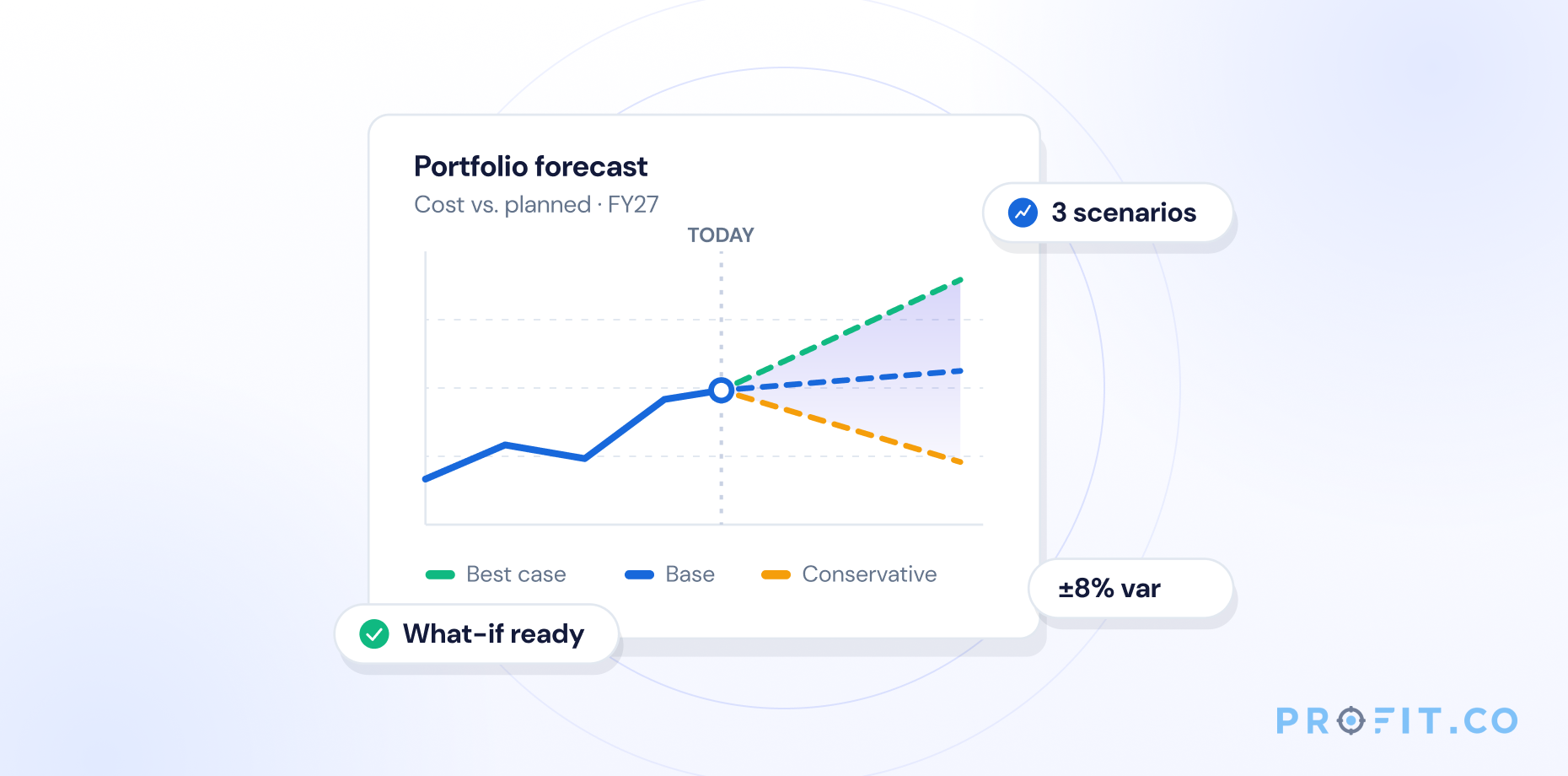
Project Portfolio Management (PPM) is being reshaped by AI, automation, ESG mandates, and rapid skills shifts. By 2030, portfolios will be recalibrated continuously, like a real-time operating system for strategy. Leaders who modernize now will move faster, fund smarter, and allocate resources dynamically.The six moves to start today: adopt AI-driven predictive decisioning, automate portfolio workflows end-to-end, switch to real-time skills-based resource allocation, embed ESG into scoring and funding, decentralize governance without losing visibility, and rebuild talent models around future capabilities. The groundwork, which starts with clean data, adaptive governance, and capability-first teams, must be laid now to avoid falling behind later.
2030 isn’t far away, and groups that wait until then to change how they do Project Portfolio Management would have missed their chance. Artificial intelligence, automation, and government rules are changing how work is funded, staffed, and run.
Project Portfolio Management leaders who change now will be the ones who set the pace. People who don’t will be reacting to it.
These things change how portfolios are judged, funded, and run.
- AI-led analysis will help leaders make decisions faster, so they can change their portfolios in days instead of months. According to McKinsey, AI analytics tools could cut the time it takes to make decisions by as much as 40%
- Automation is changing the way things are run, which lets teams do more work in less time
- Environmental, Social, and Governance (ESG) requirements are becoming a bigger factor in how companies decide whether or not to go ahead with a project.
- Leaders also need to think about how new skills are needed to deal with these changes, which affects who to hire and how to assign work.
These changes are significant, as they transform Project Portfolio Management (PPM) from a reporting tool into an integral component of organizational strategy.
By 2030, Project Portfolio Management will no longer be an administrative task, but it will be the business’s real-time operating system. It will change how quickly businesses can respond to changes in the market, how investments flow, and how resources are allocated.
How to get ready now so that your business can run smoothly in 2030
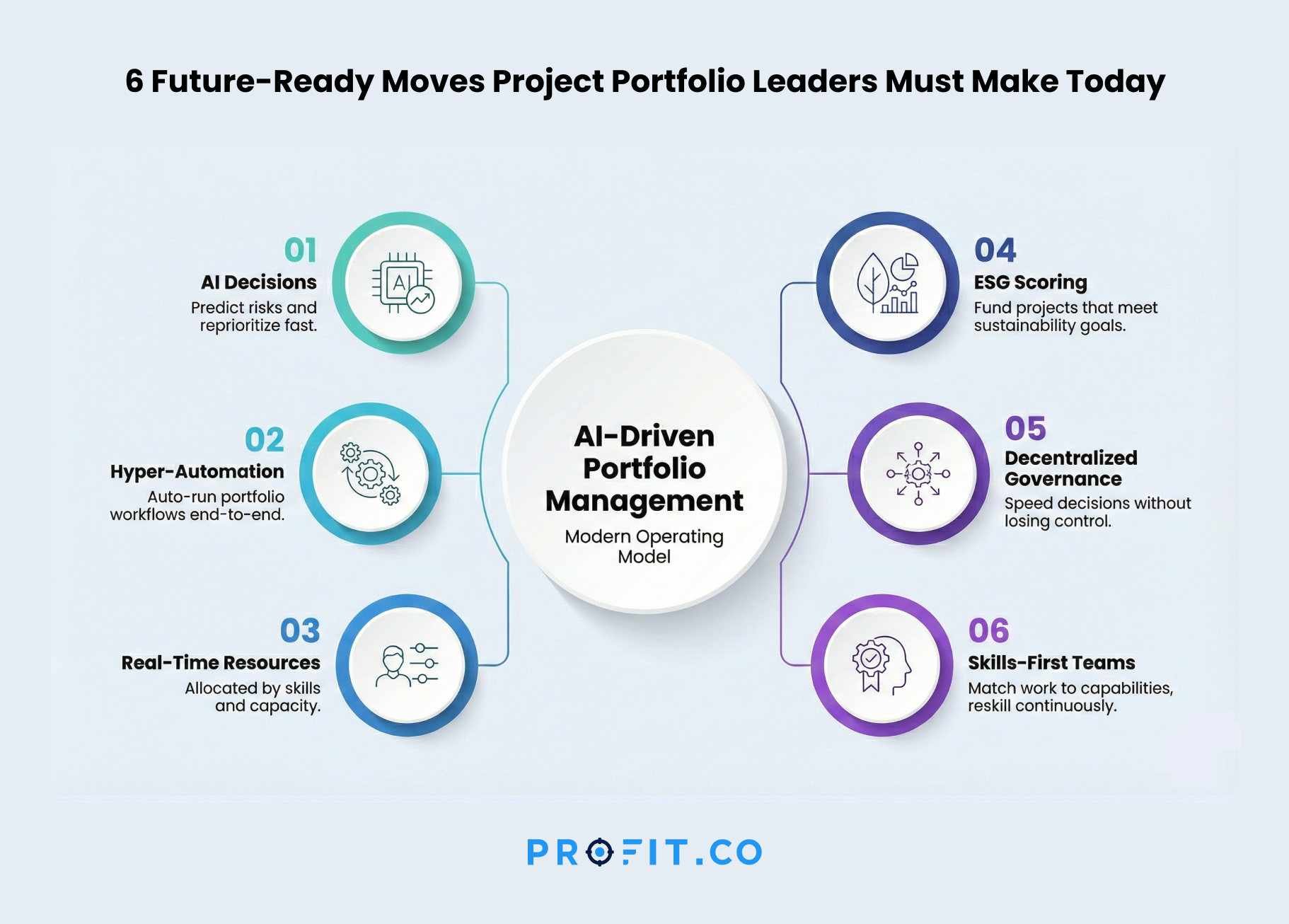
In this blog, we break down six shifts PPM leaders must act on today to thrive by 2030. You’ll see why portfolios need AI-powered foresight, hyper-automated workflows, real-time skills and capacity visibility, ESG-based investment scoring, faster decentralized governance, and a workforce model built around future capabilities1. Making decisions with AI and using predictive analytics
As companies create more data from projects, operations, and business units, it will be harder for leaders to keep up with manual reporting cycles. One recent estimate says that by 2025, the world will have created about 181 zettabytes of data. This is too much data for people to look at without help, which makes manual reporting impossible.This number will have gone up by 2030. This is where AI tools will become a necessity. They look at patterns, point out risks sooner, and give the organization information about investment opportunities.
They can help with:
- Portfolio risk forecasting
- Funding rebalancing simulations
- Dependency impact prediction
- Scenario planning across programs
Predictive analytics will also become standard practice. It will predict where problems are most likely to happen and give information about how they will affect performance metrics, budgets, and timelines. Because of this, AI tools can cut decision-making time from months to days while handling more data than any team could understand on its own.
Today, leaders use data from the past. AI tools will help leaders make choices based on predictive analytics about the next week, month, and even year.
Leaders should start using AI predictive tools so that teams can get used to using them and making decisions based on what will happen in the future instead of what has happened in the past. Making sure that your company’s data is high-quality and consistent is a key part of this change so that AI can make accurate predictions.
2. Hyper-Automation of Portfolio Workflows
AI must completely automate portfolio workflows, from taking in new projects and setting priorities to giving approvals and funding. Managing these workflows by hand will become impossible as businesses grow and take on more portfolios. Hyper-automation not only speeds up workflows like- project intake validation
- prioritization scoring
- resource approval loops
- status reporting / governance decks
But it also changes who makes decisions, when they are made, and how quickly strategic changes can happen. The change is in the structure, not the way things are done.
Automation tools are taking over most of the work that companies do that takes a lot of time and is the same thing over and over again. The amount of projects and data will have grown by 2030, making automation a necessary step. Companies that wait too long to automate will have trouble competing because their decision-making cycles will be out of sync with the market.
Automation tools won’t just speed up workflows; they’ll also start them. A drop in performance or a change in how the business is aligned is an immediate sign that something needs to be done.
Automation also gives leaders more time to think about the results, look at strategic options, and make choices that affect the company’s overall strategy. This is a change from having to check for updates, review work by hand, and give approvals.
Examine your current workflows and find the places where work often gets stuck. At this stage of the portfolio management process, people usually have to do follow-ups and check-ins by hand and wait for teams to respond. You can start by using automation tools at the places where your workflow gets stuck. This will give your teams time to get used to the changes slowly.
3. Dynamic Allocation and Real-Time Resource Intelligence
Planning once a year or once every three months in 2030 will be too restrictive for how quickly businesses will be moving. Leaders need to know exactly what skills and resources are available right now.A lot of businesses still use titles and spreadsheets to divide up work. Real-time resource intelligence improvements make resource allocation a continuous, dynamic process instead of a static yearly task.
Dynamic allocation lets resources move around on their own or almost on their own when priorities change. For instance:
- When teams are almost full, real-time dashboards can show where there are problems before they affect delivery
- If a new rule requires urgent work, leaders can see right away who has the right skills to do it without having to coordinate for weeks.
- If a team is behind on a project, the system figures out who from another team has the right skills to help
Instead of managing roles, manage capabilities. You can set up skills and capacity dashboards so that teams can start to see their workload, availability, and bottlenecks. You might also want to think about reallocation reviews, which help teams get used to the idea that plans will change more often.
4. Bringing together ESG and sustainability metrics
By 2030, environmental and social impact will be a normal part of portfolio scoring. ESG metrics are necessary because of more rules and higher expectations from investors and customers.PwC’s 2024 Global Investor Survey found that 71% of investors think that companies should include ESG in their business plans. So, leaders need to know not only what a project does, but also how it affects the environment, society, and governance. Companies that don’t do well on ESG will have to pay more for capital, have longer procurement cycles, and have less access to big clients.
By 2030, companies will probably have:
- ESG data added to dashboards to show how their actions affect the environment, how much energy they use, the risks of working with certain suppliers, or how much they are at risk of breaking the law
- Project intake scoring includes ESG criteria, which can affect whether a project moves forward or is put on hold
- Working together across departments like finance, operations, technology, and sustainability to make sure that ESG data is used and understood in the same way.
Find the most important ESG indicators for your business and test them within your company. This will help you figure out where you are now and what you need to do to get better over the next few years. Taking action early puts your company in a good position to avoid growth stalls caused by poor ESG performance.
5. Decentralized Project Governance and Models for Working Together
Many businesses still get approvals through PMOs, steering committees, or senior leadership. The result? Delays, slow responses, and bottlenecks.Companies need to make decisions faster than today’s governance models can handle by 2030. Traditional governance structures won’t be able to keep up as portfolios get bigger.
Decentralized project governance gives teams more say in decisions while still keeping leaders in charge. Instead, responsiveness gets better, and teams don’t have to deal with the governance structure slowing them down.
By 2030, decentralized governance structures will probably have:
- Clear rules about which decisions teams can make on their own and which ones need approval from the whole company
- Shared standards and templates that make sure governance stays the same without slowing down teams
- Digital tools for working together that make things more open, so leaders can still keep an eye on performance metrics without having to control every step
- Cross-functional collaboration happens faster because decision cycles get shorter and communication gets clearer
Companies need to make it clear which decisions are made by senior leaders and which ones can be made by teams. You should also update your business’s governance rules to make sure that any changes are clear. Start showing teams how to use tools that make it easy and clear for everyone to get the information they need. It gives leaders full visibility while letting teams work faster and more independently.
6. Resource management based on skills instead of roles
Skills-based resource management puts people to work based on their skills, not their job titles. This is important for 2030 because technology will change how teams work. To deal with fast changes in technology, leaders need to know what skills each member of their team has.The World Economic Forum says that by 2030, 39% of the core skills that people have now will be out of date.
Leaders can do better if they switch from assigning tasks based on roles to assigning tasks based on skills.
- Make strategic planning stronger by making sure that resource decisions are more in line with the company’s strategy
- Make operations more efficient by making sure that teams don’t get assignments that don’t match up, which slows down delivery.
- Make the organization more open, since leaders will have a better idea of the strengths and weaknesses of their employees
- Cut down on reliance on rigid, outdated job structures that can get in the way of important projects
When using a skills-based approach, you need to manage change well. Teach managers to give out work based on skills shown rather than titles. Also, make sure that development programs are up to date and take into account the skills that will be needed in 2030.
Getting Your Business Ready for Tomorrow’s Project Portfolio Management Landscape Today
Getting ready for 2030 means laying the groundwork that will let your business change with the times. It needs better data, more adaptable rules, and workers who are ready for things to change quickly.Get ready with your data first. Even the best AI and predictive tools can’t give you accurate insights if the data you give them is inconsistent or missing. You will be able to use more advanced analytics over time if you standardize your data, clean up your existing sources, and improve your reporting structures.
Next, make governance models better. Companies need decision-making paths that keep the business safe without slowing things down. Having clear rules for when to escalate an issue and when to make a team-level decision makes things run more smoothly and speeds up delivery across teams.
Invest in developing skills so that teams are ready for the future. Teams need to learn how to look at data, work together across departments, and change plans quickly. New technology enablement is very important for making sure that teams are ready to use new advanced portfolio tools.
Companies that can see the future won’t get any benefits in 2030. It will reward businesses that act now and learn how to deal with it. You have five years to change your life. The groups that modernize today will be the ones that lead the way tomorrow.
Want to see what AI-driven, real-time portfolio decisioning looks like in practice?
AI will shift PPM from hindsight reporting to foresight-driven decisioning. Instead of waiting for monthly or quarterly reviews, leaders will use predictive insights to spot risks early, simulate funding scenarios instantly, and rebalance portfolios in days. AI will also surface hidden dependencies, resource bottlenecks, and strategic misalignment before they hit delivery.
Hyper-automation means automating the full portfolio workflow—not just tasks. This includes project intake, scoring, prioritization, approvals, funding releases, progress tracking, and governance reporting. By 2030, automation won’t only accelerate workflows; it will trigger them automatically when performance drops, risks rise, or strategic priorities shift.
Because static planning can’t keep up with fast changes in strategy, regulations, and market conditions. Real-time resource intelligence lets leaders see availability, capacity, and skill-fit instantly—so they can reassign people dynamically as portfolio priorities evolve, without weeks of coordination.
Start by identifying the ESG indicators most material to your business (e.g., carbon impact, supplier risk, compliance exposure, social value). Then introduce them to project intake scoring and dashboard reporting. Even a pilot ESG scoring model builds organizational muscle and avoids a rushed compliance scramble later
Decentralized governance doesn’t remove leadership oversight—it redesigns decision rights. Teams can approve and execute within clear thresholds, while escalations happen only when risk, investment, or strategic impact crosses defined limits. Digital transparency replaces manual gatekeeping, speeding decisions while protecting accountability.
PPM teams will need stronger data literacy, AI-assisted decision fluency, cross-functional collaboration skills, and the ability to adapt plans continuously. Since many core skills will shift by 2030, leaders must begin reskilling and capability mapping now—before gaps slow execution later.
Clean and standardize portfolio data. AI and automation only work well when the inputs are reliable. Once data is consistent, organizations can layer predictive analytics, automate workflows, and move toward continuous, real-time portfolio governance.