


Published Date: March 23, 2026
TL;DR
Knowledge is one of the most critical yet least planned resources in enterprise projects. Common risks include knowledge concentration, poor documentation, and weak knowledge transfer. Managing knowledge as a formal project resource reduces delivery risk.
Knowledge is one of the most critical resources in enterprise projects, yet it is rarely planned as formally as people, budgets, or infrastructure. Most project budgets contain no explicit allocation for knowledge capture or transfer, and many portfolio systems do not track knowledge dependencies at all.
This creates a hidden risk. When critical expertise is concentrated in a few individuals, the loss of that knowledge can delay delivery, increase rework, and disrupt entire programs. In the software engineering and project management community, this vulnerability is often described using the Bus Factor — the number of people who would need to become unavailable before a project faces serious trouble. In many enterprise initiatives, that number is surprisingly low. Consider these examples:
- A legacy system expert who understands the quirks of a 15-year-old ERP implementation.
- A contractor who designed the integration architecture and holds key decisions in undocumented notes.
- A program leader who alone understands the sponsor’s expectations.
When these individuals become unavailable, projects often struggle to recover the missing context.
Knowledge Is the Most Fragile Resource
In many organizations, critical project knowledge resides in a few individuals. These individuals may understand legacy systems, integration architecture, or regulatory requirements that others do not. This concentration of expertise creates what practitioners call the bus factor — it describes how many people would need to become unavailable before the project faces serious trouble. In many programs, that number is alarmingly low.
“Knowledge has become the key resource of the world economy.”

Three Common Knowledge Resource Failures
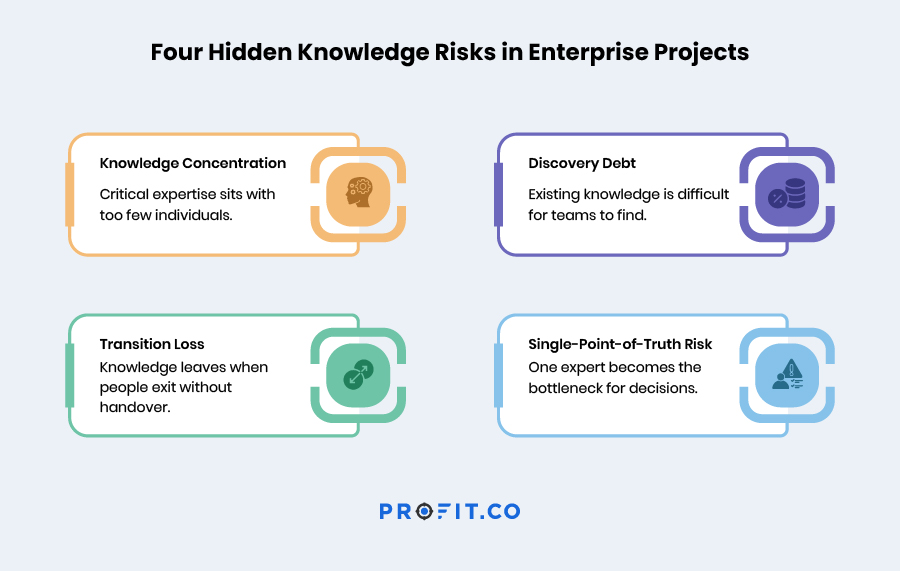
Knowledge risks usually appear in three recurring forms.
Transition Loss
When employees or contractors leave without a structured handover, critical context disappears with them. Successors often spend weeks reconstructing undocumented decisions and technical assumptions.
Discovery Debt
Organizations frequently possess valuable knowledge that teams cannot easily find. Information buried in email threads, personal notes, or poorly organized repositories forces teams to rediscover lessons learned in earlier projects.
Single-Point-of-Truth Risk
Some subject matter experts become the default authority for complex decisions. Their calendars fill with escalations, approvals, and consultations. When they are unavailable, progress across multiple teams can stall.
These risks rarely appear suddenly. They develop gradually as expertise concentrates and documentation practices weaken.
Treating Knowledge Transfer as a Project Deliverable
Mature PMOs treat knowledge not as informal context but as a project resource that must be planned and managed. This typically includes:
- Knowledge dependency mapping during project initiation to identify where critical expertise resides
- Scheduled knowledge transfer tasks included directly in the project work breakdown structure
- SME availability tracked as a resource constraint within project schedules
- Documentation standards enforced as phase-closure requirements
When knowledge dependencies are visible in project plans, teams can manage them the same way they manage budget or staffing constraints. Guidance from organizations such as the Project Management Institute increasingly emphasizes the importance of institutional knowledge and lessons learned as organizational project assets.
The Cost of Ignoring Knowledge Risks
The consequences of unmanaged knowledge risk are measurable. When a critical subject matter expert leaves mid-project and no transfer plan exists, organizations often experience weeks of delay while teams reconstruct undocumented knowledge. Rebuilding lost context is slow, expensive, and prone to error. These disruptions are rarely unavoidable events — they are predictable risks that could have been addressed through better knowledge planning.
For enterprise PMOs, managing knowledge as a formal project resource is not simply documentation discipline. It is a necessary step toward reducing delivery risk across the entire project portfolio.
Monitoring Knowledge Dependencies
Knowledge resources also require monitoring. If a subject matter expert is available only part time, that availability must be reflected in the project schedule. When knowledge dependencies are visible, teams can plan accordingly and avoid delays. Platforms such as Profit.co help organizations track knowledge dependencies and integrate documentation practices into project workflows.
Learn how Profit.co helps teams capture institutional knowledge, plan knowledge transfer, and reduce expertise related project risks
Knowledge resources include the expertise, documentation, decision history, and institutional context required to successfully execute a project. This can involve system architecture knowledge, regulatory understanding, domain expertise, and lessons learned from previous initiatives
The bus factor refers to the number of people who would need to become unavailable before a project faces serious disruption. A low bus factor indicates that critical knowledge is concentrated in too few individuals, creating significant delivery risk.
When critical expertise is held by only a few individuals, the project becomes vulnerable to delays and rework if those individuals become unavailable. Without proper documentation and knowledge transfer, teams may struggle to reconstruct key decisions and technical context
Organizations can reduce knowledge risks by mapping knowledge dependencies, enforcing documentation standards, scheduling knowledge transfer activities, and ensuring that subject matter expertise is distributed across the team rather than concentrated in a single individual.
Structured knowledge transfer ensures that critical information is passed between team members when roles change or people leave the organization. This helps prevent the loss of institutional knowledge and reduces delays caused by rebuilding missing context
Related Articles
-
Beyond Headcount: The Complete Guide to Resource Management in Enterprise Project Portfolio Management
Karthick Nethaji Kaleeswaran Director of Products | Strategy Consultant Published Date: March 23, 2026 TL;DR Most project resource plans focus... Read more
-
Financial Resource Planning in Project Portfolios
Karthick Nethaji Kaleeswaran Director of Products | Strategy Consultant Published Date: March 23, 2026 TL;DR Every project has a budget... Read more
-
Human Resource Management in Enterprise Project Portfolio Management
Karthick Nethaji Kaleeswaran Director of Products | Strategy Consultant Published Date: March 23, 2026 TL;DR Most PMOs manage human resources... Read more
-
Executing OKRs in Government: Champions, Cadence, and Execution Discipline
TL;DR Government agencies are increasingly adopting the OKR framework to improve strategy execution and accountability. However, success depends less on... Read more