

You bring up the Balanced Scorecard six months later as the strategic framework that should guide those OKRs. The room loses its energy. One person says, “Sounds hard,” and another says, “Corporate buzzwords.”
The annoying thing is that a Balanced Scorecard is powerful and strategic. But there’s a big gap in how teams perceive this. Balanced Scorecard is a strategic tool. Let’s see how to change without having to choose between the frameworks
TL;DR
There are a lot of people who don’t get how organizations use Balanced Scorecard and OKRs. Teams like OKRs because they are useful and can be put into action, but they don’t like a balanced Scorecard because it seems abstract and bureaucratic. Balanced Scorecard is a strategic foundation that, when combined with OKRs, works very well. The difference in perception makes it easier to carry out strategies. Profit.co closes this gap by combining Balanced Scorecard strategic power with OKR’s ease of execution. This makes strategy available to everyone without making it too simple or too hard to carry out.Why Balanced Scorecard Seems Hard
Let’s be honest about what people think when they hear these words.When You Say “OKRs”
- Google uses them
- Can understand quarterly goals
- Work can be done every week
- Agile and modern
- Feels useful
What You Say “Balanced Scorecard”
- No references
- Sounds like an idea or theory
- Businesslike and strict
- Not for me, but for executives
Both reactions are based on how things look, not how they really are. But how people see things affects how many people use them, and how many people use them affects how well they work. So this gap is very important.
OKRs are linked to big tech companies, the startup culture, and being flexible. Balanced Scorecard sounds like accounting and strategy consulting, but it’s a framework that can give OKRs strategic direction when used effectively
“You don’t choose your passions . Your passions choose you.”

Some Assumptions People Have About Balanced Scorecard
The gap in perception leads to a gap in understanding. Most teams don’t know this about the Balanced Scorecard:Myth 1: Balanced Scorecard Is Just a Reporting Tool
People think it’s a way for executives to look at dashboards and metrics every three months. Balanced Scorecard is a framework for strategic management that turns vision into action plans from four points of view. The scorecard helps with strategic thinking.Myth 2: Balanced Scorecard Is Top-Down and Rigid
People think that executives make it in a boardroom and then send it down. Teams don’t have any say. The actual truth is that a lot of people need to work together to make the Balanced Scorecard work. The framework makes sure that strategic goals are clear and consistent. However, teams can be creative and independent when they work toward those goals.Myth 3: You Have to Choose: OKRs or Balanced Scorecard
People say, “We’re an OKR company, so a balanced Scorecard doesn’t fit our culture.” OKRs and Balanced Scorecard are not competing frameworks; they work together. Balanced Scorecard sets your long-term strategic direction from four different but balanced points of view. OKRs turn that strategy into quarterly goals for execution with Key Results that can be measured. Companies that use both do much better than those that use only one.Myth 4: Balanced Scorecard Is Only for Big Businesses
Small businesses may need the Balanced Scorecard more than big ones because they can’t afford to have their strategies out of sync. When you don’t have a lot of resources, it’s very important to make sure that everyone’s OKRs are in line with a clear strategy. The framework works well at any size. A startup Balanced Scorecard might have 2–3 goals per perspective instead of 5–6, but the strategic clarity is just as useful.Myth 5: Balanced Scorecard Slows You Down
People think that there’s too much planning and not enough doing. Balanced Scorecard makes you go faster by stopping you from moving around for no reason. Teams start projects that go against each other, work on different priorities, and change direction all the time because they don’t have a clear strategic anchor. Balanced Scorecard gives OKR-level agility a clear purpose, so it can be strategically useful instead of strategically random.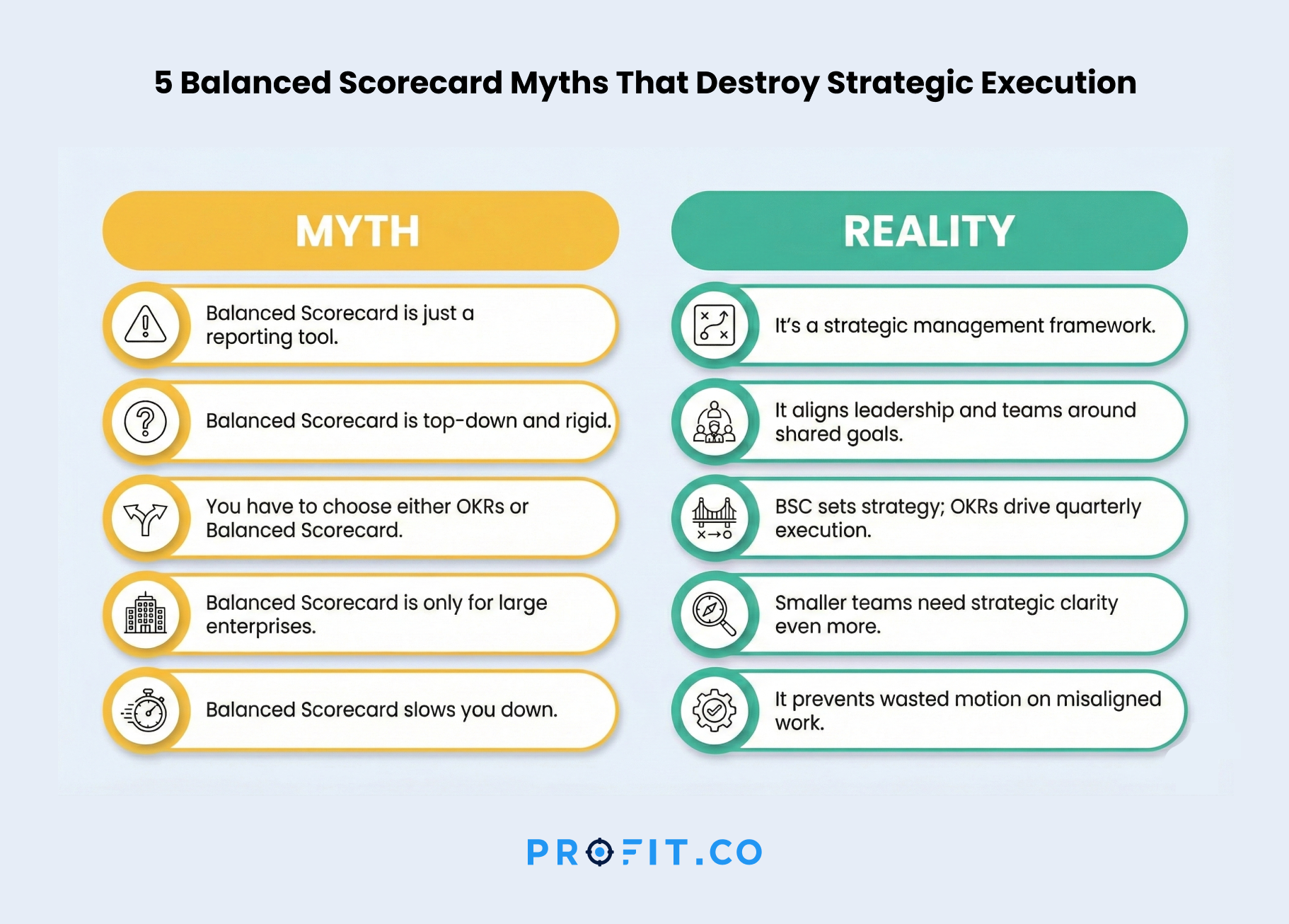
How the Balanced Scorecard Works well with OKRS
Balanced Scorecard gives you the long-term strategic map, and OKRs turn that map into short-cycle execution. Instead of competing, BSC answers the “where and why,” while OKRs handle the “what and how this quarter.” When you connect them, every OKR becomes a clear milestone toward a balanced, multi-year strategy.1. Balanced Scorecard Answers Some Tough Questions
- What do I want to accomplish this quarter? “Here’s why it matters to our long-term plan.”
- What does success look like? “Here’s how your success fits in with our overall strategic goals.”
- Are we balancing our different priorities? “Yes, because we’re measuring from the points of view of finances, customers, processes, and capabilities.”
2. Balanced Scorecard Turns Random to Strategic Focus
Teams set goals based on what they think is important, what their leaders have said recently, or what other teams are doing.This makes:
- Different departments have different priorities
- Plans that cancel each other out
- Quarterly pivots that don’t make sense from a strategic point of view
- Teams do their best work in their own areas, but the company as a whole fails.
With the Balanced Scorecard, goals immediately make strategic sense. Teams know exactly what strategic goals their OKRs should help them reach.
This makes:
- Priorities that work together to strengthen each other
- Projects that build on each other to reach strategic goals
- Flexible execution within a steady strategic direction
- Local optimization that supports the strategy of the organization
3. How Balanced Scorecard Stops the Strategic Trap
Companies successfully make plans, and everyone loves how clear and focused they are. But after 6 to 8 quarters, they hit a wall. The business is meeting its goals, but it’s not making any strategic progress.Why? Without the Balanced Scorecard , there is no way to make sure that your quarterly goals are actually working toward something.
How the Balanced Scorecard gives each quarter a strategic connection
Balanced Scorecard sets the longer strategic thread that runs through every quarter, so goals don’t reset in isolation. It helps teams see how this quarter’s OKRs build on the last one and move the same big-picture outcomes forward. That way, quarterly execution stays flexible, but always connected to a consistent multi-year direction.1. How the Balanced Scorecard Solves the Strategic Problem.
The Balanced Scorecard makes sure our teams are not pulling in different directions and that every quarter is moving the same strategy forward.2. Balanced Scorecard as the base for OKRs
Balanced Scorecard is a framework for strategic management with four points of view, and it can make sure that all of your OKRs are working together toward the same goal instead of fighting each other while retaining a balanced strategic focus.3. Balanced Scorecard connects the critical aspects in a balanced manner
Balanced Scorecard uses four perspectives, financial, customer, internal process, and learning & growth, to keep strategy balanced. When one team sets goals for rapid growth while another sets goals for cost-cutting, both end up stuck. Balanced Scorecard makes those priorities visible upfront, so your goals reinforce each other instead of competing4. Balanced Scorecard makes Strategic goals easy to see and understand
Make a simple diagram that shows your strategic goals for the next three to five years and links them to the OKRs for the current quarter. People need to see the connection before they can understand it in their minds.5. Link it to Personal Impact for more engagement
A Balanced Scorecard shows you how your work fits into the company’s plans for the next three years, so you can see how your work affects more than just this quarter. Make it personal and important.How Profit.co Helps Bring Strategic Clarity With the Balanced Scorecard
Choosing the right technology makes a big difference. Balanced Scorecard has historically been hard to put into practice as it seems abstract and not connected to daily work when it is in PowerPoint decks and Excel spreadsheets.Profit.co fixes this by making Balanced Scorecard real and part of everything in the following ways:
- Visual Strategy Connection: Each OKR on the platform shows which Balanced Scorecard goal it helps. Teams can literally see the line that connects their Key Result to their strategic goals
- Unified Experience: Teams don’t go into “BSC mode” for planning and “OKR mode” for doing things. Strategy and execution are linked in one smooth experience
- Bottom-Up Visibility: People who work on their own can see how their work fits into the big picture without having to read strategy documents. The connection is clear, quick, and always there
- Balanced View: Dashboards show progress in all four Balanced Scorecard perspectives at the same time, so it’s easy to see when OKRs are out of balance or at odds with each other
- Strategic Context Without Complexity: The platform gives strategic context without making everyone an expert in strategy. You can see what you need when you need it.
When teams use Profit.co, they stop thinking of Balanced Scorecard as a separate “executive thing” and start to see it as the strategic base that gives their OKRs meaning.
How to set up the Balanced Scorecard and integrate it with OKRs
Are you ready to help your company see BSC as the strategic tool it is? Here’s your plan:Step 1: Begin with OKR Pain Points
Begin by recognizing the problems your team has such as not being on the same page, having different priorities, and not having a clear long-term goalStep 2: Work together to make the strategic goals
Get teams involved in setting the strategic goals. People feel like they own and understand the framework when they help make it.Step 3: Show the Link in a Picture
Use tools like Profit.co to show how the Balanced Scorecard and OKR are related. People need to be able to see how their quarterly goals fit into their long-term strategic goals.Step 4: Celebrate wins that are strategic, not just OKR wins
When a team reaches an OKR, make sure to note which Balanced Scorecard goal it helped to reach. This shows that OKRs are not goals in and of themselves, but rather tools to help achieve strategic goals.Step 5: Make BSC a Framework That is Dynamic
Make it dynamic by looking at the progress of strategic objectives every month and showing how quarterly OKRs are helping to reach multi-year Balanced Scorecard goalsChoose Integration Over Selection
There is a people gap because we have set up OKRs and Balanced Scorecard as competing options when they are really two parts of the same strategic system. Without a Balanced Scorecard you execute direction. If you don’t have OKRs, BSC gives you a strategy but not momentum.They all work together to give you strategic execution: direction with speed, clarity with flexibility, and long-term vision with short-term accountability.The organizations that win don’t pick one framework over another. They’re the ones who teach their employees how to use both Balanced Scorecard and OKRs together, with Balanced Scorecard providing strategic direction and OKRs setting the execution pace.
And with platforms like Profit.co that make both frameworks work together perfectly, you don’t have to choose between being strategic and being simple. You get both.
Are you ready to connect OKR execution with Balanced Scorecard strategy?
This is like asking, “If we’re doing well every day, why do we need a yearly destination?” OKRs are great for quarterly execution. Many companies find that after a few quarters of OKRs, they are meeting their goals but not making any strategic progress. This is because there is no framework to make sure that your quarterly goals are building toward something coherent. That strategic framework is provided by Balanced Scorecard . It tells you where you’re going over the next three to five years from four balanced points of view: financial, customer, process, and learning. This turns your OKRs into quarterly milestones on a strategic journey instead of separate 90-day sprints
In fact, the opposite happens. Balanced Scorecard helps you work faster by eliminating strategic confusion and conflicting priorities, which are what really slow you down. Without a balanced scorecard, teams waste a lot of time arguing about which OKRs are most important, figuring out how to resolve conflicts between departmental goals, and changing direction every quarter because they don’t have a strategic anchor. Balanced Scorecard gives people the information they need to make decisions quickly and in line with the company’s goals
Small businesses actually benefit more from this integration because they can’t afford to waste time and money on strategic misalignment. When you have 25 people instead of 2,500, it costs more for each person to work on the wrong thing. Balanced Scorecard helps you focus your limited resources on the most important strategic goals, and OKRs help you stay disciplined so you can make quick progress. Profit.co gives you an enterprise-level strategic framework without the problems and costs that come with running a business


