Published Date: March 23, 2026
TL;DR
Every project has a budget but few have a financial resource plan. Effective financial resource management requires phased expenditure planning, CapEx and OpEx classification, contingency governance, and real-time variance monitoring. These practices help organizations avoid costly financial surprises.
A Budget Is Not a Financial Resource Plan
Most projects begin with a budget approval. Once the funding ceiling is established, the project appears financially secure. However, a budget simply defines how much money can be spent. It does not explain how that money flows across the lifecycle of the project. Without a structured financial plan, spending patterns often diverge from expectations.
Research from the McKinsey Global Institute and the University of Oxford found that large IT projects run an average of 45% over budget and deliver significantly less value than predicted. The gap between the budget and the actual spending curve is where many of these overruns originate.
Ready to optimize your resource planning?
The Flat Line Budget Assumption
One of the most common financial planning mistakes is the flat line budget model. In this model, project leaders divide the total budget by the number of months in the timeline and assume spending will be evenly distributed. In reality, project expenditure patterns rarely follow a straight line.
Infrastructure investments often occur early in the project lifecycle. Testing phases require additional resources later in the schedule. Stabilization activities after launch add a financial tail that many initial plans overlook. When these dynamics are not reflected in the financial model, executives receive variance explanations that could have been predicted from the beginning.
“You cannot escape the responsibility of tomorrow by evading it today.”

CapEx and OpEx Classification Challenges
Financial resource planning also requires careful classification of expenditures. In technology-driven projects, certain investments may qualify as capital expenditures while others are operational expenses. Misclassification can affect financial reporting and change how the project is evaluated by finance leaders.
Cloud migrations provide a common example. A project may initially treat most spending as capital investment. Later, recurring subscription costs and managed services require reclassification as operational expenses. When these changes occur during execution, they can create governance challenges and disrupt financial planning.
The Governance Role of Contingency Reserves
Most projects include a contingency reserve. However, the way these reserves are used often lacks formal governance. In many organizations, contingency funds act as an informal buffer that project managers access whenever costs exceed expectations.
A more mature approach treats contingency as a managed financial resource. Release conditions are defined in advance, linked to risk triggers, and monitored at the portfolio level. According to the Project Management Institute, organizations waste more than eleven cents for every dollar spent on projects due to poor performance and governance. Structured financial resource planning helps reduce that waste.
Financial Visibility at the Portfolio Level
Project-level financial planning is important, but portfolio visibility is equally critical. PMOs must understand how financial resources are distributed across multiple initiatives and how spending patterns affect overall investment strategy.
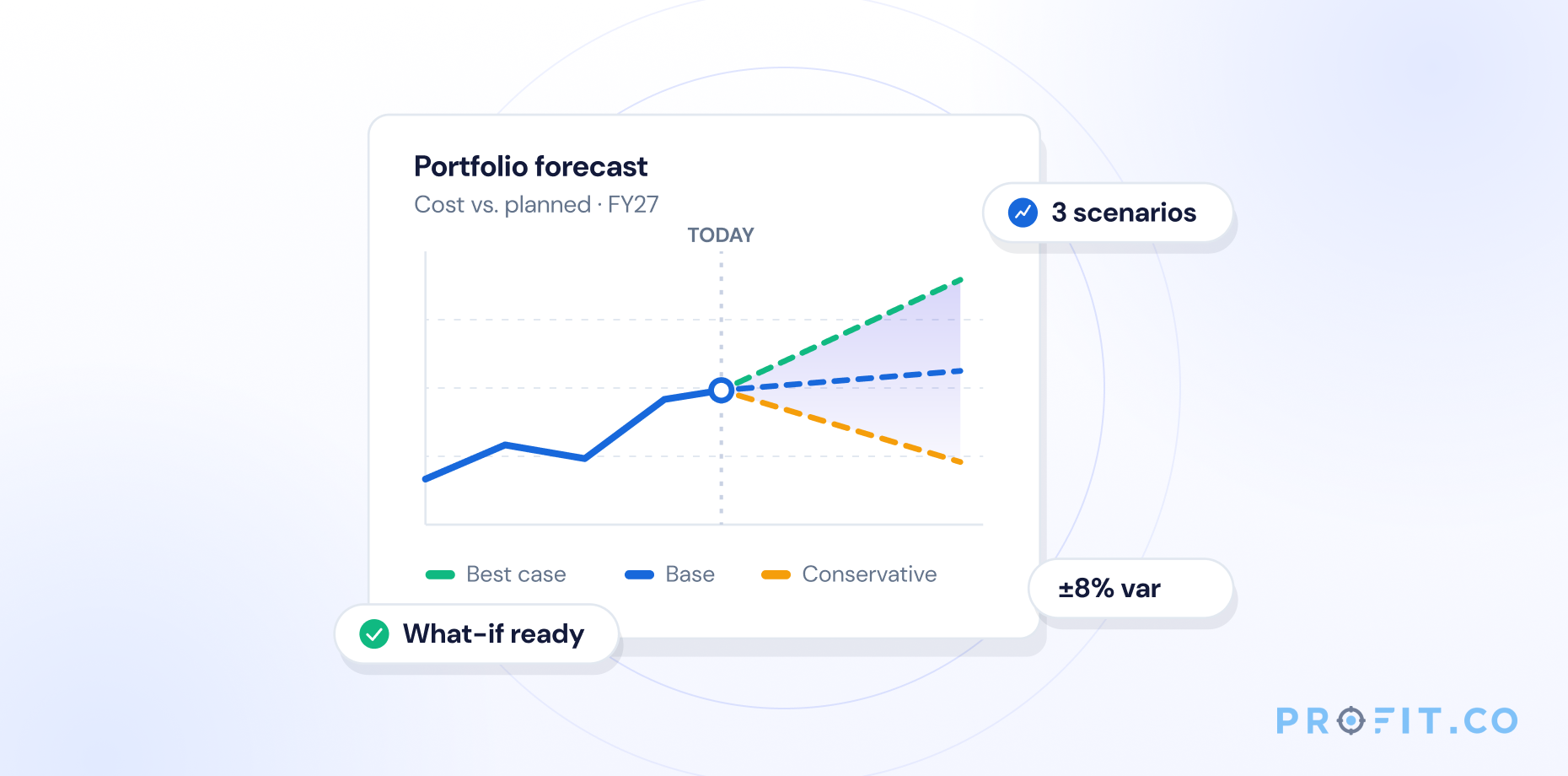
Platforms such as Profit.co help organizations track budget baselines, compare actual spending with forecasts, and identify financial variance early in the delivery cycle.
Learn how Profit.co helps PMOs manage project budgets, forecast spending patterns, and maintain financial governance across the entire portfolio.
Financial resource planning involves forecasting how project funds will be allocated and spent throughout the project lifecycle. Instead of defining only a total budget, it models expenditure timing, resource categories, contingency reserves, and financial risks so organizations can monitor spending and maintain financial governance
Projects exceed their budgets for several common reasons:
- Spending patterns are assumed to be evenly distributed across the timeline
- Early infrastructure investments and late-stage testing costs are underestimated
- CapEx and OpEx classifications change during execution.
- Contingency reserves are used without structured governance
- Financial variance is identified too late due to limited portfolio visibility
When financial resource planning is absent, these predictable cost shifts become unexpected overruns
A project budget defines the maximum amount that can be spent. A financial plan explains how and when that money will be spent across different phases of the project. Financial plans include expenditure timing, resource allocation, contingency reserves, and variance monitoring mechanisms
Projects rarely spend money evenly across their timelines. Infrastructure investments, development activities, testing phases, and post-launch stabilization often create uneven spending curves. Phased expenditure planning models these patterns so organizations can forecast cash flow and avoid unexpected financial variances.
Portfolio-level financial visibility allows PMOs to monitor spending across multiple initiatives simultaneously. By comparing forecasts, budgets, and actual expenditures across projects, organizations can identify financial risks early, rebalance investments, and ensure resources are aligned with strategic priorities