Government agencies everywhere face the same execution challenge: strategy is written clearly, priorities are publicly announced, but the connection between those priorities and day-to-day execution remains weak.
This is the execution gap. Many public sector organizations attempt to close this gap using dashboards, strategic plans, and performance reports. But these systems often measure activity rather than ensuring alignment and accountability. That is where Objectives and Key Results (OKRs) provide a powerful alternative.
However, implementing OKRs in government requires a thoughtful rollout. Programs typically fail for three predictable reasons:
- Insufficient leadership sponsorship
- Premature cascade (trying to go from agency goals to individual OKRs immediately)
- Over-engineering the system before the culture is ready
A four-phase implementation roadmap avoids these failure modes and provides a practical sequence for launching a sustainable OKR program.
TL;DR
- Government OKR programs fail when organizations rush rollout or lack leadership commitment.
- A four-phase roadmap ensures structured adoption: 1. Foundation, 2. Cascade, 3. Individual Alignment, 4. Optimization.
- Agencies should begin with agency-level OKRs, then gradually cascade to departments and individuals.
- Weekly check-ins and quarterly reviews keep OKRs connected to execution.
- Limiting the number of objectives ensures prioritization and prevents administrative overload.
Government agencies rarely fail because they lack strategy. Strategic plans are written, priorities are clearly stated, and performance metrics are reported regularly. Yet many agencies still struggle to translate those plans into consistent execution.
The challenge is not strategy but operational alignment. Different departments pursue their own priorities. Programs operate on separate timelines. Performance reporting happens after the fact rather than guiding decisions in real time. The result is a familiar public-sector pattern: strong strategic intent but uneven execution.
This is precisely the problem that Objectives and Key Results (OKRs) were designed to solve. By connecting strategic objectives to measurable outcomes and establishing a regular management cadence, OKRs create a clear line of sight between leadership priorities and everyday work.
But implementing OKRs within a government institution is not the same as doing so in a technology company. Public sector organizations operate on annual budget cycles, with multiple oversight bodies and complex accountability structures. A direct transplant of private-sector OKR practices rarely succeeds.
Successful government implementations follow a structured rollout. Rather than cascading OKRs across the entire organization immediately, they introduce the framework progressively, starting with building leadership commitment first, then expanding alignment across departments and individuals.
“Great things are accomplished by talented people who believe they will accomplish them.”

The four-phase implementation roadmap described below reflects this field-tested approach. It provides a practical sequence for launching, stabilizing, and scaling an OKR program in a government agency.
Start building your government OKR framework today.
The Four-Phase Government OKR Implementation Roadmap
Successful government OKR programs are built step by step, not deployed all at once. Each phase strengthens alignment, accountability, and execution across the organization.
| Phase | Focus | What Happens |
|---|---|---|
| Phase 1 | Foundation (Weeks 1–4) | Secure leadership sponsorship, appoint an OKR Champion, define 5–7 agency Objectives, and set up the OKR platform. |
| Phase 2 | Cascade (Weeks 5–10) | Train departments, create aligned departmental OKRs, launch weekly check-ins, and run the first OKR review. |
| Phase 3 | Individual Alignment (Weeks 11–16) | Extend OKRs to teams and individuals, connect them to performance conversations, and run the first quarterly retrospective. |
| Phase 4 | Optimization (Quarter 2+) | Integrate data systems, automate reporting with AI tools, and expand OKRs across programs and field operations. |
Introduce OKRs progressively so the culture develops alongside the system, avoiding unnecessary complexity.
Phase 1: Building the Foundation
The first month of implementation determines whether the OKR program will succeed or become another reporting exercise. Three elements are essential.
1. Leadership Sponsorship
Leadership must publicly commit to the framework, not simply approve it internally. When agency heads actively reference OKRs in meetings, the organization recognizes that the system matters.
2. A Dedicated OKR Champion
A senior leader, typically at the director level, must own the program. Their role is to guide implementation, coach teams, and ensure the system remains aligned with strategy.
3. A Focused Set of Agency Objectives
Early implementations should define 5–7 strategic objectives, each supported by up to 5 Key Results. The goal is clarity, not comprehensiveness.
Phase 2: Cascading Alignment
Once agency-level OKRs are established, the next step is to align departments. Department heads create their own OKRs that directly support agency objectives. This stage introduces several operational practices:
- Leadership training on OKR methodology
- Alignment reviews across departments
- Weekly progress check-ins
- Monthly OKR review meetings
These routines transform OKRs from a planning framework into a living management system.
Phase 3: Individual Alignment
After departmental alignment stabilizes, the organization can safely extend OKRs to individual contributors. This phase connects strategy to day-to-day work by:
- Linking individual goals to department OKRs
- Training managers to use OKRs in performance conversations
- Running the first quarterly OKR retrospective
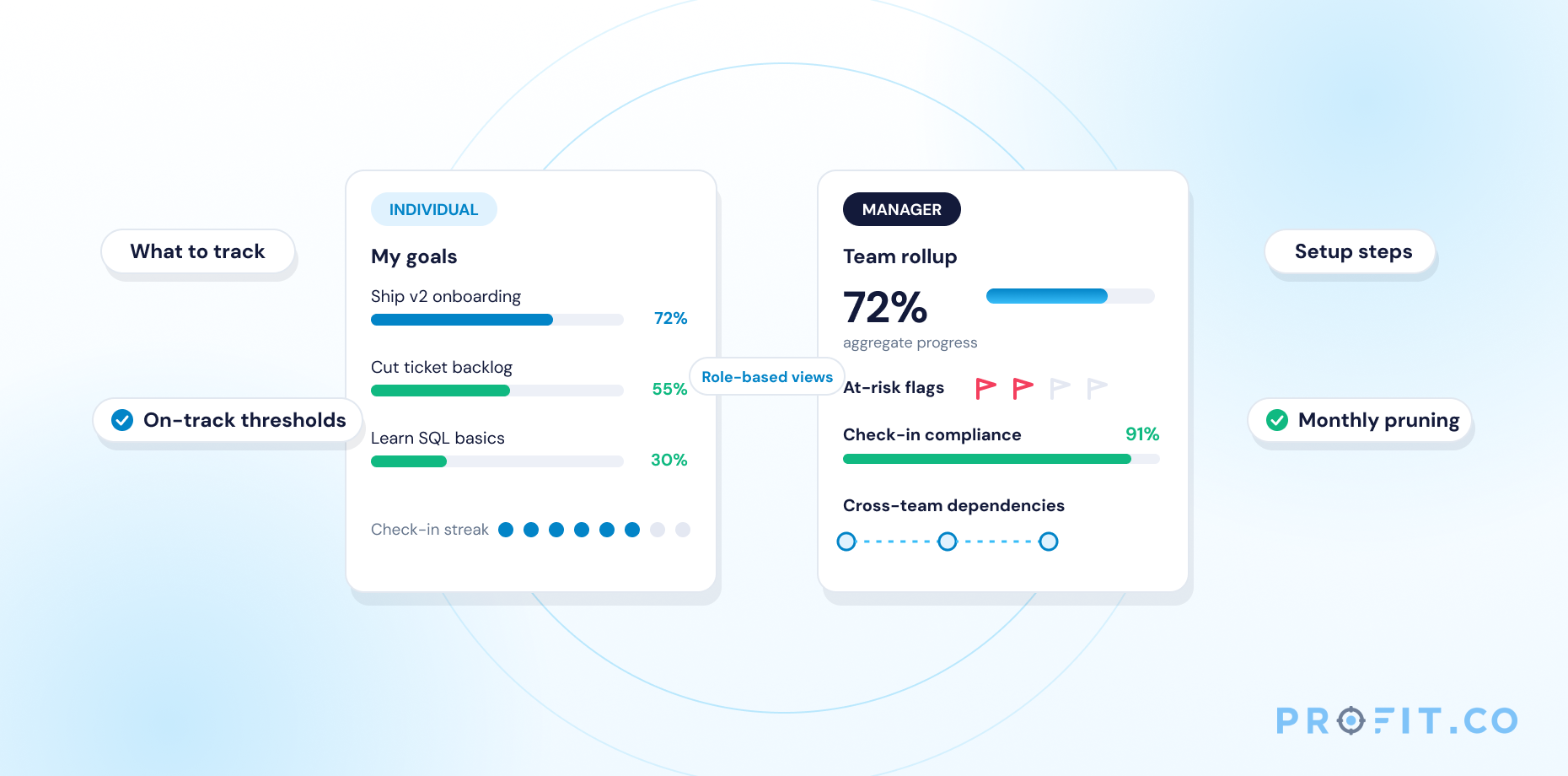
Transparency also becomes critical here. Publishing agency-wide dashboards helps every employee see how their work contributes to the broader mission.
Phase 4: Optimization
Once the basic system is functioning, agencies can begin to optimize their OKR environment. Typical improvements include:
- Integrating financial, program, and HR data systems
- Automating performance reporting using AI tools
- Connecting project portfolio decisions to strategic priorities
- Expanding the OKR structure across regional offices and programs
At this stage, OKRs evolve from a goal-setting framework into a strategic execution infrastructure.
The Most Common Implementation Mistake: Too Many Objectives
One of the biggest pitfalls in government OKR adoption is attempting to capture every program and mandate within the OKR system. Departments often create 15–20 objectives, each with multiple Key Results. The result is an unwieldy system where nothing is truly prioritized.
The discipline of OKRs is the discipline of focus. A healthy structure typically includes:
- 3–5 Objectives per department
- 2–5 Key Results per objective
If a priority does not fit within those limits, the organization has not completed the prioritization conversation.
One of the most common mistakes teams make with OKRs is trying to capture everything they are responsible for. Every initiative, every program, every mandate somehow finds its way into the system. Before long, the OKR list becomes so long that nothing actually feels prioritized.
A simple test helps cut through that complexity. Ask your team one question: “If we could focus on only three things this quarter, what would they be?” Those three priorities are your objectives. Everything else usually falls into a different category:
- KPIs you continue to monitor
- Operational responsibilities that keep the organization running
- Future priorities that belong in a later quarter
This distinction matters because OKRs are not meant to capture everything an agency does. Their purpose is much simpler and much more powerful: to make it unmistakably clear what matters most right now.
Why the Phased Approach Works
Government institutions are complex organizations with multiple stakeholders, regulatory requirements, and long planning cycles. A phased rollout acknowledges this reality. By starting with leadership alignment and gradually expanding participation, agencies can build a culture of accountability without overwhelming teams.
Over time, the system becomes self-reinforcing:
- Leaders set clear priorities
- Teams align around measurable outcomes
- Progress becomes visible across the organization
That is how strategy becomes execution.
Conclusion
The promise of OKRs in government is not simply better goal setting. It is the creation of a management system that continuously connects strategy to execution. When implemented thoughtfully, OKRs provide three capabilities that traditional public-sector performance frameworks often lack:
- Alignment: ensuring every department and team understands how their work supports the agency’s mission.
- Accountability: assigning clear ownership for measurable outcomes rather than broad program activities.
- Execution cadence: replacing annual reporting cycles with regular check-ins, reviews, and course corrections.
The four-phase roadmap makes this transformation manageable. By starting with leadership alignment, gradually cascading objectives, and enforcing discipline around prioritization, agencies can introduce OKRs without overwhelming the organization.
Over time, the system becomes more than a planning framework. It becomes the mechanism through which leadership sets priorities, teams coordinate their efforts, and progress toward mission outcomes becomes visible across the entire agency. For government leaders seeking to close the gap between strategy and results, that capability may be one of the most valuable management tools available today.
Explore how Profit.co helps public sector teams implement OKRs with automated check-ins, alignment dashboards, and AI-powered progress insights
The first step is to secure visible leadership sponsorship and define a small set of agency-level objectives
Best practice is 3–5 objectives per department, each with 2–5 Key Results.
No. Existing performance metrics typically become Key Results or KPIs that support OKRs, rather than being replaced.
The most common reasons are lack of leadership engagement, cascading too quickly, and creating too many objectives.