

OKR best practices center on three disciplines: set three to five goals per quarter, write key results as measurable outcomes not activities, and run structured weekly check-ins. Teams that follow all three consistently execute strategy at significantly higher rates and make individual work visible against company direction.
In this guide
- Why do most OKR Programs fail before the Quarter ends?
- What do Effective OKR Goals Examples look like across Departments?
- How do OKRs connect Stage-Gate Governance and Agile Delivery?
- What Check-In Practices make OKRs stick all Quarter?
- How many OKRs should a team set per Quarter?
- How does the Right Platform support the Hybrid OKR Model?
- Frequently asked questions
Why do most OKR Programs fail before the Quarter ends?
Most leaders assume OKR programs fail because teams set the wrong goals, too vague, too aspirational, or disconnected from strategy. Goal quality is a real problem. But it is not the primary failure mode.
The primary failure is cadence. Teams set OKRs in a planning session and then do nothing structured with them for 90 days. No weekly check-ins. No owner accountability. No system to surface what is blocked before it is too late. By week six, goals exist only on a slide deck nobody opens.
Only 16% of knowledge workers report that their company effectively sets and communicates goals (Gartner, 2024). The gap is not ambition. It is infrastructure. Goals without execution infrastructure are intentions, not strategy. And only 23% of employees globally report being engaged at work (Gallup, 2023), with unclear goal visibility at the individual level named as a core driver of that disengagement.
Three failure patterns appear consistently:
1. OKRs set too high in the organization
Company-level OKRs exist but never cascade to team or individual level. Strategy is set by leadership; execution is expected of everyone else, with no structural connection between the two layers.
2. Key results measure activity, not outcome
“Launch three features” is not a key result. It measures output. A key result measures the change in the world caused by the output: “Increase feature adoption from 22% to 40%.” This distinction determines whether OKRs drive behaviour or merely track it.
3. Check-ins treated as reporting, not problem-solving
When check-ins become status meetings, teams stop attending. A check-in should answer one question: what is blocking progress, and who resolves it by when?
Speed without direction is faster failure. An OKR check-in exists to change direction, not document it.
What do Effective OKR Goals Examples look like across Departments?
An objective is a qualitative direction statement, inspiring, time-bound, and clear enough that anyone in the organization can tell whether the team is moving toward it or away from it. It contains no numbers.
A key result is a quantitative measure of progress toward that objective. It has a baseline, a target, and a clear owner. The test: if you cannot score it on a 0.0 to 1.0 scale at quarter-end, it is a task, not a key result. A score of 0.7 means 70% of target achieved, which most OKR frameworks consider a success. A 1.0 score signals the target was set too low.
Here is what this looks like in practice across three departments:
Engineering Team — OKR Example
Objective: Improve platform reliability to meet enterprise customer expectations
Reduce API error rate from 1.2% to 0.3%
Increase platform uptime from 99.1% to 99.9%
Resolve P1 incidents in under 45 minutes, measured as an 8-week rolling average
HR / People Team — OKR Example
Objective: Build a feedback culture that supports high performance every quarter
Complete 100% of quarterly reviews within the 30-day review window
Increase manager assessment completion from 67% to 95%
Raise employee NPS from 28 to 42
Sales Team — OKR Example
Objective: Accelerate mid-market revenue to hit the Q3 plan
Close 18 new mid-market accounts at $40K ARR or above each
Increase average deal size from $34K to $46K
Shorten average sales cycle from 62 days to 48 days
For 40+ ready-to-use templates across every function and industry, the OKR goals examples across every department library in OKR University covers engineering, HR, sales, product, and marketing, with both good and weak examples annotated.
How Do OKRs Connect Stage-Gate Governance and Agile Delivery?
Most project governance frameworks treat strategy and execution as separate domains. Stage-gate governance controls investment decisions and project phase progression. Agile sprints control delivery cadence and iteration. OKRs are typically added as a third layer, disconnected from both.
This is the structural flaw that breaks execution in organizations running both governance models simultaneously. The hybrid model resolves it by making quarterly OKRs the bridge between governance and delivery.
| Stage-Gate Governance | Agile Delivery Sprints |
|---|---|
| Controls project investment decisions and phase progression | Controls delivery cadence and iteration within a project |
| Gate reviews happen at defined phase boundaries | Sprint reviews happen every 1-2 weeks |
| Slower to respond to change mid-phase by design | Highly adaptive to new information and priority shifts |
| Aligned to capital allocation and investment governance | Aligned to team throughput and delivery velocity |
| Asks: should we fund this project into the next phase? | Asks: what can the team ship in the next two weeks? |
The OKR Bridge Model
Quarterly OKRs become the gate criteria.
A project advances through a stage gate only when its projected outcomes align with the active quarterly OKRs. Strategic misalignment becomes visible before resources are committed, not discovered at the quarter-end review.
Sprint goals become the execution units.
Each two-week sprint delivers the incremental progress that moves a key result. Teams see in real time how their delivery cycle contributes to the quarterly goal, without a separate reporting layer sitting between them.
Governance without delivery speed is bureaucracy. Delivery speed without governance is drift. OKRs define the terms for both.
This hybrid model only works when OKRs, project portfolios, and task execution live in the same system. When they do not, teams maintain three separate reporting cadences, producing three versions of the truth and one weekly reconciliation meeting nobody wants. Learn how project portfolio management software that connects directly to OKRs eliminates that layer entirely.
Connect Your OKRs, Projects, and Sprints in One System
What Check-In practices make OKRs stick all Quarter?
A check-in is not a status meeting. The distinction matters because it changes what teams do when they show up.
Status meetings answer: what happened? OKR check-ins answer: what is blocking progress, and what changes this week to unblock it? One produces a record. The other produces a decision.
Weekly team check-in — 15 minutes
Each key result owner updates progress, flags a specific risk, and commits to one action this week. No slides. No prep deck. The shared OKR dashboard is the agenda.
Monthly leadership review — 30 minutes
Review OKRs at risk. Decide what to deprioritize, accelerate, or close. Leadership makes trade-offs here. This is a decision meeting, not a progress report.
Quarterly Reflect and Reset — half day
Score completed OKRs on a 0.0–1.0 scale. A score of 0.7 means 70% of target achieved, considered success in most OKR frameworks. A 1.0 score means the target was set too low. A score below 0.4 requires root-cause analysis, not a penalty. Carry forward what matters. Reset with the data you now have.
Most dashboards fail structurally, not visually, because they report progress instead of surfacing the decisions that change it.
The check-in format only works when the OKR dashboard surfaces blockers in real time, not after a weekly export. Learn how structured OKR check-in templates cut check-in prep time and keep every key result owner accountable without adding meeting overhead.
How many OKRs should a team set per Quarter?
Three is right for most teams. Five is the ceiling. Anything beyond five is a task list in strategic clothing.
The constraint is the discipline. OKRs exist to force prioritization. If setting ten OKRs per quarter feels achievable, the team has solved the wrong problem. They have made goal-setting easy rather than making execution focused.
Executive teams that consistently exceed five OKRs per quarter are typically signalling one of two things: the hard trade-offs have not been made, or the OKR program has drifted from strategic alignment into project tracking.
The Right Structure Per Team
3
Objectives
x
2-4
Key Results each
=
8-12
Measurable outcomes per quarter
That is a focused and full execution agenda for any team at any size.
For a structured walkthrough of cascading OKRs from company level to team and individual, including scoring calibration and check-in facilitation frameworks, the OKR implementation guide in OKR University covers the full cascade architecture.
How does the Right Platform support the Hybrid OKR Model?
Most OKR platforms support goal-setting and check-ins. Fewer connect OKRs to project portfolio management natively. Almost none support the hybrid stage-gate and agile architecture in a single system, which means teams running both governance models maintain separate reporting layers that produce conflicting data and require manual reconciliation every week.
What a Connected OKR Platform Delivers
OKRs, project portfolios, and task execution in one system
- →
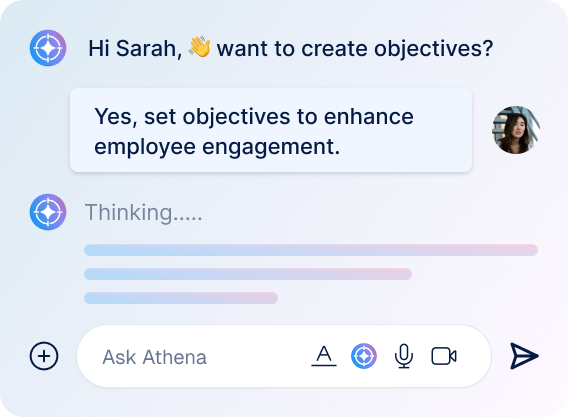
AI-assisted OKR authoring and quality scoring catches vague key results before the quarter begins, so teams execute against goals that can actually be tracked and scored.
- →
OKRs + PPM + Tasks in one platform so stage-gate decisions, sprint tasks, and quarterly OKRs are tracked together, not across three separate tools with three separate exports.
- →
100+ integrations including Jira, Azure DevOps, and Salesforce, so progress from existing delivery tools updates OKRs automatically. Teams report less and execute more.
- →
OKR management connected to performance reviews and project portfolio management in a single data layer, so the sprint board answers to the Key Result, and the Key Result answers to the quarterly strategy review.
Key OKR Best Practices
- ✓
Set three to five OKRs per team per quarter. The constraint forces the prioritization.
- ✓
Write key results that measure outcomes, not outputs. Scorable on a 0.0–1.0 scale at quarter-end.
- ✓
Run weekly 15-minute check-ins focused on blockers and decisions, not status reports.
- ✓
Cascade OKRs from company to team to individual to connect strategy with daily execution.
- ✓
Use quarterly OKRs as stage-gate criteria and sprint goals as the execution units that move them week by week.
- ✓
Score OKRs honestly at quarter-end. A 0.4 score is a learning input, not a failure to punish.
Turn OKR Best Practices into a Quarterly Execution Habit
Frequently Asked Questions
Set three to five goals per quarter, write key results as measurable outcomes not activities, run structured weekly check-ins, cascade OKRs from company to team to individual, and score OKRs at quarter-end to inform the next planning cycle.
Three OKRs per quarter is the most effective number for most teams. Five is the ceiling. More than five signals prioritization has not occurred. The team ends up with a task list, not a focused execution agenda.
A key result is measurable when it has a baseline, a target, and scores on a 0.0–1.0 scale at quarter-end. If it cannot be scored numerically, it is a task or milestone, not a key result.
Quarterly OKRs set the strategic direction. Agile sprints execute within that direction. Sprint goals become the delivery units that move key results week by week. OKRs answer what success looks like; sprints answer how the team gets there.
Weekly 15-minute team check-ins to surface blockers, monthly 30-minute leadership reviews to assess OKRs at risk, and a quarterly Reflect and Reset session to score completed OKRs and set next quarter’s goals with live data.


