Key Takeaways
- Behavioral barriers often matter more than technical ones: Cognitive biases and emotional patterns sabotage PPM more often than poor processes or inadequate tools.
- Common barriers include sunk cost bias, loss aversion, anchoring, overconfidence, confirmation bias, and herd behavior: These universal human tendencies consistently undermine portfolio decision quality.
- Layered decision frameworks acknowledge different risk tolerances: Structuring portfolios in layers makes it easier to take appropriate risks while maintaining core stability
- Pre-mortems and devil’s advocates counteract overconfidence: Explicitly encouraging critical thinking surfaces risks that groups naturally overlook
- Clear kill criteria established upfront reduce sunk cost bias: Knowing termination conditions in advance makes ending failing projects feel like a process rather than a judgment.
- Psychological safety enables honest assessments: When people aren’t punished for identifying problems, better information flows into portfolio decisions.
- External perspectives provide valuable reality checks: Outsiders without emotional investment spot patterns and problems insiders have rationalized.
- Behavioral coaching builds long-term capability: Training teams to recognize their own biases improves decision quality over time.
“But behaviour in the human being is sometimes a defence , a way of concealing motives and thoughts , as languages can be a way of hiding your thoughts and preventing communication”

The Psychology Behind Portfolio Decisions
Traditional portfolio management assumes decision-makers are rational and always choose what’s best for the organization. In reality, this is rarely the case. Executives making portfolio decisions are often influenced by past experiences, emotional ties to certain projects, social pressure from peers, and mental shortcuts that skip careful analysis. These are normal human tendencies. The main challenge is to spot when these patterns affect decisions and to use strategies that help counter themNeed a structured portfolio management system?
Common Behavioral Barriers That Derail Project Portfolio Management
1. The Sunk Cost Trap
Imagine a project that has used a lot of budget and resources for eighteen months, but the results are still disappointing and analysis suggests it should end. Even so, portfolio review meetings might keep funding it because people feel, “we’ve already invested so much.”This is sunk cost bias, the tendency to keep investing in failing projects just because resources have already been spent. In portfolio management, this bias stops organizations from cutting their losses and moving resources to better opportunities. Psychological response is understandable. Terminating a project can feel like admitting failure, wasting prior investments, and disappointing team members who contributed significant effort. As a result, organizations may continue to invest in unsuccessful projects, hoping for eventual improvement.
2. Loss Aversion and Risk Paralysis
People feel losses about twice as strongly as they feel gains. This difference, known as loss aversion, often makes decision-makers too cautious when choosing projects.When faced with a risky but promising project versus a safer, smaller improvement, executives often pick the safer choice. This isn’t always because it’s the better option, but because the fear of loss outweighs the hope for gain.
Loss aversion also manifests in holding onto underperforming projects. Terminating a project represents a definite, visible loss. Continuing it maintains the possibility, however slim, that it might still succeed, avoiding that psychological pain of realized loss.
3. Anchoring on First Impressions
The first information we get about something often becomes an anchor that shapes all later judgments. In portfolio management, this happens when early project estimates or excitement have too much influence on later evaluations.If a project starts out with a lot of excitement and high hopes, stakeholders may see it as “the innovation initiative” or “the game-changer.” Even when new evidence suggests otherwise, this anchoring can make it hard to reassess the project’s true value.
4. Overconfidence in Predictions
Ask project sponsors to estimate completion time, budget, or outcomes, and you’ll consistently get overconfident predictions. This is a cognitive bias where people systematically underestimate challenges and overestimate their ability to deliver results.In portfolio decision-making, overconfidence can result in the approval of an excessive number of projects based on unrealistic assumptions. This leads to resource constraints as the portfolio becomes overcrowded with initiatives that are unlikely to achieve projected success.
5. Confirmation Bias in Project Reviews
Once we form a belief about something, we unconsciously seek information that confirms it while dismissing contradictory evidence. During portfolio reviews, this means selectively noticing data supporting existing project priorities while overlooking warning signs.If leadership has already decided a project is strategically important, subsequent reviews tend to interpret ambiguous results favorably and explain away problems as temporary setbacks rather than fundamental issues
6. Herd Behavior and Social Proof
Humans are social people; they naturally look to others when they’re unsure. In portfolio management, this can lead to herd behavior, where projects get support just because others back them, not because of independent analysis. When a leader champions a project, others may support it despite private reservations. The perceived social cost of dissent can be significant, resulting in political considerations superseding genuine portfolio governanceThe Hidden Cost of Behavioral Barriers
These psychological patterns don’t just affect single decisions. Over time, they add up and can weaken the whole portfolio management system.Organizations may develop portfolios dominated by safe, incremental projects that do not significantly advance strategic objectives
Underperforming projects may continue to consume resources without delivering value, while political considerations override objective criteria in project selection and continuation.
Most importantly, these patterns can damage trust in the PPM process. When stakeholders see decisions driven by bias instead of data and good governance, they may lose interest in the system. Portfolio reviews can become just a formality instead of real evaluation sessions.
Recognizing these barriers is the first step. To overcome them, organizations need deliberate strategies and thoughtful process design.
Instead of treating all portfolio decisions identically, structure them in layers based on purpose and risk tolerance. This approach, borrowed from behavioral portfolio management principles, acknowledges that different types of projects serve different psychological and strategic needs
- One layer might contain core operational projects, safe initiatives that keep the business running
- Another layer holds growth projects with moderate risk and return profiles.
- A third layer includes transformational bets with high uncertainty but potentially game-changing returns
This framework legitimizes the inclusion of both conservative and aggressive projects without subjecting all initiatives to identical risk assessments. It also facilitates the termination of failing projects in the high-risk layer, as failure is anticipated and accepted from the outset.
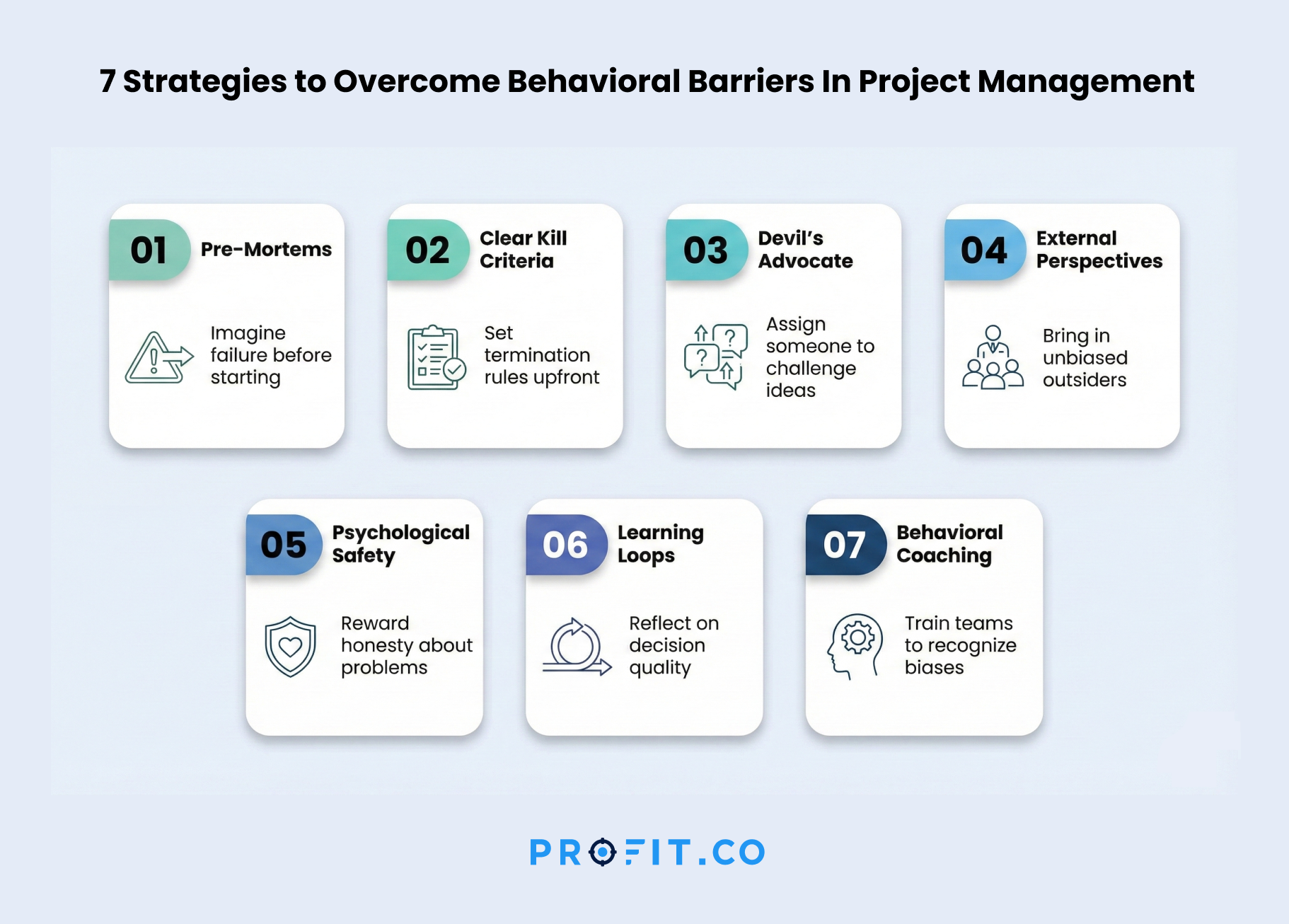
7 Practical Ideas to Avoid Behavioral Barriers in Project Portfolio Management
1. Implement Pre-Assessment
Before approving projects, conduct a pre-mortem exercise. Ask the team: “Imagine this project failed spectacularly. What went wrong?” This technique helps fight overconfidence and confirmation bias by encouraging people to think about what could go wrong and spot risks that might be missed. By asking the team to assume failure, it feels safer to share concerns. This surfaces hidden risks and unrealistic assumptions before resources are committed, leading to better project selection and fewer late-stage failures.2. Establish Clear Kill Criteria Upfront
One reason sunk cost bias is strong is that ending projects can feel random or political. To avoid this, set clear rules for continuing or ending projects before they start. Choose metrics and decision points. Document what success looks like at each stage and what conditions would trigger reassessment or termination. Make these criteria visible and reference them consistently in portfolio reviews.When everyone knows upfront that failure to achieve specific outcomes by defined dates will trigger termination discussions, it becomes a process issue rather than a personal judgment. This doesn’t eliminate the emotional difficulty entirely, but it reduces the feeling that continuing bad projects is the only fair option.
3. Use Devil’s Advocate Systematically
Give someone the clear job of challenging project proposals and questioning overly optimistic assumptions during portfolio discussions. This built-in skepticism helps fight confirmation bias and herd behavior.The essential factor is to formalize this as an official role, rather than relying on individuals to volunteer dissenting opinions. When challenging consensus is an assigned responsibility, it mitigates the social cost that typically discourages open critique.
Rotate this role among team members so no one is always seen as “the negative person,” and everyone gets practice with critical thinking.
4. Leverage External Perspectives
Behavioral biases are most problematic to spot in ourselves. Bringing in external perspectives like consultants, advisors, or cross-functional team members not emotionally invested in specific projects can help surface blind spots.External reviewers are not influenced by prior decisions, political relationships, or emotional attachments to specific initiatives. Their objective perspective enables them to identify patterns and issues that internal stakeholders may have rationalized.
This doesn’t mean outsourcing decisions, but getting outside input at key moments gives valuable reality checks.
5. Get the Organizational Culture Right
Many behavioral barriers persist because organizational culture punishes honesty about project problems. When admitting difficulties gets you blamed rather than supported, people hide problems until they become catastrophic.Leaders should explicitly reward candor in project assessments. Teams that acknowledge when a project is not succeeding and recommend pivoting.
Leaders should openly reward honesty in project reviews. Teams that admit when a project isn’t working and suggest changes or ending it should be recognized. These actions should be seen as signs of maturity and good strategy, not as failures.
6. Build in Reflection and Learning Loops
After projects complete or get terminated, conduct structured retrospectives focused on decision quality rather than just outcomes. Ask questions like:- What assumptions did we make during project approval? Which proved accurate and which didn’t?
- Could we identify any early warning signs that we might have overlooked or disregarded?
- How did our decision-making process help or hinder recognizing problems?
- What would we do differently knowing what we know now?
This kind of reflection helps organizations spot behavioral patterns and adjust their processes. Over time, teams get better at noticing biases and making more objective decisions.
7. Use Behavioral Coaching
Just as behavioral portfolio management helps individual investors understand their decision-making patterns, behavioral coaching can help portfolio decision-makers recognize their biases.This could mean working with facilitators who point out when biases like anchoring or confirmation are affecting discussions. It might also include training on cognitive biases and how they show up in portfolio decisions. The goal is to raise awareness so people notice these patterns in themselves
The Role of Technology in Managing Behavioral Barriers
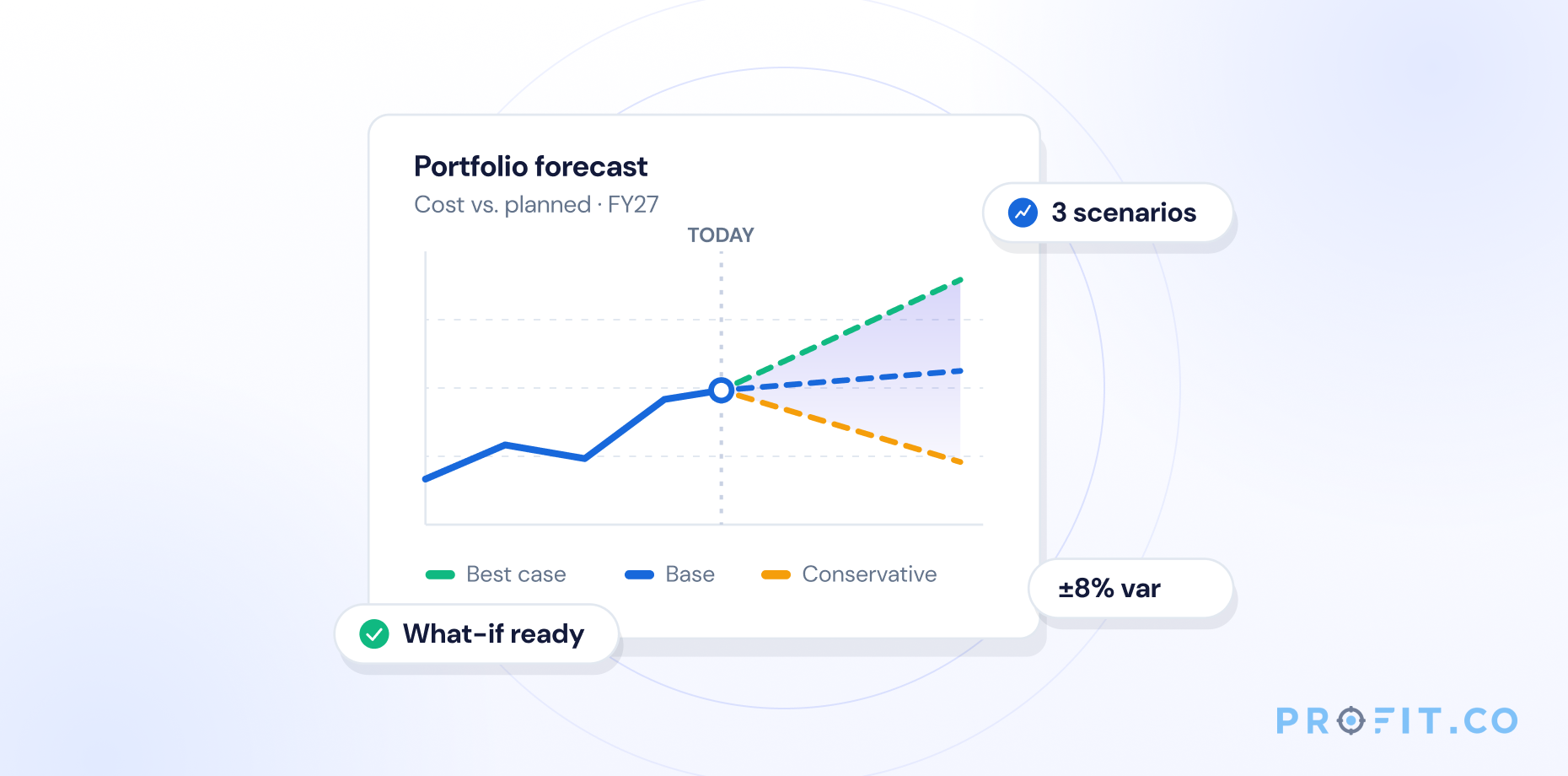
Technology can’t remove human psychology, but it can help manage behavioral barriers if used wisely. Software that visualizes portfolio health across multiple dimensions makes it harder to dismiss problems or cherry-pick favorable data. Automated alerts when projects hit predefined warning thresholds reduce the ability to rationalize continued investment. Scenario analysis tools let teams look at different possible outcomes, which helps fight overconfidence by making them consider more than one future. Tracking past estimates against actual results gives real evidence of planning accuracy and helps set better expectations. The main goal is to use technology to bring out information and encourage reflection, not to replace human judgment. Algorithms can spot possible biases, but people still need to recognize and address themManaging Executive Stakeholders and Their Biases
Executives aren’t immune to behavioral barriers. In fact, their biases can have a big impact on portfolio results. Managing executives well means understanding their psychological patterns. Executives anchor strongly on first impressions and resist updating their views as evidence accumulates. Others display extreme loss aversion, making them reluctant to terminate even clearly failing projects. Still others show herd behavior, swinging behind whatever peer executives support.Your stakeholder management plan should consider these tendencies. For executives who anchor on first impressions, schedule times to review initial assumptions with new data. For those who are loss-averse, present project termination as “freeing resources for better opportunities” instead of “admitting failure.” Understanding these patterns isn’t about manipulating executives but about structuring information and decisions to help them make choices that fit the organization’s goals, even when natural tendencies might lead elsewhere.
Looking for a data-driven, bias-free approach to project management?
You can’t eliminate biases entirely; they’re hardwired into human psychology. However, you can absolutely reduce their impact through awareness, process design, and structured decision-making approaches. Organizations that acknowledge biases and build countermeasures make consistently better portfolio decisions than those pretending everyone is rational.
Frame it as improving the process rather than fixing people. Everyone experiences cognitive biases; acknowledging this is a sign of sophistication, not weakness. Focus on how systematic approaches help everyone make better decisions by counteracting universal human tendencies
Political environments actually need behavioral approaches more, not less. Start small with pilot applications in areas where you have support. Document improvements and build momentum gradually. Sometimes demonstrating better outcomes is what shifts culture over time.
Some benefits appear quickly—pre-mortems and clear kill criteria can improve individual decisions immediately. Building broader organizational capability to recognize and manage biases takes longer, typically measured in months or years rather than weeks. The key is sustained commitment rather than one-time interventions.
Transparency generally works better than manipulation. Explain that everyone has biases and the goal is improving collective decision quality. When people understand the reasoning behind approaches like devil’s advocates or external reviews, they’re more likely to engage constructively rather than viewing them as bureaucratic obstacles.