

Earned Value Management (EVM) measures project performance by integrating scope, schedule, and cost through key metrics.
Table of Contents
- What is Earned Value Management (EVM)?
- What are the core EVM metrics?
- How do I interpret Cost Performance Index (CPI)?
- How do I interpret the Schedule Performance Index (SPI)?
- How do I interpret the To-Complete Performance Index (TCPI)?
- Best practices for uploading profile pictures in Profit.co
- Related Questions
- Frequently Asked Questions
What is Earned Value Management (EVM)?
Earned Value Management (EVM) is a project management technique that integrates three critical dimensions of project performance: scope, schedule, and cost.
What are the core EVM metrics?
Three Foundation Metrics:
- Planned Value (PV)
- Definition: The budgeted cost of work planned to be completed by a specific date.
- What It Represents:
- What do you plan to accomplish
- Baseline budget timeline
- Expected progress at any point
- Example:
- Planned completion by Month 5 = 50.55%
- Total Budget (BAC) = $100,000
- PV = 50.55% × $100,000 = $50,550
- Earned Value (EV)
- Definition: The budgeted cost of work actually completed.
- What It Represents:
- Value of work actually accomplished
- Progress in budget terms
- What you've earned for work done
- Example:
- Actual work completed = 56.67%
- Total Budget (BAC) = $100,000
- EV = 56.67% × $100,000 = $56,670
- Actual Cost (AC)
- Definition: The actual cost incurred for the work completed.
- What It Represents:
- What you actually spent
- Real expenditure
- Resources consumed
- Example:
- Completed 40% of work (EV = $40,000)
- Actually spent $45,000 to complete that work
- AC = $45,000
How do I interpret Cost Performance Index (CPI)?
CPI: Measures Cost Efficiency
What It Means:
- For every dollar spent, how much value did you earn?
- Cost efficiency of the project
- Budget performance indicator
Interpretation:
- CPI > 1.0 → Under Budget (Good): Earning more value than spending
- CPI = 1.0 → On Budget (Baseline): Earning exactly what you're spending
- CPI < 1.0 → Over Budget (Concern): Spending more than the value earned
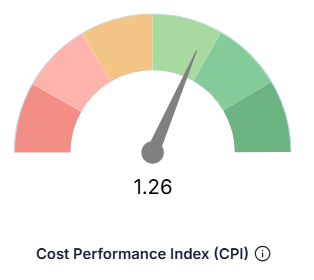
Formula: CPI = EV ÷ AC
Project at Month 5
- Earned Value (EV) = $56,670 (work completed)
- Actual Cost (AC) = $45,000 (money spent)
- CPI = $56670 ÷ $45,000 =1.259
Interpretation:
- The project is highly cost-efficient. For every dollar spent, the project is generating $1.26 worth of value, indicating it is well under budget.
How do I interpret the Schedule Performance Index (SPI)?
SPI: Measures Schedule Efficiency
What It Means:
- How much work completed vs. planned?
- Schedule adherence indicator
- Progress efficiency
Interpretation:
- SPI > 1.0 → Ahead of Schedule (Good)
- SPI = 1.0 → On Schedule (Baseline)
- SPI < 1.0 → Behind Schedule (Concern)
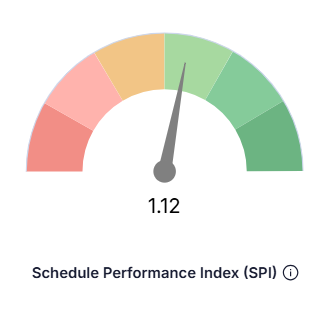
Formula: SPI = EV ÷ PV
Project at Month 5:
- Earned Value (EV) = $56670 (work completed)
- Planned Value (PV) = $50,550 (work should have been completed)
- SPI = $56670 ÷ $50,550 = 1.121
Interpretation:
- The project is ahead of schedule. Work is being completed about 12% faster than planned, showing strong execution efficiency.
How do I interpret the To-Complete Performance Index (TCPI)?
TCPI: Indicates Future Efficiency Required
What It Means:
- Cost efficiency needed for remaining work
- Required future performance
- Feasibility of meeting budget
Formula (based on BAC): TCPI = (BAC − EV) ÷ (BAC − AC)
Interpretation:
- TCPI > 1.0 → Higher Efficiency Needed
- TCPI = 1.0 → Maintain Current Efficiency
- TCPI < 1.0 → Lower Efficiency Acceptable
Project Status:
- Budget at Completion (BAC) = $100,000
- Earned Value (EV) = $56670
- Actual Cost (AC) = $45,000
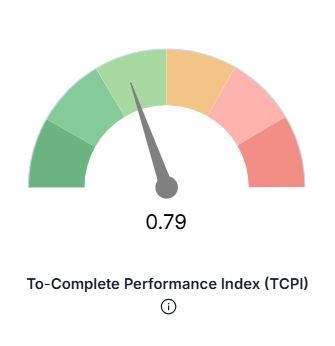
Formula: TCPI = (BAC − EV) ÷ (BAC − AC)
- TCPI = ($100,000 − $56,670) ÷ ($100,000 − $45,000)
- TCPI = $43330 ÷ $55,000
- TCPI = 0.787
Interpretation:
- The project needs lower cost efficiency going forward to meet the original budget. This indicates there is comfortable budget flexibility, and current performance is more than sufficient to complete the project within budget.
Best practices for uploading profile pictures in Profit.co
- To maximize the effectiveness of EVM performance measurement:
- Trend Over Time: Don't rely on single-point measurements; watch how CPI, SPI, and TCPI change over multiple periods to identify true performance trends versus temporary fluctuations.
- Use All Three Together: Never interpret CPI alone; always consider CPI, SPI, and TCPI together for complete performance picture and understand full project health context.
Related Questions
How to Configure EVM Tracking, Click Here
How to create a Project in the PPM module, Click Here
Frequently Asked Questions
All three provide different but equally important insights. CPI shows past cost performance, SPI shows schedule performance, and TCPI shows future requirements. Use all three together for complete understanding.
No, EVM requires budget (Planned Value) to calculate meaningful metrics.
