KEY TAKEAWAYS
- A high turnover rate is not beneficial to any organization.
- HR professionals use turnover rate metrics to understand where they need to make adjustments in their organization.
- The turnover rate applies to large and small organizations.
- Human resource executives must have in-depth knowledge of the turnover rate.
TLDR:
Turnover rate is a key HR metric that measures the percentage of employees leaving an organization over a specific period. It helps businesses understand workforce stability, employee satisfaction, and retention effectiveness. A high turnover rate can indicate issues such as poor management, lack of growth opportunities, or inadequate compensation, while a low rate reflects a healthy work environment. By regularly tracking turnover and analyzing its causes, organizations can implement strategies like improving workplace culture, offering career development, and enhancing employee engagement to retain top talent and reduce hiring costs.Definition of the Turnover Rate
Turnover rate is a way to determine how many employees you lose in a set time period and compare this number to your total number of employees. As an HR professional, your goal is to keep your turnover rate as low as possible so you can hold on to top talent and not have to spend time and resources hiring and training replacement employees.
Clients do not come first. Employees come first.

According to Richard Branson, clients do not come first. Employees come first. So you must always ensure that the turnover rate is low and the net retention rate is high. When the rate is high, you should take time to understand what factors are contributing to this metric and to develop a solution.
The article explains how to calculate the turnover rate.
Formula & Calculation of Turnover Rate
The average employee turnover rate is a significant metric to track in any organization. How this rate changes over time can be a strong indicator telling you what strategies work to reduce turnover and what ones don’t. Tracking this metric is an important part of an HR department’s duties because it can reveal a lot about how likely employees are to stay at your company for the long-haul.
The turnover rate calculation is not complex. You divide the total number of employees who leave the company within a certain period by the initial number of employees at the company at the start of that period, and then you multiply by 100. Some companies exclude involuntary terminations– or, employees who were asked to leave. This gives an idea of how many employees are choosing to go.
For example, if an organization employs 100 employees and in the year five people resign, then the turnover rate will be 5/100 = 0.05 or 5%.
However, an alteration of the formula can emerge depending on your data. Turnover rate calculation enables you to determine:
- The voluntary turnover
- Involuntary turnover
- Retention rate
a) Calculating the Retention Rate
The formula for calculating the retention rate is quite simple to comprehend. You take the total number of employees remaining in employment for a specific period, divide by the initial number of employees in that particular period, and multiply by 100. Retention rate can be improved using retention strategies.
b) Calculating the Voluntary Turnover
Voluntary turnover happens when an employee decides to leave an organization. To determine the voluntary turnover is also simple: take the sum of voluntary resignations, divide it by the overall employee number, then multiply by 100
c) Calculating the Involuntary Turnover
Involuntary turnover happens when the human resource executive terminates the employee contract. To determine the involuntary turnover, you take the sum of involuntary resignations; divide by the overall number of employees, then multiply by 100
Why Is The Turnover Rate Significant?
There are many reasons why the turnover rate is essential to any organization, including:
- It creates a healthy work environment due to employee satisfaction.
- Turnover rate calculation enables the human resource executives to comprehend the culture in the workplace, people procedures, and policies within an organization.
- You can learn about the employee experience.
- It enables the organization to reduce the expenses of training the new employees.
- It allows you to make a comparison to the industry benchmarks.
- Average employee turnover rates play a pivotal role in ensuring success.
- The turnover rate measures the effectiveness of the human resource department and the entire management of an organization.
Reasons for High Employee Turnover Rate
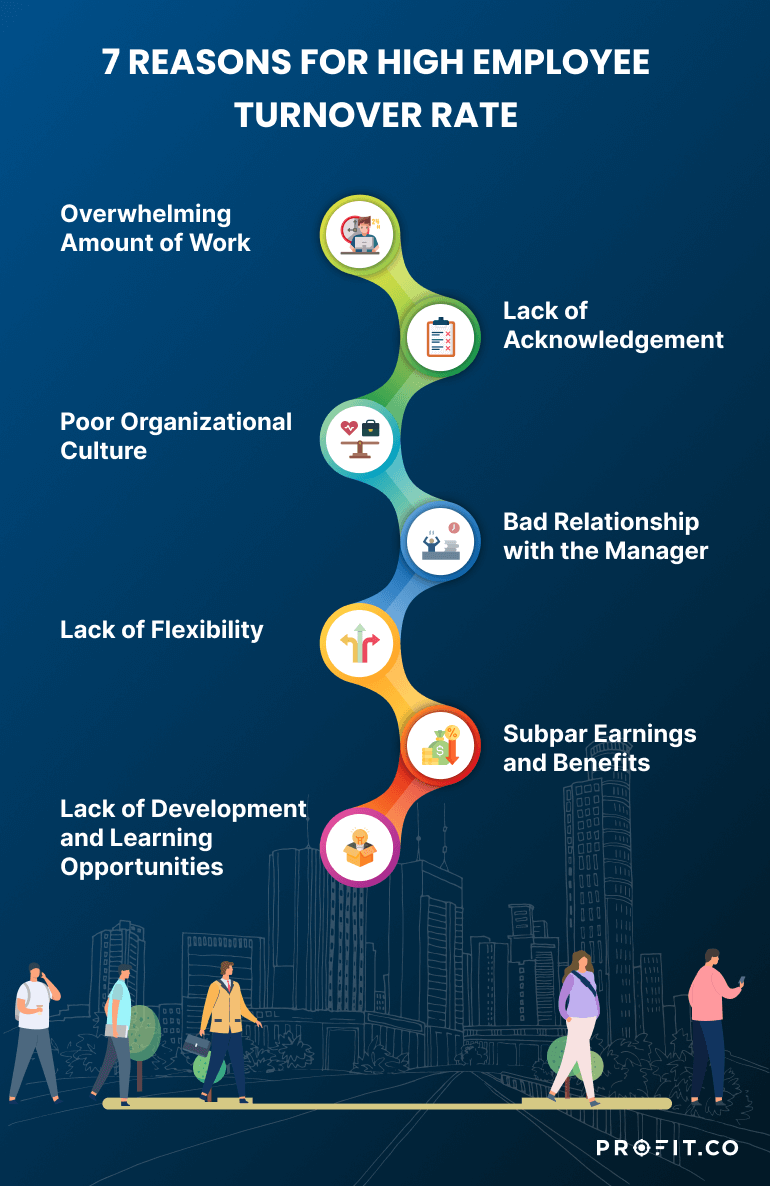
There are many causes of the high turnover rate in an organization. Some of the main contributing factors include:
1. Overwhelming Amount of Work
You can end up with overwhelmed employees just by overworking them. As a result, they become uncomfortable and start looking for opportunities in other companies. To counter this, you must provide them with work and life balance. Additionally, line managers must always monitor the workload and solve any existing challenges.
2. Lack of Acknowledgement
Recognizing your employees plays a crucial role in seeing its success. Recognition comes in many shapes and forms, including saying thank you or even giving bonuses to employees. As a result, you inspire the employee, and they work hard to deliver exceptional results.
3. Poor Organizational Culture
The company culture has a great interconnection to making employees happy. Poor organizational culture demotivates your employees.
4. Bad Relationship with the Manager
Managers play a vital role in seeing the success of any organization. So, managers must have various skills or attributes, including;
- Fairness
- Knowledgeable
- Approachable
When employees feel distant and dissatisfied at work, it can be an indication of a manager’s inability to connect with their employees. To avoid such disappointments, you should always hire managers who have good people skills.
5. Lack of Flexibility
Flexibility has close links with the culture of an organization. If possible, always introduce flexible options, including remote working. If the options are unavailable, employees may look for opportunities at companies that offer flexibility.
6. Subpar Earnings and Benefits
A considerable number of people in the workforce leave their jobs and go to another company because of a better pay offer. It’s good practice to issue decent salaries, commissions, and benefits on par with the industry standards. In addition, you should track employee performance progress and reward them accordingly.
7. Lack of Development and Learning Opportunities
Learning and development are vital to all employees. They always desire to advance in their careers and be sure there is an abundant opportunity in the organization. So when development and learning projects are absent, it affects average employee turnover rates.
What Are Strategies To Lower The Turnover Rate?
Calculating the employee turnover rate and comprehending the factors that contribute to the turnover challenge is essential.
Below are some of the main strategies that you can use to lower the turnover rate and boost employee retention.
Measure the Turnover Rate Regularly
When the turnover rate is high, your company has a big issue. You need to address the problems affecting this rate immediately so that you can lower the rate. Calculating the turnover regularly on a monthly or quarterly basis is a great way to continuously monitor this metric.
Seek Advice from Your Staff
If you wish to retain employees in your organization, you should conduct frequent meetings with your staff in order to hear feedback and find out what roadblocks your team is facing. Then, you can help them address problems, making employees feel more supported and improving retention.
Offering the Employees Growth Opportunities
When you don’t offer the employees growth opportunities, they might look for similar opportunities from other organizations. So, if you wish to retain your employees, you must give each of them a chance to progress in their careers.
To track the turnover rate as well as other important metrics, you can create custom KPI boards in the Profit.co software. You can get started on Profit.co today, or schedule a free demo with our experts.
Track the rate, understand the causes, build the culture that reverses it — Profit.co gives HR teams the platform to do all three
Turnover rate is calculated by dividing the number of employees who left during a period by the total number of employees at the beginning of that period, then multiplying by 100.
A turnover rate of 10% or less is generally considered healthy, while a retention rate of 90% or higher indicates strong employee stability
Turnover rate measures how many employees leave, while retention rate measures how many employees stay within a given period.
Common causes include poor management, lack of recognition, limited growth opportunities, low compensation, poor work culture, and lack of flexibility.
It helps organizations understand employee satisfaction, reduce hiring and training costs, improve workplace culture, and maintain productivity