

TL;DR
A Key Result is a measurable outcome that tracks progress toward achieving an objective in the OKR (Objectives and Key Results) framework. While objectives define what you want to accomplish, key results define how you measure success. Effective key results are specific, measurable, time-bound, relevant, challenging, and actionable. Typically, each objective has 3–5 key results that objectively determine whether the goal has been achieved. Strong key results drive alignment, accountability, transparency, and performance across teams by turning strategic intent into clear, trackable outcomes.OKR (Objectives and Key Results) is a collaborative goal-setting framework that helps your team, organization, or company reach its goals using ambitious objectives and measurable targets. The OKR framework helps your organization derive achievable, yet ambitious goals from its high-level mission, purpose, and strategy.
OKRs is an effective leadership and goal-setting tool organizations use to set and enact strategies. OKRs communicate what you want to accomplish and what milestones you will need to meet to achieve your objectives.
Strategy is a commodity, execution is an art.

What Are the Components of an OKR?
The fundamental components of an OKR are objectives and key results. An objective is simply what needs to be achieved. It tells your organization what they are trying to accomplish in brief, memorable, and ambitious terms. Key results are targets that help measure your progress on the objective. Key Results benchmark and monitor how you get to the objective, and when the objective is complete.Benefits of using OKR
The OKR framework is popular with industry-leading organizations like Netflix, Google, LinkedIn, and many others. Such organizations use this framework to drive progress on their high-priority organizational goals. You need to consider implementing this framework in your organizations to enjoy the following OKR benefits:
- Improved accountability within the organization
- Highly motivated employees
- Improved corporate direction
- 100% aligned departments
- Enhanced communication
- Transparency in an organization
You may be asking yourself what qualifies as a good OKR objective. You need to ensure that your set objectives:
- Bring positive change
- Are very clear
- Are challenging
- Are inspiring
- Give direction
What Are Key Results?
Key results are measurable outcomes required to achieve the organization’s objectives. A key result is used to measure your progress on a given objective. The key results you define for your goals should help you determine whether or not you have made the progress you have set out to within the quarter. Each objective should have between three and five key results.
Profit.co’s intuitive OKR management software gives you step-by-step guidance on how to create amazing key results for your team. Get started for free today!
OKR Result Criteria and Characteristics of a Good Key Results
An excellent Key Result:
- Can be monitored over the OKR period
- Is specific to the objective
- Helps determine the success of the objective
- Is measured objectively– no room for interpretation
Types of Key Results
Key results are divided into two major types: activity-based key results and value-based key results. Activity-based key results measure the completion of activities or tasks in terms of an organization’s project deliverables. On the other hand, value-based key results measure the delivery of value to an organization or customers. Value-based key results are most often more qualitative than activity-based key results.How Do You Write a Good Key Result?
Whether personal or professional, one of the most complicated tasks is writing a meaningful and valuable key result. The beauty of a key result lies in its simplicity.
The key results you choose will either make or break your OKRs. Writing a good OKR can be difficult, but learning the key components of both objectives and key results can help you set better goals each quarter.What Is a Good Key Result?
Good key results are fundamental to the success of your organization. Effective key results are:
- Measurable
- Relevant
- Clear
- Time-bound
- Challenging
- Actionable
1. Measurable
A good key result must be measured objectively, without subjective interpretation. It must measure your organization’s progress and success in the long run. As much as key results need to be measurable, they have to be outcomes as well, rather than outputs.2. Relevant
Key results have to be relevant and directly connected to the objectives. If key results don’t directly relate to your objective, they cannot help your team measure progress. Achievements of each key result will determine the success of the objective.3. Clear
A good key result must be easy to understand and clearly communicated throughout the organization.4. Time-bound
Key Results need to be time-bound. This means there needs to be a clear due-date for each target. Usually, key results adhere to the same quarterly cycle (90 days) as their associated objective.5. Challenging
Like objectives, key results should also be challenging and ambitious. In order to achieve more with OKRs, targets should be pushed just beyond the scope of what employees believe they can achieve. This drives higher performance and productivity in an organization.6. Actionable
When we say “actionable”, this does not necessarily mean that your key results have to be actions or strictly activity-based. In this context, actionable means that your team or organization can act on those targets and know what steps they need to take in order to achieve them. You should not set Key Results that may seem impossible to work on.
After writing your Key Results, ensure they meet the basic result criteria discussed above.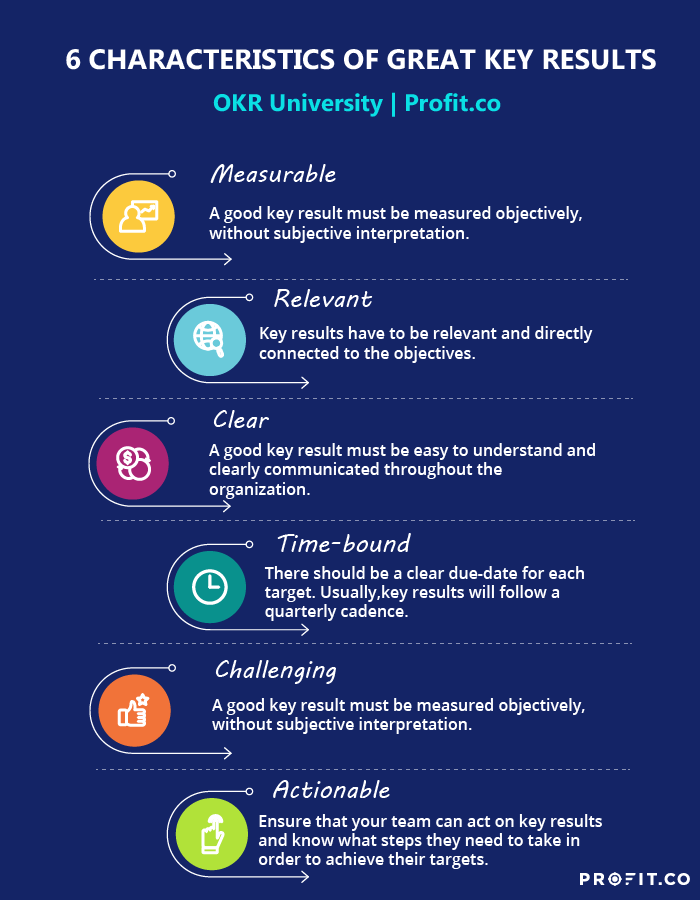
Why Are Key Results Significant?
A well-developed key result helps members of your team stay focused on important targets to achieve high-level goals. Key results are essential to organizational success with OKRs because they:
- Help prioritize team activities and improve the overall management of time and work
- Communicate actionable targets to an entire team or organization to keep everyone on track
- Help align employee roles with the organization’s overall strategic plan
- Improve communication among divisions of the organization
- Solidify the structure of your organization and break down goals into measurable targets, helping to define how each team member contributes to the organization
How to Decide What the Correct Key Results Are?
To decide on the correct key results, you should begin by looking at each objective individually. Think of three to five things that would have to change in the next three months (quarter cycle) to make the specific objective a reality.
Having 3-5 key results for each objective prevents you from focusing only on one aspect of a goal, but keeps you from diluting focus among too many targets. During the planning process, you must be thoughtful and pick the right metrics to use for your key results.Examples of Key Results
Here are some objective and key results examples that may help you set key results for your objectives.
 Objective

Build a High-Quality Inbound Lead Pipeline
Target Date: Annual-2022
Visibility: All Employees
Key Results

Acquire at least 500 leads per week
 Leads
Leads Maintain leady quality above 50%
 Leady Quality
Increase # of sessions per week to 2500
 # of sessions
Increase CTR for email to 15%
 CTR
CTRObjective
Produce and Roll Out Amazing Content
Target Date: Annual-2022
Visibility: All Employees
Key Results
Publish 6 ebooks on business management
ebooksPublish 25 blogs for our human resources audience
Blogs for our Human Resources AudienceCreate 15 infographics on business strategy
Infographics on Business StrategyGenerate 5000 visitors per week
VisitorsReady to start your OKR Journey for FREE?
Checkout our OKR Software
Get a Free DemoA Key Result is a measurable outcome used to track progress toward achieving an objective within a specific time frame
Each objective should typically have three to five key results to maintain focus and clarity.
A good Key Result is measurable, relevant, clear, time-bound, challenging, and actionable
Activity-based key results measure completed tasks or outputs, while value-based key results measure the impact or outcomes delivered to the organization or customers.
Key Results are important because they define success, align teams with strategy, improve accountability, and ensure progress can be tracked objectively.
Related Articles
-
OKR Software with Mobile App: Track Your Goals Anywhere
TL;DR OKR software with a mobile app keeps your team aligned and productive wherever they are. Profit.co's mobile app allows... Read more
-
Top OKR Tools That Integrate Seamlessly with Microsoft 365
TL;DR If your company runs on Microsoft 365, your OKR tool should too. The best platforms integrate deeply with Teams,... Read more
-
The 6 Biggest Goal Management Challenges During M&A And How to Solve Them
TL;DR M&A integrations create unique goal management challenges that don't exist in normal operations: cultural conflicts, system incompatibility, talent loss,... Read more
-
6 Adaptations Required to Implement OKRs in Government
TL;DR The Objectives and Key Results (OKR) framework helps organizations align strategy, measure outcomes, and improve execution. However, government agencies... Read more