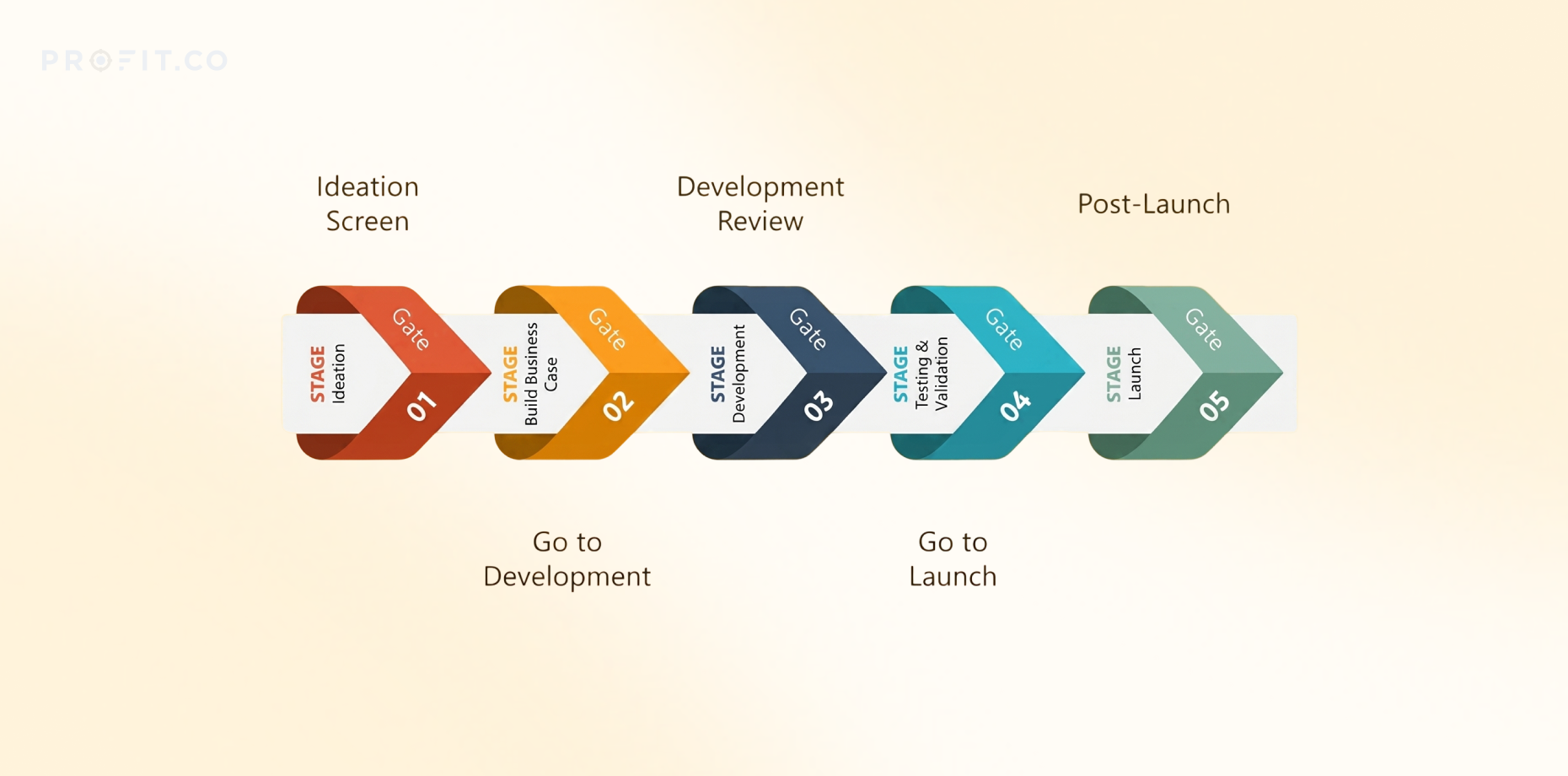
Stage-gate governs projects through sequential approval gates that must be passed before the next phase begins. Agile delivers work in short iterative sprints with continuous planning and real-time adjustment. Stage-gate protects large upfront investments; agile protects against building the wrong thing. Most projects need both — gates for irreversible decisions, sprints for everything else.
In this guide
- What is stage-gate methodology?
- What is agile project management?
- Stage-gate vs agile: which methodology should you choose?
- Can you combine stage-gate and agile in a hybrid model?
- When should you choose stage-gate vs agile?
- How do you implement a hybrid stage-gate and agile model?
- Frequently asked questions
What is stage-gate methodology?
Stage-gate is a project governance framework that divides work into sequential phases separated by decision gates. Each gate requires deliverables, budget approval, and executive sign-off before the next phase begins. Originated in manufacturing and product development, the model assumes you can define requirements completely before execution starts.
The framework typically includes five stages:
- Scoping — Define the business case and feasibility
- Build business case — Detailed analysis, financial projections, resource planning
- Development — Build the product or solution
- Testing and validation — Verify against requirements
- Launch — Market release or implementation
Each stage ends with a gate review where executives decide: proceed, kill, hold, or recycle.
The structural problem: Stage-gate assumes stability. Requirements frozen at Gate 2 become outdated by Gate 4. Market conditions shift. Competitors move. Technology evolves. By the time you reach launch, the original problem may have changed entirely. The governance structure that was supposed to protect investment becomes the mechanism that locks teams into obsolete plans.
Stage-gate works when:
- Regulatory compliance requires documentation at each phase
- Physical products demand upfront tooling investment
- Failure costs exceed delay costs
Stage-gate breaks when:
- Market conditions change faster than your gate cycle
- Learning during execution invalidates initial assumptions
- Cross-functional coordination requires real-time adjustment
What is agile project management?
Agile delivers work in short cycles called sprints — typically 1–2 weeks — with continuous planning and customer feedback. Instead of defining all requirements upfront, agile teams build incrementally, adjusting priorities based on what they learn.
Core agile principles:
- Working software over comprehensive documentation — Ship something usable early
- Customer collaboration over contract negotiation — Adjust based on feedback, not fixed scope
- Responding to change over following a plan — Treat change as information, not failure
The execution reality: Agile optimizes for learning velocity but provides no governance structure. Sprints move fast, but toward what? Teams ship features without confirming strategic alignment. Product backlogs grow without prioritization frameworks. Velocity becomes the goal instead of business impact. Speed without direction is just faster failure.
Agile works when:
- Requirements emerge through experimentation
- Feedback loops are short and actionable
- Teams have direct access to end users
Agile breaks when:
- Multiple teams need coordinated releases
- Stakeholder alignment requires predictable milestones
- Resource allocation decisions require quarterly planning
Stage-gate vs agile: which methodology should you choose?
Most comparison articles frame this as a binary choice. That framing is structurally wrong. The question isn’t which methodology to choose — it’s which problems each methodology solves and where their failure modes appear.
| Dimension | Stage-gate | Agile |
|---|---|---|
| Planning cycle | Upfront, comprehensive | Continuous, iterative |
| Decision authority | Executive gates | Team autonomy |
| Change response | Requires gate review to modify | Built into sprint planning |
| Documentation | Heavy, compliance-ready | Minimal, just-enough |
| Predictability | High for timeline, low for relevance | Low for timeline, high for relevance |
| Risk model | Mitigate risk through planning | Mitigate risk through learning |
| Best for | Regulated, capital-intensive, sequential | Exploratory, customer-driven, iterative |
| Failure mode | Plans become obsolete | Work becomes disconnected from strategy |
The insight most teams miss: Both methodologies fail for the same reason — they lack a strategic alignment mechanism. Stage-gate governance doesn’t guarantee strategic fit. Agile delivery doesn’t automatically connect to business outcomes. You get either slow irrelevance or fast misalignment. This happens under both stage-gate and agile — the methodology choice doesn’t fix the alignment problem.
Manage stage-gate and agile in one system
Can you combine stage-gate and agile in a hybrid model?
Yes, but most hybrid implementations fail structurally. Organizations typically try one of three approaches:
Approach 1: Stage-gate for planning, agile for execution
- Use stage-gate project management to approve projects
- Execute approved projects using agile sprints
- Problem: Gate decisions happen quarterly, market feedback happens weekly. By the time you reach the next gate, your sprint insights are three months old.
Approach 2: Agile within stages
- Run agile sprints during each stage-gate phase
- Hold gate reviews between stages
- Problem: Agile’s “respond to change” principle conflicts with stage-gate’s “freeze requirements at gates.” Teams either ignore agile principles or bypass gate governance.
Approach 3: Different methodologies for different project types
- Strategic initiatives use stage-gate
- Product development uses agile
- Problem: No framework connects the two. Strategic projects deliver plans. Agile teams deliver features. Neither group knows what the other is optimizing for.
These hybrids fail because they combine delivery models without solving the underlying problem: strategic alignment happens at a different cadence than execution feedback.
Stage-gate makes strategic decisions at gates. Agile makes execution decisions in sprints. Nothing connects the two time horizons.
Profit.co’s tollgate module structures gate criteria and approval workflows directly alongside OKR tracking — so the strategic question at each gate (does this project still serve our objectives?) is answered with live data, not a slide deck prepared the week before.
When should you choose stage-gate vs agile?
Stage-gate is structurally correct when failure means unrecoverable investment. Physical manufacturing with custom tooling. Pharmaceutical development where Phase 3 trials cost hundreds of millions. Infrastructure projects with permitting dependencies and regulatory approval chains. The gate structure forces the question: does the evidence justify the next investment? When the answer requires board-level approval and financial commitment, gates are the mechanism that prevents throwing good money after bad.
Healthcare organizations building medical devices default to stage-gate because regulatory documentation requirements map naturally to gate deliverables. FDA approval isn’t negotiable. The gate structure becomes the evidence trail. Financial services implementing core banking systems use stage-gate because risk review committees need defined checkpoints. Audit trails matter more than iteration speed.
Agile is structurally correct when the cost of being wrong is lower than the cost of being slow. Software products where deployment is reversible. Marketing campaigns where A/B testing changes assumptions weekly. Customer experience improvements where user feedback invalidates hypotheses. The sprint structure optimizes for learning velocity. When competitive advantage comes from responding to what you learn faster than competitors respond to what they learn, agile creates the cadence for that.
Technology companies building SaaS products default to agile because feature deployment is continuous and rollback is cheap. Customer feedback comes in hours, not quarters. E-commerce companies optimizing conversion funnels use agile because testing cycles are measured in days. Every delay is lost revenue.
The decision framework: Ask what kills the project. If it’s making the wrong bet early — stage-gate forces better bets through structured analysis. If it’s making bets too slowly — agile optimizes for bet velocity. If both kill you equally — you need a hybrid model that applies gates to irreversible decisions and agile to reversible ones.
Most organizations face both constraints simultaneously. Manufacturing companies need stage-gate for product development and agile for software that controls the product. Financial services need stage-gate for compliance and agile for customer-facing features. Government agencies need stage-gate for procurement and agile for digital services. The methodology choice isn’t organizational — it’s project-specific, phase-specific, and decision-specific.
How do you implement a hybrid stage-gate and agile model?
Successful hybrid models don’t try to make stage-gate more agile or agile more gated. They identify which decisions require gates and which require sprints, then build the system around that clarity.
Step 1: Map irreversible vs reversible decisions
List every major decision point in your project. Ask: if we’re wrong, can we undo this? Manufacturing tooling orders — irreversible. Feature deployment — reversible. Vendor contracts with exit penalties — irreversible. UI design iterations — reversible. Regulatory filing submissions — irreversible. Marketing copy tests — reversible.
Irreversible decisions get gates. Reversible decisions get sprints. The hybrid model isn’t “use both everywhere.” It’s “use gates for bets you can’t take back, sprints for everything else.”
Step 2: Define gate criteria before phases start
Stage-gate fails when gate criteria emerge during the gate review. If stakeholders discover they need different evidence than what the team prepared, the gate becomes a negotiation instead of a decision. Define success criteria at the beginning of each phase: what questions must the next gate answer? What evidence format do reviewers need? What risk threshold triggers a kill decision?
Write gate criteria as testable claims. Not “validate market demand” — that’s vague. Write “demonstrate 100+ qualified leads from target segment willing to pilot at proposed price point.” The gate review becomes: did we generate that evidence or not?
Step 3: Run agile sprints between gates
Between gate approvals, operate in sprint mode. Build incrementally. Test assumptions. Adjust based on what you learn. The gate deadline creates a fixed time horizon — use sprints to generate the evidence the gate requires. Sprint goals become: what must we learn this sprint to answer the gate question?
A medical device company might gate the regulatory submission decision but run agile sprints for usability testing between gates. A financial services firm might gate the vendor selection but run agile sprints for integration prototypes. Gates provide the governance checkpoints. Sprints provide the learning velocity between them.
Step 4: Separate gate reviews from sprint retrospectives
Gate reviews ask: should we continue? Sprint retrospectives ask: what did we learn? Don’t combine them. Gate reviews happen quarterly or at major milestones. Sprint retrospectives happen every 1–2 weeks. Different cadence, different stakeholders, different decision authority. Mixing them creates confusion about what’s being decided.
The hybrid model succeeds when gates govern investment decisions and sprints govern execution decisions — with clear boundaries between the two. Most organizations fail because they try to make every sprint a mini-gate or every gate a mega-sprint. Neither works. The system works when each mechanism operates at its natural frequency.
Measuring hybrid model success
Track two separate metrics. For stage-gate effectiveness: what percentage of projects that pass gates actually deliver the promised business outcome? If most projects pass all gates but fail to deliver value, your gate criteria are wrong. For agile effectiveness: how many sprint cycles does it take to invalidate a major assumption? If teams run 20 sprints without learning anything that changes direction, velocity isn’t creating value.
The strongest indicator of hybrid success is decision quality at gates. When gate reviews consistently reference sprint learnings as evidence — not just phase completion status — the model is working. When sprint teams consistently organize work around upcoming gate questions, the integration is real. When neither happens, you have two disconnected processes running in parallel, not a hybrid model. The breakthrough comes when teams stop asking “are we stage-gate or agile?” and start asking “which decisions need gates and which need sprints?”
Project portfolio management (PPM) platforms like Profit.co provide tollgate features that support stage-gate governance alongside agile project tracking. This allows organizations to maintain approval gates for high-risk phases while enabling iterative development in others — managing both methodologies within a single system rather than forcing teams to choose one or the other. Teams can structure their tollgate reviews at natural project milestones while running agile sprints for execution.
See how Profit.co’s project portfolio management platform organizations manage stage-gate and agile projects in one system
Frequently asked questions
Stage-gate uses sequential phases with approval gates between each phase. Agile uses iterative sprints with continuous planning and feedback. Stage-gate optimizes for governance, agile optimizes for learning velocity.
Yes, but most hybrid models fail structurally. Successful approaches identify specific project phases where governance gates are essential and phases where agile iteration adds value, rather than forcing one methodology everywhere.
Neither alone. Enterprises need governance rigor and execution speed. Pure stage-gate delivers obsolete plans. Pure agile delivers misaligned work. Hybrid models provide strategic checkpoints quarterly while enabling agile goal management at sprint-level.
Stage-gate fails when market conditions change faster than gate cycles — teams lock into obsolete plans. Agile fails when work disconnects from strategy — teams ship fast but toward unclear outcomes. Both fail at strategic alignment.
Agile is better for software development because requirements emerge through iteration and deployment is reversible. Stage-gate applies only when software projects have regulatory approval requirements or large irreversible infrastructure commitments.