TL;DR
AI is generating genuine capability improvements in project financial forecasting, anomaly detection, and procurement risk identification. But every one of these capabilities depends on a data foundation that most project management offices do not currently have. The organizations that will benefit from AI in project finance are the ones that solve their data integration and financial visibility problems first. The ones that skip that foundation and try to adopt AI directly will discover that the technology amplifies bad data faster than it surfaces good insights.The conversations happening in boardrooms and PMO leadership meetings right now about AI in project management tend to follow a predictable arc. Someone describes a capability, usually something involving predictive cost forecasting or anomaly detection. Someone else asks when they can have it. The technology team starts scoping a proof of concept. Three months later the proof of concept produces results that nobody trusts.
The reason the results are not trusted is always the same. The underlying data has too many gaps, inconsistencies, and conflicting sources to serve as a reliable training foundation for any predictive model.
Key Takeaways
- AI in project finance is a data quality story before it is a technology story. Every meaningful AI capability in this space, including predictive forecasting, anomaly detection, and procurement risk scoring, requires a data foundation that most project management offices are still building.
- There are five AI capabilities delivering measurable value where the data foundation exists: predictive cost-to-complete forecasting, anomaly detection in transactions, procurement risk scoring, natural language financial querying, and benefit realization signal detection. Each requires a different level of data maturity.
- Natural language querying is the most accessible starting point because it adds value with current data quality rather than requiring years of clean historical depth. It is the right first AI investment for most organizations.
- AI cannot replace experienced project financial management judgment in novel or politically complex situations, cannot produce reliable answers from incomplete or inconsistent data, and cannot substitute for the governance structures that make financial data trustworthy in the first place.
- The data foundation required for AI capability in project finance is the same foundation required for good project financial management regardless of AI: real-time integration, clean cost classification, complete commitment tracking, and a Cost Breakdown Structure aligned to the Chart of Accounts.
- Organizations that invest in project financial management fundamentals for the right reasons will find they have simultaneously built their AI readiness. Those that skip the fundamentals and try to adopt AI directly will find that the technology amplifies their data problems rather than solving them.
“What gets measured gets managed”

Why AI in project finance is a data quality story before it is a technology story.
The capabilities are real. The forecasting improvements are measurable in organizations with clean, integrated, real-time financial data. The anomaly detection is genuinely valuable when the baseline of normal is well established and consistently maintained. The procurement risk identification works when commitment data is complete and current.The problem is that the data quality required to make these capabilities work is the same data quality that most organizations are still trying to achieve through better Project Portfolio Management and ERP integration. AI does not replace that foundational work. It rewards it.
This blog explains what AI can realistically do in project financial management, what data foundation each capability requires, and the honest answer to the question every PMO leader is being asked right now: are we ready for this?
What AI Can Realistically Do in Project Financial Management
Separating genuine AI capability from vendor marketing in project financial management requires looking at three things: what the technology actually does, what data it requires to do it, and what the current reality is for most organizations.Here are the five capabilities that are delivering measurable value where the data foundation exists to support them.
Predictive Cost-to-Complete Forecasting
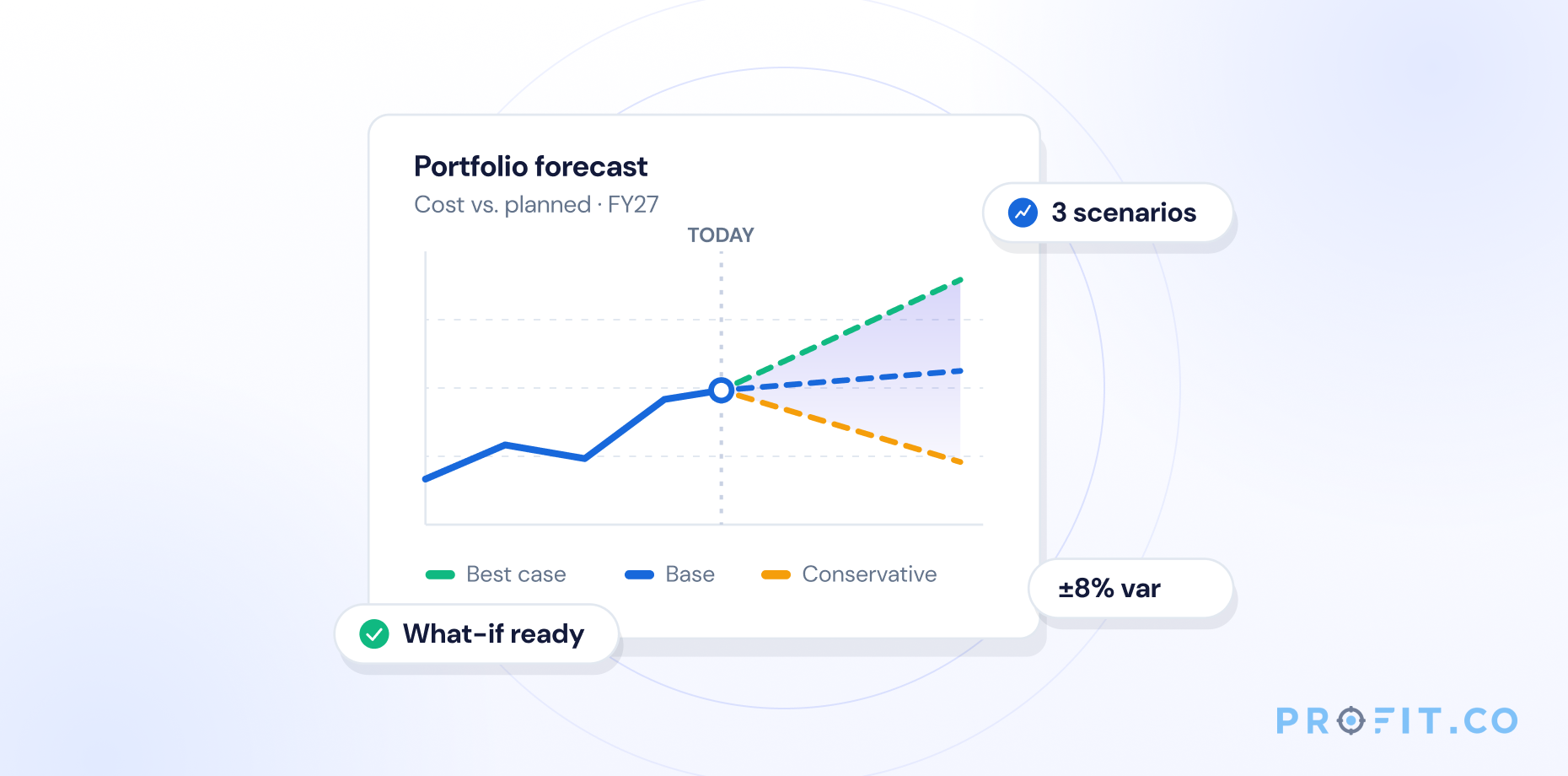
Uses historical project performance data, current earned value metrics, and pattern matching across similar past projects to produce probabilistic cost-to-complete forecasts that are more accurate than point estimates based on current trajectory alone. Instead of a single Estimate at Completion number, the model produces a range with confidence intervals.
Anomaly Detection in Invoice and Commitment Patterns
Monitors incoming invoices, purchase orders, and payment patterns in real time, flagging transactions that deviate significantly from established baselines: unusually large invoices from low-activity vendors, duplicate payment risks, invoice amounts that do not match contract terms, or commitment patterns that suggest scope creep before it appears in formal change orders.
Procurement Risk Scoring
Analyses vendor payment history, contract terms, invoice dispute rates, and project context to score procurement relationships by financial risk. Surfaces vendors who are statistically more likely to generate payment disputes, scope creep claims, or retention challenges based on their behavior on previous projects in the portfolio.
Natural Language Querying of Project Financial Data
Allows project managers and portfolio executives to query project financial data in plain language rather than through structured report interfaces. Questions like ‘which projects have committed spend within ten percent of their approved budget?’ or ‘show me vendors with outstanding disputed invoices across active projects’ are answered directly from integrated financial data without requiring report configuration.
Benefit Realization Signal Detection
Connects project investment data to business outcome data from operational systems to identify early signals that a delivered project is or is not generating its intended benefits. Flags portfolio executives when adoption metrics, process performance indicators, or revenue signals suggest that benefit realization is deviating from the business case forecast.
Best practices require a database of completed projects with full financial histories, including actuals at the work package level, integrated commitment and payment data, and consistent cost classification across the historical dataset. Typically requires three or more years of clean project financial data.
Available and performing well in organizations with mature Project Portfolio Management platforms, clean ERP integration, and consistent historical data. Rare in organizations that have recently migrated systems or where historical data lacks granularity at the work package level.
Best practices require real-time integration between the Project Portfolio Management platform and ERP so that transaction data flows continuously rather than in batches. A sufficient volume of historical transactions to establish reliable baseline patterns. Clean vendor master data to avoid false positives from inconsistent vendor identification.
Delivering genuine value in organizations with real-time integration and high transaction volumes. Less effective in organizations with batch integration, inconsistent vendor master data, or insufficient historical volume to establish meaningful baselines.
Best practices require longitudinal vendor performance data across multiple projects, including payment dispute history, change order frequency, invoice correction rates, and completion rate against contracted milestones. Requires that vendor records are consistent across projects.
Genuinely useful in organizations managing large vendor ecosystems across long-running project portfolios. Requires several years of consistent vendor data to produce reliable scores. Newer or smaller organizations typically lack the transaction volume needed for meaningful risk differentiation.
Best practices require a well-structured, consistently populated project financial data model that the language interface can query reliably. The quality of responses is directly limited by the consistency and completeness of the underlying data. Gaps in the data produce gaps in the answers, and users quickly lose confidence if answers are frequently incomplete or contradicted by other sources.
Available in several platforms and delivering genuine productivity value for executive reporting and project review preparation. The most accessible AI capability for organizations that are not yet ready for predictive models, because it adds value with existing data rather than requiring historical depth.
Best practices require integrated data flows between the Project Portfolio Management platform, the ERP, and the operational systems where project benefits are realized. This is the most complex data integration requirement of any AI application in project finance because it spans organizational boundaries that rarely have existing integration infrastructure.
The least mature of the five capabilities in terms of real-world deployment. Organizations that have implemented Business Value Management frameworks are best positioned to add benefit realization signal detection, because they have already defined measurable outcomes and established baseline measurements.
Profit.co provides the integrated Project Portfolio Management and financial platform that AI applications in project finance are built on top of
The AI Readiness Assessment: What Each Capability Actually Requires
The honest assessment of AI readiness in project finance starts with data, not with technology selection. Use this table to evaluate where your organization stands against each capability.| AI Capability | Data Foundation Required | Integration Depth Required | Realistic Time Horizon |
|---|---|---|---|
| Predictive cost-to-complete forecasting | 3+ years of granular project financial history | Deep: real-time ERP actuals integration | Available now for data-mature organizations |
| Anomaly detection in transactions | Real-time transaction feeds, clean vendor master data | Deep: real-time bidirectional integration | Available now with real-time integration in place |
| Procurement risk scoring | Multi-year longitudinal vendor performance data | Moderate: historical data consolidation | 1 to 2 years of data investment before meaningful scores |
| Natural language financial querying | Consistent, well-structured current data | Moderate: clean data model required | Most accessible: adds value with existing data |
| Benefit realization signal detection | Integrated outcome data from operational systems | Very high: spans organizational boundaries | 2 to 4 years for most organizations to build foundation |
The Readiness Gradient
Natural language querying is the most accessible AI capability because it does not require historical depth, only current data quality and consistency. It is the right starting point for most organizations.Anomaly detection and predictive forecasting require real-time integration as a prerequisite. Procurement risk scoring requires longitudinal data patience.
Benefit realization detection is the longest journey.
The sequence matters: start where your current data foundation supports value, and build toward the more demanding capabilities as the foundation matures.
What AI Cannot Do in Project Finance
The boundaries of AI capability in project finance are as important as the capabilities themselves. Understanding them prevents the expensive disappointments that follow when technology is deployed against problems it was not designed to solve.| What AI can do in project finance | What AI cannot do in project finance |
|---|---|
| Surface patterns in financial data that human analysts would miss or catch too late | Replace the judgment of experienced project financial managers in novel or politically complex situations |
| Generate probabilistic forecasts that are more accurate than single-point estimates | Eliminate forecast uncertainty or produce reliable predictions for genuinely unprecedented project types |
| Flag anomalies and exceptions for human review faster than manual monitoring | Determine whether a flagged anomaly represents a real problem or a benign variation without human context |
| Provide real-time answers to structured financial queries across large portfolios | Produce reliable answers from incomplete, inconsistent, or poorly structured data |
| Identify statistical patterns in vendor behavior that predict financial risk | Assess the qualitative factors in vendor relationships that experienced procurement managers understand intuitively |
| Reduce administrative burden in routine financial reporting and exception management | Substitute for the governance structures and accountability frameworks that determine whether financial data is trustworthy in the first place |
AI does not fix broken financial architecture. It scales whatever discipline already exists. In project finance, organizations with strong governance, clean data, and financially literate leadership gain an exponential advantage from AI. Those without it simply automate confusion.
The PMO Leader’s AI Readiness Agenda: What to Do Right Now
The pressure to adopt AI in project management is real and intensifying. Boards are asking about it. Vendors are leading with it. Peers are piloting it. The productive response is not to resist or to rush. It is to invest deliberately in the foundation that makes AI capability durable rather than experimental.In the next 90 days
- Assess your current data quality honestly against the requirements in the readiness table above.
- Identify which AI capability your existing data foundation could support today, and which ones require foundational investment before a proof of concept makes sense. Do not scope a predictive forecasting pilot if your historical project data lacks work-package-level granularity.
- Start with natural language querying if your current data model is clean and consistent, because that is where you will build organizational confidence in AI-generated financial insights before moving to more demanding capabilities.
In the next 6 to 12 months
- If you have not yet established real-time integration between your Project Portfolio Management platform and your ERP, make that your primary investment priority. Anomaly detection and predictive forecasting both require it.
- Batch integration produces data that is stale enough to make AI-generated insights unreliable. Every month you operate with batch integration is a month of delay in building the data foundation that the most valuable AI capabilities require.
- Simultaneously, invest in consistent data classification across your project portfolio. Historical data with inconsistent cost categories, changing work breakdown structures, and vendor records that differ between projects cannot support the pattern recognition that AI models depend on. Retroactive data cleaning is expensive and imperfect. Consistent classification from this point forward is the investment that compounds over time.
Looking further ahead
The organizations that will have the strongest AI capabilities in project finance three years from now are the ones making the right infrastructure investments today. Real-time integration. Clean vendor master data. Consistent cost classification. Complete commitment tracking from purchase order date. A Cost Breakdown Structure aligned to the Chart of Accounts. These are the structural foundations that were described throughout this series as the requirements for good project financial management regardless of AI.They are also exactly the structural foundations that AI capability in project finance is built on top of. The organizations that solve their project financial management fundamentals for the right reasons will find that they have simultaneously built their AI readiness. The ones that skip the fundamentals and try to adopt AI directly will find that the technology surfaces their data problems faster than they can solve them.
The Data Foundation Is the AI Strategy
Every major AI capability in project finance, from predictive forecasting to anomaly detection to natural language querying, is built on top of the same foundation: real-time integrated financial data, clean and consistent data classification, and complete commitment-to-payment audit trails. If your PMO is asking what its AI strategy should be, the answer starts with getting these fundamentals right. The AI capabilities follow from the foundation. They do not substitute for it.Get the fundamentals right. Build real-time integration. Implement proper cost structures. Close the visibility gap. Establish genuine dual accountability through EVM and Business Value Management. Manage the change with the seriousness it deserves.
The AI capabilities that follow from that foundation will be real, measurable, and durable. The ones that are bolted on top of an unreformed architecture will be impressive in a proof of concept and invisible in practice.
Profit.co gives PMOs the integrated platform, real-time visibility, and clean data architecture that makes AI in project finance a real capability, not a proof of concept
The five AI capabilities most relevant to project financial management right now are:
- Predictive cost-to-complete forecastinguses historical project data, earned value metrics, and pattern recognition to generate probabilistic forecasts instead of single-point estimates. It works best in organizations with three or more years of clean, structured project financial data and strong integration between the Project Portfolio Management platform and ERP
- Anomaly detection in invoice and commitment patternsmonitors invoices, purchase orders, and payments in real time to flag unusual transactions, duplicate risks, contract mismatches, or early indicators of scope creep. It requires real-time system integration, clean vendor master data, and sufficient transaction volume to establish reliable baselines.
- Procurement risk scoringanalyzes multi-year vendor performance data such as dispute rates, change order frequency, and milestone adherence to identify financially risky vendor relationships. It delivers the most value in organizations managing large vendor ecosystems with consistent longitudinal data
- Natural language querying of project financial dataallows executives and project managers to ask plain-language questions and receive direct answers from integrated financial systems. It is the most immediately accessible AI capability because it does not require deep historical data, but it does depend on a well-structured and consistently populated financial data model
- Benefit realization signal detectionconnects project investment data to operational and business outcome systems to identify early signs that benefits are or are not materializing. It requires the most complex cross-system integration and clearly defined measurable outcomes, making it the least mature in real-world deployment
In practice, the relevance of each capability depends less on the AI itself and more on the organization’s data maturity, governance discipline, and system integration depth.
Anomaly detection and predictive forecasting both depend on current, complete data about financial events as they occur. A batch integration that updates overnight produces data that is already twelve to twenty-four hours old by the time it is available for analysis. By the time an anomaly is detected in overnight data, the circumstances that caused it may have already progressed beyond early intervention. Real-time integration means that a duplicate invoice submission, an unusual vendor charge, or a commitment pattern suggesting scope creep is flagged within hours of the event, while corrective action is still straightforward.
Reliable AI cost-to-complete forecasting requires a historical dataset of completed projects with financial records at the work package level, not just at the project total level. Cost categories must be consistently classified across projects so that the model can identify meaningful patterns. Actual costs must come from integrated ERP data rather than manual spreadsheet entries to ensure completeness. And the historical dataset must span enough project types and sizes to be representative of the portfolio the model will be asked to forecast. Organizations that have recently migrated systems, changed cost classification approaches, or managed projects in spreadsheets typically need twelve to twenty-four months of clean integrated data before forecasting models produce trustworthy results
Procurement risk scoring is the process of evaluating vendors by their likelihood of generating financial risk on future project engagements, based on their historical performance. Traditional procurement risk assessment relies on qualitative vendor evaluation and references. AI-assisted procurement risk scoring analyses quantitative patterns in vendor behavior across the project portfolio: invoice dispute frequency, change order rates, payment correction volumes, milestone achievement rates, and retention claim patterns. Vendors that have historically generated high dispute rates or frequent scope creep claims receive higher risk scores that inform future contracting decisions and payment term negotiations before risk materialize
After. The data foundation that AI requires in project finance is the same foundation that good project financial management requires regardless of AI. Real-time integration, clean cost classification, complete commitment tracking, and consistent vendor data are the prerequisites for both. Organizations that attempt to deploy AI before establishing this foundation find that the technology surfaces and amplifies their data problems rather than producing useful insights. The organizations that will have the strongest AI capabilities in project finance three years from now are the ones investing in these fundamentals today, not the ones conducting AI pilots on unreliable data
The ERP remains the system of record for financial transactions: invoice processing, payment execution, and general ledger entries. In an AI-enabled project financial management architecture, the ERP’s primary role is to feed real-time transactional data to the Project Portfolio Management platform and, from there, to the AI layer. The quality of ERP data, including vendor master consistency, invoice data completeness, and payment record accuracy, directly determines the quality of AI-generated insights. Organizations with fragmented or inconsistent ERP data will find that their AI capabilities are limited to whatever is reliably recorded, regardless of how sophisticated the model is
Get the fundamentals right. Build real-time integration. Implement proper cost structures. Close the visibility gap. Establish genuine dual accountability through EVM and Business Value Management. Manage the change with the seriousness it deserves.
The AI capabilities that follow from that foundation will be real, measurable, and durable. The ones that are bolted on top of an unreformed architecture will be impressive in a proof of concept and invisible in practice.